
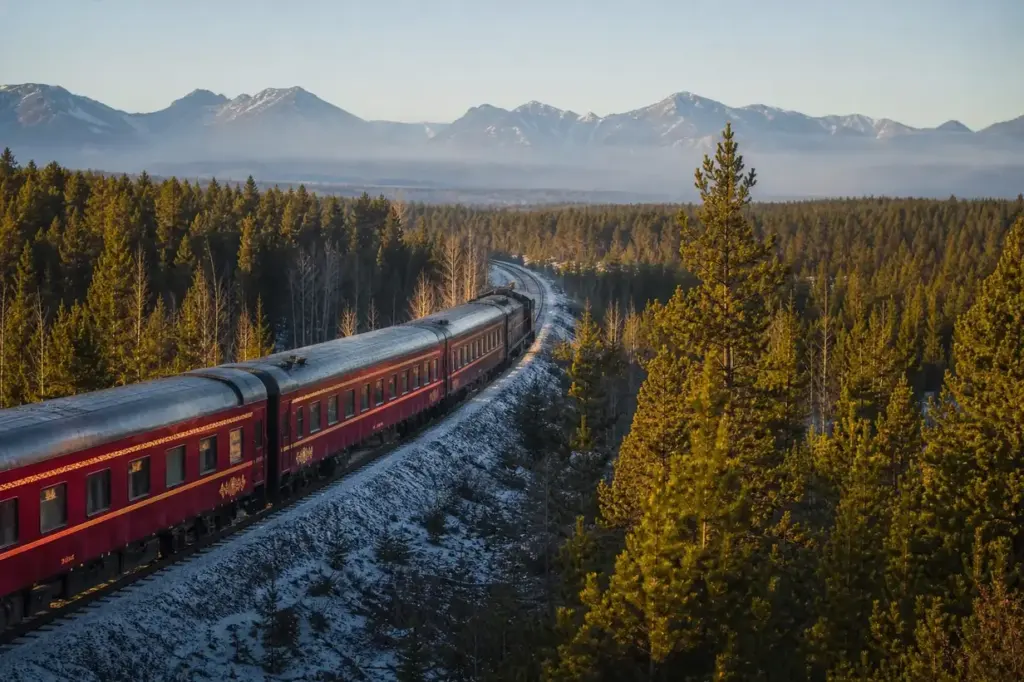
The Trans-Siberian Railway spans over 9,000 kilometers across Russia, crossing eight time zones and passing through nearly a hundred cities and towns. This guide covers the best stops along the Trans-Siberian Railway—the places most worth leaving the train to explore during a multiweek journey east.
You’ll find the classics here: Moscow’s grand capital, Yekaterinburg’s Ural crossroads, Siberia’s cultural heart in Irkutsk, Lake Baikal‘s clear waters, and Vladivostok’s Pacific terminus. We’ve included 10 stops chosen for their character, accessibility by train, and what they reveal about Russia’s landscape and heritage.
At a Glance
| # | Place | Best for | Good to know |
|---|---|---|---|
| 1 | Moscow | Journey's starting point | Moscow, Yaroslavsky Station; Red Square, Kremlin and major metro station a short walk away |
| 2 | Yekaterinburg | Europe–Asia boundary marker | Yekaterinburg (26 hours from Moscow); train arrives at main station in city center |
| 3 | Novosibirsk | Siberia's largest city | Novosibirsk (about 60 hours from Moscow); central location near the main station |
| 4 | Krasnoyarsk | Siberian river city | Krasnoyarsk (about 80 hours from Moscow); riverside location |
| 5 | Irkutsk | Gateway to Lake Baikal | Irkutsk (about 75 hours from Moscow); major hub for Baikal access |
| 6 | Listvyanka | Lake Baikal waterside village | Listvyanka (60 km east of Irkutsk); accessible by minibus or organized tour |
| 7 | Olkhon Island | Lake Baikal's island sanctuary | Olkhon Island (accessible via ferry from Slyudyanka or Arshan; 1–2 hours by road from Irkutsk) |
| 8 | Ulan-Ude | Buryatia's Buddhist center | Ulan-Ude (about 100 hours from Moscow); junction where Trans-Siberian and Trans-Mongolian routes diverge |
| 9 | Khabarovsk | Far East river port | Khabarovsk (about 130 hours from Moscow); major rail junction |
| 10 | Vladivostok | Pacific terminus | Vladivostok (about 145 hours from Moscow); major international port and rail terminus |
How We Chose
These stops were selected based on:
- Direct or nearby access from the main Trans-Siberian rail line
- Verified appeal to international travelers seeking cultural and natural experiences
- A mix of urban centers and natural attractions across the entire route
- Feasibility for a 1–3 day visit from the train station
- Historical and geographical significance to understanding Russia’s geography and culture
1. Moscow – Journey's starting point
Russia's capital sits at the western terminus of the Trans-Siberian, with the famous Yaroslavsky Station marking the route's official beginning. The Kremlin, Red Square, Saint Basil's Cathedral and world-class museums offer several days of exploration before or after your rail journey. Allow at least two days here.
Good to know: Moscow, Yaroslavsky Station; Red Square, Kremlin and major metro station a short walk away
Tip: Arrive in Moscow 2–3 days before your train departure to adjust to Russian time and secure any last-minute permits or travel documents you may need.
2. Yekaterinburg – Europe–Asia boundary marker
Straddling the Ural Mountains, Yekaterinburg marks the symbolic divide between Europe and Asia. The city is also home to the Church of the Blood, built on the site where Tsar Nicholas II and his family were executed. The city center retains 19th-century architecture and offers a clear sense of Siberia beginning here.
Good to know: Yekaterinburg (26 hours from Moscow); train arrives at main station in city center
Tip: Visit the Europe–Asia border monument on the outskirts as a day trip; many travelers underestimate how meaningful this symbolic boundary actually feels.
3. Novosibirsk – Siberia's largest city
Russia's third-largest city sits on the Ob River and serves as Siberia's de facto capital. The State Theatre of Opera and Ballet—one of Russia's largest—dominates the central plaza. The city also has pleasant parks, museums and good restaurants, offering a taste of urban Siberia without Moscow's intensity.
Good to know: Novosibirsk (about 60 hours from Moscow); central location near the main station
Tip: The opera house hosts performances year-round; check schedules in advance if you want to catch an evening show during your stay.
4. Krasnoyarsk – Siberian river city
Sitting on the Yenisei River, one of Russia's largest waterways, Krasnoyarsk offers dramatic scenery and a pace slower than Novosibirsk. The surrounding Sayan Mountains provide backdrop to this less touristy stop. The city's museums and riverside walks reveal Siberian life away from the main tourist circuit.
Good to know: Krasnoyarsk (about 80 hours from Moscow); riverside location
Tip: Ask locals about viewpoints along the Yenisei; the evening light over the river valley is particularly striking.
5. Irkutsk – Gateway to Lake Baikal
The cultural capital of Siberia, Irkutsk was once called the Paris of Siberia. The city retains elegant wooden houses with intricate fretwork trim, a tradition of the region. More importantly, it serves as the main jumping-off point for Lake Baikal, the world's oldest and deepest freshwater lake. Most travelers allocate 2–3 days here, with at least one day at the lake itself.
Good to know: Irkutsk (about 75 hours from Moscow); major hub for Baikal access
Tip: Book your Lake Baikal excursion (to Listvyanka, Olkhon Island, or a lake tour) a day before arriving to avoid missing onward train connections; tours fill quickly in summer.
6. Listvyanka – Lake Baikal waterside village
This small village on Lake Baikal's western shore offers direct access to the lake's clear, cold waters. Visitors can hike along the shoreline, take boat tours, or simply sit by the water. The Baikal Museum displays the lake's unique freshwater seal and fish species. Most travelers make this a day trip from Irkutsk or stay overnight.
Good to know: Listvyanka (60 km east of Irkutsk); accessible by minibus or organized tour
Tip: The lake is warmest (though still cold) in July and August; bring a swimsuit if you plan to wade, but water temperatures rarely exceed 15°C even in summer.
7. Olkhon Island – Lake Baikal's island sanctuary
This large island in Lake Baikal can be reached by ferry from the small village of Slyudyanka. Olkhon is known for its rocky shores, Shamanka Rock (a sacred site in local Buryat tradition), and isolation from the main railway route. The village of Khuzhir on the island offers homestays and guides for multi-day stays.
Good to know: Olkhon Island (accessible via ferry from Slyudyanka or Arshan; 1–2 hours by road from Irkutsk)
Tip: Ferry schedules and island accommodations fill in summer; confirm availability in Irkutsk before committing to this detour.
8. Ulan-Ude – Buryatia's Buddhist center
East of Lake Baikal, Ulan-Ude is the capital of the Republic of Buryatia, an autonomous region with a predominantly Mongolic population. The city is home to the Ivolginsky Datsan, an active Buddhist monastery—a striking contrast to the Orthodox churches seen throughout European Russia. The city also features an ethnographic museum and retains a distinct eastern character.
Good to know: Ulan-Ude (about 100 hours from Moscow); junction where Trans-Siberian and Trans-Mongolian routes diverge
Tip: If continuing on the Trans-Mongolian route toward Beijing, this is your last stop in Russia; plan accordingly for visa and currency changes.
9. Khabarovsk – Far East river port
Situated on the Amur River, which forms Russia's border with China, Khabarovsk marks the approach to the Pacific terminus. The city has tree-lined streets, Soviet-era architecture, and a sense of being at Russia's eastern frontier. Fewer Western tourists stop here, making it a genuine look at regional Russian life.
Good to know: Khabarovsk (about 130 hours from Moscow); major rail junction
Tip: The Amur embankment offers pleasant walks; locals often gather here in summer, providing informal glimpses of contemporary Russian life.
10. Vladivostok – Pacific terminus
At the end of the 9,000+ kilometer journey lies Vladivostok, a harbor city on Russia's Pacific coast. Founded in the 19th century as a strategic port, it has wide streets, a waterfront promenade, and a distinctly different character from inland Siberia. The journey's end here carries real weight—this is genuinely far from where you started.
Good to know: Vladivostok (about 145 hours from Moscow); major international port and rail terminus
Tip: The train arrives in mid-morning; consider staying 2–3 days to adjust before flying out, as the time zone change (9 hours ahead of Moscow) can be disorienting.
Russia Vibes Tips
- Book your return journey or onward travel weeks in advance. Trans-Siberian trains fill quickly in summer (June–August), and you may need to secure seats for departing trains from Vladivostok or alternative gateways.
- Plan your stops before departure from Moscow. Each stopover requires leaving the train; you'll need to rebook your next leg. Most travelers break the journey into 2–3 train segments rather than staying on one train for the entire route.
- Carry small bills and coins for station snacks and tips. While major cities have ATMs and card payments, smaller stations along the way operate mostly in cash, and currency exchange may not be available at every stop.
- Many Trans-Siberian travelers overlook the smaller cities between major stops (Tyumen, Omsk, Chelyabinsk, Nizhny Novgorod). These are worth brief explorations if your schedule allows, each revealing different layers of Russian and Siberian character.
- Winter travel (November–March) significantly reduces crowds and accommodation prices, but some Baikal activities become limited and extreme cold can make sightseeing uncomfortable. Spring (April–May) and autumn (September–October) offer better balance between comfort and fewer tourists.
- Download offline maps for each city before your journey; internet can be spotty at smaller stations, and having maps on your phone prevents confusion at arrival.
Explore Nearby Best Stops Along the Trans-Siberian Railway, Trans-Siberian Railway
Related guides
 Lake Baikal: Where to Go, What to See and How to Visit
Main image: AI-generated illustration. It may not show the place exactly as it looks.
 Altai Mountains: Best Places, Scenic Routes and Travel Tips
Main image: AI-generated illustration. It may not show the place exactly as it looks.
 Kamchatka Peninsula: Volcanoes, Wildlife and Travel Guide
Main image: AI-generated illustration. It may not show the place exactly as it looks.
Browse more: All Culture Lists · All Guides · All Guides in Trans-Siberian Railway · All Trans-Siberian Railway
FAQ
Do I have to take the entire Moscow-to-Vladivostok journey, or can I board and exit anywhere?
You can board and exit at any station. Most travelers break the journey into segments (Moscow–Yekaterinburg, Yekaterinburg–Irkutsk, Irkutsk–Vladivostok), booking separate tickets for each leg. This allows time to explore each city without losing your reservation.
Which single stop is most worth making if I have limited time?
Lake Baikal via Irkutsk is the essential stop. It offers geology, natural beauty and cultural significance you cannot find elsewhere. A 2–3 day break here justifies the schedule disruption.
How do I know if a city is actually on the main Trans-Siberian line or a detour?
Moscow, Yekaterinburg, Novosibirsk, Krasnoyarsk, Irkutsk, Ulan-Ude, Chita, Khabarovsk and Vladivostok are on the main line. Other cities (Kazan, Perm, Tomsk, Listvyanka, Olkhon Island) require side trips from the main route but remain accessible by regional transport.
What is the difference between the Trans-Siberian, Trans-Mongolian and Trans-Manchurian?
All three routes share the same path from Moscow to Ulan-Ude. From there, the Trans-Siberian continues east to Vladivostok; the Trans-Mongolian branches south through Mongolia to Beijing; the Trans-Manchurian goes through northern China to Beijing. All are referred to as "Trans-Siberian" colloquially.
Is the train on time? Will delays affect my plans between stops?
The Rossiya train (Russia's premium service) maintains a reliable schedule, though delays of a few hours are common in winter. Always build in 1–2 extra days between segments if you have a flight or onward booking. Check with your train operator on the day of departure.
Do I need a Russian visa if I only stop briefly and get back on the train?
Yes. You need a valid Russian visa for any disembarkation, even for a single day. Visa requirements depend on your nationality; check with a Russian consulate well before travel.
What happens to my luggage if I leave the train to explore a city?
For segment bookings (separate tickets for each leg), you collect your luggage when you disembark and take it with you. If you book a continuous journey with internal stops, some luggage services store your bags overnight, though this varies by train. Confirm with your booking agent.
Are there organized tours that stop at multiple cities, or is independent travel the only option?
Both exist. Tour operators offer fixed itineraries with guides and pre-arranged accommodation. Independent travelers book their own train tickets and hotels at each stop. Independent travel is cheaper and more flexible; tours offer convenience and social connection.
Russia Vibes is a one-person project. A coffee keeps it going

Take this guide with you
Get a free PDF of this guide to print or read offline: key facts, tips and a map link on a few clean pages.
Report an issue on this page
Paying for your trip: please read
Payments and bookings between Russia and many other countries are currently restricted. In practice, cards issued in the EU, the UK, the US and several other countries often cannot be used in Russia, Russian cards usually cannot be used abroad, and some booking platforms, airlines and payment providers limit or pause their services for Russia. The situation changes frequently.
We do not give legal or financial advice, and this site does not encourage anyone to break any rule that applies to them. Whatever you plan, you are responsible for following the laws and regulations that apply to you, including those of your country of residence and citizenship.
Many travelers still organise their stay without problems. It is worth asking your bank or payment provider what is currently possible, contacting hotels, tour operators and carriers directly about the payment methods they accept, and checking which services are open to customers from your country. Clarify payment, cancellation and refund terms before you commit to a booking, and keep your plans flexible.
Partner links on this site may not be available in every country, and prices, availability and rules in our guides can differ from what you see when you book.
How we research and update our guides
About this guide: AI assistance and accuracy
This guide is created with the help of AI and is based on official sources where available. Mistakes can still happen. Opening hours, prices, rules and other details are given to the best of our knowledge as of the date shown and can change without notice. It offers general recommendations only, not professional, legal or travel advice. Please confirm important details with the official source before you travel; you are responsible for your own plans and decisions.
* Affiliate link: as an Amazon Associate we earn from qualifying purchases at no extra cost to you.