
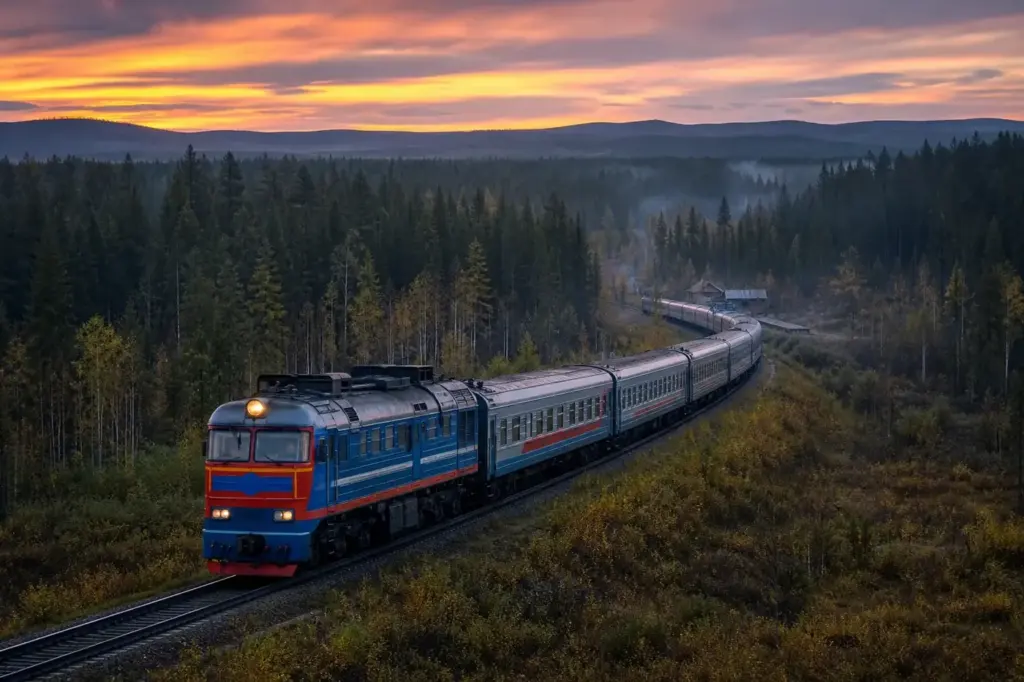
You’ve reached Lake Baikal, the heart of the Trans-Siberian journey. Now comes the decision: how to continue from Lake Baikal to Vladivostok, Trans-Siberian Railway style. This section of the route takes you from Irkutsk across vast Siberian taiga and frozen tundra to Russia’s Pacific port, passing through eight time zones and crossing remote wilderness that few visitors ever see.
Most travelers either take the direct Trans-Siberian main line southward to Vladivostok (the classic choice), or explore the alternative Baikal-Amur Mainline running north of the lake before rejoining the main line. The recommended approach is booking each leg separately as you go, allowing flexibility to extend stays in Baikal towns or make unplanned stops.
Current access notice: As of October 2026: Regular Trans-Siberian trains continue operating despite international sanctions. However, international travel to Russia requires a Russian visa, which may face restrictions depending on your nationality. Check your government's travel advisories and Russia's visa policies before booking. Ticket bookings remain open 90 days in advance through RZD. Payment options for foreign travelers are limited; contact a travel agency if your credit card is declined online.
Quick answer: From Irkutsk, book a ticket on a Trans-Siberian train heading east toward Vladivostok. The journey takes approximately 60–70 hours of train time, typically spread over 3–4 calendar days with stopovers. Alternatively, take the Baikal-Amur Mainline north from near Lake Baikal, then rejoin the main line east of the lake. Total cost depends on class and whether you travel direct or with breaks.
At a Glance
| Total time | 60–70 hours of train time; typically 3–4 calendar days including stops and overnight journeys |
|---|---|
| Typical cost | ₽₽ to ₽₽₽ depending on class (second class 4-berth or first class 2-berth) and whether you purchase direct or through an agency |
What You Need Before You Start
- Valid Russian visa (check your nationality's requirements)
- Passport (original, required for all ticket purchases at stations)
- Return ticket from Vladivostok or onward travel plans
- Russian rubles or pre-arranged payment method (Western credit cards do not work on RZD website)
- Luggage within station baggage limits (no strict size restrictions for compartments)
- Knowledge of departure times in Moscow local time zone (train schedules use Moscow time throughout Russia)
- Flexible dates (tickets sell 90–60 days in advance and go quickly on popular services)
Compare Your Options
| Option | Duration | Price | Notes |
|---|---|---|---|
| Trans-Siberian main line (Irkutsk to Vladivostok direct) | 60–70 hours of travel; 3 calendar days typical (with 1–2 overnight legs) | ₽₽₽₽ | Most frequent option, direct routing, passes south of Lake Baikal near Slyudyanka (about 100 km of lake views). Trains operate every 1–2 days on multiple services (Rossiya and other numbered trains). Fastest choice for reaching the Pacific. Best for travelers on a schedule or first-timers wanting the classic route. |
| Baikal-Amur Mainline (BAM) via Severobaikalsk, then rejoin at Komsomolsk | 80–100+ hours of travel; 4–5 calendar days (fewer frequent stops, more remote) | ₽₽₽₽ | Runs north of Lake Baikal through pristine wilderness, single-track line, not fully electrified, fewer passengers. Requires transferring from main line at Tayshet (west of Baikal) or boarding at Irkutsk and connecting via Severobaikalsk. Only 1–2 passenger trains weekly on BAM. Scenery is more remote, infrastructure more basic. Best for adventurous travelers and photographers seeking untouched Siberia. |
| Main line with extended stops (Baikal, Ulan-Ude, Chita, Khabarovsk) | 5–7 calendar days (breaking journey with 1–2 day stopovers) | ₽₽₽₽ | Book separate tickets for each leg instead of one through-ticket. Allows exploring Baikal towns, Mongolian cultural influences in Ulan-Ude, and the Amur River region. Most travelers choose this option. Each leg sells independently; more flexibility if plans change. Requires more planning but offers deeper experience. |
| Overnight express trains (higher class with services included) | Same as main line (60–70 hours) but with premium amenities | ₽₽₽₽ | Premium trains like Rossiya may offer meals, fresh bedding changes, or dedicated dining service included. Depart most evenings. More comfortable but not faster. Available only on main line, not BAM. Suitable for travelers prioritizing comfort over budget. |
₽ budget · ₽₽ moderate · ₽₽₽ upscale · ₽₽₽₽ splurge. Price levels are estimates compared with typical prices for visitors.
Step-by-Step Instructions
Step 1: Confirm your onward connection from Irkutsk
Before booking, decide whether you'll continue on the main Trans-Siberian line directly to Vladivostok, or divert to the Baikal-Amur Mainline (BAM) for a more remote experience. The main line is more frequent and faster; BAM requires more planning but offers untouched Siberian landscapes. If choosing BAM, you'll likely transfer at Tynda or Komsomolsk back to the main line before reaching Vladivostok.
Tip: BAM trains are less frequent; check schedules weeks in advance if interested.
Step 2: Purchase your ticket at Irkutsk Railway Station or book online in advance
Go to Irkutsk Railway Station (Vokzalnaya ploshchad, near the city center) and look for ticket windows marked with destination cities. Present your passport and state your desired destination and date. Alternatively, book online at eng.rzd.ru (English interface) up to 90 days ahead using a Russian MIR card or international travel agency. Station ticket staff speak only Russian; write your destination in Cyrillic or use a translation app.
Tip: Buying at the station when you arrive is cheapest and most flexible, but evening trains may sell out in summer. Booking 2–3 weeks ahead guarantees availability.
Step 3: Choose your class and compartment type
RZD offers three main classes: first class (SV/Spalny Vagon) is a 2-person closed compartment with lower berths; second class (Kupe) is a 4-person closed compartment (you may share with strangers unless you buy all berths); third class (Platskart) is open-plan with no compartments. First and second class include a bedding package. State your preference when purchasing; if budget allows, first class offers more comfort on the 3-day journey.
Tip: Second class offers the best balance of price and privacy. If traveling alone and want guaranteed privacy, buy all four berths in a Kupe compartment, but this costs significantly more.
Step 4: Note the departure time and location
Your ticket will show track (platform) and coach (car) number. Trains typically depart from Irkutsk Railway Station between 4 p.m. and 10 p.m. All times on tickets and station displays are in Moscow time (currently UTC +3), which is 8 hours ahead of Irkutsk local time. Arrive at the station at least 30 minutes early. Coaches are marked with numbers on the platform.
Tip: The ticket's departure time is in Moscow time but the physical train leaves on Irkutsk time. Ask station staff or use a time converter to avoid missing your train.
Step 5: Board the train and settle into your compartment
Find your coach number on the platform, climb aboard and locate your compartment by the number shown on your berth ticket. Your compartment will have one or more berths with bedding (pillows, sheets, blankets). Store luggage under lower berths or on overhead racks. You'll share the compartment with 1–3 other passengers (or travel solo if you bought all berths). A provodnitsa (female attendant) manages each carriage and can provide hot water for tea.
Tip: Introduce yourself to compartment mates early—sharing a confined space for 3 days goes better with a friendly start. Small gifts (chocolate, snacks) are appreciated gestures.
Step 6: Experience travel through Eastern Siberia and the Far East
The train travels 24 hours a day through taiga forest, crossing major rivers (Lena, Amur) and passing small towns. You'll see dramatic landscape changes: mountains around Lake Baikal give way to endless forests, then tundra. Trains often stop for 10–30 minutes in stations, allowing brief walks or shopping at local vendors. The dining car serves hot meals (typically soups, pelmeni, meat dishes) and drinks at moderate prices.
Tip: Keep your curtains open at dawn (around 5–6 a.m. Irkutsk time, much earlier in Moscow time) for the best photography. The Amur River crossing near Khabarovsk is a particularly scenic moment.
Step 7: Prepare for time zone changes and varied conditions
As you travel east, you'll cross through 8 time zones. Some train schedules show all times in Moscow time, causing confusion. Bring a watch set to Moscow time or use your phone with the Moscow time zone to check timetables. Carriages are heated in winter but compartments can feel stuffy; open windows slightly for fresh air. Humidity and temperature vary along the route.
Tip: Download a time zone converter app before boarding to avoid confusion at stops. Keep a notebook of actual local times at each station stop.
Step 8: Disembark at Vladivostok and collect your luggage
The train arrives at Vladivostok Railway Station (Vokzalnaya ploshchad) in the city center. Retrieve all luggage from your compartment before leaving; the train will move to a depot and become inaccessible. Station staff can assist with luggage if needed. Exit through the main concourse where taxis and local transport are available.
Tip: Don't rush off the train immediately—other passengers will also be leaving. Take a few minutes to stretch and organize your belongings before exiting.
Common Mistakes to Avoid
- Assuming all train times are in local time. All Trans-Siberian Railway schedules use Moscow time (UTC +3), even in Vladivostok, which is 9 hours ahead. Missing your train by 8 hours is common for inexperienced travelers. Always convert to Irkutsk local time (subtract 5 hours from ticket time) or confirm with station staff.
- Booking a single through-ticket Moscow–Vladivostok instead of separate leg tickets. While you can buy one ticket, you cannot exit and re-board at will. Travelers planning Baikal stopovers must buy Irkutsk–Vladivostok as a separate journey, or buy individual segments (Irkutsk–Ulan-Ude, Ulan-Ude–Khabarovsk, etc.) for complete flexibility.
- Expecting Western credit cards to work on RZD.ru. Only Russian MIR cards and some Russian bank accounts work for online bookings. Foreign Visa and Mastercard are declined. You must either use a travel agency (adding 10–50% fee) or buy at a station ticket window in Russian with your passport.
- Overpacking luggage beyond compartment storage space. Train compartments are compact; large suitcases must fit under lower berths. Bringing wheeled luggage that cannot be stored will result in leaving it in the aisle, disturbing other passengers or risking damage.
- Not bringing a power adapter or relying on compartment outlets. Most train compartments have no electrical outlets except in first-class berths. Bring a portable charger for phones and cameras, as you'll have limited charging opportunities between major stations.
- Forgetting that the provodnitsa (carriage attendant) can be helpful but is not a guide. They manage bedding, lock compartments at night, and call out stations, but do not speak English and are not tour guides. Plan stops and logistics independently using online resources before boarding.
- Underestimating the need for small Russian rubles for station purchases and vendor stops. While cities accept cards, small train stops have only cash vendors selling snacks, drinks, and souvenirs. Bring 500–1,000 rubles in small notes for emergencies.
Tickets, Payment and Booking
Official booking: Tickets are sold by Russian Railways (RZD) via their English-language website at eng.rzd.ru or at any railway station ticket window in Russia. Booking opens 90 days before departure. Each leg requires a separate ticket purchased independently.
Payment methods: Online booking requires a Russian MIR card or Russian bank account; Western credit cards (Visa, Mastercard) are not accepted. If you lack a Russian payment method, buy tickets at station windows (bring your passport) or use international travel agencies that handle payment on your behalf (usually charging 10–50% markup).
Alternatives: International agencies and ticket resellers offer convenience but add significant fees. Agencies include Real Russia, Russian Train, and others listed online. Avoid unofficial resellers or touts at stations; always book through official channels.
Warning: The RZD website occasionally goes offline for maintenance. Have a backup plan or contact an agency if you cannot access the site.
Russia Vibes Tips
- Save money by purchasing tickets at Irkutsk Railway Station the day before you wish to depart, rather than booking weeks ahead online. Evening and night trains often have cheaper fares and depart when the station is less crowded. You'll avoid online payment issues and last-minute changes.
- Pack a thermos or empty water bottle to fill from the samovar (hot water urn) in each carriage. Free hot water is available 24 hours; bring instant tea, coffee, and noodles to supplement dining car meals, which can be expensive and repetitive after several days.
- The view of Lake Baikal from the train lasts only 1.5–2 hours between Slyudyanka and Ulan-Ude, and only on the right side of the train in the Moscow–Vladivostok direction. Wake early or stay alert during this segment; missing it is a common regret. The best lighting is early morning in summer.
- Bring a comfortable pillow or neck pillow; train pillows are thin and firm. The compartment will feel cramped after 24 hours, so small entertainment (books, tablet with downloaded films, playing cards) matters more than you'd expect for passing time during the second and third days.
- Build a relationship with your compartment mates by sharing snacks or information on the first evening. On the second day, boredom peaks and cabin fever begins; a friendly compartment is far more tolerable than a tense one. Fellow travelers often share tips about stops and restaurants.
- Do not rely on mobile data after leaving Irkutsk; coverage is patchy across remote Siberia. Download offline maps, translation apps, and schedules (including local times for each major station) before boarding. A printed itinerary with station names in Cyrillic and your ticket details is invaluable.
Explore Nearby How to Continue from Lake Baikal to Vladivostok, Trans-Siberian Railway
Sights near How to Continue from Lake Baikal to Vladivostok, Trans-Siberian Railway
 Listvyanka, Lake Baikal · typical visit: 2–3 days
Main image: AI-generated illustration. It may not show the place exactly as it looks.
 Olkhon Island, Lake Baikal · typical visit: 2–3 days
Main image: AI-generated illustration. It may not show the place exactly as it looks.
Related guides
 Lake Baikal: Where to Go, What to See and How to Visit
Main image: AI-generated illustration. It may not show the place exactly as it looks.
 How to Book Trans-Siberian Railway Tickets, Trans-Siberian Railway: Booking Guide
Main image: AI-generated illustration. It may not show the place exactly as it looks.
Browse more: All How-To · All How-To in Trans-Siberian Railway · All Metro and Trains · All Trans-Siberian Railway
FAQ
How long does the journey from Lake Baikal (Irkutsk) to Vladivostok actually take?
The train travels approximately 60–70 hours of actual moving time, but most travelers experience 3–4 calendar days including overnight stops. The official timetable typically shows a 3-day journey with two or three overnight legs. If you break the journey with stopovers in Ulan-Ude, Chita, or Khabarovsk, add 1–2 extra days depending on how long you stay.
Can I get off the train during the journey and rejoin later?
Only if you purchase separate tickets for each leg. A single through-ticket from Irkutsk to Vladivostok does not permit getting off and reboarding. Most travelers buy separate tickets: Irkutsk–Ulan-Ude, Ulan-Ude–Chita, Chita–Khabarovsk, Khabarovsk–Vladivostok, allowing flexible stopovers. This requires more planning but offers freedom.
What class should I book for a 3-day train journey?
Second class (Kupe) is the most popular choice: a 4-person closed compartment with decent privacy and relative comfort, costing moderately. First class (SV) offers 2-person compartments with more space but costs notably more. Third class (Platskart) is open-plan with no compartments—cheaper but no privacy or personal space. Most first-time travelers choose second class.
Will my Western credit card work to buy tickets online?
No. The RZD website (eng.rzd.ru) accepts only Russian MIR cards or Russian bank accounts. Foreign Visa and Mastercard are declined. Buy tickets at a railway station ticket window in person (bring your passport) or use an international travel agency to handle the booking. Agencies charge extra fees but solve the payment problem.
Is food included in the ticket price, or do I need to bring my own?
Food is not included in standard RZD tickets. A dining car operates on most trains serving hot soups, pelmeni, meat dishes, and drinks at moderate prices. However, meals can be repetitive and availability varies. Bring snacks, instant noodles, tea, and coffee to supplement. Most travelers pack their own breakfast items and use the dining car for lunch and dinner.
Can I take luggage that won't fit under the berth?
Do I need to speak Russian to buy a ticket or travel on the train?
Very helpful but not strictly necessary. Station ticket staff speak only Russian. Write your destination in Cyrillic, use a translation app, or show a map. Once aboard, the provodnitsa (carriage attendant) will call out major stations. Fellow travelers are often helpful. English is rare on trains, so download an offline translation app and carry a notebook for communication.
What is this BAM route I keep seeing mentioned, and should I take it instead?
The Baikal-Amur Mainline (BAM) is a parallel route running north of Lake Baikal through remote, pristine Siberia. It's less frequent (1–2 trains weekly versus daily on the main line), takes longer, and is more basic in comfort and infrastructure. Choose BAM only if you specifically want wilderness and adventure; most travelers prefer the main line for its frequency, speed, and comfort. BAM requires more advance planning.
Russia Vibes is a one-person project. A coffee keeps it going
Not legal advice. This is general information for visitors. Rules on visas, entry, registration, customs and similar matters change often and can depend on your nationality. Check the official source and, if in doubt, ask your embassy or a qualified adviser.

Take this guide with you
Get a free PDF of this guide to print or read offline: key facts, tips and a map link on a few clean pages.
Report an issue on this page
Paying for your trip: please read
International sanctions affect payments between Russia and many other countries. In practice, cards issued in the EU, the UK, the US and several other countries often do not work in Russia, Russian cards usually do not work abroad, and some booking platforms, airlines and payment providers limit or suspend their services for Russia. The situation changes frequently.
We do not give legal or financial advice, and this site does not encourage anyone to break or circumvent sanctions. Whatever you plan, you are responsible for following the laws and regulations that apply to you, including those of your country of residence and citizenship.
Many travelers still organise their stay lawfully. It is worth asking your bank or payment provider what is currently permitted, contacting hotels, tour operators and carriers directly about the payment methods they accept, and checking which services are open to customers from your country. Clarify payment, cancellation and refund terms before you commit to a booking, and keep your plans flexible.
Partner links on this site may not be available in every country, and prices, availability and rules in our guides can differ from what you see when you book.
How we research and update our guides
About this guide: AI assistance and accuracy
This guide is created with the help of AI and is based on official sources where available. Mistakes can still happen. Opening hours, prices, rules and other details are given to the best of our knowledge as of the date shown and can change without notice. It offers general recommendations only, not professional, legal or travel advice. Please confirm important details with the official source before you travel; you are responsible for your own plans and decisions.
* Affiliate link: as an Amazon Associate we earn from qualifying purchases at no extra cost to you.