
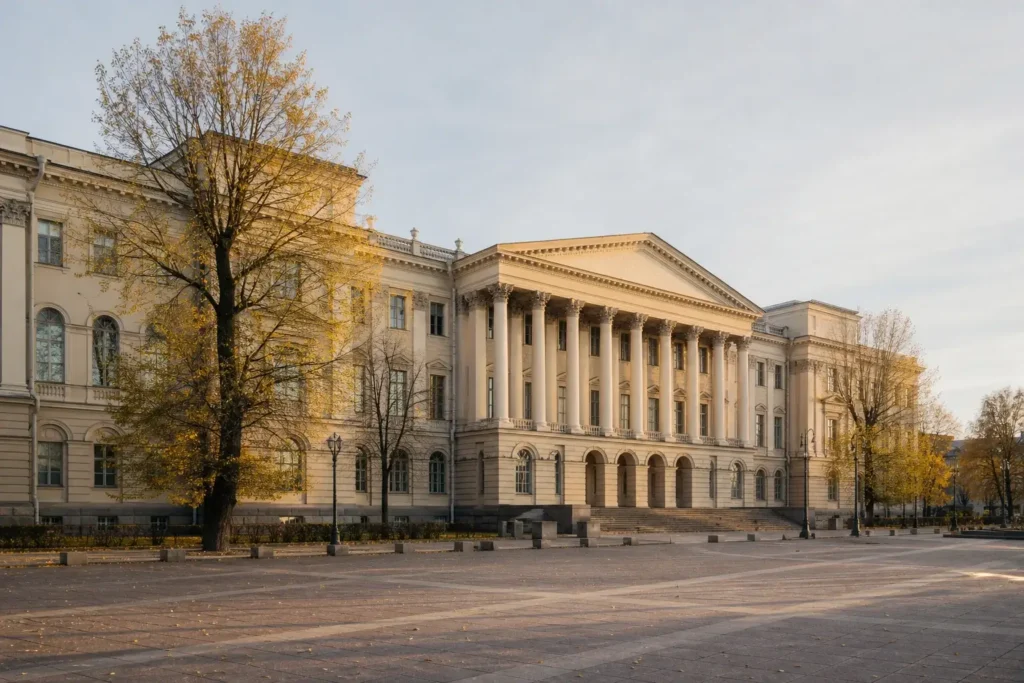
The Russian Ethnographic Museum is the museum of the peoples of Russia, with a collection of about half a million objects that covers more than 150 peoples. It stands on Inzhenernaya Street, directly behind the Russian Museum and a short walk from Nevsky Prospect, in a building designed specially for it by the architect Vasily Svinyin.
Inside you can see traditional costumes, housing, tools, religious objects and crafts from European Russia, Siberia, the Far East, the Caucasus and Central Asia. This page explains the opening hours, ticket categories and free days, what the permanent displays cover, which exhibitions are on in autumn 2026 and how to plan a visit.
Quick Facts
| Russian name | Российский этнографический музей |
|---|---|
| Built / opened | 1913 |
| Architect(s) | Vasily Svinyin |
| Address | Санкт-Петербург, Инженерная улица, 4/1 OpenStreetMap · Google Maps |
| District | Central District |
| Metro | Nevsky Prospect (Line 2, within walking distance, about 10–15 minutes) Gostiny Dvor (Line 3, within walking distance, about 10–15 minutes) |
| Opening hours | Tuesday 10:00–21:00 (ticket office until 20:00); Wednesday to Sunday 10:00–18:00 (ticket office until 17:00); closed on Mondays. Entry sessions run every half hour from 10:00 to 17:00. The Marble Hall may be closed on days when events are held (as of October 2026 – check the official site). |
| Admission | A full ticket (₽₽); pensioners, students, cadets and children aged 7–16 pay less (₽); children up to 6 enter free. Certain categories enter free on the third Sunday and the first Thursday of each month. |
| Best time to visit | Tuesday evenings, when the museum is open until 21:00, tend to be quieter. Weekday mornings are also calm, while weekends and free days (the third Sunday and first Thursday of the month) are busier. As the visit is indoors, it works in any season. |
| Recommended duration | 2–3 hours |
| Website | ethnomuseum.ru/en |
| Last updated | October 16, 2026 |
What Is (and Isn't) Part of a Visit to Russian Ethnographic Museum, Saint Petersburg?
| Part | Status | Notes |
|---|---|---|
| Permanent exhibitions by region | Included in the standard ticket | European Russia, Siberia and the Far East, the Caucasus and Crimea, Central Asia and Kazakhstan, and Russian traditional costume. |
| Temporary exhibitions | Separate ticket or institution | Some are included in the ticket and some may need a separate exhibition ticket; check at the ticket office. |
| Guided tours and audio guide | Separate ticket or institution | Tours such as the overview tour and the Treasures of the Special Storeroom are booked and paid separately. |
| Souvenir shop and cafe | Included in the standard ticket | On the ground floor and open without a museum ticket. |
| Marble Hall | Separate ticket or institution | May be closed on days when events are held; ask before your visit. |
Why Visit Russian Ethnographic Museum, Saint Petersburg?
The museum shows how people across Russia lived, worked, dressed, celebrated and believed, and every object is authentic, collected by generations of museum staff or acquired from collectors. Foreign visitors sometimes call it the ethnographic Hermitage, and the collection is one of the largest of its kind in Europe.
It is a good complement to the nearby art museums because it focuses on everyday life rather than painting. The halls are organised by region, so you can choose to see Siberia, the Caucasus or Central Asia, and the building itself, with its pink marble, is an attraction.
How Russian Ethnographic Museum, Saint Petersburg Is Laid Out
The museum occupies a large building at Inzhenernaya Street, 4/1, close to Arts Square. The entrance area has information desks, and the cloakroom and toilets are in the basement. The souvenir shop and cafe are on the ground floor and can be visited without buying a museum ticket.
The permanent displays are arranged by region: European Russia, Siberia and the Far East, the Caucasus and Crimea, and Central Asia and Kazakhstan, together with a gallery of Russian traditional costume. Floor plans are available on the museum’s website, and there is an audio guide.
The building is historic and has stairs, which makes access harder for visitors with limited mobility, so the museum asks you to notify it a day before your visit. Entry is by timed sessions every half hour, so arriving at the start of a session helps you avoid queues.
Highlights of Russian Ethnographic Museum, Saint Petersburg
Russian traditional costume
The permanent exhibition of Russian traditional costume, opened in December 2008, includes 32 women's, men's and children's costumes with accessories and ornaments dated to the nineteenth and early twentieth centuries. All are authentic objects of everyday life, brought to the museum from ethnographic expeditions made between 1902 and 2000.
The costume collection is one of the museum's best-known assets.
Tip: Look at the embroidery and headdresses; they differ widely between regions.
Siberia and the Far East
The displays on Siberia and the Far East cover sea hunters, settled fishermen and hunters, and the shamanism of the peoples of the region. Objects include ritual items, clothing and tools, with carved items from mammoth and walrus ivory among the museum's special collections.
The museum also runs a tour on the Arctic as an inhabited land.
Tip: Read the labels on shamanic objects; they explain how the items were used.
The Caucasus and Crimea
The Caucasus displays present the craftsmen of Armenia and Azerbaijan, the hospitality of the peoples of the North Caucasus and a Georgian feast. Ceremonial weapons, utensils and jewellery from the region are among the highlights.
The museum also has a temporary exhibition on the peoples of Crimea, which runs until the end of 2026.
Tip: Allow time for the Georgian feast display, which shows how a table is set.
Central Asia and Kazakhstan
This permanent exhibition, opened in 2009, covers the culture of the peoples of Central Asia and Kazakhstan in the nineteenth and early twentieth centuries: agriculture, crafts, houses and family life, costume, feasts and rituals. The museum's carpet collection from nomadic tribes is one of its prized holdings.
Colourful textiles and costume make these halls visually striking.
Tip: Look at the carpets from close up to see the weaving patterns.
The building and the Marble Hall
The museum's home, designed by the young and then little-known architect Vasily Svinyin, is considered one of the outstanding works of Petersburg architecture of the early twentieth century. The interiors use pink marble quarried in Karelia at Tivdia. The Marble Hall is used for events, so it may be closed on some days.
The architecture is worth a look in its own right.
Tip: Ask at the information desk whether the Marble Hall is open on your visit.
Temporary exhibitions in autumn 2026
The museum runs several temporary exhibitions: Weapons: Symbol, Amulet, Protection (19 September 2026 to 28 February 2027), School Stories (1 September 2026 to 17 January 2027), The Land of Golden Mountains (30 April 2026 to 13 March 2027), Peoples of Crimea (until 31 December 2026) and a show on the religious culture of the Jewish people (until 31 December 2026).
Some exhibitions may need a separate ticket, so check at the ticket office.
Tip: Check which exhibitions are included in your ticket before you buy.
Atmosphere
The museum feels grand and calm. Pink marble, high ceilings and wide stairs lead to halls where costumes, tents and carpets stand in glass cases or reconstructed interiors. Footsteps are muffled, voices low, and there are often school groups and families moving between displays.
The mood is educational but warm, and the colours of textiles, embroidery and beadwork give the halls a lively look. On Tuesday evenings the museum stays open until 21:00 and is quieter. The cafe and shop on the ground floor add a relaxed note, and the building as a whole feels more like a palace than a typical museum.
History of Russian Ethnographic Museum, Saint Petersburg
The idea of a museum of the peoples of Russia was born in the Imperial Russian Geographical Society. Emperor Alexander III dreamed of a museum of Russian national and folk culture, and after his death his successor Nicholas II founded the Russian Museum of Emperor Alexander III in 1895, with an Ethnographic Department. Sources date the museum’s founding to 1895 or 1902, because funding for the building began on 10 January 1902.
The project required a building, and the task went to Vasily Svinyin, a young and then little-known architect. The project stipulated Russian materials and Russian firms. Preparatory work began at the end of 1902 in the former Laundry Building, and the new building on Inzhenernaya Street, next to the Russian Museum, took shape in the following years and was completed around 1913. Its interiors used pink Tivdia marble from Karelia.
The museum’s collection came largely through expeditions. Between 1902 and 2000 staff gathered costumes, tools and ritual objects across the country, and others came from collectors. In the Soviet period the Ethnographic Department grew into an independent museum.
Today the museum holds about half a million objects relating to some 157 peoples, along with a large collection of nineteenth-century photographs and negatives, around 180,000 in all, as well as drawings, graphics and paintings. The most valuable collections include traditional costume, carpets of nomadic peoples of Central Asia and Kazakhstan, and carved ivory from Siberia and the Far East.
The museum continues to add new displays: a permanent exhibition on Russian traditional costume opened in 2008 and one on Central Asia in 2009, and a rotating programme of temporary exhibitions runs year-round. It also offers lectures, children’s programmes, craft workshops and tours such as the Treasures of the Special Storeroom.
Tickets and Booking for Russian Ethnographic Museum, Saint Petersburg
| Ticket | Price | Includes |
|---|---|---|
| Full ticket | ₽₽ | Entry to the permanent exhibitions and temporary exhibitions covered by the entrance ticket; the same price applies to foreign visitors. |
| Pensioners and cadets | ₽ | A reduced ticket for pensioners of Russia and the EAEU and for cadets of Russian educational institutions. |
| Students | ₽ | A reduced ticket for students of Russia and EAEU countries. |
| Ages 7 to 16 | ₽ | A reduced ticket for children from 7 to 16 inclusive. |
| Family ticket | ₽₽₽ | Entry for a group of up to four people with children under 16. |
| Children up to 6 | Free | Free entry for children up to 6 years inclusive. |
₽ budget · ₽₽ moderate · ₽₽₽ upscale · ₽₽₽₽ splurge. Price levels are estimates compared with typical prices for visitors.
Tickets are sold at the museum’s ticket office and on the official website, which is the only authorised online seller. The museum warns of fraudulent sites, so buy only on ethnomuseum.ru.
- Entry is by timed sessions every half hour from 10:00 to 17:00.
- The third Sunday of each month is free for people under 18 and for pensioners of Russia and EAEU countries.
- The first Thursday of each month is free for students, cadets and licensed guides.
- Discounted and free tickets require documents, or a digital ID in the MAX app for some categories.
Rates for Russian citizens and for foreign visitors are the same full ticket, while reduced rates apply to citizens of Russia and EAEU countries for pensioners and students. Check the official price list for the current categories.
Plan and Book
Suggested itineraries Russian Ethnographic Museum, Saint Petersburg
1.5 hours
See the Russian costume gallery and one regional display, such as Siberia or the Caucasus. Finish with a look at the Marble Hall area if it is open.
3 hours
Walk through all four regional displays, then visit a temporary exhibition. Take a break in the ground-floor cafe halfway through.
Half day
Combine the museum with the Russian Museum next door and a walk through Arts Square and Mikhailovsky Garden. Choose the Tuesday evening, when the museum stays open until 21:00.
How to Get to Russian Ethnographic Museum, Saint Petersburg
By metro: the museum is within walking distance of Nevsky Prospect (Line 2) and Gostiny Dvor (Line 3), roughly 10 to 15 minutes on foot.
On foot: it is directly behind the Russian Museum, near Arts Square, and a short walk from the Church of the Savior on Spilled Blood and Saint Michael’s Castle.
By car: the museum has no car park; paid street parking is available on Arts Square and along Inzhenernaya and Italyanskaya streets. By taxi: ask for Inzhenernaya Street, 4/1 (Инженерная, 4/1).
Accessibility
The museum notes that because of the building's architecture and history, visiting the exhibitions has limitations for visitors with limited mobility. Wheelchair users with a seated wheelchair can visit, and staff help carry the chair up stairs (without the person in it). The museum asks you to notify it at least a day ahead using its accompaniment request form or by phone. Seated strollers are allowed.
Food Nearby
The museum has a cafe and souvenir shop on the ground floor, which can be visited without a ticket. More cafes and restaurants are on Arts Square, along Italyanskaya Street and around Nevsky Prospect.
What to Bring
Comfortable shoes, a light layer for the halls, and your ticket or ID for reduced and free categories. Use the cloakroom in the basement for coats and large bags.
Best Views and Photo Spots of Russian Ethnographic Museum, Saint Petersburg
Costume gallery
Rows of embroidered Russian costumes in glass cases, good for close-ups of patterns if photography is allowed.
Best time: Quiet weekday mornings.
Marble staircase and interior
The pink Karelian marble and the high spaces of Svinyin's building, with strong light and decorative detail.
Best time: Morning, when light is soft.
Central Asian carpet display
Large nomadic carpets with intense colours and geometric patterns.
Best time: Any time inside; avoid flash.
Facade on Inzhenernaya Street
The museum's exterior from the street, with Arts Square nearby.
Best time: Late afternoon light.
Photography Rules
Amateur photography and filming without flash, tripod or selfie stick is welcome, except where restricted for the preservation of objects or copyright. Watch for signs banning photography at the entrance to exhibitions or by objects. Photo sessions of any kind need the museum's agreement, and professional shooting requires permission.
Family Suitability
Good for children: the museum runs programmes for families, a children's ethnographic centre and tours aimed at young visitors, such as one on the houses in which people live. Children up to 6 enter free, and family tickets are available. The historic building has stairs, though seated strollers are allowed and staff help on stairs.
Russia Vibes Tips
- Buy tickets only from the official website or the ticket office; the museum warns about fraudulent sellers.
- Choose Tuesday evening if you can. The museum is open until 21:00, with the ticket office closing at 20:00.
- Check the free days before you plan: the third Sunday for under-18s and pensioners, and the first Thursday for students, cadets and guides.
- Do not confuse the museum with the Russian Museum next door; the ethnographic museum is in a separate building at Inzhenernaya Street, 4/1.
- If you need step-free help, notify the museum a day in advance, because the historic building has stairs.
Explore Nearby Russian Ethnographic Museum, Saint Petersburg
Sights near Russian Ethnographic Museum, Saint Petersburg
 State Russian Museum, Saint Petersburg · typical visit: 3–4 hours for the main building
Main image: AI-generated illustration. It may not show the place exactly as it looks.
 Saint Michael's Castle, Saint Petersburgabout 300 m away (~5 min walk) · typical visit: 1.5–2 hours
Main image: AI-generated illustration. It may not show the place exactly as it looks.
 Church of the Savior on Spilled Blood, Saint Petersburg · typical visit: 1 hour inside, plus time to walk around the outside
Main image: AI-generated illustration. It may not show the place exactly as it looks.
 Summer Garden, Saint Petersburgabout 600 m away (~10 min walk) · typical visit: 1–2 hours
Main image: AI-generated illustration. It may not show the place exactly as it looks.
 Nevsky Prospekt, Saint Petersburg · typical visit: 2–4 hours for the main stretch; a full day with stops
Main image: AI-generated illustration. It may not show the place exactly as it looks.
 Palace Bridge, Saint Petersburg – about 1.4 km away (~23 min walk) · typical visit: 30–45 minutes; allow 1.5–2 hours if you wait for the night raising
Main image: AI-generated illustration. It may not show the place exactly as it looks.
Metro stations near Russian Ethnographic Museum, Saint Petersburg
 Nevsky Prospekt Metro Station, Saint Petersburgabout 550 m away (~9 min walk)
Main image: AI-generated illustration. It may not show the place exactly as it looks.
 Gostiny Dvor Metro Station, Saint Petersburgabout 600 m away (~10 min walk)
Main image: AI-generated illustration. It may not show the place exactly as it looks.
 Admiralteyskaya Metro Station, Saint Petersburgabout 1.1 km away (~18 min walk)
Main image: AI-generated illustration. It may not show the place exactly as it looks.
Train stations and river piers near Russian Ethnographic Museum, Saint Petersburg
 Moskovsky Railway Station, Saint Petersburgabout 1.9 km away (~31 min walk)
Main image: AI-generated illustration. It may not show the place exactly as it looks.
Related guides
 State Memorial Museum of the Defense and Siege of Leningrad: Guide
Main image: AI-generated illustration. It may not show the place exactly as it looks.
 Smolny Cathedral, Saint Petersburg: Belfry, Hours and Tips
Main image: AI-generated illustration. It may not show the place exactly as it looks.
 Alexander Nevsky Lavra, Saint Petersburg: Necropolis Guide
Main image: AI-generated illustration. It may not show the place exactly as it looks.
 Fabergé Museum: Imperial Eggs, Hours and How to Find It
Main image: AI-generated illustration. It may not show the place exactly as it looks.
Browse more: More in Central District · All Museums · All Saint Petersburg · All Sightseeing · All Sightseeing in Saint Petersburg
FAQ: Russian Ethnographic Museum, Saint Petersburg
What is the Russian Ethnographic Museum?
A museum of the peoples of Russia with about half a million objects covering more than 150 peoples, in a building on Inzhenernaya Street designed by Vasily Svinyin.
When is it open?
Tuesday 10:00 to 21:00 and Wednesday to Sunday 10:00 to 18:00, closed on Mondays. Entry is in half-hour sessions.
How much is a ticket?
A full ticket is moderately priced and is the same for foreign visitors. Pensioners, students, cadets and children aged 7 to 16 pay less, and children up to 6 enter free.
Are there free days?
Yes. The third Sunday of each month is free for under-18s and pensioners of Russia and EAEU countries, and the first Thursday is free for students, cadets and licensed guides.
What is on display?
Traditional costume, housing, tools, crafts and religious objects of the peoples of European Russia, Siberia and the Far East, the Caucasus and Crimea, and Central Asia and Kazakhstan.
Is it far from the Russian Museum?
No. It is directly behind the Russian Museum's Mikhailovsky Palace, on Inzhenernaya Street, near Arts Square.
Can I take photos?
Amateur photography without flash, tripod or selfie stick is welcome, unless signs ban it. Photo sessions and professional shooting need the museum's permission.
Is the museum accessible?
Seated wheelchairs and strollers are allowed and staff help on stairs, but the historic building has limits for visitors with reduced mobility. Notify the museum a day in advance.
Russia Vibes is a one-person project. A coffee keeps it going
Last updated: October 16, 2026. Found an error or something out of date? Report it and we will check and fix it.
How we research and update our guides
About this guide: AI assistance and accuracy
This guide is created with the help of AI and is based on official sources where available. Mistakes can still happen. Opening hours, prices, rules and other details are given to the best of our knowledge as of the date shown and can change without notice. It offers general recommendations only, not professional, legal or travel advice. Please confirm important details with the official source before you travel; you are responsible for your own plans and decisions.
International sanctions affect payments between Russia and many other countries. In practice, cards issued in the EU, the UK, the US and several other countries often do not work in Russia, Russian cards usually do not work abroad, and some booking platforms, airlines and payment providers limit or suspend their services for Russia. The situation changes frequently. We do not give legal or financial advice, and this site does not encourage anyone to break or circumvent sanctions. Whatever you plan, you are responsible for following the laws and regulations that apply to you, including those of your country of residence and citizenship. Many travelers still organise their stay lawfully. It is worth asking your bank or payment provider what is currently permitted, contacting hotels, tour operators and carriers directly about the payment methods they accept, and checking which services are open to customers from your country. Clarify payment, cancellation and refund terms before you commit to a booking, and keep your plans flexible. Partner links on this site may not be available in every country, and prices, availability and rules in our guides can differ from what you see when you book.Paying for your trip: please read

Take this guide with you
Get a free PDF of this guide to print or read offline: key facts, tips and a map link on a few clean pages.