
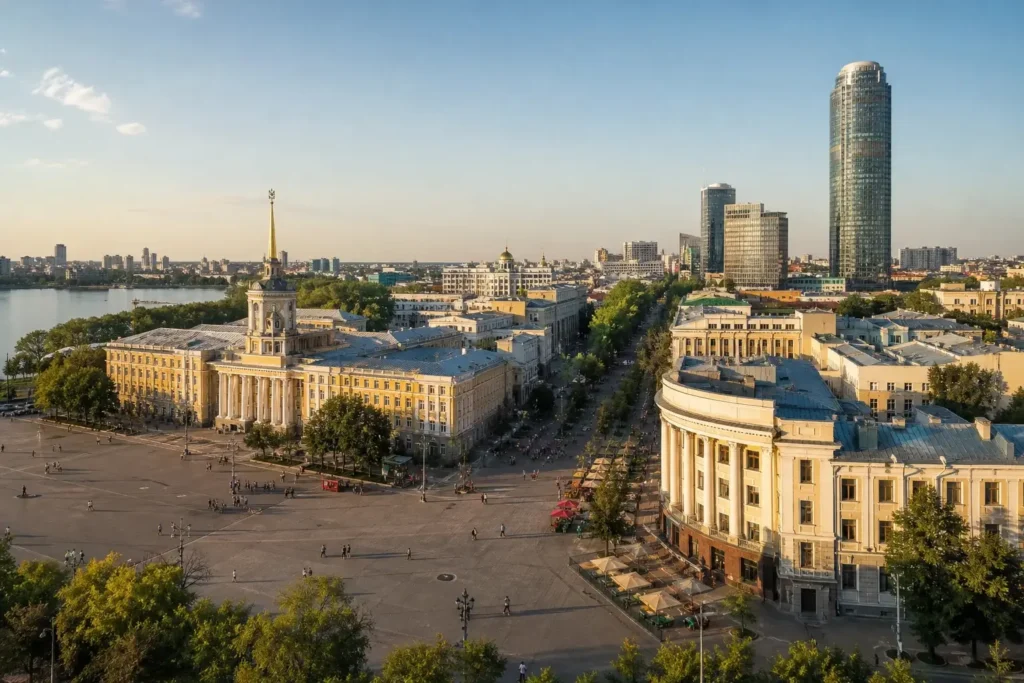
Downtown Yekaterinburg occupies the historic heart of Russia’s fourth-largest city and the Urals’ main commercial hub. The area fans out from 1905 Square (Ploshchad 1905 Goda), the city’s symbolic center, and stretches along the embankment of the Iset River toward the modern Yekaterinburg-City commercial district.
This is where you experience the city’s character most vividly: 19th-century buildings that housed merchants and industrialists stand shoulder to shoulder with early Soviet monuments, contemporary cafés, and new glass towers. The pedestrian Vaynera Street, locally called the Urals Arbat after its famous Moscow counterpart, runs through the center lined with shops, galleries, and street life.
Quick Facts
| Russian name | Центр города / Центральный район |
|---|---|
| Address | OpenStreetMap · Google Maps |
| District | Verkh-Isetsky District |
| Metro | Ploshchad 1905 Goda (First Line, Near the central square) Geologicheskaya (First Line, Central city area) Dinamo (First Line, Historic center) |
| Best time to visit | Spring (May–June) and early autumn (September–October) offer the most pleasant weather for walking downtown. Days are warm without excessive heat; trees and parks are green or colorful. Vaynera Street and the city pond attract crowds during these seasons, especially on weekends.Summer (July–August) is warm and lively, with outdoor cafés and events. Downtown feels energetic; however, peak tourist season and mid-day heat can make walking tiring.Winter (December–February) transforms downtown into a colder, quieter atmosphere; snow covers classical buildings beautifully, but streets are icy and days are short. Many outdoor activities cease. Christmas and New Year holidays bring festive decorations and events.Weekdays are quieter than weekends; weekday early mornings (7–9 am) offer the most peaceful experience. Lunch hours (12–2 pm) bring crowds to Vaynera Street and restaurants. Late afternoons are pleasant when offices empty and locals relax at the city pond. |
| Recommended duration | 3–4 hours |
What Is (and Isn't) Part of a Visit to Downtown/City Center, Yekaterinburg?
| Part | Status | Notes |
|---|---|---|
| Downtown as a public neighborhood | Included in the standard ticket | Free public access to streets, squares, parks, and most embankments; no ticket required to walk and explore. |
| Church on the Blood | Separate ticket or institution | Separate religious site within downtown; free entry but donations accepted; dress code applies (covered shoulders and knees for women; respectful attire). |
| Boris Yeltsin Presidential Center | Separate ticket or institution | Separate museum and cultural center; requires paid ticket; on Boris Yeltsin Street embankment. |
| Vysotsky Observation Deck | Separate ticket or institution | Commercial observation deck in a private office/residential tower; requires paid ticket. |
| Museums and galleries throughout downtown | Separate ticket or institution | Scattered museums and galleries (Museum of Fine Arts, Drama Theatre, smaller cultural venues) each require separate tickets. |
| Yekaterinburg-City commercial district | Included in the standard ticket | Modern complex on Boris Yeltsin Street; public areas, shops, and restaurants are freely accessible; some venues require payment. |
| City Pond Embankment and park areas | Included in the standard ticket | Free public recreational space; some seasonal activities (boat rentals, skating lessons) may require fees. |
Why Visit Downtown/City Center, Yekaterinburg?
The downtown is the starting point for understanding Yekaterinburg’s identity as a crossroads between Europe and Asia, a city of industrial prowess and surprising cultural depth. Iconic sights cluster here: the Church on the Blood marking where the last Russian imperial family was executed; the Boris Yeltsin Presidential Center exploring post-Soviet political history; and the renovated city pond where locals gather to walk and relax.
Unlike Moscow or Saint Petersburg, downtown Yekaterinburg feels manageable and less overwhelming. You can walk between major sights in an afternoon, hop on the single-line metro when legs tire, and discover small cafés serving local specialities. The neighborhood reveals how Russia’s regions, beyond the capital’s shadow, developed their own architectural and civic traditions.
How Downtown/City Center, Yekaterinburg Is Laid Out
The downtown’s core runs north–south along the Iset River embankment and centers on 1905 Square, reachable via Ploshchad 1905 Goda metro station. East of the square lies Vaynera Street, a lively pedestrian thoroughfare heading southeast toward quieter residential areas. West of the square, Boris Yeltsin Street and surrounding blocks house the modern Yekaterinburg-City commercial complex with office towers, hotels, and restaurants.
The city pond (Gorodskoy Prud) sits to the northeast, a pleasant green space for walks. Main metro stations serving the center are Ploshchad 1905 Goda (downtown square), Geologicheskaya (8th Marta Street, central), and Dinamo (northern historic center). Most major museums, shops, and restaurants lie within 15–20 minutes’ walk of these stations.
Highlights of Downtown/City Center, Yekaterinburg
1905 Square
The symbolic heart of downtown, a broad plaza named after the 1905 Russian Revolution. The square fronts the Sverdlovsk Drama Theatre and is surrounded by administrative buildings and cafés. This is where locals gather and city landmarks orient themselves. Free to access and a natural starting point for exploring downtown.
Tip: Visit early morning or late afternoon for best light and fewer crowds; the square can feel busy during lunch hours.
Church on the Blood
Built on the site of the Ipatiev House where Tsar Nicholas II and his family were executed in 1918, this Orthodox cathedral rises prominently on the riverside embankment. The brick church with golden domes commemorates the last Russian imperial family. Ornate interior with modern icons and religious art. Open to visitors; modest dress respectful.
Tip: Enter from the rear entrance facing the river if the front is crowded; the riverside approach offers better photography.
Boris Yeltsin Presidential Center
Opened in 2015, this contemporary cultural and educational center explores modern Russian political history through exhibits, archives, and interactive displays focused on Boris Yeltsin's role in Russia's post-Soviet transition. Designed by architect Boris Bernaskoni, the building itself is a striking example of 21st-century Yekaterinburg architecture. Located on Boris Yeltsin Street on the embankment.
Tip: Tickets required; allow 1.5–2 hours for a meaningful visit; audio guides help navigate the exhibits.
Vaynera Street
A pedestrian shopping and cultural street at the heart of downtown, lined with independent shops, galleries, cafés, and street performers. This is the local version of Moscow's famous Arbat and captures the everyday life and character of Yekaterinburg. Popular with both visitors and residents year-round for strolling and people-watching.
Tip: Best on weekends when street life is most vibrant; arrive mid-morning before lunch crowds.
Vysotsky Skyscraper Observation Deck
A 52-story mixed-use tower with an observation deck on the upper floors offering panoramic views of downtown and the surrounding cityscape. From this vantage point you see the city pond, the Iset River embankment, Yekaterinburg-City commercial district, and the broader Urals landscape. Clear days offer views far into the surrounding region.
Tip: Go in late afternoon on a clear day for best light; bring a camera for city views. Tickets required.
City Pond Embankment
A recreational waterfront park where locals walk, sit, and enjoy seasonal activities. The pond (Gorodskoy Prud) on the Iset River provides a pleasant green space in the heart of downtown. In summer, small boats and water activities operate here; in winter, the pond may freeze for skating. Free public access.
Tip: The embankment is most pleasant in late afternoon when light softens; locals often gather here after work.
Sevastyanov's House
A striking example of 19th-century Russian merchant architecture, this elegant mansion represents Yekaterinburg's prosperity as a trading and industrial center. The neoclassical building with ornate details now houses cultural functions and occasionally operates as a museum. Located centrally and easily recognized by its distinctive facade.
Tip: Best photographed from across the street; check locally if special exhibitions are open to the public.
Atmosphere
Downtown Yekaterinburg pulses with a mix of Soviet-era grandeur and contemporary energy. Broad avenues lined with linden trees create natural corridors between historic buildings and modern offices. The Iset River embankment feels calm and green, a refuge from the busier streets. Cafés spill onto sidewalks in good weather, and the hum of traffic is lighter than in major Russian capitals.
In daytime, business people and shoppers dominate; the district fills during lunch hours at restaurants and around Vaynera Street. Evenings bring families to the city pond and outdoor cafés. Winter transforms the center—snow and dark afternoons give the classical buildings a somber, atmospheric quality. Street musicians and small cultural events happen year-round, especially on Vaynera Street.
The overall feel is urban but not overwhelming, with space to breathe and move. Unlike Moscow’s frenetic pace, Yekaterinburg’s downtown invites lingering—a coffee break watching the river, a long walk down a side street discovering old architecture.
History of Downtown/City Center, Yekaterinburg
Yekaterinburg was founded in 1723 on the banks of the Iset River as a fortress and trading post, strategically placed at the boundary between Europe and Asia. Named after Empress Catherine I, the city grew rapidly in the 18th and 19th centuries as a center of mining and metallurgy, drawing merchants and industrialists to the Urals.
The downtown’s architectural character reflects this prosperity. 1905 Square emerged as the civic heart by the late 19th century, surrounded by government buildings and the Drama Theatre. Surrounding streets filled with merchant mansions, banks, and commercial buildings in neoclassical and eclectic styles—structures like Sevastyanov’s House that still define the streetscape today.
The Russian Revolution of 1917 marked a tragic turning point. In July 1918, the last Russian imperial family—Tsar Nicholas II, his wife Alexandra, and their five children—were executed in the basement of the Ipatiev House located downtown. This event haunted the city for decades. The Soviets demolished the house in 1977, but the Church on the Blood was built on the site decades later (completed 1991–2003) as a memorial and spiritual symbol of reconciliation.
During the Soviet era (1924–1991, when the city was renamed Sverdlovsk), downtown became a gray but functionally organized administrative and cultural center. Post-Soviet Yekaterinburg began rejuvenating its downtown in the 1990s and 2000s. The city pond was cleaned and restored as a public space; Vaynera Street was pedestrianized; and in the 2000s, the modern Yekaterinburg-City commercial complex rose on the embankment, transforming the riverside skyline with glass and steel towers.
By the 2010s–2020s, downtown Yekaterinburg emerged as a surprisingly well-balanced urban center: historic buildings preserved and respectfully adapted, modern architecture integrated rather than dominating, and public spaces reclaimed for walking and leisure. The opening of the Boris Yeltsin Presidential Center in 2015 reinforced the downtown’s role as a cultural and intellectual hub reflecting Russia’s complex modern history.
Legends and Myths about Downtown/City Center, Yekaterinburg
The Ipatiev House Execution
In the basement of a merchant's house downtown, Tsar Nicholas II, his wife, four daughters, and son were shot by Bolsheviks on the night of July 16–17, 1918, ending the Romanov dynasty. The family had been held under house arrest in Yekaterinburg (then Sverdlovsk) during the Russian Civil War. This is not legend but documented history, so profound that it defines the city's spiritual consciousness. The Church on the Blood now stands where the house was demolished, becoming a place of pilgrimage and remembrance.
Vaynera Street as the Urals Arbat
Legend – historically unreliable. Locals and visitors call Vaynera Street the Urals Arbat, comparing it to Moscow's famous pedestrian Arbat. The name reflects both pride in a local cultural thoroughfare and a playful acknowledgment that Yekaterinburg, while Russia's fourth-largest city, lives somewhat in Moscow's shadow. The nickname has become accepted usage, and the street embraces the identity of a place where ordinary Yekaterinburg culture lives and is exchanged.
Tickets and Booking for Downtown/City Center, Yekaterinburg
Downtown Yekaterinburg is a free public neighborhood—no ticket is required to walk its streets, browse shops, or enjoy parks and embankments. However, specific attractions within downtown (the Church on the Blood, Boris Yeltsin Presidential Center, Vysotsky observation deck, and museums) each require separate paid tickets or donations, detailed in their own sections of this guide.
To visit downtown, simply arrive at one of the central metro stations (Ploshchad 1905 Goda, Geologicheskaya, or Dinamo) on the First Line and exit to street level. A single metro token grants entry to the system; no advance booking needed for general exploration. For specific cultural venues, book online through official websites or purchase tickets at the venue on the same day during opening hours (availability permitting).
Plan and Book
Advertisement: these are partner links. If you book or buy through them, we may earn a commission at no extra cost to you.
Suggested itineraries Downtown/City Center, Yekaterinburg
2 hours
Start at Ploshchad 1905 Goda metro station and emerge onto the central square. Spend 20 minutes observing the square, Drama Theatre, and surrounding architecture. Walk south down Vaynera Street for 30 minutes, browsing shops and cafés. Return toward the river, visit the Church on the Blood from the exterior (10 minutes), and finish with a walk along the city pond embankment (20 minutes) for sunset views.
3–4 hours
Begin at 1905 Square as above. Explore Vaynera Street more thoroughly (45 minutes). Visit the Boris Yeltsin Presidential Center (1.5 hours including exhibit time). Walk the Iset River embankment west toward Yekaterinburg-City commercial district to observe modern architecture (30 minutes). Optional: café break overlooking the river or city pond (30 minutes).
Half day
Spend full morning or afternoon in downtown. Walk 1905 Square and its surroundings (30 minutes). Explore Vaynera Street and side streets with independent shops and galleries (1 hour). Visit either the Church on the Blood or Boris Yeltsin Center (1–2 hours). Walk the city pond embankment and Iset River parks (45 minutes). End with lunch or coffee at a downtown café overlooking the river (1 hour). Total: 4–5 hours.
How to Get to Downtown/City Center, Yekaterinburg
By Metro: The Yekaterinburg Metro (First Line) provides direct access to downtown. Key stations: Ploshchad 1905 Goda (central square; nearest station to most landmarks), Geologicheskaya (8th Marta Street, central city), and Dinamo (northern historic center). Exit at ground level; all three stations are within walking distance of major downtown sights.
Walking from Ploshchad 1905 Goda: Exit at ground level onto the square. 1905 Square is immediately visible; Vaynera Street runs southeast from here. The Church on the Blood is west across the square toward the river. City pond embankment is 10 minutes north on foot.
By taxi or ride-share: Useful if arriving from outside downtown; ask drivers for Ploshchad 1905 Goda (1905 Square) or Tsentralny (Central) district as a central reference point. Downtown is compact; once there, most sights are walkable.
Accessibility
Downtown Yekaterinburg's metro stations and main thoroughfares are accessible for wheelchair users. Ploshchad 1905 Goda station has elevators and step-free access to the square. Most downtown streets are paved and level; however, not all shops, cafés, and cultural venues have accessible entrances or facilities—check specific venues before visiting.The city pond embankment is partially accessible with flat walkways, but some sections have steps or uneven ground. Church on the Blood has a main entrance accessible to wheelchairs but may have limited interior accessibility due to its religious architecture; inquire at the entrance. Boris Yeltsin Presidential Center has full modern accessibility with elevators and accessible restrooms.Public restrooms are available in shopping areas and larger museums; few are freely accessible on the street. Accessible taxis and ride-share apps (standard in Yekaterinburg) are practical alternatives to walking longer distances.
Food Nearby
Downtown is well-supplied with dining options. Vaynera Street and surrounding blocks have independent cafés serving coffee, salads, soups, and sandwiches (budget to moderate prices). International cuisines (Italian, Asian, Georgian) are represented. Restaurants cluster near 1905 Square and along the Iset embankment, ranging from casual to upscale.For quick meals, widespread small cafés and fast-food chains serve pies (pelmeni, cheburek), pancakes (blini), and Russian comfort food. Supermarkets (Magnit, Perekrestok chains) are scattered throughout downtown for snacks and picnic supplies. City pond embankment and Yekaterinburg-City commercial district have modern food courts and restaurants with river or city views.
What to Bring
Comfortable walking shoes are essential; downtown involves 2–4 hours of strolling on pavement. In spring and fall, a light jacket or sweater suits variable temperatures. Summer requires sunscreen and sunglasses. Winter demands warm coat, hat, gloves, and waterproof boots (streets may be icy).Camera for photography of architecture and river views. A small daypack or crossbody bag for personal items; downtown shops and restaurants do not have bag checks, but secure your items. Phone and portable charger useful for navigation and photos.Formal or respectful dress if entering the Church on the Blood (covered shoulders and knees for women). No special rules for walking public streets; locals dress casually. Small cash helpful for street vendors or small cafés, though card payment is widely accepted.
Best Views and Photo Spots of Downtown/City Center, Yekaterinburg
1905 Square facing the Drama Theatre
Broad vista of the theatre's neoclassical facade, surrounding civic buildings, and the square's open plaza. This vantage point captures downtown's formal civic character and works well for wide-angle shots emphasizing the scale and architecture.
Best time: Late afternoon for warm side light on buildings; cloudy days minimize harsh shadows.
Iset River embankment looking toward Church on the Blood
The gilded domes of the Church on the Blood rise prominently against the river and trees. This classic downstream perspective includes the riverside park, water, and the cathedral's distinctive architecture in one frame.
Best time: Golden hour (late afternoon or early evening) for warm light on the domes; morning light is cooler but also pleasing.
Boris Yeltsin Street looking west toward Yekaterinburg-City towers
Modern skyscrapers of the commercial district frame against the river embankment and sky. This angle contrasts contemporary glass and steel with the riverside landscape, showing downtown's modern transformation.
Best time: Clear days with blue skies; late afternoon light adds warmth to the glass facades.
City pond from the north bank
Wide reflection of the water with downtown buildings in the background and greenery framing the scene. In winter, the frozen pond creates a stark, atmospheric view with surrounding architecture.
Best time: Early morning or late afternoon when light is soft; clear days show reflections best.
Vaynera Street pedestrian zone at midday
Lively street life with local shops, pedestrians, and street performers (when present). This captures downtown's everyday character and cultural atmosphere, showing how locals and visitors interact.
Best time: Weekends or weekend mornings for maximum street activity; avoid very crowded lunch hours for clearer compositions.
Photography Rules
Photography is freely permitted in downtown streets, parks, and public spaces. No restrictions on cameras, smartphones, or tripods in public areas. The Church on the Blood permits photography in its exterior; interior photography rules vary—respect signage and ask staff if unsure. Museums and galleries have individual photography policies (usually no flash or tripods in galleries; ask at ticket offices). Drones are not permitted in city center areas without prior authorization.
Family Suitability
Downtown Yekaterinburg is family-friendly for walking and general exploration. 1905 Square and the city pond embankment are open, safe public spaces where children can run freely. Stroller access is good on main streets and embankments, though smaller side streets may be less smooth.Cultural venues vary by child age: the Boris Yeltsin Presidential Center suits older children and teenagers interested in modern history; younger children may tire of exhibits. The Church on the Blood is visually impressive but requires sitting still for respectful observation. Street museums and galleries suit those aged 8+.Vaynera Street is lively and manageable for families; shops and cafés welcome children. Parks around the city pond have some playground areas in warm months. In winter, frozen surfaces can be slippery for young walkers. Overall, downtown works well for families with older children (8+) on a 2–3 hour outing; younger children may prefer the city pond park and lighter schedule.
Russia Vibes Tips
- Arrive at Ploshchad 1905 Goda metro station early morning (before 10 am) to experience 1905 Square in its quietest state—you'll see the classical architecture and space more clearly before crowds gather.
- Don't miss the side streets and courtyards off Vaynera Street; small independent cafés, vintage shops, and galleries are tucked away from the main pedestrian drag and offer the most authentic downtown atmosphere.
- The city pond embankment is less crowded than Vaynera Street but equally beautiful; walk it in late afternoon when locals gather to relax after work—you'll experience the neighborhood as residents do.
- If visiting the Church on the Blood, approach from the riverside embankment rather than from the street side; the architecture looks more impressive from the lower angle, and the river setting is more evocative.
- Combine downtown with the nearby Yekaterinburg-City commercial district in one afternoon; the two areas are adjacent and show the city's historical and modern faces side by side.
- The single Yekaterinburg Metro line is easy to navigate and the most efficient way to enter/exit downtown; buying a multi-ride card is cheaper than single tokens if you plan to use the metro beyond downtown.
Where to Find Downtown/City Center, Yekaterinburg in Russia
More chains in Russia
 Leninsky, Yekaterinburg
Main image: AI-generated illustration. It may not show the place exactly as it looks.
 Verkh-Isetsky, Yekaterinburg
Main image: AI-generated illustration. It may not show the place exactly as it looks.
Related guides
 Yeltsin Center: Museum of Modern Russia and 1990s History
Main image: AI-generated illustration. It may not show the place exactly as it looks.
 Stolovaya Maslenitsa: A Transit Traveler’s Honest Canteen
Main image: AI-generated illustration. It may not show the place exactly as it looks.
Browse more: More in Verkh-Isetsky District · All Neighborhoods · All Neighborhoods · All Neighborhoods in Yekaterinburg · All Yekaterinburg
FAQ: Downtown/City Center, Yekaterinburg
Is there a free public area in downtown Yekaterinburg to walk and explore?
Yes, downtown is entirely free to walk. Streets, squares, parks, and embankments are public and require no ticket. Museums, the Church on the Blood, and commercial attractions each require separate paid admission, but strolling, shopping, and enjoying outdoor spaces are free.
How do I get to downtown from the airport or train station?
Use the Yekaterinburg Metro (First Line). From the airport, take a taxi or bus to a central station like Ploshchad 1905 Goda or Geologicheskaya. From Yekaterinburg Passazhirsky railway station (main station), board the metro at Uralskaya station heading toward Ploshchad 1905 Goda; this takes 5–10 minutes.
What are the main sights to see in downtown?
1905 Square (civic heart), Vaynera Street (pedestrian shopping street), Church on the Blood (memorial cathedral), Boris Yeltsin Presidential Center (modern museum), city pond embankment (recreational park), and Yekaterinburg-City commercial district (modern architecture). Most are free to see from outside; specific attractions require paid entry.
Is the Church on the Blood free to enter?
Entry is free; however, donations are welcomed. It is an active Orthodox church, so respectful dress is required (covered shoulders and knees for women). Interior photography may be restricted; ask at the entrance.
How long should I spend in downtown Yekaterinburg?
2–3 hours suffices for walking the main sights (square, Vaynera Street, river embankment). 4–5 hours allows time to visit one major museum (like the Boris Yeltsin Center) and cafés. An entire day is pleasant if you enjoy leisurely exploration and dining.
Is downtown safe for solo travelers, especially women?
Downtown is one of the safest areas of Yekaterinburg. It is well-lit, busy during daytime, and populated by locals and tourists. Standard urban safety practices apply (watch belongings in crowds, avoid isolated areas very late at night). The metro is safe and widely used by women.
What are the best seasons to visit downtown?
May–June and September–October offer the most pleasant weather for walking. Summer is warm and lively. Winter is cold but visually striking with snow on classical buildings. Spring and fall have mild temperatures and fewer crowds than summer.
Can I bring a stroller in downtown?
Yes, main streets and embankments are accessible with strollers. The metro has elevators at central stations. Smaller side streets and some shops may be tighter. The city pond embankment is stroller-friendly. Plan to carry the stroller up/down some stairs.
Russia Vibes is a one-person project. A coffee keeps it going
How we research and update our guides
About this guide: AI assistance and accuracy
This guide is created with the help of AI and is based on official sources where available. Mistakes can still happen. Opening hours, prices, rules and other details are given to the best of our knowledge as of the date shown and can change without notice. It offers general recommendations only, not professional, legal or travel advice. Please confirm important details with the official source before you travel; you are responsible for your own plans and decisions.

Take this guide with you
Get a free PDF of this guide to print or read offline: key facts, tips and a map link on a few clean pages.
Report an issue on this page
Paying for your trip: please read
International sanctions affect payments between Russia and many other countries. In practice, cards issued in the EU, the UK, the US and several other countries often do not work in Russia, Russian cards usually do not work abroad, and some booking platforms, airlines and payment providers limit or suspend their services for Russia. The situation changes frequently.
We do not give legal or financial advice, and this site does not encourage anyone to break or circumvent sanctions. Whatever you plan, you are responsible for following the laws and regulations that apply to you, including those of your country of residence and citizenship.
Many travelers still organise their stay lawfully. It is worth asking your bank or payment provider what is currently permitted, contacting hotels, tour operators and carriers directly about the payment methods they accept, and checking which services are open to customers from your country. Clarify payment, cancellation and refund terms before you commit to a booking, and keep your plans flexible.
Partner links on this site may not be available in every country, and prices, availability and rules in our guides can differ from what you see when you book.