
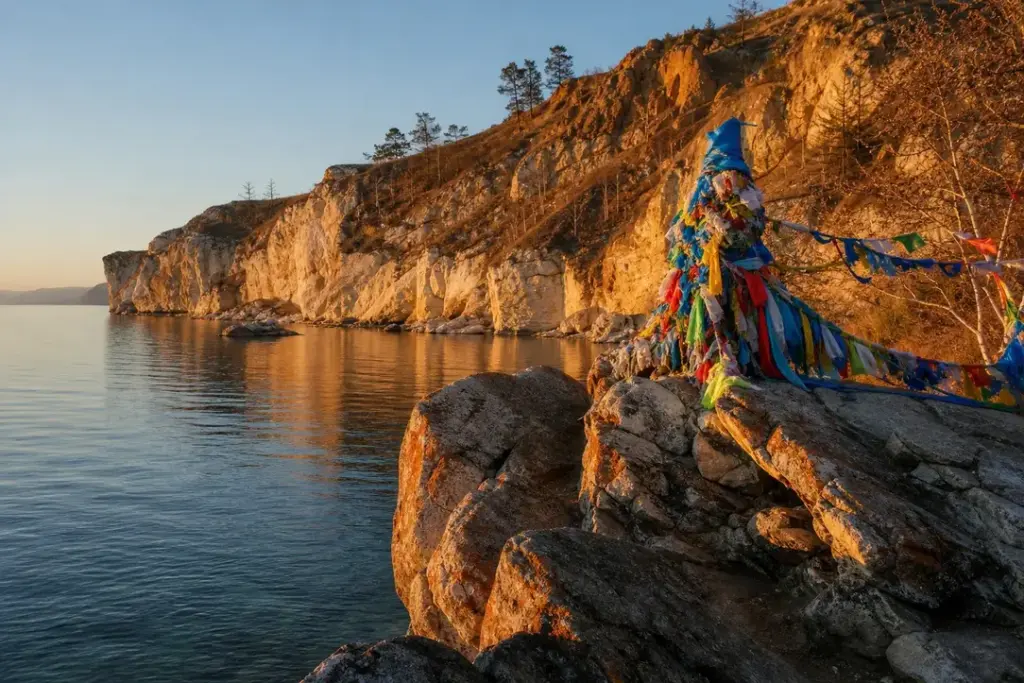
Olkhon Island is the largest island in Lake Baikal, stretching 72 kilometres across the lake’s heart in Siberia. As the world’s third-largest freshwater island, it holds deep spiritual significance for the Buryat people and is revered as one of five global centres of shamanic energy. The island is reached by free ferry from the mainland (May through mid-December) or by crossing frozen ice in winter.
Visitors come for Cape Khoboy’s northern cliffs, the sacred Shaman Rock near Khuzhir village, and vast landscapes ranging from taiga forest in the north to steppe grassland in the south. The island remains largely undeveloped—there are no paved roads—making it one of Baikal’s most authentic and wild destinations.
Quick Facts
| Russian name | Остров Ольхон |
|---|---|
| Address | Khuzhir village, Olkhonsky District, Irkutsk Oblast Google MapsApple MapsYandex Maps2GIS |
| District | Irkutsk Oblast |
| Best time to visit | Summer (June–August) brings warm weather, wildflowers and the most visitor crowds; ferry queues are longest but all sites are fully accessible. May and September–early December offer good balance—fewer crowds, stable weather, easier ferry access and lower prices. Winter (late January–mid-February) reveals the lake's frozen beauty and ice caves, but requires special guides and extreme cold weather gear; travel outside this window during the freeze/thaw transition is very difficult. Avoid mid-December to mid-January and mid-April to mid-May when ferries stop and ice is unstable. |
| Recommended duration | 2–3 days |
What Is (and Isn't) Part of a Visit to Olkhon Island, Lake Baikal?
| Part | Status | Notes |
|---|---|---|
| Olkhon Island itself | Included in the standard ticket | The entire island is accessible via ferry (free, May–mid-December) or ice road (winter). Access is included with normal entry; no separate ticket required for being on the island, though visits to specific sites may require a guide. |
| Khuzhir village | Included in the standard ticket | The main settlement is freely accessible; shops, cafes, guesthouses and village streets require no admission fee. |
| Sacred sites and national park areas (Shaman Rock, capes, interior sites) | Separate ticket or institution | Most guided tours include national park fees, typically absorbed in tour cost. Independent access to certain natural areas may require a small fee verified at Khuzhir or with local guides. |
| Ferry crossing from mainland | Included in the standard ticket | The free public ferry operates May through mid-December; hovercraft service operates during ice transition periods (late December–early February). Ferry wait times in peak summer can be many hours without pre-booking. |
| Winter ice travel | Separate ticket or institution | From mid-January to mid-February, the lake freezes and ice roads replace ferry service. Ice travel requires a licensed guide and special vehicle; this is not included in ferry costs and must be arranged separately. |
| Museum of Local Lore (Khuzhir) | Separate ticket or institution | A small museum in Khuzhir village holds Buryat cultural artifacts and Baikal history; entry is separate from island access and typically costs a small fee. |
| Guided tours and excursions | Separate ticket or institution | While the island itself is accessible, most meaningful visits are arranged through guides who provide context, transportation and safety. Tours range from one-day trips to multi-day stays and vary widely in price and focus. |
Why Visit Olkhon Island, Lake Baikal?
Olkhon offers unmatched natural drama and cultural depth. Its cliffsides rise steeply from water over 1,600 metres deep, framing ice formations in winter and turquoise shores in summer. The island is inseparable from Buryat shamanism; thousands of prayer scarves adorn sacred sites like Shaman Rock, and local guides share stories of spiritual traditions alive for centuries. In winter, the frozen lake becomes a transparent highway beneath your feet, revealing the landscape’s raw beauty.
How Olkhon Island, Lake Baikal Is Laid Out
Olkhon is elongated and thin, shaped roughly like the lake itself. Khuzhir village on the western shore serves as the main settlement and hub for all visitor services—accommodation, food, tours and ferries. From Khuzhir, two main routes explore the island: north toward Cape Khoboy at the island’s tip and its dramatic cliffs, and south toward Heart Lake, the Garden of Stones and smaller inland lakes. Most visitors explore by vehicle as part of guided tours; independent travel requires a hire car or bicycle.
Highlights of Olkhon Island, Lake Baikal
Shaman Rock (Cape Burhan)
The most sacred site on Olkhon, this rock juts from the shore near Khuzhir with a cave at its base once used for shamanic rituals. According to Buryat belief, a deity called Ugute Noyon has lived in this cave since ancient times, guiding the lake's spiritual life. Visitors leave coins and prayer scarves tied to threads as offerings. The rock is accessible via short walk from Khuzhir village and frames stunning sunset views across the water.
Tip: Visit in late afternoon for golden light on the rock face and clearest sunset reflections on the ice in winter.
Cape Khoboy
The northernmost point of Olkhon rises as a massive cliff formation with near-vertical rock walls meeting the lake. At the northern tip stands a distinctive stone beacon. The cape marks where two tectonic plates meet, sitting above the lake's deepest trenches. Reaching it requires a guided vehicle tour of several hours from Khuzhir through the island's northern landscape.
Tip: The wind is strongest and coldest at the cape; bring a windproof jacket even in summer, as air temperature can feel 15 degrees colder than on the shore.
Three Brothers Rock (Sagaan-Khushun)
Three tall rock pillars stand dramatically in a row overlooking the lake on the northern shore. According to Buryat legend, these were once three brothers turned to stone by their father for breaking a sacred oath. The rocks are iconic landmarks visible from many vantage points on the northern route and appear in countless Baikal photographs.
Tip: The rocks are best photographed from the water or from viewpoints on the shore during late morning when light is directional but not harsh.
Sagan-Khushun (Marble Capes)
On the northern coast rise striking white and pale marble cliffs streaked with orange and rust-coloured lichen, creating patterns visible from kilometres away. These ancient rock formations have been sculpted by water and ice for millennia. The capes form a dramatic boundary between taiga forest above and the deep water below.
Tip: These cliffs are often included in northern route tours; photograph them in morning light when colours are most vivid and shadows define the rock texture.
Heart Lake (Ozero Serdtse)
An internal freshwater lake sits in the island's southern interior, accessible by vehicle from Khuzhir. It lies at 208 metres elevation on a plateau and offers perspective on Olkhon's geological diversity—the island contains ecosystems ranging from forest to steppe to near-desert within 730 square kilometres.
Tip: Heart Lake is usually visited as part of a southern route day trip; bring binoculars as water birds are common and visible from shore viewing platforms.
Garden of Stones (Skalnyi Sad)
A field of distinctive rock formations scattered across landscape in the southern interior creates an otherworldly vista. These ancient stones, weathered over millennia, sit among sparse vegetation in an area that transitions between steppe and semi-desert conditions. The site offers perspectives on Olkhon's unique geological character.
Tip: This site is sometimes called Uzury Valley on tour itineraries and is typically reached only as part of a vehicle-based southern or multi-day tour from Khuzhir.
Ice Formations and Frozen Lake
From mid-January through February, Lake Baikal freezes to metres thickness, and Olkhon becomes surrounded by transparent ice formations—frozen waves, pressure ridges, and clear sections revealing water and rocks beneath. Ice caves form where water seeps from beneath the ice and refreezes. Winter transforms the landscape into an alien terrain of blue, white and translucent formations.
Tip: Winter ice is most stable mid-January to mid-February; ice touring requires guides and special preparation. Never venture onto ice alone. Bring extreme cold-weather gear; wind-chill can make air feel 20+ degrees colder than thermometer readings.
Khuzhir Village
The island's only significant settlement clusters around wooden buildings on the western shore, with no paved roads—only sand and dirt tracks. The village has grown from a traditional fishing community to a small tourism hub. A local museum holds exhibits on Buryat life and Baikal history, and scattered shamanic shrines with colourful prayer scarves mark spiritual sites throughout.
Tip: Khuzhir is compact enough to walk around on foot; local guides based here can be hired directly for informal tours if you miss organized ones. The village has basic shops and cafes but limited western amenities.
Atmosphere
Olkhon feels isolated and timeless. Wind often sweeps across open landscapes, carrying silence broken only by water or ice sounds. In summer, sandy tracks and grassy slopes frame rocky outcrops; in winter, the frozen lake dominates—a vast white plain beneath a pale sky. Khuzhir village has a frontier quality—weathered wooden buildings, dogs, smoke from chimneys—with an international backpacker presence mixed with local fishermen and Buryat residents.
Spirituality permeates the island. Prayer scarves flutter at sacred sites, and local guides speak matter-of-factly about shamanic traditions and water spirits. Visitor numbers remain modest outside peak summer months, leaving stretches of landscape entirely empty. The island rewards contemplation more than rushing; many visitors stay multiple days to absorb the place rather than complete a single-day checklist.
History of Olkhon Island, Lake Baikal
Olkhon has been inhabited for thousands of years. Archaeological evidence shows human activity dating to the Neolithic period on and around Lake Baikal. The Buryat people, descendants of Mongol groups who migrated into the Baikal region, have lived on Olkhon for centuries and maintain deep spiritual relationships with the island and lake.
In Buryat belief, Olkhon holds one of five primary poles of shamanic power across the global landscape. The first shamans are said to have gained their abilities on this island, particularly at Shaman Rock near present-day Khuzhir. The cave beneath Cape Burhan served as a ritual space for centuries and remains a pilgrimage site for Buryat shamans and believers.
In the Soviet era, Olkhon’s isolation increased as fishing communities persisted but tourism was minimal. Access remained difficult and regulated. After Soviet collapse in the 1990s, the island gradually opened to foreign visitors. A free ferry service established regular connection to the mainland, and small guesthouses and tourism operations emerged in Khuzhir. Today, managed tourism coexists with traditional settlement and spiritual practice, with the island protected as part of the Pribaikalsky National Park system.
Legends and Myths about Olkhon Island, Lake Baikal
Three Brothers Turned to Stone
Legend – historically unreliable. A Buryat legend tells of three brothers who lived on Olkhon. Their father had supernatural powers and could transform them into eagles. He granted their wish, but commanded them never to eat dead animals. The brothers flew joyfully around the island but grew hungry and found a carcass. Despite their oath, they ate. When their father discovered the betrayal, he was furious and transformed them permanently into the three tall rocks now known as Sagaan-Khushun (Three Brothers Rock), where they stand forever as a monument to broken promises.
Ugute Noyon, Master Spirit of Baikal
Legend – historically unreliable. According to Buryat shamanic tradition, Ugute Noyon—a powerful deity and master of Lake Baikal—resides in the cave beneath Shaman Rock on Cape Burhan. This spirit is revered as the lake's supreme guardian and the most important supernatural being controlling Baikal's waters and fortune. Shamans consult and appease this spirit through rituals, and visitors leave offerings and prayers at the rock to show respect and seek safe passage across the lake's dangerous waters.
First Shamans Gained Power on Olkhon
Legend – historically unreliable. Buryat oral tradition holds that the very first shamans learned to hear and communicate with spirits on Olkhon Island. The island is described as a thin place between the material and spiritual worlds, where the veil between realms grows permeable. Young initiates seeking shamanic power have traditionally journeyed to sacred sites on Olkhon to undergo spiritual transformation and receive calling from the spirit world.
Tickets and Booking for Olkhon Island, Lake Baikal
Olkhon Island requires advance planning, not tickets per se. Ferry access is free but demand often exceeds capacity in summer (May–August). Most visitors book multi-day tours through tour operators based in Irkutsk or Listvyanka; these typically include accommodation, guide, meals, vehicle transport and national park access.
The free ferry operates May 15 through December 15; booking a seat is recommended in peak season. Hovercraft service operates mid-December to early February as ice forms and melts. From mid-January to mid-February, the lake freezes solid and a natural ice road connects the island—ice travel requires a guide and must be booked separately.
One-day tours from Irkutsk are possible in summer (skipping ferry queues with priority passage) but give limited time on the island. Multi-day tours (2–4 days) are preferred and allow proper exploration of northern capes and southern lakes. Check with Irkutsk tour operators for current ferry status and book well ahead for summer or winter travel.
Plan and Book
Suggested itineraries Olkhon Island, Lake Baikal
Half day (3–4 hours)
Arrive by morning ferry and head directly to Shaman Rock (Cape Burhan) for a 1–2 hour visit including the cave and coastal views. Walk around Khuzhir village, visit local shops and the museum, explore the shoreline. Depart on late afternoon ferry. This suits ferry transfers but allows little immersion.
One day (8–10 hours)
Early ferry arrival, then vehicle tour north to Cape Khoboy (3–4 hours) visiting Sagan-Khushun cliffs and Three Brothers Rock. Return to Khuzhir for lunch. Afternoon visit to Shaman Rock and village exploration. Late ferry return. This covers the island's most dramatic northern features.
Two days
Day 1: Arrive, settle in Khuzhir accommodation, visit Shaman Rock and shoreline at sunset. Day 2 morning: Vehicle tour north to Cape Khoboy and marble cliffs (full route). Afternoon: Vehicle south tour to Heart Lake and Garden of Stones, or free time in Khuzhir. Allows deeper exploration of distinct island regions.
Three days (winter ice travel)
January–February: Day 1: Arrive in Irkutsk, settle. Day 2: Ice road crossing with guide, exploration of frozen lake formations and Baikal's transparent ice, visit Shaman Rock and cliffs. Day 3: More ice travel (ice caves, frozen shoreline formations), or vehicle tour of interior. This maximizes unique winter phenomena.
How to Get to Olkhon Island, Lake Baikal
By Ferry from Mainland (May 15–December 15)
The free ferry crosses the Olkhon Strait from the village of Slyudyanka / Shara-Togot on the mainland western shore. Ferries run hourly during peak season but queuing is common—peak summer waits can exceed 4 hours for private cars. Buses and organized tour vehicles often receive priority. The crossing takes 20–25 minutes. Ferry capacity is limited; arriving early or booking via tour operators is essential in high season.
From Irkutsk
Irkutsk is the primary access point, 300 kilometres south. Tour buses and private vehicles follow the Primorsky Mountains on Baikal’s western shore along roads of variable quality. Journey time is typically 5–6 hours one way. Most visitors book tours from Irkutsk (easier than self-driving) which include vehicle transport, accommodation and guiding.
Winter Ice Road (Mid-January to Mid-February)
When Baikal freezes solidly, an ice road forms across the southern strait. This requires a licensed guide and special vehicle; it is not accessible for independent driving or public transport. Tours operating January–February include ice road crossings and access to frozen lake phenomena.
Accessibility
Olkhon is not wheelchair accessible. There are no paved roads, uneven terrain dominates, and ferries have steep boarding ramps without accessible design. Most guided tours are conducted via vehicle over rough tracks, with walking required at sites. Visitors with reduced mobility should arrange private guides in advance and confirm specific site accessibility; some remote locations will not be feasible.
Food Nearby
Khuzhir village has basic cafes and guesthouses serving simple Russian and local food. Larger tours include meals (often Baikal omul fish soup). Independent visitors should not expect varied dining—bring snacks, energy foods and water. Some accommodations offer home-cooked meals by arrangement. Winter access to food is more limited as many establishments close seasonally.
What to Bring
Summer: sun protection (intense reflection off water), layers (temperature swings), sturdy hiking boots for rough terrain and rocky shorelines, binoculars for wildlife. Winter: extreme cold-weather clothing (temperatures drop below –20°C, wind-chill makes it feel far colder), insulated boots rated to –30°C+, balaclava, thick gloves, hand/foot warmers. Year-round: windproof jacket (wind is constant), camera with cold-weather batteries (they drain fast), high-energy snacks. Security and bag rules: ferries and vehicles are casual; leave valuables in accommodation.
Best Views and Photo Spots of Olkhon Island, Lake Baikal
Shaman Rock from shore, late afternoon
The distinctive rock silhouettes against golden-hour light; the sacred cave mouth becomes visible in lower-angle light. Prayer scarves and votive ribbons frame the composition. Water reflects warm colours at sunset. Winter ice adds foreground texture.
Best time: Late afternoon (16:00–17:00 in summer, 14:00–15:00 in winter) when sun is low and warm-toned. Clearest on calm, clear days when water mirror quality is highest.
Three Brothers Rock from distance
Three tall pillars in profile against water and sky, recognizable from kilometres along the northern coast. Best framed by rocky foreground and sparse vegetation. Scale is evident when tour vehicles or people appear nearby.
Best time: Late morning to early afternoon when light is directional but not harsh. Photograph from the vehicle as tour passes to capture different angles.
Sagan-Khushun marble cliffs, northern coast
Towering white and pale-ochre vertical cliffs covered in rust and orange lichen patterns. Cliffs rise steeply from dark water. Most striking when weather is clear and cliffs are sunlit against darker sky or water backdrop.
Best time: Morning light illuminates cliff faces and emphasizes colour and texture. Cliffs are usually visited as part of a northern tour; photograph from vehicle or designated stops.
Heart Lake overlook, southern plateau
A freshwater lake set in high plateau surrounded by sparse steppe vegetation and distant rock formations. Scale and isolation are evident; Baikal landscape visible in far distance. Light, expansive feeling.
Best time: Any clear day; sky and cloud reflections in the lake's surface change appearance dramatically. Midday light is usually adequate but morning and evening add atmospheric interest.
Frozen lake formations in winter, close detail
Transparent ice with underwater rocks and fish visible, or pressure ridges and frozen wave formations creating sculptural abstracts. Close macro photography reveals fractal-like patterns. Blue ice transitions to clear sections.
Best time: January–February when ice is thick and clear. Overcast days reduce glare. Early morning light creates cool tones and shadows that highlight ice texture. Wear sunglasses to protect from ice glare.
Khuzhir waterfront at dusk
Wooden buildings reflected in still water, prayer scarves fluttering, small boats moored, distant cliffs silhouetted. Captures village character and location intimacy. Sky and water colours change minute by minute at golden hour.
Best time: Sunset hour (17:00–18:00 in summer, earlier in spring/fall); arrive 30 minutes before sunset to capture colour transitions. Clear, calm evenings produce best reflections.
Photography Rules
Photography is generally unrestricted on the island and at most sites. No drones are permitted within national park boundaries. Tripods are allowed for static landscape shots. Flash is not needed or used outdoors. In winter, bring extra batteries as cold dramatically reduces capacity. The landscape photographs best in morning and evening light; midday sun in summer washes out colours across the pale water.
Family Suitability
Olkhon is moderately family-friendly with older children (8+) and teenagers. The ferry crossing is straightforward and scenic. Short walks to Shaman Rock and village exploration suit most ages. Multi-hour vehicle tours with rough roads are challenging for very young children—sustained bumpy travel and limited facilities test patience. Winter ice travel with professional guides is possible for fit children but requires extreme cold-weather tolerance. The island offers unique natural and cultural education, though limited infrastructure (basic food, no specialist children's activities) means family comfort depends on flexibility and age-appropriate expectations.
Russia Vibes Tips
- Book ferry passage in advance or join an organized tour in summer. Arriving without a reservation can mean 4–6 hour waits for private vehicles in peak season (July–August). Tour buses often skip the queue, making an organized tour faster than independent driving.
- Most important sites are visited via guided vehicle tours from Khuzhir, not by hiking. Independent exploration is possible but limited without a vehicle. Rent a car, hire a private guide, or join a group tour to reach Cape Khoboy, Sagan-Khushun, Heart Lake and the Garden of Stones efficiently.
- Winter ice is spectacular but demands serious preparation. Book with a licensed ice-travel guide; never venture onto ice alone. Bring extreme cold-weather gear rated to –30°C. Mid-January to mid-February is prime ice season—earlier or later ice is unstable and crossing may be cancelled.
- The island has no paved roads; be prepared for sand and pot-holes. Vehicle suspensions get a workout, and dust clouds are common. Bring water and snacks as provisions in Khuzhir are limited. Expect basic accommodation and food—do not expect luxury or variety.
- Visit Shaman Rock and prayer sites with respect. Do not remove prayer scarves or disturb offerings. Shamanic traditions remain active and the sites carry genuine spiritual meaning to local people. Following local customs (leaving a small offering, circling sites clockwise) is appreciated.
- Sunset light is incomparably beautiful for photography, especially at Shaman Rock and Sagan-Khushun cliffs. Plan tours to time major site visits for late afternoon, not midday, when light is warm and directional. Winter sunsets occur very early (14:00–15:00), so adjust timing accordingly.
Explore Nearby Olkhon Island, Lake Baikal
Related guides
 Lake Baikal: Where to Go, What to See and How to Visit
Main image: AI-generated illustration. It may not show the place exactly as it looks.
 Listvyanka Day Trip, Irkutsk: Getting to Lake Baikal and Back
Main image: AI-generated illustration. It may not show the place exactly as it looks.
 Irkutsk: 130 Kvartal, Decembrists and Gateway to Lake Baikal
Main image: AI-generated illustration. It may not show the place exactly as it looks.
Browse more: More in Irkutsk Oblast · All Lake Baikal · All Landmarks · All Sightseeing · All Sightseeing in Lake Baikal
FAQ: Olkhon Island, Lake Baikal
How do I get to Olkhon Island from Irkutsk?
From Irkutsk, drive or take a bus 300 kilometres south along Baikal's western shore (5–6 hours) to the ferry crossing at Slyudyanka / Shara-Togot. Take the free ferry across the Olkhon Strait (20–25 minutes) to reach Khuzhir village. Most visitors book a tour from Irkutsk which includes transport, accommodation and guiding. In winter, once the lake freezes (mid-January to mid-February), an ice road replaces the ferry and requires a licensed guide.
What is the best time to visit Olkhon Island?
June–August offers warm weather and full accessibility, but brings crowds and ferry queues. May and September–early December provide good balance—stable weather, fewer crowds and easier ferry access. Winter (late January–mid-February) reveals spectacular frozen lake phenomena and transparent ice, but requires extreme cold-weather preparation and special guides. Avoid mid-December to mid-January and mid-April to mid-May when ferries stop and ice is unstable.
What is there to see on Olkhon Island?
Main attractions are Shaman Rock (Cape Burhan) with its sacred cave, Cape Khoboy's dramatic northern cliffs, Sagan-Khushun marble cliffs with orange lichen, Three Brothers Rock, Heart Lake, the Garden of Stones, and Khuzhir village with its Buryat heritage. Most sites require a vehicle tour; short walks around the village are possible. Winter visitors see frozen lake formations and transparent ice instead of water.
Can I visit Olkhon Island independently or do I need a guided tour?
You can rent a vehicle in Khuzhir and explore somewhat independently, but hiring a local guide is strongly recommended. Guides provide cultural context, history of shamanic sites, and practical knowledge of access and road conditions. Most meaningful visits are part of organized tours, which also handle ferry logistics and accommodation, eliminating stress from independent travelers.
How long should I spend on Olkhon Island?
One-day trips from Irkutsk are possible but rushed. Two to three days allow proper exploration of northern and southern regions, Khuzhir village, and sacred sites without exhaustion. Three days in winter (crossing ice, seeing frozen phenomena) is ideal. Many visitors stay 2–4 days to absorb the island's atmosphere and culture.
Is Olkhon Island part of a national park?
Yes, Olkhon Island is part of the Pribaikalsky National Park system established in 1986. Most sites require park entry; fees are usually included in guided tour costs. Check with Khuzhir tour operators for exact fees if visiting independently.
What is Shaman Rock and why is it important?
Shaman Rock (Cape Burhan) is the most sacred site on Olkhon, with a cave at its base. According to Buryat tradition, the spirit deity Ugute Noyon has inhabited this cave since ancient times, governing Lake Baikal. Shamans perform rituals here, and visitors leave coins and prayer scarves as offerings. The rock is a focus of active Buryat spiritual practice, not merely a tourist site.
What should I bring to Olkhon Island?
Summer: sun protection, layers, sturdy boots, wind jacket, binoculars, camera. Winter: extreme cold-weather gear (–30°C rated), insulated boots, balaclava, thick gloves, hand warmers, extra batteries. Year-round: water, energy snacks, windproof jacket. The island has basic shops in Khuzhir but limited supplies. Do not expect luxury infrastructure.
Russia Vibes is a one-person project. A coffee keeps it going
How we research and update our guides
About this guide: AI assistance and accuracy
This guide is created with the help of AI and is based on official sources where available. Mistakes can still happen. Opening hours, prices, rules and other details are given to the best of our knowledge as of the date shown and can change without notice. It offers general recommendations only, not professional, legal or travel advice. Please confirm important details with the official source before you travel; you are responsible for your own plans and decisions.
Packing for this trip
* Affiliate link: as an Amazon Associate we earn from qualifying purchases at no extra cost to you.

Take this guide with you
Get a free PDF of this guide to print or read offline: key facts, tips and a map link on a few clean pages.
Report an issue on this page
Paying for your trip: please read
International sanctions affect payments between Russia and many other countries. In practice, cards issued in the EU, the UK, the US and several other countries often do not work in Russia, Russian cards usually do not work abroad, and some booking platforms, airlines and payment providers limit or suspend their services for Russia. The situation changes frequently.
We do not give legal or financial advice, and this site does not encourage anyone to break or circumvent sanctions. Whatever you plan, you are responsible for following the laws and regulations that apply to you, including those of your country of residence and citizenship.
Many travelers still organise their stay lawfully. It is worth asking your bank or payment provider what is currently permitted, contacting hotels, tour operators and carriers directly about the payment methods they accept, and checking which services are open to customers from your country. Clarify payment, cancellation and refund terms before you commit to a booking, and keep your plans flexible.
Partner links on this site may not be available in every country, and prices, availability and rules in our guides can differ from what you see when you book.