
This Irkutsk travel guide is for first-time visitors who want to see a Siberian city and use it as a base for Lake Baikal. Irkutsk stands on the Angara river in Eastern Siberia, and it is a major stop on the Trans-Siberian Railway, so many travellers arrive by train as part of a longer journey.
The city is compact and relaxed. Visitors usually spend a day on foot, with the restored wooden quarter known as 130 Kvartal, the Decembrist house museums and the embankment, and then add a day trip to the lakeside village of Listvyanka. Hours, tickets and transport details change, so check the official source for each place before you go.
Quick Facts
| Russian name | Иркутск |
|---|---|
| Address | OpenStreetMap · Google Maps |
| Best time to visit | Summer, from June to August, is the most comfortable time for walking the city and for Lake Baikal, and boats and day trips run more often. Winter is cold and snowy, which suits visitors who want to see the frozen lake and prefer museums and cafes in the city. Check the forecast and the schedules for boats and buses, since services change with the season. |
| Recommended duration | 2 days, plus 1 to 2 days for Lake Baikal |
| Last updated | October 13, 2026 |
Why Visit Irkutsk?
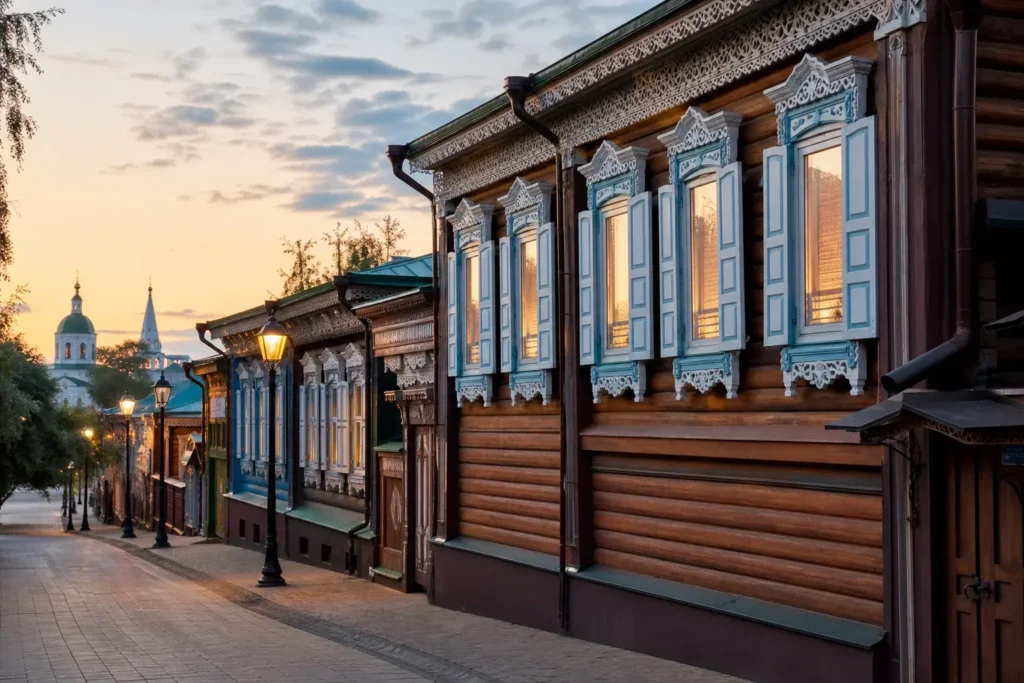
Irkutsk gives a different picture of Russia from Moscow or Saint Petersburg. Its old center keeps wooden houses with carved window frames, and the history of political exiles who settled here in the 19th century shaped its cultural life. The two Decembrist house museums, in the Volkonsky and Trubetskoy mansions, are the clearest example.
The city is also the main gateway to Lake Baikal. Listvyanka, the nearest lakeside village, is about 70 km away, and many visitors reach it in about one to one and a half hours by bus. It makes Irkutsk a practical base even for a short trip.
Highlights of Irkutsk
130 Kvartal (Irkutsk Sloboda)
A restored historic quarter in the center, with wooden houses, cafes, shops and pedestrian streets, and it is where many visitors start. Some buildings were moved here from other places and some were built recently in the traditional style, so treat it as a recreation of old Siberia rather than a fully original district. The carved decoration on the houses is often called wooden lace.
Tip: Come in the morning for photographs with fewer people, and return in the evening when the cafes are busy.
The Decembrist house museums
The museum complex has two historic mansions, the Volkonsky House and the Trubetskoy House, which tell the story of noble families exiled to Siberia after the 1825 uprising. The interiors show how the exiles lived and how they brought education and culture to the city. The two houses stand in different parts of the center, so check the official site for addresses, hours and tickets.
Tip: Plan time for both houses, since each has its own address and its own exhibition.
Spasskaya Church (Church of the Savior)
One of the oldest stone buildings in Irkutsk, an 18th-century church that is a rare surviving example of early stone architecture in the city. It is often named with the architect Moses Dolgikh, though you should check the attribution on the official site. Look at the painted facade and the interior, and check the visiting rules, since it is a working church.
Tip: Dress modestly and check service times before you go in.
The Angara embankment
The embankment runs along the Angara river, which flows out of Lake Baikal, and it is a pleasant place for an evening walk. It is close to the center and links several sights on foot. In winter the river may be partly frozen, and in summer it is a popular place for strolls.
Tip: Walk along it toward the center at sunset.
Cathedral of the Kazan Icon
A large cathedral in the center that is one of the best-known churches in Irkutsk. It shows the city's religious heritage alongside the wooden houses of the older streets. The building is a working church, so check the visiting rules and service times on the official site.
Tip: Visit outside service times if you want to look around quietly.
Listvyanka and Lake Baikal
Listvyanka is the closest village to Lake Baikal, about 70 km from Irkutsk, reached by bus in roughly an hour to an hour and a half, according to travel sources. It has a Baikal museum, a fish market selling smoked omul and viewpoints such as Chersky Stone. It is outside the city and needs a day trip of its own.
Tip: Start early and check the bus times for the return journey.
Atmosphere
Irkutsk feels like a calm provincial city with the weight of a long history. In the center, wooden houses with carved frames sit beside stone churches and Soviet-era blocks, and the streets are quiet outside the main pedestrian areas. In the evening, people stroll in 130 Kvartal and along the Angara embankment.
The seasons change the mood. Summers are light and warm, with the river and parks full of people, while winters are cold, with snow and short days that make cafes and museums more appealing. Visitors range from Trans-Siberian travellers to families heading for Baikal.
History of Irkutsk
Irkutsk began as a Cossack fort founded on the Angara river in 1661, according to general sources, and it received town status in 1686. Its position on the way to Lake Baikal and to the borders of China made it a trading post, and merchants who traded in furs and tea built stone houses and churches in the 18th century.
The Spasskaya Church, from the 18th century, is one of the oldest stone buildings that survives, and it reflects the early growth of the town. In the early 19th century Irkutsk became an administrative center for Eastern Siberia, which gave it importance far beyond its size.
After the failed uprising of December 1825, a number of noble officers, known as Decembrists, were exiled to Siberia, and several of them lived in Irkutsk and its surroundings. Families such as the Volkonskys and the Trubetskoys became part of the city’s social and cultural life, opening schools, hosting music and theater and shaping a local intelligentsia. Their houses are now museums.
A great fire in 1879 destroyed a large part of the center, according to general sources, and the city was rebuilt with more stone buildings. Many of the wooden houses that remain today are in the streets that escaped the fire or were rebuilt afterward.
The Trans-Siberian Railway reached Irkutsk at the end of the 19th century, according to a general source, which brought new trade and population and turned the city into a key stop on the line. The section around Lake Baikal was finished later, and the old route across the lake by ferry gave way to the railway.
In the Soviet period Irkutsk developed as an industrial and scientific center, with new districts, institutes and power stations in the region. At the same time, parts of its historic center were lost or changed.
In recent decades the city has restored parts of its historic center, including the quarter known as 130 Kvartal, where old wooden houses were repaired and others were built in the traditional style. Today Irkutsk is the main gateway to Lake Baikal and a regular stop for Trans-Siberian travellers.
The dates and details above come from general sources and should be checked against official museum and city sources.
Tickets and Booking for Irkutsk
Arriving by air. Irkutsk Airport (IKT) is about 7 km from the center, according to a travel source, and it has flights from Moscow and other Russian cities. A taxi or a bus is the usual way into town, but routes and fares change, so check them with the official operators.
Arriving by train. The main station is Irkutsk-Passazhirsky, on the Trans-Siberian Railway. The journey from Moscow takes about three and a half days, according to travel sources, and the city is also a stop on the long route to the east. Check which station your ticket names.
Confirm before you go. Schedules, ticket types and entry conditions for transport and sights depend on the operator and can change. Always confirm times and tickets with the official operator or the official website of each place, and keep your booking confirmations offline.
How to Get to Irkutsk
Most visitors arrive by air or by train.
- By air: Irkutsk Airport (IKT) is about 7 km from the center. A non-stop flight from Moscow takes about six hours, according to a travel source. Check current flights and the transfer options with the airline and operators.
- By train: Irkutsk-Passazhirsky Station is on the Trans-Siberian Railway, and a journey from Moscow takes about three and a half days, according to travel sources. From the station, a taxi or bus runs to the center.
- To Lake Baikal: Listvyanka is about 70 km from the city, and buses take about an hour to an hour and a half, according to travel sources. Boats also run from Irkutsk port in season; check the schedules.
Check routes, schedules and booking steps with the official operators, and save your hotel address offline in Latin letters and in Russian.
Accessibility
Accessibility differs from one building to the next, and many historic wooden houses and churches have steps, high thresholds and uneven pavements. Check the official website of each museum or sight for lifts, ramps and support for visitors with reduced mobility, and plan extra time for the longer trips outside the city.
Food Nearby
The center and 130 Kvartal have many cafes and restaurants, with Siberian dishes such as pelmeni, and Buryat buuz, steamed dumplings. At Listvyanka, smoked omul, a fish from Lake Baikal, is sold at the market. Menus differ from place to place, so ask staff for local dishes and mention any allergies. Specific venues were not verified here, so check opening hours before you go.
What to Bring
Bring comfortable walking shoes, since the center is best explored on foot and some streets are uneven. In summer pack a light jacket and insect repellent for Baikal, and in winter pack very warm layers, a hat, gloves and shoes with a good grip. A portable charger and offline maps are useful, and large bags may need to go in a cloakroom at museums.
Photography Rules
Rules differ between museums, churches and houses, and flash, tripods and photography of some rooms are often restricted. Check the signs at each entrance and ask staff if you are unsure. Drone rules also apply in cities and near the lake, so check the current regulations with the official source before you use one.
Family Suitability
Irkutsk suits families who like walking, short museum visits and a day by the lake. The pedestrian streets of 130 Kvartal are easy for strollers, but older houses and churches have steps. Day trips to Listvyanka mean long hours on a bus, so check the schedule and plan breaks with children.
Russia Vibes Tips
- Treat 130 Kvartal as a restored quarter, with some houses moved or built recently, and look for original wooden houses in the older streets nearby.
- Visit both Decembrist houses on the same day, since they stand in different parts of the center.
- Leave for Listvyanka early, so that you have time for the museum, the market and the viewpoint before the bus back.
- In summer, check whether a boat to Listvyanka is running, since it can be a pleasant alternative to the bus.
- If you arrive on the Trans-Siberian, drop your bags at the hotel first and walk to the center, since the station is not far.
- In winter, allow extra time for slow roads and short daylight on the Baikal trip.
Explore Nearby Irkutsk
Browse more: All Cities · All Landmarks
FAQ: Irkutsk
How many days do I need in Irkutsk?
Two days cover the center, 130 Kvartal and the Decembrist houses, and a day trip to Listvyanka and Lake Baikal takes another day. Many visitors add more days for the lake and its islands.
How far is Lake Baikal from Irkutsk?
Listvyanka, the nearest village on the lake, is about 70 km away, and buses take about an hour to an hour and a half, according to travel sources. Check the current timetables with the operators.
How do I get from Moscow to Irkutsk?
Many visitors fly, with a non-stop flight of about six hours, or take the Trans-Siberian train, which takes about three and a half days. Check schedules and booking steps with the official operators.
Is 130 Kvartal original?
It is a restored quarter, and some of its wooden houses were moved from other places or built recently in the traditional style. It is pleasant to visit, but it is a recreation more than an untouched district.
What are the Decembrist museums?
They are two historic houses, the Volkonsky House and the Trubetskoy House, that tell the story of nobles exiled to Siberia after the 1825 uprising. Check the official site for addresses, hours and tickets.
Is Irkutsk walkable?
Yes, the historic center is compact, and 130 Kvartal, the embankment and several churches are close together. Use buses or taxis for the station, the airport and the trip to Baikal.
What food should I try?
Many visitors try pelmeni, Buryat buuz dumplings and smoked omul, a fish from Lake Baikal. Menus differ, so ask staff for local specialties and mention any allergies before you order.
Do I need a guide for Baikal?
Not for Listvyanka, which you can reach by bus on your own, but guided tours can help for remote parts of the lake. Check the operator and the conditions before you book.
Last updated: October 13, 2026. Found an error or something out of date? Report it and we will check and fix it.
About this guide: AI assistance and accuracy
This guide is created with the help of AI and is based on official sources where available. Mistakes can still happen. Opening hours, prices, rules and other details are given to the best of our knowledge as of the date shown and can change without notice. It offers general recommendations only, not professional, legal or travel advice. Please confirm important details with the official source before you travel; you are responsible for your own plans and decisions.
International sanctions affect payments between Russia and many other countries. In practice, cards issued in the EU, the UK, the US and several other countries often do not work in Russia, Russian cards usually do not work abroad, and some booking platforms, airlines and payment providers limit or suspend their services for Russia. The situation changes frequently. We do not give legal or financial advice, and this site does not encourage anyone to break or circumvent sanctions. Whatever you plan, you are responsible for following the laws and regulations that apply to you, including those of your country of residence and citizenship. Many travelers still organise their stay lawfully. It is worth asking your bank or payment provider what is currently permitted, contacting hotels, tour operators and carriers directly about the payment methods they accept, and checking which services are open to customers from your country. Clarify payment, cancellation and refund terms before you commit to a booking, and keep your plans flexible. Partner links on this site may not be available in every country, and prices, availability and rules in our guides can differ from what you see when you book.Paying for your trip: please read
 Ask Masha