
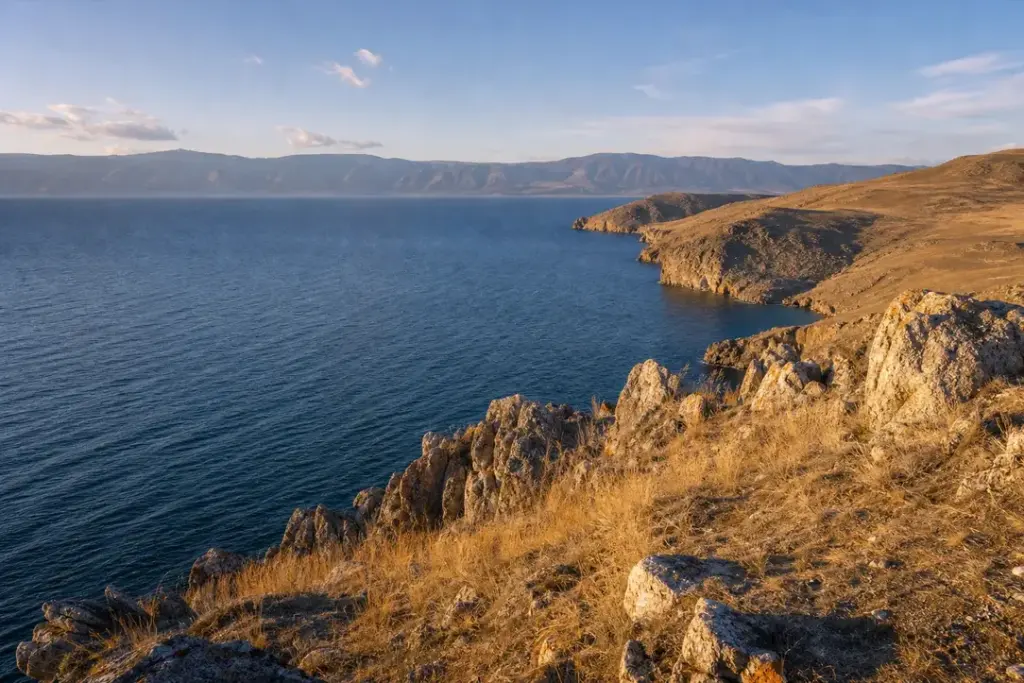
Lake Baikal stretches across southeastern Siberia, with forested mountains, rocky headlands, long beaches and villages scattered around its shores. Recognised as a UNESCO World Heritage Site, it is the world’s deepest lake and one of its oldest. Its unusual freshwater wildlife, including the endemic Baikal seal, makes it as interesting for nature enthusiasts as for travellers seeking open landscapes.
Planning a visit requires choosing a particular part of the lake. Listvyanka is accessible from Irkutsk and offers museums and short excursions. Olkhon Island is known for open steppe, cliffs and traditional Buryat cultural associations. The southern shore has railway history and mountain scenery, while the eastern and northern shores offer quieter natural surroundings. Distances between these areas are considerable. This guide explains what makes each one different and how to plan a manageable first visit.
Quick Facts
| Russian name | Озеро Байкал |
|---|---|
| Best time to visit | Summer is the most practical season for general sightseeing, village visits and many established hiking routes. Longer daylight makes it easier to explore several locations, although the lake water remains cold and exposed paths can be windy.
Autumn brings changing forest colours and potentially quieter travel conditions, but shorter days and worsening weather limit some outdoor plans. Spring is a transitional season when melting ice, muddy trails and changing transport arrangements can complicate travel. Winter attracts visitors for snow and lake ice. Ice formation varies by location, and safe access depends on current conditions rather than a fixed calendar date. Never assume that a visually frozen surface is safe to walk or drive on. Check guidance from local emergency authorities and the relevant protected-area administration. |
| Website | whc.unesco.org/en/list/754 |
Why Visit Lake Baikal?
Lake Baikal offers several experiences that are difficult to combine elsewhere in Russia. Visitors can explore a freshwater ecosystem with species found nowhere else, walk through taiga above the shoreline, travel beside historic railway tunnels and discover landscapes shaped by geological forces over millions of years.
Its appeal changes dramatically with the seasons. Summer opens hiking routes, beaches and boat excursions. Winter transforms sheltered coastal areas with ice formations, although safe access depends on conditions and local restrictions.
Baikal also offers an introduction to Siberian and Buryat cultures through villages, local food and traditions connected with particular natural landmarks. For first-time visitors, the greatest reward comes from choosing one or two areas and spending enough time to appreciate them rather than attempting to circle the entire lake.
Highlights of Lake Baikal
Listvyanka and the Source of the Angara
Listvyanka stands near the southwestern end of Lake Baikal, where the Angara River begins its journey away from the lake. It is one of the most accessible shoreline destinations from Irkutsk and provides a practical first introduction to Baikal. Visitors find a waterfront promenade, small settlements along the shore and views across the water toward the mountains. The nearby Baikal Museum explains the lake's scientific importance and distinctive wildlife. Listvyanka is especially suitable for a short visit, although it also provides a base for longer excursions.
Tip: Visit the museum and the Angara viewpoint before exploring the village's longer waterfront sections.
Olkhon Island and Shamanka Rock
Olkhon is Lake Baikal's largest island, with a combination of dry steppe, pine forests, sandy bays and dramatic rocky shores. The village of Khuzhir is the main visitor base. Nearby Shamanka Rock, also called Cape Burkhan, is a recognisable headland with important associations in local spiritual traditions. Its distinctive twin-peaked outline stands above the Maloye More strait. Visitors can appreciate the landscape from established paths around the headland. Olkhon is a separate journey from Listvyanka rather than a short extension of a village walk.
Tip: Stay in Khuzhir if you want to visit the headland on foot and explore more of the island on another day.
Cape Khoboy
Cape Khoboy marks the northern end of Olkhon Island. Its exposed rocky headlands offer broad views over the open lake and reveal the contrast between Olkhon's comparatively dry landscapes and Baikal's immense surface. The journey from Khuzhir usually involves a dedicated excursion along rough island roads. Visitors should remain on established viewing areas, as the cliffs and loose ground can be hazardous. The cape is part of a protected landscape, and its accessibility depends on the park's current route conditions.
Tip: Treat Cape Khoboy as a separate excursion rather than trying to combine it with a full exploration of southern Olkhon.
Circum-Baikal Railway
The historic Circum-Baikal Railway follows a particularly scenic section of Baikal's southwestern shoreline. Constructed as part of the railway connection around the lake, it passes through tunnels, cuttings and stone structures built into steep coastal terrain. The surviving section near Port Baikal and Slyudyanka is especially interesting for railway enthusiasts and travellers who want to see engineering beside the water. Excursion services and regular transport should not be confused: their schedules, stopping arrangements and availability can differ.
Tip: Choose the exact railway excursion before arranging your accommodation, as the historic line is not a frequent local sightseeing shuttle.
Great Baikal Trail
The Great Baikal Trail initiative has developed and promoted hiking routes around the region. One well-known route links Listvyanka with Bolshie Koty along the western shore. The trail climbs through forest before reaching viewpoints and coastal sections, including narrow paths above steep slopes. Its organising association describes the route as a substantial hike and warns that maintenance funding ended in 2023. Conditions therefore require particular attention, and walkers should not assume all structures are maintained to their former standard.
Tip: Use the trail organisation's route information, check current park access and carry offline navigation rather than relying on occasional trail markings.
Chivyrkuisky Bay and Svyatoy Nos Peninsula
On Baikal's eastern side, Chivyrkuisky Bay is associated with sheltered water, forested shores and the rugged Svyatoy Nos Peninsula. Much of this landscape lies within Zabaykalsky National Park. Compared with the southern tourist settlements, the area requires more deliberate transport planning and offers a stronger emphasis on nature. Visitors may explore designated viewpoints, bays and walking routes where access is permitted. It is best approached as a separate destination on the eastern shore rather than a brief stop during an Irkutsk-based itinerary.
Tip: Use Ust-Barguzin as a practical starting point and confirm the permitted routes with the national park before travelling.
Slyudyanka and the Khamar-Daban Mountains
Slyudyanka is a railway town on Baikal's southern shore, beneath the Khamar-Daban mountain range. It is an important starting point for travellers interested in the region's railway heritage and mountain hikes. The local railway connections make the southern shore accessible without travelling to Olkhon, while the terrain rises sharply away from the lakeside settlements. Routes toward higher ground require suitable equipment and careful assessment of weather conditions. The town also provides an alternative base for travellers who prefer train travel to long road transfers.
Tip: Keep lakeshore sightseeing and demanding mountain hikes on separate days, especially when weather visibility is uncertain.
Baikal's Wildlife and Protected Reserves
Lake Baikal is home to an unusually high proportion of endemic species, including the Baikal seal, known locally as the nerpa. The surrounding protected areas help conserve habitats ranging from open water to forests and mountains. Some destinations have visitor centres and designated routes, while strict nature reserves may allow access only under special arrangements. The Baikal Museum in Listvyanka provides an accessible introduction to the lake's biology before visitors explore the natural environment. Sightings of wild seals cannot be guaranteed.
Tip: Begin with an educational visitor centre if wildlife is your main interest, and do not assume every reserve allows independent entry.
Atmosphere
Baikal’s atmosphere depends on the shoreline. Around Listvyanka, visitors encounter boats, cafés and viewpoints, while the wide water and distant mountains dominate the scene. Olkhon feels more open: dry grassland, pale sandy shores and scattered pine trees frame the lake. On the southern shore, trains and forested hills provide a different character.
The weather can shift quickly, particularly near exposed headlands and mountain slopes. Wind, cold water and long stretches without substantial settlements are defining practical features of the region. In summer, evenings bring softer light across the headlands. Winter may reveal striking patterns in the ice, but the lake remains a natural environment rather than a managed ice attraction. The quietest experiences generally require leaving the main village centres on an appropriate designated route.
History of Lake Baikal
Geological beginnings. Lake Baikal occupies an active continental rift system that developed over millions of years. Geological processes gradually created the deep basin for which the lake is known today. UNESCO describes Baikal as approximately 25 million years old. Its exceptional age and relative isolation have allowed distinctive freshwater species to evolve, giving the lake importance far beyond its geographical setting.
Early communities and cultural traditions. Human settlement around Baikal long predates written records of Russian exploration. Indigenous communities developed ways of living adapted to the surrounding forests, steppe and lake. Buryat cultural traditions remain particularly visible around Olkhon and the eastern shores. Certain rocks and headlands carry spiritual significance, although visitors should distinguish these living traditions from the simplified legends sometimes presented in tourism.
Seventeenth-century expansion. Russian exploration and settlement expanded into the Baikal area during the seventeenth century. Irkutsk was founded in 1661 on the Angara River and later developed into an important regional centre. Trade, settlement and scientific exploration gradually increased the lake’s connections with other parts of Siberia.
Nineteenth-century scientific interest. Naturalists and researchers studied Baikal’s unusual geology, depth and freshwater ecosystems. Scientific expeditions gradually revealed the extent to which its plants and animals differed from those of other lakes. The growth of railway connections also changed the relationship between distant settlements and the lake.
The railway era. Construction of the Trans-Siberian Railway created a major engineering challenge at Baikal. Before a continuous railway connection was completed around the southern shore, trains and freight had to cross the lake by ferry. The Circum-Baikal Railway subsequently provided a connection through difficult coastal terrain, requiring tunnels, bridges and retaining structures. Its surviving historic section is now a distinctive part of the region’s tourism appeal.
Twentieth-century science and conservation. Research institutions expanded the study of Baikal’s water, organisms and geological history. Conservation areas were established around sections of the lake and surrounding landscapes. The Barguzin Nature Reserve, founded in 1916, became an important early protected area in the region. Scientific work also drew attention to environmental pressures on the lake’s ecosystems.
International recognition. In 1996, Lake Baikal was inscribed on the UNESCO World Heritage List for its exceptional freshwater ecosystem, geological history, biodiversity and natural scenery. Recognition reinforced the significance of protecting not only the lake itself but also the surrounding landscapes and habitats.
Modern visitor access. Tourism has developed around established bases such as Listvyanka and Khuzhir, alongside railway excursions, nature trails and protected-area programmes. Access remains uneven around the shoreline. Some places are readily reached by road or train, while others require boats, authorised excursions or longer journeys. The region continues to balance visitor access with conservation requirements and the practical challenges of its climate.
Tickets and Booking for Lake Baikal
Lake Baikal is a region rather than a single ticketed attraction. Most international visitors approach the western and southern shores through Irkutsk, using Irkutsk International Airport or the city’s main railway station. Listvyanka is reached by road, while Slyudyanka has railway connections. Olkhon Island requires a longer journey involving a crossing and onward road transport. Eastern-shore journeys may be organised through Ulan-Ude.
Public transport, excursion trains, boats and seasonal crossings have different operators and availability. Confirm tickets, departure points and operating conditions directly with the relevant official transport provider. Protected national park routes may require separate visitor permits. As of October 2026, Pribaikalsky National Park’s official administration provides permit information through baikal-1.ru, including route-specific restrictions. Check those conditions before arranging excursions or hikes.
How to Get to Lake Baikal
From Irkutsk: Road transport reaches Listvyanka on the southwest shore. Irkutsk also provides rail connections toward Slyudyanka and the southern lakeshore. For Olkhon Island, travel by road toward the island crossing and continue to Khuzhir; the crossing and road conditions can significantly affect the journey.
From Ulan-Ude: The eastern shore can be approached by road or rail, depending on the destination. Ust-Barguzin is a gateway for the Chivyrkuisky Bay area.
Getting around: Lake Baikal has no unified urban transport network. Villages, trailheads, rail stations and boat landings are separated by considerable distances. Use local road transport, trains, authorised boat services and walking routes according to the area selected. There is no metro system around the lake. Plan journeys separately rather than assuming direct connections between opposite shores.
Accessibility
Accessibility differs significantly between Baikal destinations. Listvyanka offers road access and relatively straightforward short visits, but parts of its waterfront and surrounding paths may have uneven surfaces or steps. Museum access should be checked directly with the institution before visiting.
Olkhon Island and remote shorelines are more challenging. Unpaved roads, rough walking paths, beaches and cliffs can make independent travel difficult for wheelchair users or visitors with limited mobility. Boat landings and vehicles may not provide step-free access.
For accessible travel, choose a defined village base and confirm the suitability of accommodation, transfers and individual attractions. The entire lake region cannot be described as uniformly accessible.
Food Nearby
Food options are concentrated in established settlements rather than along remote shorelines. Listvyanka has cafés and restaurants serving visitors, and Khuzhir offers dining options associated with its guesthouses and village centre. Slyudyanka and other railway settlements provide additional choices, although availability varies.
Regional food commonly includes Buryat buuzy, meat dishes, soups and fish preparations. Baikal omul is strongly associated with local cuisine, but visitors should check current legal sourcing and conservation restrictions rather than assuming all fish offered for sale has been obtained lawfully.
In remote hiking areas, carry your own food and sufficient drinking water. Do not rely on restaurants or shops being available at isolated viewpoints and trailheads.
What to Bring
Bring clothing suitable for rapidly changing temperatures, including a windproof outer layer even in summer. Comfortable walking shoes with good grip are useful on rocky shores, forest paths and uneven village roads.
Carry drinking water, basic first-aid supplies, insect protection and a power bank when exploring beyond the main settlements. Offline maps are especially useful where mobile reception is inconsistent. For longer hikes, add weather-appropriate equipment and let someone know your route.
Winter travel requires properly insulated footwear and clothing suited to severe cold. Follow local safety instructions for snow, ice and exposed landscapes.
Photography Rules
Landscape photography is a major attraction, particularly around Olkhon, Listvyanka and the southern shoreline. In protected areas, follow the administration's rules on permitted routes and equipment. Drone use may require separate authorisation and is subject to local airspace restrictions. Do not assume that recreational drone flights are permitted simply because an area is remote. Respect cultural sites and avoid approaching wildlife for photographs.
Family Suitability
Lake Baikal can be rewarding for families, especially when the itinerary focuses on accessible settlements rather than demanding hikes. Listvyanka is a practical introduction because children can combine lake views with a visit to the Baikal Museum.
Olkhon offers beaches and memorable landscapes, but long transfers, rough roads and exposed cliffs require careful planning. Young children should be supervised closely around the water and steep ground.
For a family trip, minimise hotel changes and include flexible days for weather. Remote hikes and winter ice excursions are not automatically suitable for children; suitability depends on the route, conditions and professional supervision.
Russia Vibes Tips
- Plan around one shore first. Listvyanka and Olkhon are both associated with Irkutsk, but they are not neighbouring attractions and cannot be explored like districts of one city.
- Check whether a village, beach or trail lies inside a protected area. A place can be freely approached by road while the surrounding designated nature route requires a separate permit.
- For an Olkhon trip, avoid scheduling a long island excursion immediately before an important flight or train connection. Crossing arrangements and roads can introduce unpredictable delays.
- Treat Baikal hiking routes according to their actual terrain, not their scenic descriptions. Even popular trails may contain steep climbs, loose stones and exposed sections.
- Use different bases for different experiences: Listvyanka for an introduction and museum visits, Khuzhir for Olkhon, and Slyudyanka for southern-shore railway and mountain trips.
- Look at the direction of the shoreline before planning sunset photography. A viewpoint facing west offers a different experience from an exposed eastern-facing coast.
Explore Nearby Lake Baikal
Related guides
 Listvyanka Day Trip, Irkutsk: Getting to Lake Baikal and Back
Main image: AI-generated illustration. It may not show the place exactly as it looks.
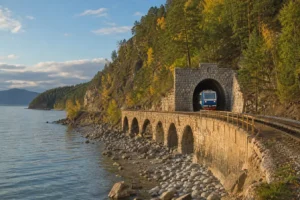 Circum-Baikal Railway Day Trip, Irkutsk: Tunnels and Lake Views
Main image: AI-generated illustration. It may not show the place exactly as it looks.
 Shashlyk: How to Make Russian Grilled Meat Skewers
Main image: AI-generated illustration. It may not show the place exactly as it looks.
 Tea culture with milk and salt, Irkutsk: How to brew and taste the Buryat tradition
Main image: AI-generated illustration. It may not show the place exactly as it looks.
Browse more: All Cities · All Lake Baikal · All Natural Regions
FAQ: Lake Baikal
Is Lake Baikal a city or a region?
Lake Baikal is a large freshwater lake and surrounding natural travel region, not a city. It spans parts of Irkutsk Oblast and the Republic of Buryatia. Visitors usually stay in separate towns or villages such as Listvyanka, Khuzhir or Slyudyanka. Each area has its own transport arrangements, accommodation and excursions.
How many days should I spend at Lake Baikal?
A short visit can introduce the lake through Listvyanka and nearby attractions. A longer stay allows time for Olkhon or the southern shore without rushing major transfers. Combining western and eastern shores requires additional travel days. Choose the duration according to the specific places you intend to visit rather than treating the entire lake as one destination.
Can you visit Lake Baikal without a guided tour?
Yes. Settlements such as Listvyanka and Slyudyanka can be visited independently, and some established walking routes can be undertaken without a guide. However, certain protected areas require permits, while stricter reserves allow only authorised visits. Remote terrain, changing weather and limited transport make guided arrangements more practical for some destinations.
Do you need a ticket to visit Lake Baikal?
There is no single admission ticket for Lake Baikal. Museums, excursions, transport and designated protected-area routes have separate arrangements. Some nature areas require visitor permits even when there is no conventional entrance gate. Check the booking section and the official administration responsible for your chosen destination before travelling.
Can you swim in Lake Baikal?
Swimming is possible in some suitable lakeside areas during warmer periods, but Baikal is a very cold freshwater lake and conditions vary substantially. Sheltered bays may feel different from exposed open-water beaches. Avoid unfamiliar depths, strong currents and hazardous shorelines. Do not assume that a popular beach is supervised by lifeguards.
When does Lake Baikal freeze?
The timing of freezing varies across the lake and changes from season to season. Sheltered areas may freeze before deeper or more exposed sections, while the southern lake and the Angara outflow can behave differently. Ice appearance alone does not establish safety. Follow current local emergency guidance and use only routes confirmed as suitable.
Where should first-time visitors stay at Lake Baikal?
Listvyanka is convenient for travellers approaching from Irkutsk who want museums and relatively straightforward sightseeing. Khuzhir suits visitors focused on Olkhon Island, while Slyudyanka is useful for railway and mountain interests. The best choice depends on the intended itinerary: staying in one location does not provide easy access to every part of Baikal.
Can I see Baikal seals in the wild?
Baikal seals are native to the lake, but wild sightings are unpredictable and depend on location, season and conditions. Some areas associated with seal habitats are protected or difficult to reach. The Baikal Museum offers an introduction to the species and its ecology. Never approach, disturb or attempt to feed wild animals.
Russia Vibes is a one-person project. A coffee keeps it going
How we research and update our guides
About this guide: AI assistance and accuracy
This guide is created with the help of AI and is based on official sources where available. Mistakes can still happen. Opening hours, prices, rules and other details are given to the best of our knowledge as of the date shown and can change without notice. It offers general recommendations only, not professional, legal or travel advice. Please confirm important details with the official source before you travel; you are responsible for your own plans and decisions.
Packing for this trip
* Affiliate link: as an Amazon Associate we earn from qualifying purchases at no extra cost to you.

Take this guide with you
Get a free PDF of this guide to print or read offline: key facts, tips and a map link on a few clean pages.
Report an issue on this page
Paying for your trip: please read
International sanctions affect payments between Russia and many other countries. In practice, cards issued in the EU, the UK, the US and several other countries often do not work in Russia, Russian cards usually do not work abroad, and some booking platforms, airlines and payment providers limit or suspend their services for Russia. The situation changes frequently.
We do not give legal or financial advice, and this site does not encourage anyone to break or circumvent sanctions. Whatever you plan, you are responsible for following the laws and regulations that apply to you, including those of your country of residence and citizenship.
Many travelers still organise their stay lawfully. It is worth asking your bank or payment provider what is currently permitted, contacting hotels, tour operators and carriers directly about the payment methods they accept, and checking which services are open to customers from your country. Clarify payment, cancellation and refund terms before you commit to a booking, and keep your plans flexible.
Partner links on this site may not be available in every country, and prices, availability and rules in our guides can differ from what you see when you book.