
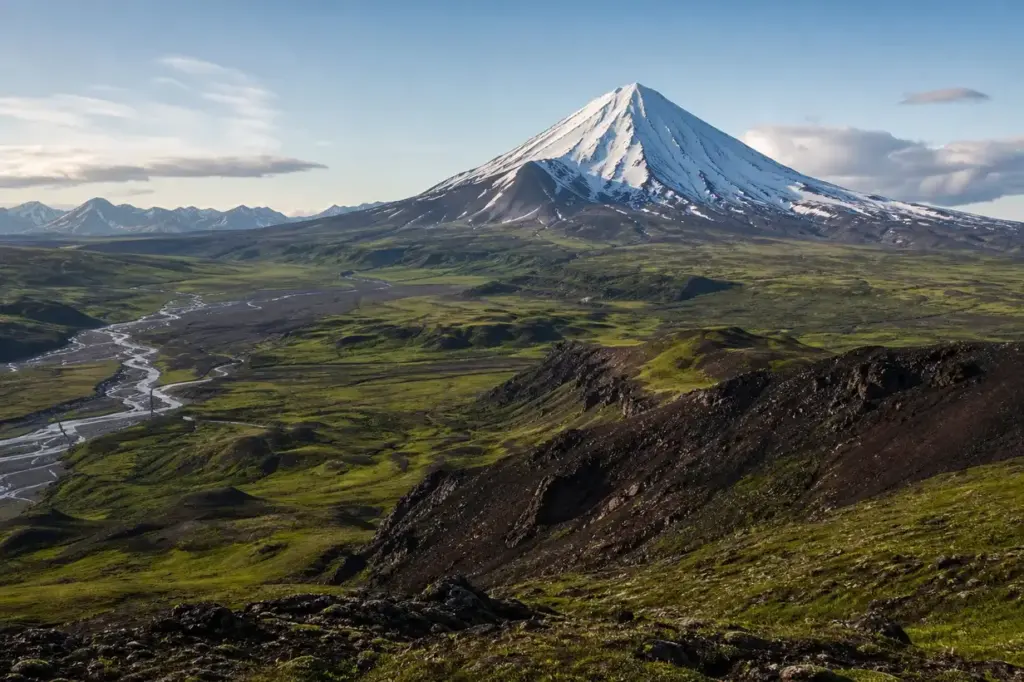
The Kamchatka Peninsula stretches into the North Pacific in Russia’s Far East, where active volcanoes rise above forests, rivers, glaciers and broad coastal landscapes. Its defining features are volcanic mountains, geothermal activity and extensive wilderness. The peninsula is also known for Pacific salmon, brown bears, seabirds and distinctive marine environments.
Most visitors begin in Petropavlovsk-Kamchatsky or nearby Yelizovo, the principal arrival area. From there, excursions lead to volcanic slopes, black-sand beaches, hot springs and Avacha Bay. Farther destinations such as the Valley of Geysers, Kurile Lake and the Klyuchevskoy volcanic group require considerably more organisation. Kamchatka is not a conventional road-trip destination: relatively few roads serve its enormous territory, and many attractions depend on specialist vehicles, helicopters or multi-day expeditions. Travellers should plan geographical areas carefully, allow flexibility for weather and distinguish accessible excursions from protected wilderness that requires formal arrangements.
Current access notice: As of October 2026: The Kamchatka tourism authority's update of October 21 reported that Klyuchevskoy Nature Park routes had closed for the winter season. Routes in Nalychevo, South Kamchatka and Bystrinsky nature parks were also affected by temporary weather-related closures. Visitors were advised not to approach Bezymianny, Klyuchevskoy, Shiveluch, Krasheninnikov or Mutnovsky volcanoes because of volcanic hazards. These conditions may change; consult the regional tourism authority and the relevant park before travel.
Quick Facts
| Russian name | Полуостров Камчатка |
|---|---|
| Best time to visit | Summer, particularly July through September, is generally the most practical period for a first visit focused on hiking, volcanic landscapes and organised nature excursions. Conditions vary according to altitude, location and recent weather.
Early autumn can offer attractive landscape colours and clearer mountain views, although colder temperatures and snowfall become more likely in elevated areas. Autumn weather may also disrupt remote access. Winter transforms the peninsula into a snow-covered environment suited to specialist outdoor activities. Some routes and parks are inaccessible, and travelling independently becomes considerably more demanding. Spring is a transitional period when snow cover, thawing ground and changing weather can complicate road access. Whatever the season, volcanoes and mountain excursions require current local safety information rather than reliance on typical seasonal patterns. |
| Website | visitkamchatka.ru |
Why Visit Kamchatka Peninsula?
Kamchatka offers an unusual combination of accessible volcanic scenery and genuinely remote natural landscapes. Around Petropavlovsk-Kamchatsky, visitors can see the Avachinsky and Koryaksky volcanoes, explore the Pacific shoreline and arrange guided mountain excursions.
Farther inland, volcanic plateaus contain lava fields, craters and geothermal features. The UNESCO-listed Volcanoes of Kamchatka property protects separate areas of exceptional geological and ecological importance.
The peninsula also supports remarkable wildlife, including brown bears, salmon and marine mammals. Wildlife observation is particularly associated with protected areas such as Kurile Lake and coastal reserves.
For travellers interested in photography, geology, hiking and nature, Kamchatka offers experiences that differ considerably from Russia’s better-connected destinations. The main limitation is not the number of attractions, but the difficulty of reaching them safely.
Highlights of Kamchatka Peninsula
Avachinsky and Koryaksky Volcanoes
Avachinsky and Koryaksky are the prominent volcanoes visible from the Petropavlovsk-Kamchatsky and Yelizovo area. Avachinsky is an active stratovolcano with a recognisable cone, while neighbouring Koryaksky rises into a steep, frequently snow-covered summit. Their slopes create the characteristic mountain skyline of southern Kamchatka. Guided excursions may reach the Avachinsky Pass area when weather, roads and volcanic conditions permit. A view of the volcanoes from town should not be confused with a summit ascent, which requires substantially greater preparation and suitable conditions.
Tip: For a first encounter with Kamchatka's volcanoes, choose an established lower-elevation excursion before considering a demanding ascent.
Valley of Geysers
The Valley of Geysers lies within Kronotsky Nature Reserve and contains geothermal features including geysers, hot springs, steaming ground and mineral deposits. The valley was discovered scientifically in 1941 and later became one of Kamchatka's best-known natural attractions. Its landscape was significantly altered by a landslide in 2007. Visitor access is tightly managed, with authorised excursions generally involving helicopter transport and designated routes. The valley is not reachable by an ordinary road trip, and its fragile geothermal environment requires visitors to remain within permitted areas.
Tip: Treat the Valley of Geysers as a weather-dependent specialist excursion rather than a guaranteed activity on a fixed day.
Kurile Lake and Brown Bear Watching
Kurile Lake occupies a volcanic caldera in southern Kamchatka and forms part of the South Kamchatka Federal Wildlife Sanctuary. The lake is associated with major sockeye salmon runs that attract brown bears during the warmer season. Authorised wildlife excursions allow visitors to observe this natural relationship under controlled conditions. The surrounding landscape includes volcanic slopes and the distinctive cone of Ilyinsky Volcano. Kurile Lake should not be confused with the Kuril Islands farther south, despite the similar names. Access arrangements are separate from those for ordinary regional nature parks.
Tip: Choose an authorised wildlife excursion with experienced guides. Brown bears are wild animals, and sightings must never depend on approaching or feeding them.
Khalaktyrsky Beach
Khalaktyrsky Beach stretches along the Pacific coast east of Petropavlovsk-Kamchatsky and is known for dark volcanic sand and an exposed ocean setting. The contrast between the black shoreline, breaking waves and distant volcanic mountains makes it one of the more accessible coastal landscapes in southern Kamchatka. Conditions differ from a sheltered swimming beach: powerful surf, cold water and changing coastal weather require caution. Many visitors come primarily for walking, landscape observation and photography rather than swimming.
Tip: Dress for wind even during summer. The beach is exposed to Pacific weather and can feel considerably colder than sheltered inland locations.
Mutnovsky and Gorely Volcanic Area
The Mutnovsky and Gorely volcanoes occupy a volcanic landscape south of Petropavlovsk-Kamchatsky. Mutnovsky is associated with fumaroles, geothermal activity and rugged volcanic terrain, while Gorely is known for its crater system and lava-shaped surroundings. These destinations are often discussed together because they lie within the same broad excursion area. However, their routes, access conditions and volcanic hazards differ. Activity around Mutnovsky has created serious safety concerns, and visitors should not assume that previously described hiking routes remain accessible.
Tip: Check the regional tourism authority's latest volcanic safety notices before booking either excursion. A route advertised in an older travel account may no longer be appropriate.
Avacha Bay and Pacific Marine Wildlife
Avacha Bay is the large natural harbour associated with Petropavlovsk-Kamchatsky. Its sheltered waters are surrounded by steep coastal terrain, with the Three Brothers rock formations marking a recognisable landmark near the entrance. Boat excursions may continue towards the Pacific coast and areas used by seabirds and marine mammals. The scenery combines volcanic mountains, ocean cliffs and working maritime landscapes. Boat routes vary according to conditions, and marine wildlife sightings depend on season and natural behaviour rather than fixed schedules.
Tip: Choose a marine excursion according to its actual route and duration. Harbour sightseeing and longer wildlife trips offer noticeably different experiences.
Klyuchevskaya Sopka and the Central Volcanoes
Klyuchevskaya Sopka rises above the central Kamchatka landscape and is the highest active volcano in Eurasia. It forms part of a volcanic group that includes Bezymianny and other major peaks within Klyuchevskoy Nature Park. The area contains lava fields, volcanic deposits and mountain scenery shaped by repeated eruptions. Travellers may approach the wider region through settlements such as Klyuchi, but reaching particular volcanic landscapes requires specialist planning. The central volcanic group is geographically distant from the usual Petropavlovsk-Kamchatsky excursions.
Tip: Do not plan an ascent or approach to an active volcano based solely on its normal tourist reputation. Eruption activity can change the safety situation rapidly.
Tolbachik Volcano and Lava Fields
The Tolbachik volcanic complex is known for broad volcanic slopes, eruption craters and extensive lava landscapes. The major eruption of 1975–1976 and the eruption that began in 2012 left distinctive geological features, including lava flows and areas of damaged forest. The contrast between dark volcanic rock, surviving trees and distant mountain ridges gives the landscape a striking appearance. Reaching Tolbachik typically involves long overland travel and specialist vehicles. It is better approached as part of a multi-day expedition than as a short excursion from the regional capital.
Tip: Allow flexibility in any Tolbachik itinerary. Long road approaches and volcanic terrain make the destination particularly sensitive to weather and transport conditions.
Esso and Bystrinsky Nature Park
Esso is a settlement in central Kamchatka associated with the Bystrinsky district and its cultural traditions. The surrounding landscape includes forested mountains, rivers and protected natural areas. Bystrinsky Nature Park forms part of the UNESCO-listed Volcanoes of Kamchatka property and represents a different environment from the coastal volcanic areas farther south. The district is also associated with Even and other Indigenous cultural traditions, which can be explored through appropriate local cultural institutions and organised experiences.
Tip: Consider Esso as a separate inland destination rather than adding it casually to a short stay near Petropavlovsk-Kamchatsky.
Atmosphere
Kamchatka’s atmosphere changes sharply between its inhabited southern corridor and the remote interior. Petropavlovsk-Kamchatsky has ordinary city streets, shops, residential districts and an active waterfront, yet large volcanic cones dominate the horizon.
Outside the city, roads lead towards open tundra, birch woodland, thermal areas and expansive volcanic slopes. Mountain weather can change quickly, with cloud suddenly obscuring summits that were clearly visible earlier.
Along the Pacific shore, surf and wind dominate the soundscape. Inland, geothermal steam, rocky terrain and broad river valleys give the landscape a different character.
Excursions often begin early because conditions can deteriorate later in the day. In the remote protected areas, organised travel and careful attention to the natural environment are essential parts of the experience.
History of Kamchatka Peninsula
Early settlement and Indigenous cultures
Human communities inhabited Kamchatka long before the arrival of written historical records. Archaeological evidence points to longstanding relationships between coastal and riverine settlements and the peninsula’s abundant marine and freshwater resources. Fishing, hunting and the seasonal movement of animals played important roles in local life.
The peninsula is associated with several Indigenous peoples, including the Itelmen, Koryak and Even. Their historical livelihoods and cultural practices developed in different environments, from coastal settlements to inland valleys. Traditional knowledge concerning salmon, marine mammals, reindeer and seasonal conditions remains an important part of Kamchatka’s cultural heritage.
Exploration and mapping
During the late seventeenth century, Russian expeditions began documenting the Kamchatka Peninsula more systematically. Vladimir Atlasov’s expedition of 1697 is a major landmark in the recorded history of Russian exploration of the area.
In the eighteenth century, expeditions connected with Vitus Bering and other explorers expanded geographical knowledge of the North Pacific. The Second Kamchatka Expedition included significant scientific and cartographic work.
Petropavlovsk-Kamchatsky traces its founding to 1740, when expedition vessels named Saint Peter and Saint Paul reached the area. The settlement developed around the sheltered waters of Avacha Bay.
Scientific exploration
Kamchatka became increasingly important to naturalists studying volcanic landscapes, plants, wildlife and the peoples of northeastern Asia. Stepan Krasheninnikov, who participated in the broader eighteenth-century scientific investigations, produced a major early account of Kamchatka’s natural environment and inhabitants. His work was published in 1755.
Scientific exploration gradually established the peninsula’s importance for understanding active volcanism, geothermal activity and northern Pacific ecosystems.
Volcanology and nature conservation
The twentieth century brought the development of systematic volcanic monitoring. The Institute of Volcanology was established in Petropavlovsk-Kamchatsky in 1962, strengthening research into active volcanoes and associated geological processes.
Kronotsky Nature Reserve, established in 1934, became an important centre of wildlife and ecosystem conservation. In 1941, Tatyana Ustinova and Anisifor Krupenin discovered the Valley of Geysers during research in the reserve.
The Tolbachik eruption of 1975–1976 attracted considerable scientific attention, providing opportunities to study volcanic processes in detail.
International recognition
In 1996, the Volcanoes of Kamchatka were added to the UNESCO World Heritage List. The designation recognised the geological diversity, active volcanoes and ecological importance of several protected areas.
The World Heritage property was expanded in 2001 to include Klyuchevskoy Nature Park, creating a broader protected network that covers different volcanic and natural environments across the peninsula.
Modern Kamchatka
Today, Kamchatka combines scientific research, conservation, fishing traditions and nature tourism. The region’s main visitor attractions include volcanoes, geothermal landscapes, coastal wildlife and protected wilderness.
Modern volcanic monitoring remains essential because eruptions, ash emissions, earthquakes and landslides can alter travel conditions. The peninsula’s protected areas continue to balance scientific research, ecosystem conservation and carefully managed public access.
Tickets and Booking for Kamchatka Peninsula
Arriving by air: Petropavlovsk-Kamchatsky is served by the airport at Yelizovo. The airport is the main gateway for visitors travelling to the peninsula and connects with the regional capital by road. Transfers generally use taxis, arranged transport or local services.
Onward travel: Petropavlovsk-Kamchatsky and Yelizovo are the most practical bases for initial sightseeing. Specialist mountain excursions often involve organised road transport, while remote protected destinations may require helicopters or multi-day expeditions.
The peninsula has no railway connection to the rest of Russia, and there is no conventional overland passenger route connecting it with the country’s principal railway network.
Confirm flight schedules and ticket arrangements with the official airline or airport operator. For protected areas, verify current visitor permissions, route availability and transport arrangements directly with the managing institution.
How to Get to Kamchatka Peninsula
By air: Flights to Yelizovo provide the principal passenger connection to Kamchatka. Travellers normally reach Petropavlovsk-Kamchatsky from the airport by road.
From Moscow: Air travel is the practical long-distance approach. Flight availability and routing vary and should be checked directly with operating airlines.
Within the region: Public transport connects the main inhabited settlements in southern Kamchatka, but it does not provide practical access to most remote natural attractions.
By organised excursion: Specialist vehicles are used for many volcanic routes, while helicopter excursions serve certain remote locations. Boat trips operate in Avacha Bay and coastal areas according to weather and seasonal conditions.
Planning distances: Do not assume that places appearing relatively close on a map are easily connected. Rivers, mountains, limited roads and protected-area restrictions can make apparently short journeys complicated.
Accessibility
Accessibility is highly dependent on the chosen destination. Petropavlovsk-Kamchatsky and Yelizovo offer the most practical bases for travellers who require accessible accommodation or transport, although facilities must be checked individually.
Natural attractions frequently involve uneven volcanic ground, snow, steep gradients or unprepared paths. Specialist off-road vehicles and helicopter boarding may create additional limitations for travellers with reduced mobility.
Some coastal viewpoints and urban attractions can be experienced without demanding hikes, depending on local ground conditions and available transport. Travellers should request detailed information about boarding, walking distances, steps and assistance directly from their excursion provider. Accessibility arrangements cannot be assumed to be consistent across protected areas.
Food Nearby
Petropavlovsk-Kamchatsky and Yelizovo provide the most practical choice of restaurants, cafés and food shops. Kamchatka's food culture is closely connected with the Pacific Ocean and the region's salmon-rich rivers.
Visitors may encounter Pacific salmon, fish soup, seafood dishes and preparations using locally available fish. Regional menus may also include crab and other seafood, depending on supply and season.
In smaller settlements, dining options are more limited. Remote excursions often involve meals arranged by the tour organiser rather than visits to restaurants.
For extended journeys outside inhabited areas, confirm what food and drinking water are provided. Do not assume that supplies can be purchased near remote trailheads or protected landscapes.
What to Bring
Bring waterproof and wind-resistant clothing, warm layers and sturdy footwear suitable for uneven ground. Kamchatka's coastal and mountain weather can be cold and unpredictable even during summer.
A hat, gloves, sun protection and a power bank are useful for excursions. For outdoor travel, carry sufficient drinking water, suitable food and a basic first-aid kit.
Download offline maps before leaving inhabited areas, but do not rely on mobile navigation as your only safety measure.
Remote excursions require equipment appropriate to their specific route. Brown-bear safety procedures, group equipment and emergency communication should be discussed with an experienced guide. Follow the equipment and visitor rules of protected areas.
Photography Rules
Photography at public viewpoints is generally possible, but protected areas and organised excursions may impose additional restrictions. Drone operations require confirmation of applicable aviation and local rules. Do not launch drones near active volcanic hazards, wildlife concentrations or restricted areas without authorisation. Respect safety barriers and designated routes when photographing geothermal features.
Family Suitability
Kamchatka can be rewarding for families when activities are selected carefully. Petropavlovsk-Kamchatsky, accessible coastal viewpoints, museums and suitable guided excursions provide a practical introduction to the peninsula.
Long mountain journeys, demanding volcanic hikes and remote wildlife expeditions are not appropriate for every age group. Children may find extended off-road transfers tiring, and some routes involve steep or unstable terrain.
Families should prioritise reliable transport, accommodation with suitable facilities and flexible schedules. Bear safety and weather protection require particular attention. Excursion providers should confirm age recommendations and the physical demands of their routes before bookings are made.
Russia Vibes Tips
- Use Petropavlovsk-Kamchatsky or Yelizovo as the starting base for a first journey. The central and northern volcanic districts are better treated as separate expedition areas rather than ordinary day trips.
- Plan at least one flexible day around major helicopter or mountain excursions. Weather can affect visibility and flying conditions even when the departure area appears clear.
- Learn the difference between viewing a volcano and climbing it. Kamchatka has excellent lower-elevation landscapes where volcanic scenery can be appreciated without attempting a summit.
- Choose accommodation based on where your excursions depart. A hotel in the centre of Petropavlovsk-Kamchatsky may not be equally convenient for every activity.
- Expect substantial differences between coastal weather and conditions in elevated volcanic areas. A clear morning beside Avacha Bay does not guarantee similar conditions on a mountain pass.
- When comparing excursions, look beyond the destination name. Two tours advertised for the same volcano may differ greatly in walking requirements, approach routes and the landscape they actually visit.
Explore Nearby Kamchatka Peninsula
Browse more: All Cities · All Kamchatka Peninsula · All Regions & Nature
FAQ: Kamchatka Peninsula
Is the Kamchatka Peninsula a city or a region?
The Kamchatka Peninsula is a large geographical landmass in Russia's Far East, not a city. Petropavlovsk-Kamchatsky is the main urban centre and usual arrival base. The wider Kamchatka Krai administrative region also includes territories beyond the peninsula. Visitors should distinguish the geographical peninsula from individual nature parks, settlements and protected areas.
How many days do you need in Kamchatka?
Seven to ten days allows a first-time visitor to explore the southern area around Petropavlovsk-Kamchatsky, enjoy selected volcanic excursions and consider a marine or specialist nature trip. Longer journeys are advisable for remote destinations such as Tolbachik or the central volcanic region. It is important to leave room for weather-related changes rather than filling every day with inflexible activities.
Can you travel around Kamchatka independently?
Independent travel is practical around the main urban settlements and selected public areas. Reaching remote volcanic landscapes is substantially more complicated because of limited roads, difficult terrain and changing natural hazards. Organised excursions are useful for places requiring specialist transport, protected-area arrangements or mountain experience. A self-drive vehicle alone does not guarantee access to wilderness destinations.
Can you see active volcanoes without climbing them?
Yes. Several of Kamchatka's major volcanic peaks can be viewed from inhabited areas, public viewpoints and appropriately organised excursions. Avachinsky and Koryaksky are especially visible around the southern urban corridor when skies are clear. Scenic viewpoints can provide excellent experiences without the physical demands or hazards associated with summit routes.
Is the Valley of Geysers accessible by road?
No. The Valley of Geysers lies in Kronotsky Nature Reserve and is normally visited through authorised specialist excursions involving air transport. Access is governed by the reserve's visitor arrangements and can be affected by weather or natural conditions. It is not a destination that travellers can simply reach by driving from Petropavlovsk-Kamchatsky.
Are brown bears commonly seen in Kamchatka?
Kamchatka supports substantial brown bear populations, and the animals inhabit many natural environments across the peninsula. Observing them is a specialist wildlife activity, particularly around salmon rivers and protected areas. Sightings cannot be guaranteed, and visitors should never attempt to approach bears independently for photographs. Experienced guides and appropriate safety procedures are especially important.
Do you need permits to visit Kamchatka's volcanoes?
Some volcanoes and surrounding routes lie within protected natural areas where permits, designated routes or additional visitor conditions apply. Requirements depend on the exact destination rather than on the peninsula as a whole. As of October 2026, travellers should verify the relevant regulations with the responsible park administration and regional authorities. Conditions may change because of volcanic activity or weather.
What is the difference between Kamchatka and the Kuril Islands?
Kamchatka is a peninsula extending south from the Russian Far East, while the Kuril Islands form a separate island chain stretching towards Hokkaido. Both regions have volcanic landscapes, but their geography, transport connections and visitor arrangements are different. A trip to Kamchatka does not automatically include the Kuril Islands, which require separate travel planning.
Russia Vibes is a one-person project. A coffee keeps it going
How we research and update our guides
About this guide: AI assistance and accuracy
This guide is created with the help of AI and is based on official sources where available. Mistakes can still happen. Opening hours, prices, rules and other details are given to the best of our knowledge as of the date shown and can change without notice. It offers general recommendations only, not professional, legal or travel advice. Please confirm important details with the official source before you travel; you are responsible for your own plans and decisions.
Packing for this trip
* Affiliate link: as an Amazon Associate we earn from qualifying purchases at no extra cost to you.

Take this guide with you
Get a free PDF of this guide to print or read offline: key facts, tips and a map link on a few clean pages.
Report an issue on this page
Paying for your trip: please read
International sanctions affect payments between Russia and many other countries. In practice, cards issued in the EU, the UK, the US and several other countries often do not work in Russia, Russian cards usually do not work abroad, and some booking platforms, airlines and payment providers limit or suspend their services for Russia. The situation changes frequently.
We do not give legal or financial advice, and this site does not encourage anyone to break or circumvent sanctions. Whatever you plan, you are responsible for following the laws and regulations that apply to you, including those of your country of residence and citizenship.
Many travelers still organise their stay lawfully. It is worth asking your bank or payment provider what is currently permitted, contacting hotels, tour operators and carriers directly about the payment methods they accept, and checking which services are open to customers from your country. Clarify payment, cancellation and refund terms before you commit to a booking, and keep your plans flexible.
Partner links on this site may not be available in every country, and prices, availability and rules in our guides can differ from what you see when you book.