
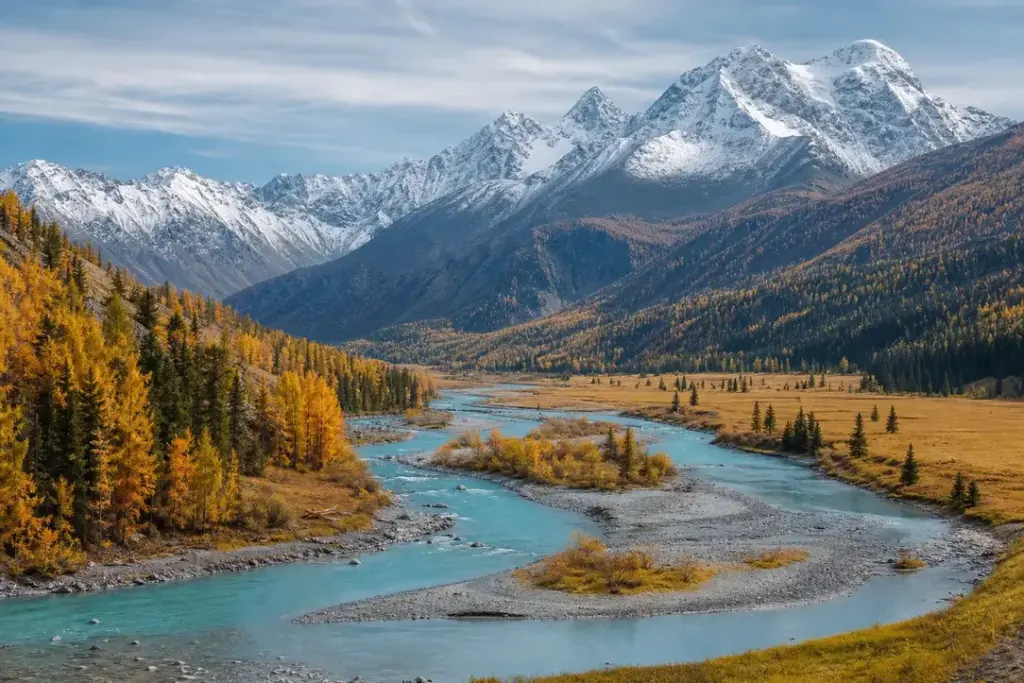
The Altai Mountains stretch across southern Siberia and neighbouring parts of Central Asia, creating a landscape of forested valleys, open steppe, snow-covered peaks and glacier-fed rivers. The Russian section is best explored through the Altai Republic, where the Chuysky Trakt highway connects accessible holiday areas with increasingly remote mountain scenery.
This is a region rather than a single city. Gorno-Altaysk serves as a practical starting point, while Chemal, Lake Teletskoye, Aktash and Ust-Koksa offer very different experiences. Travellers can follow scenic roads, visit archaeological sites, take short nature walks or arrange longer expeditions into protected mountain country. The UNESCO-listed Golden Mountains of Altai cover three separate protected areas, not the entire mountain range. Distances are substantial, and a successful journey depends on choosing one or two geographical areas instead of trying to see everything.
Quick Facts
| Russian name | Алтайские горы |
|---|---|
| Best time to visit | Summer is the most practical season for a first visit to the Altai Mountains. June through August generally offers better conditions for road trips, lakeside stays and many established hiking routes, although mountain weather remains unpredictable.
Early autumn can bring clear air, changing forest colours and attractive photography conditions. September is especially appealing along accessible road corridors, but colder nights and early mountain snowfall become increasingly important. Spring is a transitional season, with melting snow, changing river levels and variable trail conditions. Winter transforms the region into a snow-covered landscape suited to specialist activities and carefully organised travel. High passes, remote roads and exposed mountain routes require particular caution outside the warmer season. |
| Website | altai.travel |
Why Visit Altai Mountains?
The main attraction is the variety of landscapes encountered during a single journey. The lower Katun Valley offers pine forests, river viewpoints and comfortable tourist bases. Farther southeast, the Chuysky Trakt crosses high passes and enters open valleys framed by snowy ridges.
Lake Teletskoye provides a different experience, with forested slopes rising directly above deep water. The Belukha area attracts experienced trekkers, while the Ukok Plateau is suited to carefully organised remote expeditions.
The region also preserves evidence of ancient communities, including burial mounds, rock carvings and archaeological discoveries associated with the Pazyryk culture. Visitors interested in landscapes, photography, archaeology and independent road travel will find considerably more to explore than a conventional sightseeing itinerary allows.
Highlights of Altai Mountains
Chuysky Trakt Scenic Highway
The Chuysky Trakt is the principal road corridor through the Russian Altai, connecting the northern foothills with the mountainous southeast. Travelling along it reveals a sequence of river valleys, forested slopes, high passes and increasingly open landscapes. Two memorable crossings are Seminsky Pass and Chike-Taman Pass. Farther southeast, the road approaches the North Chuya Range, where snow-covered peaks form a striking backdrop. The journey is best treated as a destination in itself rather than simply transport between attractions.
Tip: Allow extra time for the section beyond Onguday. Several worthwhile viewpoints are spread along the road, and stopping frequently is part of the experience.
Katun River and Chemal Valley
The Katun is one of the defining rivers of the Altai, flowing from the high mountains through narrow gorges and wider valleys. Around Chemal, visitors find riverside paths, viewpoints and tourist accommodation. The small rocky island of Patmos, reached by a suspension bridge, contains a wooden Orthodox church. Nearby, the meeting of the Chemal and Katun rivers offers views of contrasting water colours under suitable conditions. This part of the Altai is particularly suitable for visitors seeking mountain scenery without committing to a long wilderness expedition.
Tip: Walk the river paths rather than relying exclusively on roadside viewpoints. The changing perspective reveals the shape of the valley much more clearly.
Lake Teletskoye
Lake Teletskoye lies in the northeastern Altai, surrounded by steep forested mountains. Its shores form part of a landscape connected with the UNESCO-listed Golden Mountains of Altai. Artybash and Iogach are practical bases near the northern end of the lake. In the warmer season, boat excursions provide access to views and waterfalls that cannot all be reached easily by road. The protected Altaisky Nature Reserve occupies part of the surrounding area, and its visitor routes have separate access requirements.
Tip: Stay near Artybash for an easier introduction to the lake. Confirm boat arrangements locally, since wind and lake conditions can affect excursions.
Mount Belukha and the Katun Range
Mount Belukha is the highest mountain in the Altai range and one of its most recognisable natural landmarks. Its snowy summit rises above glaciers, mountain rivers and remote valleys. The surrounding landscape forms part of the UNESCO-listed protected area associated with the Katunsky Nature Reserve. Reaching the mountain's trekking areas generally requires a multi-day expedition rather than a casual day trip. Visitors should distinguish the protected reserve from neighbouring travel routes, since access conditions and permitted activities differ.
Tip: Choose a supported trek appropriate to your experience. Weather, river crossings and altitude make this a substantially more demanding destination than the northern tourist valleys.
Kyzyl-Chin Coloured Mountains
Near Chagan-Uzun, the Kyzyl-Chin area displays remarkable bands of red, orange and other mineral colours across exposed hillsides. The landscape is popularly called Altai Mars because the rocky terrain looks dramatically different from the green valleys farther north. The coloured formations are associated with mineral-rich geological layers, not volcanic activity currently taking place. Reaching the area involves leaving the main highway for a rougher approach road, and access conditions depend on weather and vehicle suitability.
Tip: Visit in clear daylight to appreciate the colour differences. After rain, check the condition of the unpaved approach before committing to the drive.
Geyser Lake near Aktash
Geyser Lake is a small body of water known for its unusual blue patterns beneath the surface. Underwater springs move fine sediment across the lakebed, creating shifting circular and branching shapes. Despite its name, the lake does not contain erupting hot-water geysers. Visitors approach along a short prepared trail that crosses wet ground. Its modest size can surprise travellers expecting a large mountain lake, but the distinctive colours make it an interesting stop along a Chuysky Trakt road trip.
Tip: Observe the lake from the designated viewing areas and avoid disturbing the water. The coloured sediment patterns are the main attraction.
Chuya and Katun River Confluence
The confluence of the Chuya and Katun rivers is one of the most recognisable natural viewpoints along the Chuysky Trakt. From elevated positions near the road, visitors can see the two waterways approaching from different valleys and joining beneath the surrounding mountains. Differences in suspended sediment can make their colours appear distinct, although the effect changes with weather and river conditions. The location is also an excellent place to understand how the major river systems shape the mountain landscape.
Tip: Look for an established elevated viewpoint rather than approaching the riverbanks directly. The meeting of the waterways is easier to understand from above.
Kalbak-Tash Petroglyphs
Kalbak-Tash is an archaeological site beside the Chuysky Trakt, known for rock carvings created during different periods of Altai history. The images include animals, human figures and symbolic scenes. Their presence shows that these valleys served as important routes and inhabited landscapes long before modern roads appeared. Visitors should approach the site as an outdoor archaeological area rather than a conventional museum. Its exposed rock surfaces and cultural significance require careful treatment.
Tip: A knowledgeable local guide can help distinguish the different carving styles and explain the images without relying on speculative interpretations.
Ukok Plateau
The Ukok Plateau occupies a remote high-altitude landscape in the southern Altai near several international borders. Broad grasslands, wetlands and distant mountain ridges create an unusually open environment compared with the forested northern valleys. The area forms one of the three separate components of the UNESCO-listed Golden Mountains of Altai. It is also associated with important Pazyryk archaeological discoveries, including the famous Ukok burial. Travel here requires considerably more preparation than a normal highway trip.
Tip: Treat Ukok as a specialist expedition. Confirm protected-area access, border-related requirements and transport arrangements with the relevant authorities before planning the journey.
Atmosphere
The atmosphere of the Altai changes dramatically with distance from the northern valleys. Around Chemal, riverside accommodation, cafés and excursion providers create a familiar holiday setting. Pine forests soften the slopes, and the sound of the Katun carries through the valley.
Farther along the Chuysky Trakt, settlements become smaller and the landscape grows more open. Mountain passes reveal successive ridgelines, while dry valleys contrast with snowy peaks. At Lake Teletskoye, water and forest dominate the view. In the more remote mountain areas, long stretches of road or trail can pass through landscapes with few visitor facilities.
Early mornings often provide quieter conditions around popular viewpoints. Even during summer, the high mountains can feel markedly colder than the lower valleys.
History of Altai Mountains
Prehistoric Altai
The Altai Mountains have a human history extending far beyond the earliest written records. Archaeological evidence demonstrates that prehistoric people occupied parts of the region during the Palaeolithic period. Denisova Cave, in the wider Altai region, became internationally significant through discoveries associated with an ancient human population now known as Denisovans. Research into its archaeological layers has helped transform scientific understanding of prehistoric human diversity in Eurasia.
Later prehistoric communities developed different forms of settlement, animal husbandry and metalworking. Archaeologists identify the Afanasievo culture among the early Bronze Age traditions of the region. The archaeological record also shows connections between the Altai and the wider landscapes of Central Asia.
The Pazyryk period
During the first millennium BC, communities associated with the Pazyryk archaeological culture inhabited the Altai highlands. Their burial mounds, known as kurgans, provide some of the region’s most important historical evidence.
Frozen conditions within certain burial chambers preserved textiles, wooden objects and other materials that would normally decay. Excavations at Pazyryk, beginning in 1929, revealed exceptional examples of this preservation. The discoveries illuminate the clothing, craftsmanship and burial practices of ancient inhabitants.
The Ukok Plateau later became famous for another frozen burial discovered during archaeological research. Objects from these investigations help explain the connections between the Altai and other ancient cultures of the Eurasian steppe.
Early medieval traditions
From the sixth century AD, Turkic-speaking communities and wider Turkic cultural traditions became increasingly important in the Altai. Archaeological remains, stone monuments and inscriptions testify to the region’s role within historical networks extending across Central Asia.
Mountain passes and river valleys provided routes for the movement of people, livestock and goods. The difficult landscape did not prevent exchange; instead, particular valleys became natural corridors through otherwise challenging terrain.
Later settlement and cultural development
Over subsequent centuries, the Altai retained its close connections with the societies of southern Siberia and Central Asia. Local communities maintained traditions of animal husbandry, storytelling, music and spiritual relationships with mountains, rivers and particular natural places.
The development of permanent settlements and improved transport gradually changed access to the northern valleys. Gorno-Altaysk began as the settlement of Ulala in 1824 and developed into the principal urban centre of what is now the Altai Republic.
Modern research and conservation
The twentieth century brought systematic archaeological research and the creation of nature reserves. The Altaisky Nature Reserve was established in 1932 to protect significant landscapes and ecosystems around the eastern Altai and Lake Teletskoye.
The Katunsky Nature Reserve was established in 1991, providing additional protection to important high-mountain environments. In 1998, the Golden Mountains of Altai were inscribed on the UNESCO World Heritage List. The inscription covers three geographically separate areas: the Altaisky Reserve and Lake Teletskoye buffer zone, the Katunsky Reserve and Belukha buffer zone, and the Ukok Quiet Zone.
Today, archaeological study, nature conservation and responsible tourism remain closely connected. Travellers encounter this history through museums, protected landscapes, rock-art sites and traditional cultural practices rather than through a single historical centre.
Tickets and Booking for Altai Mountains
Arriving in the Altai
Gorno-Altaysk Airport is the main airport serving the Altai Republic. The city is reached from the terminal by road, generally using a taxi or arranged transfer. Gorno-Altaysk does not have a mainline passenger railway station.
Rail travellers commonly approach the region through Biysk or Barnaul, continuing by road to the Altai Republic. Travellers arriving through Novosibirsk should allow for a considerably longer onward journey.
For a regional holiday, book accommodation according to the area you intend to explore rather than keeping every night in Gorno-Altaysk. Chemal, Artybash and Aktash serve different travel routes.
Flight schedules, train services and bus connections must be confirmed with the respective official operators. Protected reserves, organised treks and specialist excursions may require separate advance arrangements.
How to Get to Altai Mountains
By air: Gorno-Altaysk Airport provides the most direct air gateway to the Altai Republic. Available routes vary, so confirm connections before choosing an itinerary.
By train: Biysk and Barnaul are important railway approaches. From these cities, onward travel into the mountainous areas is by road.
By road: The Chuysky Trakt is the main route through the region. It provides access towards Chemal via connecting roads, as well as Onguday, Aktash and the southeastern valleys.
Local transport: Buses and taxis connect selected settlements, but services become less convenient in remote districts. A rental vehicle with an experienced driver or an organised tour is often more practical for multi-stop sightseeing.
Planning distances: Do not treat the entire Altai Mountains as one compact destination. Lake Teletskoye, Mount Belukha and the Chuya Valley require different routes and substantial travelling time between them.
Accessibility
Accessibility varies considerably across the Altai Mountains. Gorno-Altaysk and established tourist settlements provide the most practical starting points for travellers with limited mobility. Accommodation accessibility must be confirmed individually.
Natural attractions frequently involve uneven ground, steep approaches, steps or narrow paths. The suspension bridge to Patmos Island and many remote mountain trails are unsuitable for unrestricted wheelchair access.
Some roadside viewpoints may be enjoyed without lengthy walks, depending on parking and ground conditions. For Lake Teletskoye excursions, request specific information about boarding arrangements and vessel accessibility before making plans. Protected-area accessibility should be confirmed directly with the relevant reserve administration.
Food Nearby
Food options are concentrated in Gorno-Altaysk, Chemal, Manzherok, Artybash and larger settlements along the main road corridors. Visitors can find cafés, guesthouse meals and restaurants serving Russian and regional dishes.
Traditional Altaian food includes meat-based dishes, dairy products and preparations influenced by pastoral life. Travellers may encounter boorsok, small pieces of fried dough, as well as regional cheese and other milk products. Availability depends on the establishment.
Outside the principal tourist areas, the distance between places to eat can increase significantly. Carry sufficient food and drinking water for long drives, especially when visiting remote valleys or planning full-day excursions.
What to Bring
Pack clothing suitable for changing temperatures rather than relying only on the weather forecast for Gorno-Altaysk. A waterproof outer layer, warm mid-layer and comfortable walking shoes are useful even during summer.
Bring sun protection, insect repellent, drinking water and a basic first-aid kit. For road trips, download offline maps before leaving larger settlements and carry a charging cable or power bank.
Longer mountain routes require equipment appropriate to their difficulty, including proper footwear and weather protection. Avoid treating ordinary sightseeing equipment as sufficient for high-altitude trekking. Keep belongings compact and follow the specific equipment rules of any protected area you enter.
Photography Rules
The Altai offers extensive opportunities for landscape photography, particularly along established roads and public viewpoints. Photography inside museums and protected areas may be subject to separate rules.
Drone operation requires individual verification of applicable aviation, protected-area and local restrictions. Do not assume that an open mountain landscape permits unrestricted flying. Respect marked trails, archaeological surfaces and any restrictions imposed by reserve staff.
Family Suitability
The Altai Mountains can work well for families when the itinerary concentrates on accessible valleys, short walks and manageable road journeys. Chemal, the northern shore of Lake Teletskoye and selected Chuysky Trakt viewpoints are practical options.
Younger children may find extended drives and repeated transfers tiring. Strollers are of limited use on rocky paths, suspension bridges and unprepared trails.
Families should distinguish ordinary scenic excursions from demanding treks. Remote mountain routes, difficult river crossings and high-altitude expeditions require experience and careful planning. Choose accommodation with suitable facilities and keep daily travelling distances realistic.
Russia Vibes Tips
- Divide the Altai into geographical zones before choosing accommodation. Combining the Chemal Valley and Chuysky Trakt is generally more straightforward than trying to add both Lake Teletskoye and the Belukha area to a short trip.
- Do not confuse the Altai Republic with neighbouring Altai Krai. Both appear in travel searches, but they are different administrative regions with different transport connections and visitor routes.
- The most dramatic mountain scenery along the Chuysky Trakt appears well beyond the northern tourist settlements. Reserve sufficient time to continue southeast rather than spending the entire journey near the first river viewpoints.
- Save Russian-language place names alongside their English transliterations. This helps when searching for small settlements, accommodation or trailheads that may appear under different spellings.
- Treat river colours as seasonal rather than permanent features. Meltwater, rainfall and sediment can change the appearance of the Katun and Chuya substantially.
- For archaeological sites, choose established paths and viewpoints. Walking directly across burial mounds or touching rock carvings can damage fragile historical remains.
Explore Nearby Altai Mountains
Related guides
 How to Get to the Altai Mountains from Moscow: Flights and Train Options
Main image: AI-generated illustration. It may not show the place exactly as it looks.
 Multinsky Lakes Hiking Route: 8-12 Day Trek in the Altai
Main image: AI-generated illustration. It may not show the place exactly as it looks.
 Mount Belukha and Akkem Lake Trek: High Alpine Adventure in the Altai
Main image: AI-generated illustration. It may not show the place exactly as it looks.
 Shavlo Lakes Multi-Day Trek, Altai Mountains: Route and What to Expect
Main image: AI-generated illustration. It may not show the place exactly as it looks.
 Chulyshman Valley and Katu-Yaryk Pass Route: A 5-Day Mountain Adventure
Main image: AI-generated illustration. It may not show the place exactly as it looks.
Browse more: All Altai Mountains · All Cities · All Nature & Mountains
FAQ: Altai Mountains
Are the Altai Mountains a city or a region?
The Altai Mountains are an extensive mountain system, not a city. They stretch across parts of Russia, Mongolia, Kazakhstan and China. This guide concentrates on the Russian Altai, particularly the Altai Republic. Gorno-Altaysk is its main urban gateway, but the principal natural attractions are distributed across a much larger area.
How many days do you need in the Altai Mountains?
Five to seven days is a useful starting point for a focused road trip through the accessible northern and central Altai. A longer journey allows additional time around Aktash and the southeastern valleys. Travellers planning Lake Teletskoye, the Belukha area or remote expeditions should allocate separate days rather than treating these places as quick diversions.
Can you visit the Altai Mountains without a guide?
Yes, many settlements, public roads and established viewpoints can be visited independently. However, remoteness and route difficulty vary enormously. A guide is particularly valuable for unfamiliar hiking terrain, archaeological interpretation and specialist mountain expeditions. Some protected-area routes have specific conditions concerning permits or qualified guides.
Is Mount Belukha part of the Golden Mountains of Altai?
The Belukha area is associated with one component of the UNESCO-listed Golden Mountains of Altai, together with the Katunsky Nature Reserve and its surrounding buffer zone. The World Heritage designation also includes separate protected areas around Lake Teletskoye and the Ukok Plateau. It does not cover every attraction in the Altai Republic.
Can you explore the Altai Mountains by public transport?
Public transport is useful for reaching selected towns and villages, particularly along major roads. It becomes less practical for visiting several remote viewpoints in one day or reaching isolated trekking areas. Travellers without a car should consider choosing one accommodation base, arranging local transfers and booking excursions rather than attempting an ambitious multi-region itinerary.
Is Lake Teletskoye close to Chemal?
Not in the sense of being a convenient short excursion. Chemal lies in the Katun Valley, while Lake Teletskoye occupies a different part of the Altai Republic. Visiting both requires a substantial road transfer and separate planning. It is usually more comfortable to arrange overnight accommodation near the lake instead of returning to Chemal immediately.
Do you need permission to visit nature reserves in the Altai?
Some protected areas require permits and restrict visitors to designated routes. The Altaisky and Katunsky nature reserves publish their own visitor rules. Requirements depend on the precise route, and certain remote areas may involve additional formalities. As of October 2026, travellers should verify current conditions with the responsible reserve administration before setting out.
What is the difference between the Altai Mountains and the Altai Republic?
The Altai Mountains are a geographical mountain system crossing several countries and Russian administrative territories. The Altai Republic is one Russian region containing many of the destinations described in this guide. The distinction matters when arranging transportation, researching accommodation and understanding the location of protected landscapes.
Russia Vibes is a one-person project. A coffee keeps it going
How we research and update our guides
About this guide: AI assistance and accuracy
This guide is created with the help of AI and is based on official sources where available. Mistakes can still happen. Opening hours, prices, rules and other details are given to the best of our knowledge as of the date shown and can change without notice. It offers general recommendations only, not professional, legal or travel advice. Please confirm important details with the official source before you travel; you are responsible for your own plans and decisions.
Packing for this trip
* Affiliate link: as an Amazon Associate we earn from qualifying purchases at no extra cost to you.

Take this guide with you
Get a free PDF of this guide to print or read offline: key facts, tips and a map link on a few clean pages.
Report an issue on this page
Paying for your trip: please read
International sanctions affect payments between Russia and many other countries. In practice, cards issued in the EU, the UK, the US and several other countries often do not work in Russia, Russian cards usually do not work abroad, and some booking platforms, airlines and payment providers limit or suspend their services for Russia. The situation changes frequently.
We do not give legal or financial advice, and this site does not encourage anyone to break or circumvent sanctions. Whatever you plan, you are responsible for following the laws and regulations that apply to you, including those of your country of residence and citizenship.
Many travelers still organise their stay lawfully. It is worth asking your bank or payment provider what is currently permitted, contacting hotels, tour operators and carriers directly about the payment methods they accept, and checking which services are open to customers from your country. Clarify payment, cancellation and refund terms before you commit to a booking, and keep your plans flexible.
Partner links on this site may not be available in every country, and prices, availability and rules in our guides can differ from what you see when you book.