
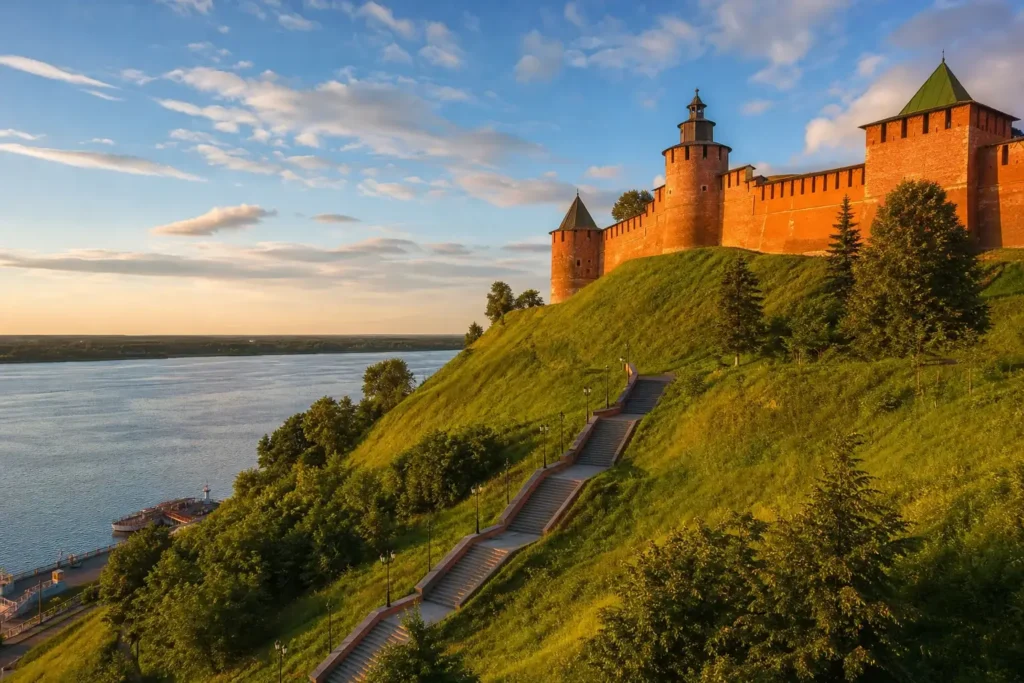
This Nizhny Novgorod travel guide is for first-time visitors who want to plan a stop in one of the main cities on the Volga. The city stands at the confluence of the Volga and Oka rivers, about four hours from Moscow by fast train, and its center is built around a red-brick Kremlin on a high bank above the water.
Most visitors spend a day or two on foot, with the Kremlin, the Chkalov Staircase, Bolshaya Pokrovskaya Street and the embankments, and many add a ride on the cable car across the Volga. The center lies on the high bank in the northeast of the city. Hours, tickets and transport details change, so check the official source for each place before you go.
Quick Facts
| Russian name | Нижний Новгород |
|---|---|
| Address | OpenStreetMap · Google Maps |
| Best time to visit | Late spring to early autumn is the most comfortable time for walking the Kremlin walls, the embankments and Bolshaya Pokrovskaya, and summer evenings are lively. Winter is cold, with short days, which suits visitors who plan museums and indoor sights. Check the forecast and the schedules of the sights and the cable car, since seasonal services differ. |
| Recommended duration | 2 days |
| Last updated | October 13, 2026 |
Why Visit Nizhny Novgorod?
Nizhny Novgorod is easy to see and easy to reach. The Kremlin, with its walls and towers, stands above the confluence of two great rivers, and from its terraces you look across to the lower town and the meeting of the Oka and the Volga. The walk along its walls is about two kilometers, according to a travel source.
The city also has a lively historic center. Bolshaya Pokrovskaya is a long pedestrian street with historic buildings and cafes, the Chkalov Staircase descends to the Volga embankment, and a cable car crosses the river to the town of Bor. It makes a good short break, either from Moscow or as part of a longer route along the Volga.
Highlights of Nizhny Novgorod
The Nizhny Novgorod Kremlin
A red-brick fortress on a high bank above the confluence of the Oka and Volga rivers, with a stone Kremlin built in the early 16th century, according to a travel source. The grounds are free to walk, and a circuit of the walls takes about an hour to an hour and a half, according to a travel source. Inside there are the Cathedral of the Archangel Michael, an art museum branch and a contemporary art center, which have their own tickets.
Tip: Walk the wall for the views of the confluence, and check which museums you want to enter.
The Chkalov Staircase
A monumental staircase that descends from the Chkalov Monument near the Kremlin to the lower Volga embankment, with about 560 steps in a figure-eight pattern, according to travel sources. It is named after the test pilot Valery Chkalov, who was born in the region. It is one of the symbols of the city, and the views of the river improve as you go down.
Tip: Go down for the view of the river and take the cable car or a taxi back up if you prefer.
Bolshaya Pokrovskaya Street
The main pedestrian street of the city, running from Gorkovskaya Square toward the Kremlin and lined with historic buildings, cafes, souvenir shops and street musicians, according to travel sources. It is lively in the evening, and it links the Metro with the Kremlin on foot. It is an attraction in its own right.
Tip: Walk it toward the Kremlin from Gorkovskaya station in the late afternoon.
Strelka and the confluence
Strelka is the spit of land at the confluence of the Oka and the Volga, in the Kanavinsky district across the river from the old center, with the Alexander Nevsky Cathedral and the 2018 World Cup stadium nearby, according to travel sources. It gives a view back to the Kremlin on its high bank. It is reached by Metro, and the station is called Strelka.
Tip: Go in the evening for the light on the Kremlin and the cathedral.
The Alexander Nevsky Cathedral
A large Orthodox cathedral on the former territory of the Nizhny Novgorod Fair, in Kanavino, which is one of the unofficial symbols of the city, according to a travel source. Its large size makes it visible from across the river. It is a working cathedral, so dress modestly and check the visiting times.
Tip: Combine it with a walk to Strelka and the confluence.
The cable car to Bor
A cable car that crosses the Volga to the town of Bor, with views of the city and the river, according to travel sources. The ride takes about 15 minutes each way, according to a travel source, and it is an attraction in itself, since there is little to see in Bor beyond the scenery. Check the official site for the stations, hours and tickets.
Tip: Take a return ride for the views, and check the weather first.
The Metro and the Oka bridge
The Nizhny Novgorod Metro has run since 1985, according to a travel source, and includes a metro bridge over the Oka, which gives a view of the city from the train. The Gorkovskaya station, which opened in 2012, according to a travel source, is the usual stop for Bolshaya Pokrovskaya and the Kremlin. Check the lines and payment with the operator.
Tip: Use it for the distances between the center and Strelka.
Atmosphere
Nizhny Novgorod feels like a river city on two levels. The old center sits on a high bank, with the Kremlin walls, squares and terraces, and the lower town and the Volga lie far below, so the views are wide and open. The streets climb and fall, and stairs and viewpoints appear around many corners.
The mood is relaxed and lively. Bolshaya Pokrovskaya fills with walkers, musicians and cafes in the evening, the embankments are busy in summer, and in winter the river is gray and the city turns to its museums and warm interiors. Visitors are a mix of Russian weekend travellers and people on a Volga route.
History of Nizhny Novgorod
Nizhny Novgorod was founded in 1221, according to general sources, by a prince of the Vladimir-Suzdal land at the confluence of the Oka and the Volga, as a fortress on the eastern frontier. Its position on the two rivers made it a trading town, and the name means Lower Novgorod.
The stone Kremlin was built in the early 16th century, between 1500 and 1511, according to a travel source, to replace earlier wooden fortifications. Its walls and towers still stand on the high bank above the confluence.
In the early 17th century the city played a role in the Time of Troubles, when the merchant Kuzma Minin and Prince Dmitry Pozharsky raised a volunteer militia here in 1611 and 1612, according to general sources, that marched to Moscow. The main square near the Kremlin is named after them.
In the 19th century the city became known for its annual trade fair, which drew merchants from across Russia and abroad and made the area on the opposite bank, Kanavino, a center of commerce. The Alexander Nevsky Cathedral was built on the fair’s territory, according to a travel source.
The writer Maxim Gorky was born in the city, and from 1932 until 1990 it was named Gorky in his honor, according to general sources. In the Soviet period it became a major industrial center, with factories along the Oka and the Volga, and it was closed to foreign visitors for a time.
The Metro opened in 1985, according to a travel source, and the city has one of the older tram networks in Russia, which has run since 1896, according to another source. In 1990 the city regained its historic name.
In the 2010s the city restored its center and built new facilities, including the stadium at Strelka, which hosted matches of the 2018 FIFA World Cup, according to a travel source. Today Nizhny Novgorod is the administrative center of Nizhny Novgorod Oblast and one of the largest cities in Russia.
The dates and details above come from general sources and should be checked against official museum and city sources.
Tickets and Booking for Nizhny Novgorod
Arriving by train. The main station is Moskovsky, in Kanavino, across the river from the old center. Fast Sapsan and Lastochka trains from Moscow take about three and a half to four hours, according to travel sources, and slower trains also run. Check which station your ticket names, and check the transfer to the center with the operators.
Arriving by air. The airport is Strigino (GOJ), about 17 to 18 km from the city, according to travel sources. There is no direct Metro; a bus or a taxi is the usual way into town, but routes and fares change, so check them with the official operators.
Confirm before you go. Schedules, ticket types and entry conditions for transport and sights depend on the operator and can change. Always confirm times and tickets with the official operator or the official website of each place, and keep your booking confirmations offline.
How to Get to Nizhny Novgorod
Most visitors arrive by train from Moscow.
- By train: fast Sapsan and Lastochka trains from Moscow take about three and a half to four hours, according to travel sources, and arrive at Moskovsky Station in Kanavino. The Metro and buses link the station with the center, and the Strelka area is close to it.
- By air: Strigino Airport (GOJ) is about 17 to 18 km from the city, according to travel sources. A bus to the Park Kultury Metro station and a taxi are the usual ways in; check the current options with the operators.
- In the center: Gorkovskaya station is the usual Metro stop for Bolshaya Pokrovskaya and the Kremlin, and a walk of about 1.5 km separates the station from the Kremlin, according to a travel source.
Check routes, schedules and booking steps with the official operators, and save your hotel address offline in Latin letters and in Russian.
Accessibility
Accessibility differs between sights. The Kremlin and the old center are on a hillside, and the Chkalov Staircase has hundreds of steps, though other routes lead down to the embankment. Check the official website of each place for lifts, ramps and support for visitors with reduced mobility, and confirm access at Metro stations and on the cable car with the operator.
Food Nearby
Bolshaya Pokrovskaya and the streets around the Kremlin have many cafes and restaurants, with Russian dishes and international cuisine, and the embankments have places for a lighter meal. Menus differ from place to place, so ask staff for local dishes and mention any allergies. Specific venues were not verified here, so check opening hours before you go.
What to Bring
Bring comfortable walking shoes, since the center is hilly and the staircase is long. In summer pack sun protection and a light jacket for the river wind, and in winter pack warm layers, a hat, gloves and shoes with a good grip. A portable charger and offline maps are useful, and large bags may need to go in a cloakroom at museums.
Photography Rules
Photography is usually allowed in the Kremlin grounds, on the streets and on the embankments, but rules differ in museums and in the cathedrals, and flash and tripods may be restricted. Check the signs and ask staff if you are unsure. Drone rules also apply in cities, so check the current regulations with the official source before you use one.
Family Suitability
Nizhny Novgorod suits families who like walking, views and short museum visits, and the cable car is popular with children. The hills, long staircases and cobbled paths can be hard with strollers, so check access at each sight and plan taxis for the steeper parts.
Russia Vibes Tips
- Start at the Kremlin, walk the wall, and then go down the Chkalov Staircase to the embankment.
- Use the Metro to reach Strelka, which is far from the Kremlin on foot because the river lies between them.
- Ride the cable car for the view of the confluence, and treat Bor itself as an optional stop.
- Walk Bolshaya Pokrovskaya in the evening, when the street is busiest and the lights are on.
- Check which Kremlin museums you want to enter, since each has its own opening times and ticket.
- If you arrive by fast train, leave your bags at the hotel first, since the station is across the river from the old center.
Explore Nearby Nizhny Novgorod
Browse more: All Cities · All Landmarks
FAQ: Nizhny Novgorod
How many days do I need in Nizhny Novgorod?
Two days cover the Kremlin, the Chkalov Staircase, Bolshaya Pokrovskaya, Strelka and the cable car. With one day you can see the Kremlin, the staircase and the main street.
How do I get from Moscow to Nizhny Novgorod?
Fast Sapsan and Lastochka trains take about three and a half to four hours, according to travel sources. Check schedules and booking steps with the official operators.
Is the Kremlin free to enter?
The grounds are free to walk, according to a travel source, but the museums and some buildings inside have their own tickets. Check the official site of each museum.
How many steps are on the Chkalov Staircase?
It has about 560 steps in a figure-eight pattern, according to travel sources. Other paths lead down to the embankment if you prefer.
What is Strelka?
It is the spit of land at the confluence of the Oka and the Volga, in the Kanavinsky district, with the Alexander Nevsky Cathedral nearby. It is reached by Metro, at the Strelka station.
Is the cable car worth it?
Many visitors ride it for the views of the city and the rivers, and the ride takes about 15 minutes each way, according to a travel source. Check the hours and tickets with the operator.
Does Nizhny Novgorod have a Metro?
Yes, it has run since 1985, according to a travel source, and it includes a bridge over the Oka. Check the lines, hours and payment with the operator.
Is Nizhny Novgorod a good stop on a Volga route?
Yes, many visitors combine it with other Volga cities or with a trip from Moscow. Check the schedules and plan how long to stay.
Last updated: October 13, 2026. Found an error or something out of date? Report it and we will check and fix it.
About this guide: AI assistance and accuracy
This guide is created with the help of AI and is based on official sources where available. Mistakes can still happen. Opening hours, prices, rules and other details are given to the best of our knowledge as of the date shown and can change without notice. It offers general recommendations only, not professional, legal or travel advice. Please confirm important details with the official source before you travel; you are responsible for your own plans and decisions.
International sanctions affect payments between Russia and many other countries. In practice, cards issued in the EU, the UK, the US and several other countries often do not work in Russia, Russian cards usually do not work abroad, and some booking platforms, airlines and payment providers limit or suspend their services for Russia. The situation changes frequently. We do not give legal or financial advice, and this site does not encourage anyone to break or circumvent sanctions. Whatever you plan, you are responsible for following the laws and regulations that apply to you, including those of your country of residence and citizenship. Many travelers still organise their stay lawfully. It is worth asking your bank or payment provider what is currently permitted, contacting hotels, tour operators and carriers directly about the payment methods they accept, and checking which services are open to customers from your country. Clarify payment, cancellation and refund terms before you commit to a booking, and keep your plans flexible. Partner links on this site may not be available in every country, and prices, availability and rules in our guides can differ from what you see when you book.Paying for your trip: please read
 Ask Masha