
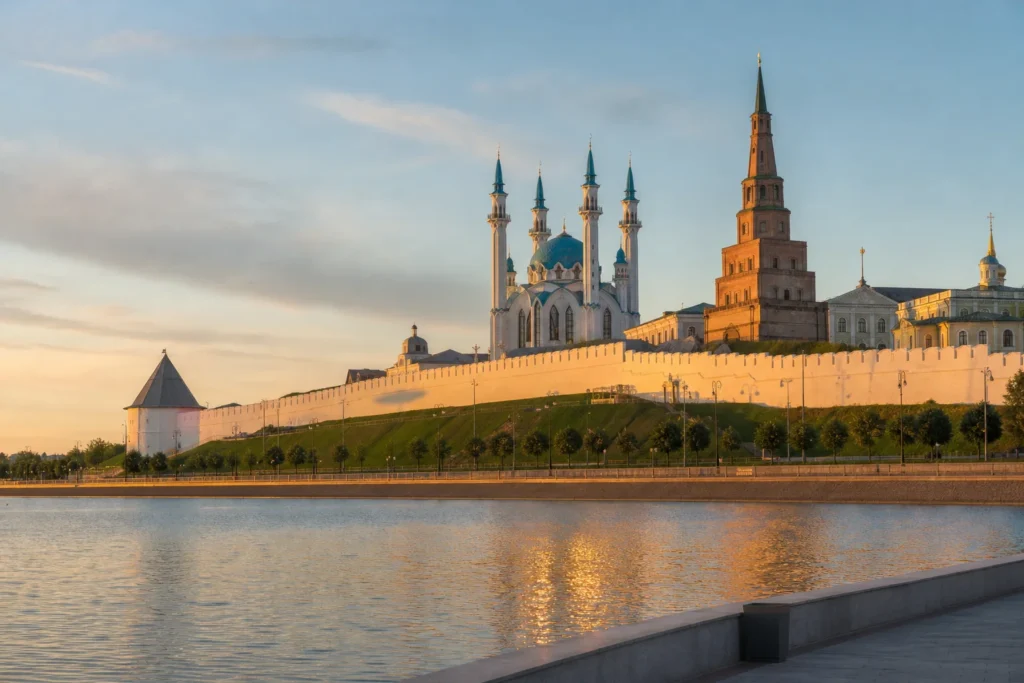
This Kazan travel guide is for first-time visitors who want to plan a trip to the capital of the Republic of Tatarstan. The city stands at the confluence of the Volga and Kazanka rivers, and its center is compact enough to explore on foot, with the Kremlin at one end and the pedestrian Bauman Street leading away from it.
Kazan is known for the mix of Russian and Tatar cultures, which you can see in its buildings, its food and its everyday life. Most visitors build their days around the Kremlin, Bauman Street, the Kazanka embankment and a few Tatar dishes. Opening hours, tickets and transport details change, so check the official source for each place before you go.
Quick Facts
| Russian name | Казань |
|---|---|
| Address | OpenStreetMap · Google Maps |
| Best time to visit | Late spring to early autumn is the most comfortable time for walking the Kremlin, the embankment and Bauman Street. Summer evenings are lively, while winter is cold with short days, which suits visitors who prefer museums and quieter streets. Check the forecast and the dates of any festival you want to see, since events change each year. |
| Recommended duration | 2 to 3 days |
| Website | kzn.ru |
| Last updated | October 13, 2026 |
Why Visit Kazan?
Kazan is one of the few places in Russia where a mosque and an Orthodox cathedral stand together inside a Kremlin. The Kazan Kremlin is a UNESCO World Heritage site, and its white walls overlook the Kazanka river and the city center.
The city is also easy to handle for a first trip. The center is walkable, the single Metro line links the Kremlin area with several other parts of town, and Tatar cuisine gives you something to try that you will not find everywhere else in Russia. It suits a long weekend, either on its own or as an extension from Moscow.
Highlights of Kazan
The Kazan Kremlin
The Kremlin is the historic citadel of Kazan and a UNESCO World Heritage site, inscribed in 2000, according to a travel source. Inside the white-stone walls are the Kul Sharif Mosque, the Annunciation Cathedral, the leaning Söyembikä Tower, the presidential palace and several museums. The grounds are open to walk, but museums and some buildings have their own hours and tickets, so check the official site.
Tip: Visit once by day for the museums and again in the evening, when the buildings are lit and the grounds are quieter.
Kul Sharif Mosque
The main mosque of Tatarstan stands inside the Kremlin, with turquoise domes and tall minarets that you can see across the city. It is a modern building, put up on the site of an earlier mosque of the Khanate, and visitors are welcome if they dress modestly. It is a working mosque, so access is limited around prayer times.
Tip: Cover your shoulders and knees, and check prayer times before you go in.
The Annunciation Cathedral
The Orthodox cathedral inside the Kremlin dates from the Russian period of the city and stands close to the mosque, so the two buildings can be seen together. The pairing of a cathedral and a mosque in the same fortress is what many visitors associate with the city. Check the opening hours and visiting rules on the official site.
Tip: Look at both buildings from the central path to see how they sit together.
Söyembikä Tower
A brick tower in the Kremlin that leans slightly, and one of the best-known symbols of Kazan. It is a part of the Kremlin complex and can be seen from the grounds, and the surrounding walls give good views over the river. Check on the official site whether the tower is open to visitors.
Tip: Look at it from a distance along the path for the lean.
Bauman Street
The main pedestrian street of Kazan runs from the Kremlin toward Tukay Square, about 1.3 kilometers long, according to a travel source, lined with shops, cafes, churches and museums. It is named after the revolutionary Nikolay Bauman, who was born in Kazan, and it is often compared to the Arbat in Moscow. It is where many visitors eat and stroll in the evening.
Tip: Walk it from the Kremlin end in the late afternoon and keep going to Tukay Square.
The Kazanka embankment and viewpoints
The embankment below the Kremlin gives a clear view of the white walls and the mosque's domes from the river side. Another popular viewpoint is the Kazan Family Center, a building across the river, which looks back at the Kremlin from above. Both are easy to reach by Metro and on foot.
Tip: Go to the embankment at sunset for the best light on the walls.
The Old Tatar Quarter
A district of old wooden houses and small mosques, centered on Kayuma Nasyri Street, near Lake Kaban, which gives a feel for the Tatar part of the city's history. It is quieter than the center and is served by the Sukonnaya Sloboda Metro station, according to a travel source. Check which museums and buildings are open.
Tip: Combine it with a walk along Lake Kaban.
Atmosphere
Kazan feels like two cities in one. Around the Kremlin the walls are pale and the skyline mixes domes, a tilted tower and the slim minarets of the mosque. On Bauman Street the mood is that of a busy pedestrian boulevard, with musicians, shop signs and people taking their time between cafes.
The pace is relaxed, and evenings are lively but not loud. Many visitors walk from the Kremlin to the river as the lights come on. In the cold months the days are short and the city is quieter, so visits to museums, cafes and the Metro take up more of the day.
History of Kazan
Kazan lies on the Volga trade route, in a region that was settled long before the city took its present form. The city marked its thousandth anniversary in 2005, a date that reflects the traditional view of its founding rather than an exact record.
In the 15th century Kazan became the capital of the Khanate of Kazan, a Tatar state that arose after the breakup of the Golden Horde. The city’s fortress stood on the hill where the Kremlin is today, and a mosque stood within it.
In 1552 Ivan the Terrible captured Kazan after a siege, and the city became part of the Russian state. A new stone Kremlin was built on the site by Russian builders, and the architect Postnik Yakovlev is traditionally credited with part of the work, though the attribution is debated. Orthodox churches and cathedrals replaced the older mosque and buildings.
Over the following centuries Kazan grew into an important center on the Volga. It was made the seat of a governorate in the early 18th century, and the university founded there in 1804 made it a center of learning in the eastern part of the Russian Empire.
In the Soviet period the city became the capital of the Tatar Autonomous Soviet Socialist Republic, founded in 1920. Industry grew in the north of the city, and the Metro, which has a single line, was opened in the early 21st century.
The Kazan Kremlin was inscribed on the UNESCO World Heritage list in 2000, according to a travel source that should be checked. The Kul Sharif Mosque, a modern reconstruction of the older mosque that stood in the fortress, opened in 2005.
Today Kazan is the capital of the Republic of Tatarstan and one of the largest cities in Russia. It is often called the third capital of Russia in tourism marketing, a title that is informal. The city is known for both its Russian and its Tatar heritage, and this mix is visible in its architecture, its food and its festivals.
Tickets and Booking for Kazan
Arriving by air. The main airport is Kazan International Airport (KZN), about 25 km southeast of the center, according to a travel source. A train service to the main station and a bus to the Metro have been used for the transfer, but routes and times change, so check them with the official operators.
Arriving by train. The main railway station is Kazan-1, close to the center. From Moscow there are overnight trains of about 11 to 13 hours, according to a travel source, and other long-distance trains also run. Check which station your ticket names.
Confirm before you go. Schedules, ticket types and entry conditions for transport and sights depend on the operator and can change. Always confirm times and tickets with the official operator or the official website of each place, and keep your booking confirmations offline.
How to Get to Kazan
Most visitors arrive by train from Moscow or by air.
- By air: Kazan International Airport (KZN) is about 25 km southeast of the center. A train service to the central station and a bus to the Prospekt Pobedy Metro station are possible ways in, according to travel sources; check the current options with the operators.
- By train from Moscow: overnight trains take about 11 to 13 hours, and they arrive at the Kazan-1 station near the center.
- By Metro: the city has a single line, and the Kremlevskaya station is about a three-minute walk from the Kremlin and the start of Bauman Street, according to a travel source.
Check routes, schedules and booking steps with the official operators, and save your hotel address offline in Latin letters and in Russian.
Accessibility
Accessibility differs from one building to the next, and many historic sites have steps, cobbles and older entrances. The Kremlin grounds include slopes and paved paths. Check the official website of each sight for lifts, ramps and support for visitors with reduced mobility, and confirm access at Metro stations with the operator.
Food Nearby
Bauman Street and the streets around the Kremlin have many cafes and restaurants, including places that serve Tatar dishes such as chak-chak, a sweet honey dessert, and echpochmak, a triangular meat and potato pie. Menus differ from place to place, so ask staff for local dishes and mention any allergies. Specific venues were not verified here, so check opening hours before you go.
What to Bring
Bring comfortable walking shoes, since the center is best explored on foot and some paths are cobbled. Pack a light jacket for evenings, warm layers in winter, and a scarf or cover-up for visiting the mosque. A portable charger and offline maps are useful, and large bags may need to be left in a cloakroom at museums.
Photography Rules
Photography is usually allowed in the Kremlin grounds, but rules differ inside museums, the mosque and the cathedral, and flash and tripods are often restricted. Check the signs at each entrance and ask staff if you are unsure. Drone rules also apply in cities, so check the current regulations with the official source before you use one.
Family Suitability
Kazan suits families who like walking and short museum visits, with open space in the Kremlin and along the embankment, and plenty of cafes on Bauman Street. The cobbled paths and steps can be awkward for strollers, so check access at each sight. Dress modestly if you plan to enter the mosque with children.
Russia Vibes Tips
- Start at the Kremlin early in the morning, then walk down Bauman Street as the day gets busier.
- Return to the Kremlin in the evening, when the walls and the mosque are lit and the grounds are quieter.
- Use the Metro to reach the Old Tatar Quarter and the Kazan Family Center viewpoint, since both are away from the center.
- Try one Tatar dish at lunch and one at dinner, so that you compare sweet and savory classics.
- Check prayer times before you plan a visit to the Kul Sharif Mosque.
- If you add Kazan to a Moscow trip, an overnight train saves a hotel night but check the schedule well in advance.
Explore Nearby Kazan
Browse more: All Cities · All Landmarks
FAQ: Kazan
How many days do I need in Kazan?
Two days cover the Kremlin, Bauman Street, the embankment and one or two other areas, according to travel sources. With one day you only have time for the Kremlin, Bauman Street and a walk by the river.
Is the Kazan Kremlin free to enter?
The grounds are usually open to walk, but museums and some buildings have their own hours and tickets. Check the official website of the Kremlin and of each museum for the current terms.
Can visitors enter the Kul Sharif Mosque?
Yes, visitors are welcome if they dress modestly, but it is a working mosque, so access is limited around prayer times. Check the current visiting rules before you go.
How do I get from Moscow to Kazan?
Many visitors take an overnight train of about 11 to 13 hours, or fly. Check schedules and booking steps with the official operators, and note that airports are outside the city.
How do I get from the airport to the center?
Options include a train to the central station, a bus to the Metro and a taxi. Check current routes and times with the official operators, since they can change.
Is Kazan walkable?
Yes, the center is compact, and the Kremlin and Bauman Street are close together. The Metro, which has a single line, helps with places further out, so use it for the Old Tatar Quarter.
What food should I try in Kazan?
Many visitors try Tatar dishes such as echpochmak, a savory pie, and chak-chak, a honey sweet. Menus differ, so ask staff for local specialties and mention allergies.
Is Kazan a good extension to a Moscow trip?
Yes, many visitors combine them, since the two cities are linked by overnight trains and flights. Check the schedules and plan enough time, since journeys between cities can be long.
Last updated: October 13, 2026. Found an error or something out of date? Report it and we will check and fix it.
About this guide: AI assistance and accuracy
This guide is created with the help of AI and is based on official sources where available. Mistakes can still happen. Opening hours, prices, rules and other details are given to the best of our knowledge as of the date shown and can change without notice. It offers general recommendations only, not professional, legal or travel advice. Please confirm important details with the official source before you travel; you are responsible for your own plans and decisions.
International sanctions affect payments between Russia and many other countries. In practice, cards issued in the EU, the UK, the US and several other countries often do not work in Russia, Russian cards usually do not work abroad, and some booking platforms, airlines and payment providers limit or suspend their services for Russia. The situation changes frequently. We do not give legal or financial advice, and this site does not encourage anyone to break or circumvent sanctions. Whatever you plan, you are responsible for following the laws and regulations that apply to you, including those of your country of residence and citizenship. Many travelers still organise their stay lawfully. It is worth asking your bank or payment provider what is currently permitted, contacting hotels, tour operators and carriers directly about the payment methods they accept, and checking which services are open to customers from your country. Clarify payment, cancellation and refund terms before you commit to a booking, and keep your plans flexible. Partner links on this site may not be available in every country, and prices, availability and rules in our guides can differ from what you see when you book.Paying for your trip: please read
 Ask Masha