
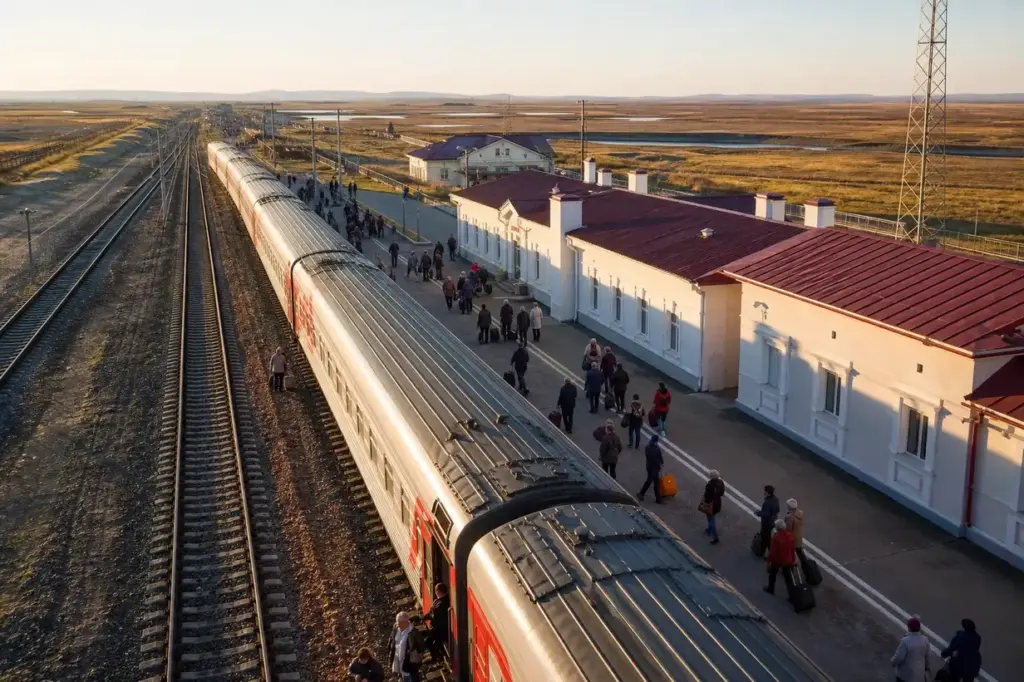
The Trans-Siberian Railway spans nearly 9,300 km from Moscow to Vladivostok, crossing eight time zones and Russia’s most dramatic landscapes. Doing the full journey nonstop in seven days is possible but exhausting; most travellers instead break it into legs of two to three weeks, stopping in key cities that reveal different faces of Russia.
This guide identifies the eight best stopovers for short and long journeys—whether you have three days or three weeks. Each stop offers a distinct character: imperial capitals, Soviet industrial cities, gateway towns to nature, and the Pacific coast. The stops work for any traveller type: history buffs exploring Romanov heritage, photographers capturing Siberian scenery, nature lovers heading to Lake Baikal, and those simply wanting to stretch their legs and sleep in a real bed.
At a Glance
| # | Place | Best for | Good to know |
|---|---|---|---|
| 1 | Moscow | Gateway and cultural capital | Moscow; Yaroslavsky Station is the Trans-Siberian departure point |
| 2 | Yekaterinburg | Europe-Asia border and regional history | Yekaterinburg; approximately 26 hours from Moscow by train |
| 3 | Irkutsk | Gateway to Lake Baikal and Siberian charm | Irkutsk; approximately 75 hours from Moscow by train |
| 4 | Best Places to Visit at Lake Baikal | World's deepest freshwater lake | Lake Baikal region; 65–75 km south of Irkutsk by road; access via organized tours or hire |
| 5 | Ulan-Ude | Buddhist culture and Mongolian gateway | Ulan-Ude; approximately 100 hours from Irkutsk by train |
| 6 | Novosibirsk | Siberia's sprawling capital | Novosibirsk; approximately 44 hours from Moscow by train |
| 7 | Krasnoyarsk | Halfway point with mountain views | Krasnoyarsk; approximately 60 hours from Novosibirsk by train |
| 8 | Vladivostok | Pacific endpoint and port city | Vladivostok; approximately 147 hours from Irkutsk by train |
How We Chose
These stops were chosen based on:
- Direct railway access on the main Moscow-Vladivostok line or as well-established side trips from main stations
- Distinct cultural, historical, or natural character that justifies stopping rather than staying on the train
- Practical stopover duration: each can be experienced properly in one to three days
- Infrastructure for visitors: accommodation, food, English-language information readily available
- Balance across the route: equal distribution from west to east for meaningful variety
The list includes the four essential stops (Moscow, Yekaterinburg, Irkutsk, Vladivostok), plus four equally worthwhile alternatives for different journey lengths and interests.
1. Moscow – Gateway and cultural capital
Moscow remains one of the main stops on the Trans-Siberian, and most journeys start or end here. The city offers the Bolshoi Theater, Kremlin, Tretyakov Gallery, and St Basil's Cathedral. Plan 2–4 days to explore the city's historic centre and major museums before boarding your train east.
Good to know: Moscow; Yaroslavsky Station is the Trans-Siberian departure point
Tip: Arrive at least two days early if possible to adjust to Moscow time and visit the Kremlin or Red Square without rushing on your first morning.
2. Yekaterinburg – Europe-Asia border and regional history
Yekaterinburg marks the symbolic border between Europe and Asia, with history tied to the fall of the Romanov dynasty. Once closed during the Soviet period, it is now home to nearly 1.5 million people and a thriving arts, music, and food scene. The city makes an essential first stopover from Moscow on any journey.
Good to know: Yekaterinburg; approximately 26 hours from Moscow by train
Tip: The Europe-Asia border marker is 17–20 km outside the city; ask your hotel to arrange transport or join a local tour rather than attempting it alone.
3. Irkutsk – Gateway to Lake Baikal and Siberian charm
Irkutsk is the most popular stop for Trans-Siberian travellers, once known as the Paris of Siberia, where people are friendlier and more relaxed than in European Russia. The city features well-preserved wooden architecture that survived the Soviet era. It is the mandatory base for visiting Lake Baikal.
Good to know: Irkutsk; approximately 75 hours from Moscow by train
Tip: Book accommodation near the city centre to walk to wooden buildings and cafes; don't rely solely on taxis for small distances.
4. Best Places to Visit at Lake Baikal – World's deepest freshwater lake
Lake Baikal is probably the single most popular stopover on the whole route. Baikal is the world's deepest freshwater lake, and views from the train near Slyudyanka are among the most photographed moments of the journey. Visit from Irkutsk as a day trip or overnight excursion; Listvyanka and Olkhon Island are the main access points.
Good to know: Lake Baikal region; 65–75 km south of Irkutsk by road; access via organized tours or hire
Tip: If you have only one full day, visit Listvyanka near Irkutsk for views and a shoreline walk; Olkhon Island requires a separate overnight trip.
5. Ulan-Ude – Buddhist culture and Mongolian gateway
Ulan-Ude is a distinctly different stop from other Russian cities on the route, located in an area called Buryatia, named after the Buryat Mongols. The city is where the Trans-Siberian and Trans-Mongolian railway routes meet, making it a natural point to branch toward Mongolia or continue east.
Good to know: Ulan-Ude; approximately 100 hours from Irkutsk by train
Tip: Ulan-Ude functions as a practical junction; allow a day here to adjust or to decide whether to continue to Vladivostok or branch to Mongolia.
6. Novosibirsk – Siberia's sprawling capital
Novosibirsk is Russia's third-largest city and one of the world's most rapidly growing cities, referred to as the capital of Siberia. The city hosts the impressive Alexander Nevsky Cathedral and the Theater of Opera and Ballet, the largest theater in Russia.
Good to know: Novosibirsk; approximately 44 hours from Moscow by train
Tip: Novosibirsk appeals mainly to those interested in Soviet urban architecture and contemporary Russian culture; nature-focused travellers often skip it to save time for Irkutsk and Lake Baikal.
7. Krasnoyarsk – Halfway point with mountain views
Nearly halfway along the journey, you arrive in Krasnoyarsk, located on the Yenisei River with views of rocky outcrops nearby. The city offers a natural break point on longer journeys and access to outdoor activities in the surrounding Sayan Mountains.
Good to know: Krasnoyarsk; approximately 60 hours from Novosibirsk by train
Tip: Krasnoyarsk works as an optional stop if you have time for a longer journey; it's not essential but breaks up the monotony of consecutive overnight train legs.
8. Vladivostok – Pacific endpoint and port city
The final stop on the Trans-Siberian route is Vladivostok, established in 1860 on the shore of the Golden Horn Bay. Vladivostok became Russia's most important Pacific port and has undergone rapid development in recent years. The city has a dramatic harbor setting and good seafood, worth at least a couple of days before flying home or catching a ferry onward to Japan or South Korea.
Good to know: Vladivostok; approximately 147 hours from Irkutsk by train
Tip: Arrive with low expectations for a Russian city and you'll be pleasantly surprised; the waterfront is genuinely walkable and the food culture differs markedly from Moscow.
Russia Vibes Tips
- Plan stopovers in advance and book accommodation before you travel. Improvising stops on the journey is time-consuming; having a rough itinerary means you can move between train stations smoothly and avoid losing seats on your next leg.
- Most overnight trains depart in early evening and arrive mid-morning the next day. This rhythm means you gain full daylight hours in each city without paying for extra hotel nights; use this to your advantage.
- Do not attempt to visit more than one or two stops if your total time is less than two weeks. The rule of thumb: Moscow (2 days), Yekaterinburg (1 day), Irkutsk plus Lake Baikal (2–3 days), Vladivostok (2 days) = 8–10 days absolute minimum.
- Check official train schedules weekly on the Russian Railways website (rzd.ru) if booking independently; times shift seasonally and some trains run fewer days per week in winter. Tourist agencies often show outdated timetables.
- Bring a physical guidebook or offline maps for each city; mobile internet is unreliable on trains and patchy in smaller Siberian cities. Download maps and key phrases before you depart.
- Food at major train stations is usually basic. Bring shelf-stable snacks (nuts, chocolate, biscuits) and a thermos; hot water is available on trains but meal options are limited compared to European services.
Explore Nearby Best Stopovers for Short and Long Journeys, Trans-Siberian Railway
Related guides
 Altai Mountains: Best Places, Scenic Routes and Travel Tips
Main image: AI-generated illustration. It may not show the place exactly as it looks.
 Circum-Baikal Railway Day Trip, Irkutsk: Tunnels and Lake Views
Main image: AI-generated illustration. It may not show the place exactly as it looks.
Browse more: All Guides · All Guides in Trans-Siberian Railway · All Other · All Trans-Siberian Railway
FAQ
How many days minimum do I need to stop in each city?
Moscow: 2 days (one for Kremlin/Red Square, one for museums or a day trip). Yekaterinburg: 1 full day is sufficient for the city centre and Europe-Asia border. Irkutsk: 2 days minimum (one in the city, one for Lake Baikal). Lake Baikal: 1 full day as a side trip from Irkutsk. Vladivostok: 2 days to see the harbour and walk the waterfront. Ulan-Ude, Novosibirsk, Krasnoyarsk: each requires 1 day if you stop at all; they are optional unless you have 3+ weeks.
What is the difference between a short journey stopover plan and a long one?
Short (2 weeks total): Moscow → Yekaterinburg → Irkutsk → Lake Baikal → Vladivostok, dropping intermediate cities. Long (3+ weeks): add Ulan-Ude, Novosibirsk, or Krasnoyarsk, and spend extra time in Lake Baikal region or Moscow museums.
Can I buy open tickets and hop on and off trains freely?
No. Open tickets are not available on the Trans-Siberian. You must book each leg of your journey separately. Your travel dates lock you into specific trains; missing a train means losing your ticket or paying to rebook.
Which stops are essential and which are optional?
Essential for any journey: Moscow (departure point), Irkutsk (gateway to Lake Baikal), and either Vladivostok or Ulan-Ude (endpoint). Optional but excellent: Yekaterinburg (Europe-Asia border), Lake Baikal. Skip if time is tight: Novosibirsk, Krasnoyarsk, Ulan-Ude (unless going to Mongolia).
Is a guide necessary at each stopover?
Not essential. Moscow, Yekaterinburg, Irkutsk, and Vladivostok all have English-language information and tourist infrastructure. Lake Baikal and Ulan-Ude benefit from local guides for nature excursions or cultural context; hotel staff can arrange these. Solo exploration works fine in all cities.
How do I transfer luggage between hotels and trains?
Most hotels near main train stations offer luggage storage for a small fee. Drop bags in the morning, explore the city, retrieve them before dinner. Book hotels within walking distance (15 minutes maximum) of the train station for convenience.
What season is best for stopovers?
June–August for summer travel and full access to Lake Baikal (boat tours, outdoor activities). December–February for winter Lake Baikal (ice walking) if you are cold-experienced. May and September are shoulder seasons with fewer tourists but still good weather. April and October can be muddy and unpredictable.
Can I reverse the route and travel west instead of east?
Yes. You can start in Vladivostok and travel west to Moscow using the same stopovers. The experience is identical except the landscape unrolls in reverse; many travellers prefer east-to-west to end in Moscow or Saint Petersburg. Book the same way: each leg as a separate ticket.
Russia Vibes is a one-person project. A coffee keeps it going

Take this guide with you
Get a free PDF of this guide to print or read offline: key facts, tips and a map link on a few clean pages.
Report an issue on this page
Paying for your trip: please read
Payments and bookings between Russia and many other countries are currently restricted. In practice, cards issued in the EU, the UK, the US and several other countries often cannot be used in Russia, Russian cards usually cannot be used abroad, and some booking platforms, airlines and payment providers limit or pause their services for Russia. The situation changes frequently.
We do not give legal or financial advice, and this site does not encourage anyone to break any rule that applies to them. Whatever you plan, you are responsible for following the laws and regulations that apply to you, including those of your country of residence and citizenship.
Many travelers still organise their stay without problems. It is worth asking your bank or payment provider what is currently possible, contacting hotels, tour operators and carriers directly about the payment methods they accept, and checking which services are open to customers from your country. Clarify payment, cancellation and refund terms before you commit to a booking, and keep your plans flexible.
Partner links on this site may not be available in every country, and prices, availability and rules in our guides can differ from what you see when you book.
How we research and update our guides
About this guide: AI assistance and accuracy
This guide is created with the help of AI and is based on official sources where available. Mistakes can still happen. Opening hours, prices, rules and other details are given to the best of our knowledge as of the date shown and can change without notice. It offers general recommendations only, not professional, legal or travel advice. Please confirm important details with the official source before you travel; you are responsible for your own plans and decisions.