
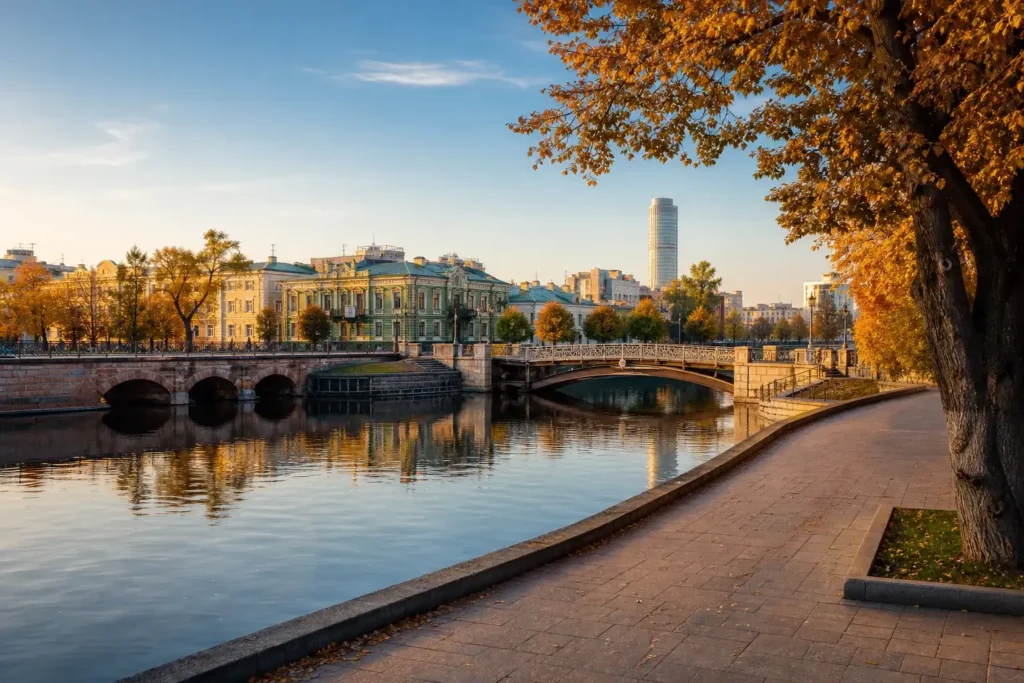
This Yekaterinburg travel guide is for first-time visitors who want to plan a stop in the largest city of the Ural Mountains. The city stands on the Iset river, close to the historic border between Europe and Asia, and it is a major stop on the Trans-Siberian Railway.
The center is compact, and many visitors explore it on foot by following the Red Line, a painted walking route of about 6.5 km that links the main sights. Others add the Yeltsin Center, a viewpoint in a skyscraper and a trip to the border obelisk. Hours, tickets and transport details change, so check the official source for each place before you go.
Quick Facts
| Russian name | Екатеринбург |
|---|---|
| Address | OpenStreetMap · Google Maps |
| Best time to visit | Summer is the most comfortable for walking the Red Line and the embankment and for the trip to the border obelisk, but the city can be visited all year. Winters are cold with short days, which suits visitors who plan museums and indoor sights. Check the forecast and the schedules of the sights, since seasonal services differ. |
| Recommended duration | 2 days, plus 1 day for trips outside the city |
| Last updated | October 13, 2026 |
Why Visit Yekaterinburg?
Yekaterinburg is easy to explore, because the Red Line painted on the pavement leads you past the historic center without a map. The route links the old dam on the Iset river, where the city began, with 19th-century mansions, monuments and the Church on the Blood.
It also gives a clear sense of modern Russia and of the Urals. The Yeltsin Center is a museum on recent Russian history, a skyscraper viewpoint shows the whole city, and the obelisk on the border of Europe and Asia, about 17 km from the center, is a popular photograph stop. Many visitors combine it with a stop on the Trans-Siberian route.
Highlights of Yekaterinburg
The Red Line walking route
A red line painted on the pavement leads around the center for about 6.5 km and links dozens of sights, according to travel sources, including historic mansions, monuments and the Church on the Blood. A keyboard-shaped monument on the Iset embankment is a popular starting point. A full walk takes about two and a half hours without stops, according to a travel source.
Tip: Follow it in sections, and leave time for the museums you want to enter.
Plotinka and the Iset embankment
Plotinka is the historic dam on the Iset river where the city began in 1723, according to a travel source, and it is now the heart of the embankment, with a park and views of old buildings. It is one of the most photographed places in the center and links several sights on foot.
Tip: Walk the embankment in the evening, when the lights come on.
The Church on the Blood
A large Orthodox church built between 2000 and 2003 on the site of the Ipatiev House, where the family of Emperor Nicholas II was killed in 1918, according to travel sources. It is a memorial as well as a working church, with several chapels and a small exhibition. Visitors usually behave quietly and dress modestly, and the church lies a little north of the center.
Tip: Dress modestly and check visiting times, since services limit access.
The Yeltsin Center
A cultural and educational center, opened in 2015, devoted to recent Russian history and to Boris Yeltsin, the first president of Russia, according to travel sources. Its museum is the main reason to visit, and the building also has galleries, a shop and cafes. It stands by the river, a little off the Red Line.
Tip: Allow at least a couple of hours, and check the official site for exhibitions and tickets.
The Vysotsky observation deck
The Vysotsky business center is a skyscraper on Malysheva Street, and its open-air observation deck, high up on the building, gives the best panorama of the city and the surrounding hills, according to travel sources. The building also holds a museum of the singer Vladimir Vysotsky on its lower floors. Check the official site for access and opening times.
Tip: Go on a clear day, ideally before sunset.
The Europe-Asia border obelisk
A monument about 17 km west of the city that marks the symbolic border between Europe and Asia, according to a travel source, where visitors stand with one foot in each continent for a photograph. It sits outside the city, so it needs a taxi, a bus or a guided tour. Check the transport options in advance.
Tip: Combine it with a half day outside the city, and agree on a return ride.
The Ural city's architecture
Yekaterinburg is known for its constructivist buildings from the Soviet period, for 19th-century mansions built by mining and gold rush families and for bronze sculptures along its streets. The Sevastyanov House and Vaynera Street are on the Red Line and show the older streets. Walking between them gives a good idea of how the city developed.
Tip: Look up at the facades on Vaynera Street and the side streets nearby.
Atmosphere
Yekaterinburg feels like a confident industrial city that has become a place for visitors. The center is compact, with the Iset river running through it, bridges and an embankment that fills with walkers in the evening. Old mansions stand next to constructivist blocks and glass towers.
It does not look Asian, and many visitors are surprised by how European the center feels. The mood is relaxed, with cafes and galleries, and the Red Line gives the streets a trail to follow. In winter the days are short and cold, and the city turns to indoor sights; in summer the embankment is busy.
History of Yekaterinburg
Yekaterinburg was founded in 1723 as an ironworks and fortress on the Iset river, according to general sources, on the orders of Peter the Great, and the founders are traditionally named as Vasily Tatishchev and Georg de Gennin. The city was named after Catherine, the wife of Peter the Great. The dam, known today as Plotinka, was the center of the original works.
In the 18th century the city became the administrative center of mining in the Urals, and it later grew into one of the main cities on the route to Siberia. In the 19th century gold and gemstone mining brought wealth, and merchants and mine owners built mansions in the center, some of which are on the Red Line today.
In July 1918, during the Russian Civil War, the family of Emperor Nicholas II was killed in the Ipatiev House in the city, according to general sources. The house was later demolished, and the Church on the Blood was built on the site between 2000 and 2003.
In 1924 the city was renamed Sverdlovsk, after the Bolshevik leader Yakov Sverdlov, and it became a major industrial center of the Soviet Union. Large factories were built, and the city developed constructivist architecture, parts of which survive.
During the Second World War many factories and institutions were evacuated to the Urals, and the city grew in importance as a center of industry and science, according to general sources. Boris Yeltsin, later the first president of Russia, built his career in the Sverdlovsk region.
In 1991 the city regained its historic name, Yekaterinburg. The Yeltsin Center, a museum and cultural center devoted to modern Russian history, opened in 2015, according to travel sources.
Today Yekaterinburg is the administrative center of Sverdlovsk Oblast and one of the largest cities in Russia. It has one Metro line, a major airport and a place on the Trans-Siberian Railway, and it is a common stop for visitors who want to see the Urals and the border of Europe and Asia.
The dates and details above come from general sources and should be checked against official museum and city sources.
Tickets and Booking for Yekaterinburg
Arriving by air. The main airport is Koltsovo (SVX), about 15 km from the center, according to travel sources, with flights from Moscow of about two hours. An express train, buses and taxis are the usual ways into town, but routes and fares change, so check them with the official operators.
Arriving by train. The main station is Yekaterinburg-Passazhirsky, on the Trans-Siberian Railway. A journey from Moscow takes about 24 to 27 hours, according to travel sources. Check which station your ticket names.
Confirm before you go. Schedules, ticket types and entry conditions for transport and sights depend on the operator and can change. Always confirm times and tickets with the official operator or the official website of each place, and keep your booking confirmations offline.
How to Get to Yekaterinburg
Most visitors arrive by air or by train.
- By air: Koltsovo Airport (SVX) is about 15 km from the center. A flight from Moscow takes about two hours, according to travel sources. An express train to the city, a bus and a taxi are the usual ways into town; check the current options with the operators.
- By train: Yekaterinburg-Passazhirsky Station is on the Trans-Siberian Railway, and a journey from Moscow takes about 24 to 27 hours, according to travel sources.
- By Metro: the city has one line with nine stations that crosses the center from north to south, according to travel sources, and it runs from early morning until about midnight, which should be checked with the operator.
Check routes, schedules and booking steps with the official operators, and save your hotel address offline in Latin letters and in Russian.
Accessibility
Accessibility differs between sights, and many historic buildings and the viewpoint areas have steps or narrow passages. The center and the embankment are mostly flat. Check the official website of each place for lifts, ramps and support for visitors with reduced mobility, and confirm access at Metro stations with the operator.
Food Nearby
The center has many cafes and restaurants, especially around the embankment, Vaynera Street and the Yeltsin Center, with Russian, Uralic and international cuisine. Menus differ from place to place, so ask staff for local dishes and mention any allergies. Specific venues were not verified here, so check opening hours before you go.
What to Bring
Bring comfortable walking shoes, since the Red Line is a long walk, and a light jacket for evenings by the river. In winter pack very warm layers, a hat, gloves and shoes with a good grip. A portable charger and offline maps are useful, and large bags may need to go in a cloakroom at museums.
Photography Rules
Photography is usually allowed in the streets, on the embankment and at the viewpoint, but rules differ in museums, churches and some memorials, and flash and tripods are often restricted. Check the signs at each entrance and ask staff if you are unsure. Drone rules also apply in cities, so check the current regulations with the official source before you use one.
Family Suitability
Yekaterinburg suits families who like walking and short museum visits, and the Red Line and the embankment are easy to follow with children. The viewpoint in the skyscraper and the border obelisk are good for photographs. Cobbled paths and steps can be hard with strollers, so check access at each sight.
Russia Vibes Tips
- Start the Red Line at the keyboard monument on the Iset embankment and follow it in sections.
- Treat the Church on the Blood as a memorial and a working church, and plan a quiet, modest visit.
- Visit the Yeltsin Center early, so that you have time for the exhibitions before the viewpoint.
- Go up the Vysotsky skyscraper on a clear day, and check the weather before you buy a ticket.
- Agree on a return ride before you go to the border obelisk, since it is outside the city.
- If you travel on the Trans-Siberian, check the train times before you plan how long to stay.
Explore Nearby Yekaterinburg
Browse more: All Cities · All Landmarks
FAQ: Yekaterinburg
How many days do I need in Yekaterinburg?
One day covers the essentials of the center, such as the Church on the Blood, Plotinka, the Yeltsin Center and the viewpoint, according to a travel source. Two days let you add the Europe-Asia obelisk and a trip outside the city.
What is the Red Line?
It is a line painted on the pavement that leads around the center for about 6.5 km and links the main sights, according to travel sources. You can follow it without a map.
How far is the Europe-Asia border from the city?
The obelisk is about 17 km west of the center, according to a travel source. Many visitors go by taxi or with a guided tour; check the transport options in advance.
How do I get from Moscow to Yekaterinburg?
Many visitors fly, with a flight of about two hours, or take the train of about 24 to 27 hours. Check schedules and booking steps with the official operators.
Does Yekaterinburg have a Metro?
Yes, it has one line with nine stations that crosses the city from north to south, according to travel sources. Check the current hours and fares with the operator.
Can I visit the Church on the Blood?
Yes, it is a church and a memorial built on the site of the Ipatiev House. Dress modestly, behave quietly and check visiting times, since services limit access.
What is the Yeltsin Center?
It is a museum and cultural center on recent Russian history and Boris Yeltsin, which opened in 2015, according to travel sources. Check the official site for exhibitions and tickets.
Is Yekaterinburg a good stop on the Trans-Siberian?
Yes, many travellers stop here for a day or two. Check the train times and plan your onward journey in advance.
Last updated: October 13, 2026. Found an error or something out of date? Report it and we will check and fix it.
About this guide: AI assistance and accuracy
This guide is created with the help of AI and is based on official sources where available. Mistakes can still happen. Opening hours, prices, rules and other details are given to the best of our knowledge as of the date shown and can change without notice. It offers general recommendations only, not professional, legal or travel advice. Please confirm important details with the official source before you travel; you are responsible for your own plans and decisions.
International sanctions affect payments between Russia and many other countries. In practice, cards issued in the EU, the UK, the US and several other countries often do not work in Russia, Russian cards usually do not work abroad, and some booking platforms, airlines and payment providers limit or suspend their services for Russia. The situation changes frequently. We do not give legal or financial advice, and this site does not encourage anyone to break or circumvent sanctions. Whatever you plan, you are responsible for following the laws and regulations that apply to you, including those of your country of residence and citizenship. Many travelers still organise their stay lawfully. It is worth asking your bank or payment provider what is currently permitted, contacting hotels, tour operators and carriers directly about the payment methods they accept, and checking which services are open to customers from your country. Clarify payment, cancellation and refund terms before you commit to a booking, and keep your plans flexible. Partner links on this site may not be available in every country, and prices, availability and rules in our guides can differ from what you see when you book.Paying for your trip: please read
 Ask Masha