
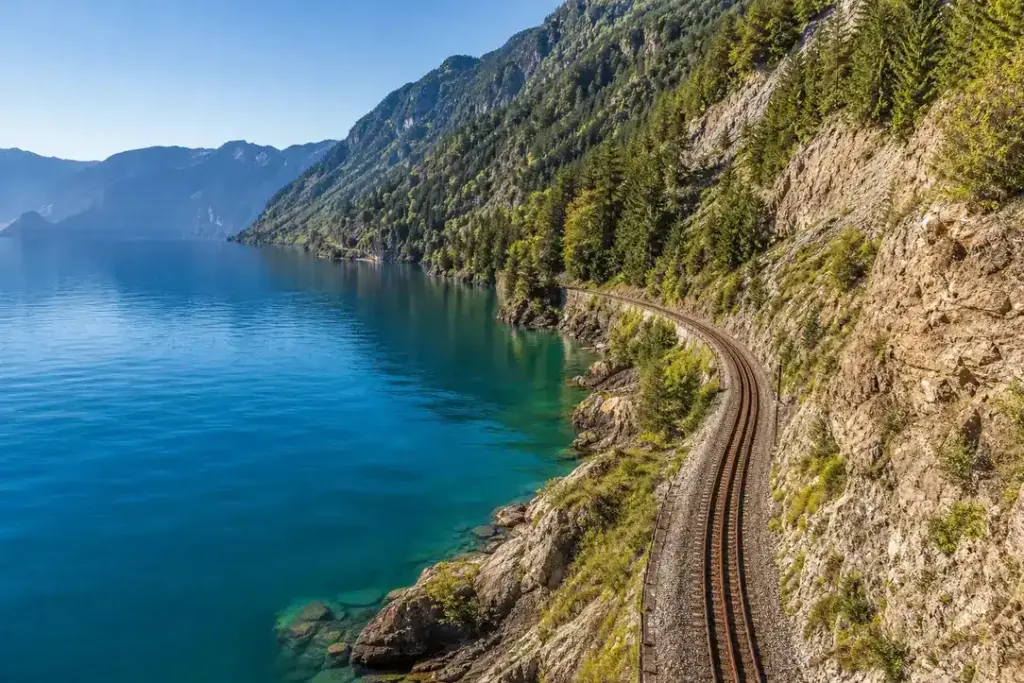
The Trans-Siberian Railway spans nearly 9,300 kilometres across Russia’s diverse landscapes, but certain sections stand out for their extraordinary scenery. This guide focuses on the most photogenic and memorable stretches of track that reward both the patient window-gazer and the explorer willing to step off the train.
The journey takes you across seven time zones, passing through mountains, taiga forest, and some of Earth’s most pristine wilderness. Whether you’re riding the full route from Moscow to Vladivostok or planning stopovers, knowing which sections deserve your attention helps you make the most of each day on the rails. This list covers eight key scenic sections, each with distinct landscapes and photographic opportunities.
At a Glance
| # | Place | Best for | Good to know |
|---|---|---|---|
| 1 | Lake Baikal Southern Shore Section | Most famous scenic stretch | Between Slyudyanka and Ulan-Ude stations, Lake Baikal (Irkutsk region); most visible in daytime journeys; note train #002M (Moscow–Vladivostok) passes at night—choose alternative services if planning a daylight crossing. |
| 2 | Circum-Baikal Railway | Historic mountain rail engineering | Slyudyanka to Port Baikal stations, Lake Baikal region; separate heritage train service, not standard Trans-Siberian trains; full journey approximately 6–7 hours; accessible by transferring from main Trans-Siberian route. |
| 3 | Ural Mountains Section | Europe-Asia boundary landscape | Approaching Yekaterinburg station (1,816 km from Moscow, approximately 26 hours); best in autumn when the contrast between deciduous and coniferous trees is clearest, and winter when snow accentuates the ridge lines. |
| 4 | Krasnoyarsk and Yenisei River Section | Midpoint river gorge | Krasnoyarsk station, approximately 4,065 km from Moscow, day 2–3 of journey; river views most striking in morning light heading east; fall colors in surrounding taiga. |
| 5 | Siberian Taiga Between Novosibirsk and Krasnoyarsk | Endless forest wilderness | Between Novosibirsk and Krasnoyarsk stations; viewed from windows continuously; best light in morning or late afternoon when shadows deepen the forest. |
| 6 | Amur River Valley Section | Far East river passage | Eastern sections approaching Vladivostok, approximately days 5–7 of Moscow–Vladivostok journey; Amur River crossing around Khabarovsk region; summer shows the river at full flow. |
| 7 | Volga River at Nizhny Novgorod | European Russia river landmark | Nizhny Novgorod station, 461 km from Moscow, approximately 6 hours from the start; best viewed from left-hand windows heading east; visible during daytime hours. |
| 8 | Golden Horn Bay Approach to Vladivostok | Final Pacific terminus landscape | Vladivostok Vladivostok railway station, 9,259 km from Moscow, day 6–7 of journey; bay views clear in daylight approach; best in summer and early autumn light. |
How We Chose
Sections selected for scenic excellence are based on verified geography, accessibility from the main Trans-Siberian route, and documented landscape characteristics. Each section is currently traversed by operational trains. Entries reflect how the landscape actually appears from train windows and the practical reality of viewing conditions (time of day, season, vantage points). Criteria include dramatic topography, water views, forest character, and photographic composition from moving trains.
1. Lake Baikal Southern Shore Section – Most famous scenic stretch
The Trans-Siberian skirts Lake Baikal's southern shore between Slyudyanka and Ulan-Ude for approximately 100 kilometres and 1.5 to 2 hours of travel. The water spreads directly below rocky cliffs on clear days, and mountains rise across the far shore. Lake Baikal is the world's deepest freshwater lake and holds 20 percent of Earth's unfrozen fresh water. Best viewed from the right-hand side of the train heading east. Morning and afternoon light bring out the water's crystalline blue.
Good to know: Between Slyudyanka and Ulan-Ude stations, Lake Baikal (Irkutsk region); most visible in daytime journeys; note train #002M (Moscow–Vladivostok) passes at night—choose alternative services if planning a daylight crossing.
Tip: Take a day train from Irkutsk to Ulan-Ude rather than the evening service to experience the full Baikal views. The Rossiya train often passes in darkness; check the specific service schedule before booking.
2. Circum-Baikal Railway – Historic mountain rail engineering
This 89-kilometre heritage railway winds along Lake Baikal's southwestern shore from Slyudyanka-2 to Port Baikal, featuring 38 tunnels, 18 galleries, and 248 bridges carved from the landscape more than a century ago. The train moves slowly enough to observe stone viaducts and masonry work set against water views. The tracks hug cliffsides rising 270 to 400 metres above the shore. Though no longer the main Trans-Siberian route, it remains in operation for excursions and scenic journeys.
Good to know: Slyudyanka to Port Baikal stations, Lake Baikal region; separate heritage train service, not standard Trans-Siberian trains; full journey approximately 6–7 hours; accessible by transferring from main Trans-Siberian route.
Tip: Plan this as a dedicated excursion from Irkutsk rather than trying to fit it into a continuous Moscow–Vladivostok journey. Many travelers disembark at scheduled stops to photograph tunnels and explore sections on foot.
3. Ural Mountains Section – Europe-Asia boundary landscape
The train winds through the breathtaking Urals, a mountain range that marked a natural boundary between two continents. The route crosses snow-covered Ural Mountains, with slopes and taiga forest creating dimensional layers. The crossing from European Russia into Siberia is felt in the landscape's shift from gentler terrain to wilder forest. Yekaterinburg is located at the border of Europe and Asia.
Good to know: Approaching Yekaterinburg station (1,816 km from Moscow, approximately 26 hours); best in autumn when the contrast between deciduous and coniferous trees is clearest, and winter when snow accentuates the ridge lines.
Tip: The Urals are more subtle than Lake Baikal—no single climactic moment. Spend time watching from morning onwards as the forests change character and rock outcrops appear. The transition itself is the beauty.
4. Krasnoyarsk and Yenisei River Section – Midpoint river gorge
Nearly halfway along the journey, you'll arrive in Krasnoyarsk. It's located on the banks of the Yenisei River, surrounded by picturesque mountains. Krasnoyarsk has the Stolby Nature Reserve immediately at its edge — dramatic basalt pillars rising from taiga forest. The river creates a valley where the train descends, offering the first strong sense of Siberian depth. The railway crosses 16 large rivers including the Volga, the Yenisey.
Good to know: Krasnoyarsk station, approximately 4,065 km from Moscow, day 2–3 of journey; river views most striking in morning light heading east; fall colors in surrounding taiga.
Tip: Krasnoyarsk marks the midpoint psychologically and geographically. Step off for an hour or two to see the Yenisei River embankment; the landscape visible from a platform is different from what the moving train reveals.
5. Siberian Taiga Between Novosibirsk and Krasnoyarsk – Endless forest wilderness
The stretch between Novosibirsk and Krasnoyarsk (approximately 760 kilometres and 11 hours) is pure Siberian taiga—mile after mile of coniferous forest punctuated by small wooden villages and frozen or flowing rivers depending on season. The vast Siberian taiga unfolds, presenting an expanse of unspoiled wilderness. The repetition itself is meditative; the scale of untouched forest conveys Russia's vastness more than any singular landmark. In winter, birch trees appear as white lines against snow.
Good to know: Between Novosibirsk and Krasnoyarsk stations; viewed from windows continuously; best light in morning or late afternoon when shadows deepen the forest.
Tip: Do not expect dramatic peaks or water features—the taiga's power is in its unbroken continuity. Bring binoculars to spot distant rock formations and occasional animals at the forest edge. Summer and early autumn show the most varied greens.
6. Amur River Valley Section – Far East river passage
The railway crosses 16 large rivers including the Volga, the Yenisey, the Amur. The Amur River section in the Russian Far East presents a different character from Lake Baikal—a working river bordered by taiga and small settlements. The landscape becomes more remote as you approach Vladivostok. The valley shows evidence of both indigenous and Russian settlement patterns along the water.
Good to know: Eastern sections approaching Vladivostok, approximately days 5–7 of Moscow–Vladivostok journey; Amur River crossing around Khabarovsk region; summer shows the river at full flow.
Tip: The Amur section is less famous than Baikal but equally worth watching. River views alternate with forest; keep cameras ready for sudden clearing and water vistas.
7. Volga River at Nizhny Novgorod – European Russia river landmark
Not long after you leave Moscow, you'll pull into Yaroslavl, one of the oldest cities in Russia, founded in 1010. The Volga promenade is one of the most beautiful sights, Europe's longest river, dotted with cafes. The Volga crossing near Nizhny Novgorod marks the first major river landscape. The railway crosses 16 large rivers including the Volga. The valley here has a softer character than Siberian sections, with gentle slopes and historic settlements visible from the train.
Good to know: Nizhny Novgorod station, 461 km from Moscow, approximately 6 hours from the start; best viewed from left-hand windows heading east; visible during daytime hours.
Tip: This section comes early in the journey when energy is high. Don't sleep through it—the contrast between European Russia's river valleys and what comes later is part of the Trans-Siberian's narrative.
8. Golden Horn Bay Approach to Vladivostok – Final Pacific terminus landscape
Vladivostok, the Pacific terminus, is built on steep hills above Golden Horn Bay with the atmosphere of a naval and merchant city at the edge of the world. It has excellent seafood, a visible Korean and Chinese cultural influence, and remarkable views from the suspension bridge to Russky Island. The final hours of the journey descend into this coastal valley. The train arrives on hills overlooking the bay.
Good to know: Vladivostok Vladivostok railway station, 9,259 km from Moscow, day 6–7 of journey; bay views clear in daylight approach; best in summer and early autumn light.
Tip: Arrive during daylight if possible to see the bay and city from the final kilometres of track. The psychological and geographical endpoint carries its own drama after nearly a week on rails.
Russia Vibes Tips
- Book day trains strategically. Take the day train from Irkutsk to Ulan-Ude – either the D150IJ (09:30) or the 520CH (13:30) to see the south shore of Lake Baikal during the daytime. Evening and night trains pass scenic sections in darkness. Check specific train schedules (the Rossiya train often covers Lake Baikal at night) and choose services that align with daylight hours over key sections.
- Sit on the correct side of the train. The Trans-Siberian skirts the southern shore of Lake Baikal for roughly 100 km between Slyudyanka and Ulan-Ude. This section takes about 1.5–2 hours and offers direct water views from the right (south) side of the train in the Moscow-to-Vladivostok direction. When heading to Vladivostok, request right-side windows for Lake Baikal; when returning westbound, sit on the left.
- Winter transforms scenery completely. The birch forest under snow, the frozen rivers with ice fishermen working through holes in the ice, the steam rising from towns against clear cold skies: the landscape strips itself down to line and white. Lake Baikal frozen solid is one of the most extraordinary sights in Russia. If visiting in winter (December–February), expect entirely different views; plan accordingly for photography and bring warm-weather window access.
- Protect your camera from window reflections. As the train departs Moscow, the urban landscape gives way to the serene surroundings of the Russian countryside. The contrast is striking: rolling fields, aspen groves, and quaint village homes dot the landscape. Shooting through train windows requires care—clean the glass frequently, angle to minimize interior reflections, and use a lens hood. Carry a cloth for wiping.
- Don't expect constant dramatic scenery. Long sections of the route are repetitive taiga forest, which has its own meditative quality but lacks peaks and water. Despite the long distances there are not a wide-range of landscapes. The highlight is undoubtedly Lake Baikal and its surroundings. Plan rest and sleep knowing that focus periods (Urals, Baikal, Amur) are separated by hours of steady forest.
- Build stopovers into your itinerary. Rather than riding Moscow–Vladivostok non-stop, plan 1–2 day stops in key cities (Yekaterinburg, Irkutsk, Vladivostok) to experience landscapes on foot and from different angles. The train stops first in Irkutsk and, about seven hours later, in Ulan-Ude. Use Irkutsk as a base for the lake excursions.
Explore Nearby Best Scenic Sections of the Trans-Siberian Railway, Trans-Siberian Railway
Related guides
 Lake Baikal: Where to Go, What to See and How to Visit
Main image: AI-generated illustration. It may not show the place exactly as it looks.
 Listvyanka Day Trip, Irkutsk: Getting to Lake Baikal and Back
Main image: AI-generated illustration. It may not show the place exactly as it looks.
 Irkutsk: 130 Kvartal, Decembrists and Gateway to Lake Baikal
Main image: AI-generated illustration. It may not show the place exactly as it looks.
 Yekaterinburg: Red Line, Yeltsin Center and Europe-Asia Border
Main image: AI-generated illustration. It may not show the place exactly as it looks.
 Vladivostok: Bridges, Eagle’s Nest and the Trans-Siberian End
Main image: AI-generated illustration. It may not show the place exactly as it looks.
Browse more: All Guides · All Guides in Trans-Siberian Railway · All Trans-Siberian Railway · All Viewpoints and Photo Spots
FAQ
Can you see Lake Baikal from the main Trans-Siberian train?
Yes, briefly, and beautifully. The Trans-Siberian skirts the southern shore of Lake Baikal for roughly 100 km between Slyudyanka and Ulan-Ude. This section takes about 1.5–2 hours and offers direct water views from the right (south) side of the train in the Moscow-to-Vladivostok direction. However, if you don't stop off in Irkutsk and are travelling on the Rossia train you will hardly be able to see the lake as the train passes it at night.
Is the Circum-Baikal Railway part of the main Trans-Siberian route?
The Circum-Baikal railway was part of the main line of Trans–Siberian Railway until the middle of the 20th century; later on, however, a duplicate section of the railway was built. Today it operates as a separate heritage train service for excursions, not as the standard route. You must travel the main line and then book a separate Circum-Baikal excursion.
What is the best season for scenic views on the Trans-Siberian?
Summer — late June through August — offers the most accessible version: birch trees in full leaf, Lake Baikal ice-free, the famous 3 am light in the long Siberian twilight, and the full range of platform vendors and river views. The Baikal segment in July, with long warm evenings and the lake's extraordinary clarity, is the route at its most cinematically beautiful. Winter offers entirely different scenery (frozen landscapes, ice on Baikal) but requires more caution in travel planning.
How long does the Lake Baikal section take?
For about 5-6 hours trains run along the coast of Lake Baikal. However, the section between Slyudyanka and Ulan-Ude takes about 1.5–2 hours with direct water views from the train. The exact duration depends on which station you start from and the specific train service.
Are there observation cars or special seating for scenery on the Trans-Siberian?
Standard Trans-Siberian trains do not have dedicated observation cars. Scenery is best viewed from regular compartment or corridor windows. Luxury tours (such as the Golden Eagle train) may offer better window access, but these are premium services. For the standard Rossiya and other common trains, position yourself by a window and book an outside-facing compartment if possible.
What is the most dramatic section of the Trans-Siberian Railway?
Lake Baikal is universally recognised as the most visually spectacular section. Lake Baikal is the largest freshwater, deepest and most wildlife-rich lake on Earth. Few natural sights can surpass the beauty and grandeur of Lake Baikal, so it is no surprise that this is one of the most highly anticipated stops on the journey. The Ural Mountains section is also significant as the Europe-Asia boundary, though less sudden in impact.
How far in advance should I book the Trans-Siberian to get good seating for views?
Standard Russian trains operate on a ticketing system that allows bookings several weeks in advance. Specific window positions (left or right side, higher or lower berths) are assigned after booking, often only at the station or a few days before departure. For scenic purposes, request right-side windows for the Lake Baikal section (heading east) when booking. If flexibility is possible, choose daytime trains for key scenic sections rather than focusing on cabin position.
What photography equipment should I bring for Trans-Siberian scenery?
Bring a good digital camera with both wide and medium telephoto lenses (to capture distant landscapes and close forest details). A tripod is impractical on moving trains, so practice hand-holding techniques. Bring a lens cloth and cleaning cloth (train windows accumulate dust and condensation). Consider a polarizing filter to reduce window reflections. A long-range smartphone lens adapter is lighter than carrying multiple camera lenses. Protect all equipment from the dust that enters compartments during station stops.
Russia Vibes is a one-person project. A coffee keeps it going

Take this guide with you
Get a free PDF of this guide to print or read offline: key facts, tips and a map link on a few clean pages.
Report an issue on this page
Paying for your trip: please read
Payments and bookings between Russia and many other countries are currently restricted. In practice, cards issued in the EU, the UK, the US and several other countries often cannot be used in Russia, Russian cards usually cannot be used abroad, and some booking platforms, airlines and payment providers limit or pause their services for Russia. The situation changes frequently.
We do not give legal or financial advice, and this site does not encourage anyone to break any rule that applies to them. Whatever you plan, you are responsible for following the laws and regulations that apply to you, including those of your country of residence and citizenship.
Many travelers still organise their stay without problems. It is worth asking your bank or payment provider what is currently possible, contacting hotels, tour operators and carriers directly about the payment methods they accept, and checking which services are open to customers from your country. Clarify payment, cancellation and refund terms before you commit to a booking, and keep your plans flexible.
Partner links on this site may not be available in every country, and prices, availability and rules in our guides can differ from what you see when you book.
How we research and update our guides
About this guide: AI assistance and accuracy
This guide is created with the help of AI and is based on official sources where available. Mistakes can still happen. Opening hours, prices, rules and other details are given to the best of our knowledge as of the date shown and can change without notice. It offers general recommendations only, not professional, legal or travel advice. Please confirm important details with the official source before you travel; you are responsible for your own plans and decisions.