
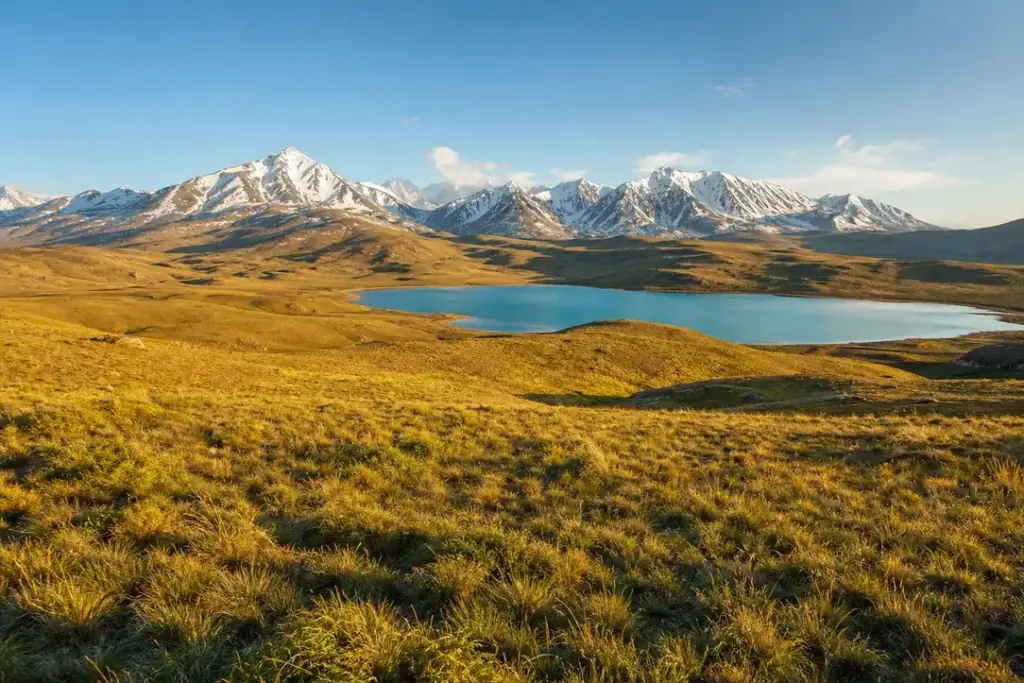
The Ukok Plateau is a remote and pristine grassland landscape sitting at 2,200–2,500 metres above sea level in the southern Altai Mountains, near the tri-border region of Russia, Kazakhstan, and Mongolia. Visitors find themselves in one of Russia’s least accessible protected areas—a place of windswept steppe, turquoise lakes, glaciers, and mountain peaks rising 500–600 metres above the plain.
The plateau is recognized as part of the UNESCO World Heritage Site Golden Mountains of Altai. It is best known internationally for the 1993 discovery of a naturally preserved Pazyryk mummy—a young woman from the 5th century BCE whose body remained frozen in the permafrost for 2,400 years. Today, the plateau attracts archaeologists, wildlife researchers, and adventurous visitors willing to undertake the challenging journey across mountain passes and steppe trails.
Current access notice: As of October 2026: The Ukok Plateau remains a strictly protected area. Foreign visitors require a border pass issued two months in advance. Visits are possible only June through September when mountain passes are open. At least 60 days advance notice is recommended, though the process can be managed in some cases.
Quick Facts
| Russian name | Укок |
|---|---|
| Built / opened | 1994 |
| Address | Kosh-Agach District, Altai Republic, Russia Google MapsApple MapsYandex Maps2GIS |
| District | Altai Republic |
| Admission | Requires special permit and recreational fee |
| Best time to visit | June through September. Vehicle access is possible only after snow melts from the passes, typically late June onward. July and August offer the warmest weather (+15–25°C daytime, +5–7°C nights), clearest skies, and best wildlife viewing. June brings spring flowers but lingering snow; September offers golden steppe and autumn colours but cold nights and risk of early storms. Winter (October–May) is inaccessible due to extreme snow and cold. |
What Is (and Isn't) Part of a Visit to Ukok Plateau, Altai Mountains?
| Part | Status | Notes |
|---|---|---|
| The plateau grasslands and steppe landscape | Included in the standard ticket | Vehicle and hiking access permitted in Zone C (recreation zone). Zones A and B require special authorization. |
| Burial mounds and archaeological sites | Outside / not part of it | The specific excavation sites are off-limits to tourists. Archaeological excavations have been banned since the 1990s. Visitors may view the general landscape and petroglyphic sites but cannot disturb burial mounds. |
| The Siberian Ice Maiden mummy | Outside / not part of it | The mummy is housed in the National Museum of the Altai Republic in Gorno-Altaysk, not on the plateau. The burial site itself is not accessible to visitors. |
| Petroglyph sites, especially Elangash | Included in the standard ticket | Petroglyphic rock art is viewable. The Elangash complex in the adjacent Chuyskaya Steppe is accessible as part of Ukok-region tours. |
| Tarkhatinskoe Lake | Included in the standard ticket | Alpine lake in Zone C is a standard stop on vehicle tours. Located on the plateau itself. |
| Tepliy Klyuch pass | Included in the standard ticket | The pass is the main vehicle route onto the plateau and is visited as part of the journey. Dramatic views and the sense of crossing into a remote region are key experiences. |
| Wildlife observation | Included in the standard ticket | Snow leopards, argali sheep, eagles, and other wildlife inhabit the plateau. Sightings are not guaranteed but possible in July–August during daytime travel. |
| Gorno-Altaysk National Museum | Outside / not part of it | Located in the Altai Republic's capital, not on the Ukok Plateau. It houses the Ice Maiden mummy and Pazyryk artifacts. A separate visit from an Ukok trip. |
Why Visit Ukok Plateau, Altai Mountains?
The plateau offers one of Russia’s last intact alpine steppe ecosystems. Visitors encounter endangered snow leopards, argali mountain sheep, and vast herds of wildlife in pristine grasslands largely untouched by development. The area contains over 150 Scythian burial mounds and petroglyphic sites, offering a window into the ancient Pazyryk culture.
The extreme remoteness itself is an attraction: reaching Ukok requires crossing high-mountain passes, fording rivers, and traveling hours across steppe trails. The landscape shifts dramatically with season—June brings snowmelt and spring flowers, July-August offer clear skies and moderate weather, and September sees golden grass and the onset of cold. Few places in Russia reward such effort with such solitude.
Highlights of Ukok Plateau, Altai Mountains
High-altitude steppe landscape
The plateau rises 2,200–2,500 metres above sea level and stretches across an undulating grassland dotted with alpine meadows, turquoise karst lakes, and clear cold streams. Surrounding ridges push 500–600 metres higher, with the highest peak, Khüiten (also called Kuiten-Uul), reaching 4,374 metres. The terrain looks desolate but hosts dozens of glaciers and thriving high-altitude plant and animal communities adapted to severe conditions.
Tip: The plateau is accessible by vehicle only from late June onward, when snow melts from the mountain passes. Even then, only specialist four-wheel-drive vehicles can cross the terrain.
Ak-Alakha burial mounds and the Ice Maiden discovery site
In 1993, archaeologist Natalia Polosmak discovered a naturally preserved mummy of a young Pazyryk woman dated to the 5th century BCE buried in a frozen kurgan (earthen mound) near the Altai-Mongolia border. She lay in a wooden sarcophagus surrounded by horses and treasured objects, all preserved by permafrost that had sealed the burial chamber. The discovery revealed extraordinary details about Pazyryk society, including elaborate tattoos on the woman's body.
Tip: The mummy itself is now housed in the National Museum of the Altai Republic in Gorno-Altaysk, not on the plateau. Visits to the burial sites on Ukok are restricted; archaeological excavations have been banned since the 1990s out of respect for local beliefs and conservation concerns.
Ancient petroglyphic sites
Scattered across the plateau are rock carvings dating back thousands of years. The nearby Elangash natural area in the Chuyskaya Steppe contains an entire complex of approximately 30,000 petroglyphic images, among the most ancient in Siberia. They depict animals, hunters, and ritual scenes connected to the Pazyryk and earlier cultures. Some petroglyphs are thought to date to the Bronze Age.
Tip: Petroglyphs are fragile. Do not touch or climb on them. Photographs should be taken from a distance and preferably during early morning or late afternoon light, which brings out the carved details.
Snow leopard habitat
The Ukok Plateau is home to one of the world's least studied large predators, the snow leopard, an endangered species found only in high Central Asian mountains. The plateau also shelters argali mountain sheep, steppe eagles, and black storks. Wildlife sightings are rare due to the animals' shyness and the vastness of the terrain, but the plateau's protection means populations remain viable.
Tip: Early mornings in July and August offer the best chance of seeing wildlife. Binoculars are essential. Move slowly and quietly; sudden movements will startle animals. Respect restricted zones—parts of the plateau are closed to protect breeding and wintering grounds.
Tarkhatinskoe Lake
One of the plateau's clear alpine lakes, Tarkhatinskoe sits amid endless grassland. The water is ice-cold even in summer, fed by snowmelt and glaciers. The lake offers a dramatic illustration of the plateau's harsh beauty—stark, windswept, and seemingly at the edge of the world. It is accessible by vehicle and provides a focal point for day excursions.
Tip: The lake is extremely cold; do not attempt swimming. Bring wind-resistant gear; the plateau is notoriously windy, and conditions change rapidly. The nearest shelter is the vehicles themselves.
Tepliy Klyuch pass
The main crossing into the plateau from the south, Tepliy Klyuch is a high-mountain pass that requires skilled driving. The route up and over the pass passes through dramatic terrain—narrow switchbacks, river fords, and exposed ridges with panoramic views across the border regions. Crossing the pass is a central element of any Ukok journey, offering a visceral sense of the plateau's isolation.
Tip: Travel only with experienced local drivers familiar with the seasonal conditions of the pass. Do not attempt to drive it in poor weather or when snow is present. Even in summer, the pass can be impassable after rain.
Atmosphere
The plateau feels like the end of the earth. Wind is almost constant, carrying the smell of steppe grass and distance. The sky is huge and often dramatic—clear blue mornings can turn to sudden cloud or rain by afternoon. In July and August, daytime temperatures reach +15–25°C, but nights drop to +5–7°C, and the sun barely sets in late June. The landscape is largely empty; other people are rare, and the absence of development is absolute.
Wildlife moves distantly across the grassland, barely visible. Silence dominates, punctuated only by wind and occasional birdsong. The place carries an undeniable spiritual weight for local Altai and Kyrgyz herders who still use parts of the plateau for summer pasture and consider it sacred ground.
History of Ukok Plateau, Altai Mountains
The Pazyryk culture flourished in the Altai Mountains and surrounding steppes during the 5th to 3rd centuries BCE. This nomadic people left a legacy of elaborate burial mounds—kurgans—scattered across the region. The permafrost of the Ukok Plateau, unusual for its latitude, created an exceptional natural preservation environment. When burial chambers at these sites froze over, they became sealed vaults, preserving organic materials like wood, textiles, leather, and even hair and skin in conditions normally found thousands of metres higher in altitude.
Over 150 Scythian-influenced burial mounds dot the plateau. Early archaeological work in the mid-20th century uncovered spectacular finds, including the world’s oldest known carpet, discovered in 1949 in the Pazyryk mounds of the eastern Altai. However, the most famous discovery came in 1993 when archaeologist Natalia Polosmak and her international team excavated mound Ak-Alakha-3 near the Altai-Mongolia border. There they found the naturally preserved body of a young Pazyryk woman, her skin bearing intricate blue tattoos depicting animals, and her grave containing six saddled horses and an array of precious goods meant for the afterlife.
The discovery of what became known as the Siberian Ice Maiden or Princess of Ukok generated worldwide scientific interest but also sparked local controversy. Altai and Kyrgyz communities viewed the excavation and the removal of the remains to a museum in Novosibirsk as a desecration. Local shamans linked earthquakes and other disasters in the region to the disturbance of her burial. By the late 1990s, a ban was imposed on further excavations on the plateau, and the mummy was eventually returned to a museum in Gorno-Altaysk in 2012, a compromise between archaeological study and local respect for the dead.
In 1994, the plateau was designated a nature reserve to protect its unique ecosystem. In 1998, it became part of the UNESCO World Heritage Site called Golden Mountains of Altai, recognizing both its biological significance and its cultural heritage value. Today, the plateau remains one of Russia’s most strictly protected areas, divided into zones that restrict visitor access and prohibit economic exploitation.
Legends and Myths about Ukok Plateau, Altai Mountains
The Ice Maiden as guardian of the gates
Shangri-la and sacred Altai
Legend – historically unreliable. Buddhist and Burkhanic traditions identified the Altai Mountains, and by extension the high plateau, as a refuge of spiritual power—even as the location of Shangri-la, known in Buddhist cosmology as Shambala, a hidden kingdom of enlightenment and peace. The Ukok Plateau, sitting at the convergence of borders and at extreme altitude, fits this mythic geography as a place where the material and spiritual worlds thin and merge.
The plateau as the realm of mammoth steppe spirits
Legend – historically unreliable. Ancient peoples viewed the Ukok and surrounding steppe as the living remnant of the mammoth era—a time when ice-age megafauna roamed these grasslands. Folklore holds that the spirits of mammoths and other prehistoric creatures inhabit the windy plateau, and that shamans travel there to commune with ancestral animal powers and the deep past.
Tickets and Booking for Ukok Plateau, Altai Mountains
Visiting the Ukok Plateau requires advance planning and multiple permits. Foreigners must obtain a border pass through official Russian channels at least two months before their intended visit date. Russian citizens need 15–30 days advance notice.
A recreational fee must be paid to the Ukok Quiet Zone Park Directorate. Most international visitors arrange visits through registered tour operators based in Gorno-Altaysk or Barnaul, who handle permit applications, vehicle hire, and logistics. Independent visits are theoretically possible but impractical; the area offers no accommodation or facilities, and vehicles must be specially equipped four-wheel-drive SUVs or UAZ vans familiar to the terrain.
Tours typically range from five to fourteen days and include transport, fuel, food, camping equipment, and the necessary permits. Tour operators maintain schedules aligned with seasonal access (June through September). Check with the official park directorate or registered tour operators for current permit timelines and fees; these can vary by season and by visitor nationality.
Plan and Book
Suggested itineraries Ukok Plateau, Altai Mountains
5 days
Day 1: Travel from Gorno-Altaysk or Barnaul south along the Chuysky Tract to Kosh-Agach. Day 2: Depart Kosh-Agach in equipped vehicles, travel through the Chui Steppe toward the border checkpoint, then climb toward Tepliy Klyuch pass. Day 3: Cross the pass and reach the plateau; visit Tarkhatinskoe Lake. Day 4: Explore the plateau interior, view petroglyph sites, search for wildlife. Day 5: Return journey via the same route.
10 days
Includes longer exploration across the plateau. Days 1–2: Drive to Kosh-Agach and begin ascent. Days 3–8: Multiple days on the plateau visiting different zones, following river valleys, camping near lakes, exploring burial mound areas, petroglyph sites, and attempting wildlife viewing. Days 9–10: Return to regional centers. Allows for multi-day hiking excursions and better acclimatization to altitude.
14 days
Extended expedition allowing deep exploration. Initial days: Travel and acclimatization. Middle days: Horseback and hiking treks into remote sections of the plateau, visiting peripheral ridges, glacier viewpoints, river gorges, and secondary archaeological sites. Later days: Return via Chuya Gorge and time in Kosh-Agach. Enables experience of changing weather patterns and higher chance of wildlife encounters.
How to Get to Ukok Plateau, Altai Mountains
By vehicle from Gorno-Altaysk (capital of Altai Republic): The journey begins on the Chuysky Trakt (Altai Highway), one of Russia’s most scenic routes, heading south from Gorno-Altaysk toward the village of Kosh-Agach (approximately 670 kilometres). The highway passes through mountain passes and varied terrain. Asphalt ends at Kosh-Agach; from there, only unpaved tracks suitable for four-wheel-drive vehicles lead onward.
Beyond Kosh-Agach, the route follows dirt trails south through the Chui Steppe, crosses a border checkpoint (approximately 30 kilometres out), then continues along the Tarhata River valley. After roughly 70 kilometres of rough terrain, the road reaches Tepliy Klyuch, a high mountain pass that serves as the main gateway onto the plateau. The pass itself requires skilled navigation—river fords, sharp switchbacks, and rocky inclines. Vehicle travel time from Kosh-Agach to the plateau is 8–12 hours depending on weather and road conditions.
Independent travel is not feasible. Visitors must hire experienced local drivers and properly equipped four-wheel-drive vehicles (usually UAZ or GAZ-66 models). Travel in convoy of two or more vehicles is strongly advised—the nearest help is 100+ kilometres away. Fuel is not available beyond Kosh-Agach; vehicles must carry sufficient supplies.
From Moscow or other major Russian cities: Fly to Gorno-Altaysk (served by regional flights from Moscow, Novosibirsk, and other hubs), then arrange vehicle transport southward. Most visitors book multi-day tours through Altai-based operators who coordinate all logistics.
Accessibility
The Ukok Plateau is not accessible to people with mobility restrictions. The terrain is remote and roadless beyond Kosh-Agach; all access is by four-wheel-drive vehicle or on foot. Altitude exceeds 2,200 metres, posing risks for those with altitude sensitivity. Vaccination against plague is required (endemic in the region). There are no wheelchair-accessible facilities, medical services, or accommodation infrastructure on the plateau. This is an expedition-level destination.
Food Nearby
No food services exist on the plateau. Visitors must either bring pre-prepared food or rely on tour operators who provide meals as part of package tours. Kosh-Agach village (the last supply point) has basic shops and small cafés selling simple Russian and local dishes. Restaurants in Gorno-Altaysk or Barnaul serve regional Altai cuisine before departure. All meals on the plateau are self-contained and usually cooked over campfires as part of organized tours.
What to Bring
Extreme-weather gear: warm insulated jacket, windproof layers, wool socks, and a hat even in summer (nights drop to +5–7°C and wind is relentless). Waterproof pants and jacket. High-sun SPF sunscreen (UV exposure at altitude is intense). Insect repellent for late June and July. Trekking boots with ankle support for rocky terrain. Sleeping bag rated for +5°C. Headlamp or flashlight. Water bottle or hydration system. Binoculars for wildlife viewing. First-aid kit. High-altitude acclimatization aids if prone to mountain sickness. Tablet/e-reader with offline maps of the region. Small camera for photography. All food, fuel, and specialized camping equipment should be arranged through tour operators. Bag rules are minimal—the plateau has no security checkpoints—but bring only essential gear; space in vehicles is limited.
Best Views and Photo Spots of Ukok Plateau, Altai Mountains
Tepliy Klyuch pass descent
Looking back toward the plateau after cresting the pass offers sweeping views of grassland, distant mountains, and the scale of the terrain. The road winds away below, emphasizing the remoteness and the sense of arriving in a different world.
Best time: Late afternoon, when the low sun illuminates the slopes and casts long shadows that emphasize the terrain's contours. Early morning also works for dramatic cloud effects.
Tarkhatinskoe Lake shore
Alpine lake surrounded by bare grassland and distant ridges. The turquoise water contrasts starkly with the green-brown steppe. Reflections in calm morning conditions are striking. The lake conveys the plateau's scale and isolation.
Best time: Early morning when the water is calm and the sky is clearest. Midday wind often ruffles the surface. Cloudy skies photograph well too, adding drama.
High ridge overlooking the southern plateau
Panoramic vistas encompassing three or four mountain ranges and the vast steppe plain stretching to borders with Mongolia and China. On clear days, the horizon seems limitless. This is the 'roof of the world' perspective.
Best time: Clear days in July and August. Early morning often has better visibility before afternoon haze develops. Avoid windy afternoons when clouds build quickly.
Petroglyph cluster at Elangash
Ancient rock carvings depicting animals, hunters, and ritual scenes carved into dark stone faces. The carvings contrast with the light rock background. The surrounding landscape context emphasizes the age and mystery of the images.
Best time: Early morning or late afternoon when raking light brings out carved details. Midday overhead sun flattens the rock surface. Avoid shooting directly into the sun to reduce glare on polished stone.
Steppe grassland in full colour (July–August)
Endless rolling grassland dotted with wildflowers and low shrubs. The golden grass, blue sky, and distant mountains form a vast, peaceful composition. No human structures interrupt the view.
Best time: Mid-morning or late afternoon for warm light across the grass. July offers more flowers; August shows richer golden tones. Midday light can bleach colours.
River ford crossing
Vehicles crossing icy glacial rivers offer dramatic action. The turquoise water, wet rocks, and splashing vehicles convey the expedition's challenge and the landscape's rawness.
Best time: During actual crossings, typically in late morning after water levels stabilize from overnight freeze-thaw cycles. Overcast light reduces water glare.
Photography Rules
Drone photography is restricted; check current regulations with your tour operator or the park directorate before bringing drones. Tripods are useful for landscape and wildlife photography but can be cumbersome in remote terrain. Wide-angle lenses are ideal for capturing the vast steppe and mountain horizons. Golden hour (sunrise and sunset) is brief but dramatic in summer. Petroglyphic sites should be photographed from a distance without climbing on rocks. Do not use flash near wildlife, as it disturbs animals. Ask permission before photographing local herders or other people encountered.
Family Suitability
The Ukok Plateau is not suitable for families with young children or for any visitor not in excellent health and experienced with high-altitude backcountry travel. The plateau sits at 2,200+ metres elevation, and the terrain requires all-day vehicle travel over rough roads and high passes. Accommodation is camping in remote conditions far from medical help. Nights are cold even in summer. Children under 12 are unlikely to enjoy or safely tolerate the physical demands. Teenagers and adults should have solid outdoor experience and no altitude sensitivity. This is an expedition destination, not a family holiday.
Russia Vibes Tips
- Book your border pass at least two months in advance. The permit process can be done independently online, but many tour operators handle it as part of their package. Without a valid pass, you will be turned back at the checkpoint.
- Arrive in Gorno-Altaysk 1–2 days before your plateau trip to acclimatize to high altitude (the city is at 320 metres, but internal flights can arrive at higher-altitude airports in the region). Spend the first days on the Chuysky Tract, which climbs gradually, rather than driving directly to 2,200 metres.
- The plateau is extremely windy; pack a good windproof jacket and expect it to be cold even on sunny days. Layers are essential—the sun is intense but the wind strips away heat rapidly.
- Hire a tour operator rather than attempting independent travel. Local drivers know the terrain, river-crossing techniques, and weather patterns. They also have emergency communication and can handle vehicle breakdowns. Independent travel poses real safety risks in a region 100+ kilometres from help.
- Do not expect to see snow leopards or other large wildlife guaranteed. Sightings are rare. Bring binoculars and patience. Early mornings (5–7 a.m.) offer the best chance of spotting animals before human activity disturbs them.
- The plateau is sacred ground for local Kyrgyz and Altai communities. Approach burial mounds and petroglyph sites with respect—do not disturb, remove, or touch artifacts. Photography is fine, but reverence is appropriate.
Explore Nearby Ukok Plateau, Altai Mountains
Related guides
 Altai Mountains: Best Places, Scenic Routes and Travel Tips
Main image: AI-generated illustration. It may not show the place exactly as it looks.
 Best Hiking Trails and Nature Walks, Lake Baikal: Coastal Routes and Alpine Treks
Main image: AI-generated illustration. It may not show the place exactly as it looks.
 Chuya and Katun Confluence: Free Viewpoint and Sacred Altai LandmarkOpen 24 hours
Main image: AI-generated illustration. It may not show the place exactly as it looks.
 Uchar Waterfall: Hiking to Russia’s Most Remote Cascade
Main image: AI-generated illustration. It may not show the place exactly as it looks.
 Akkem Lake: Alpine Trek to Mount Belukha’s Base
Main image: AI-generated illustration. It may not show the place exactly as it looks.
Browse more: More in Altai Republic · All Altai Mountains · All Parks · All Sightseeing · All Sightseeing in Altai Mountains
FAQ: Ukok Plateau, Altai Mountains
Can I visit the Siberian Ice Maiden mummy on the plateau?
No. The mummy is housed in the National Museum of the Altai Republic in Gorno-Altaysk, the regional capital, roughly 670 kilometres north. Visits to the burial sites (kurgans) on the plateau itself are prohibited; archaeological excavations have been banned since the 1990s. The plateau is accessible to general visitors, but the specific burial sites are off-limits.
Do I need a visa to visit the Ukok Plateau?
If you require a Russian visa, you need one to visit any part of Russia, including Altai. Additionally, because the plateau is in a border zone, you must obtain a separate border permit in advance—a requirement separate from your visa. Consult your travel agent and the Russian Ministry of Foreign Affairs for current visa requirements based on your nationality.
What happens if I don't have a border permit?
You will be turned back at the checkpoint approximately 30 kilometres south of Kosh-Agach. Border guards enforce this strictly. Apply for your permit at least two months in advance through official channels or via a registered tour operator.
Is the plateau open year-round?
No. Vehicle access is possible only June through September, when mountain passes are free of snow. Winter temperatures plunge to –30°C or colder, and metre-high snow blocks all routes. The plateau is inaccessible and inhospitable November through May.
Can I drive myself to the plateau?
Theoretically, yes, if you have the necessary permits, a properly equipped four-wheel-drive vehicle, fuel, food, and navigation skills. In practice, hired drivers and tour operators are strongly advised. The terrain is unforgiving, emergency services are 100+ kilometres away, and hiring local drivers supports the regional economy.
Do I need to be vaccinated against plague?
Yes, and this is mandatory. The plague bacillus is endemic in rodent populations in the Kosh-Agach region, including parts of the Ukok area. You must be vaccinated at least 10 days before your visit. Vaccinations are available in Gorno-Altaysk and Kosh-Agach. Consult a travel medicine clinic for current protocols.
What should I pack?
Extreme-weather gear: insulated jacket, wind-resistant layers, warm hat, gloves, thick socks, sturdy trekking boots, and a sleeping bag rated for +5°C. Waterproof pants and jacket. High-SPF sunscreen. Binoculars. Headlamp. First-aid kit. Water bottle. All food must be brought or provided by your tour operator. Tour operators typically supply camping equipment.
How many days should I plan for a visit?
Minimum five days: two days of travel to/from the plateau and three days on it. Seven to ten days allows better exploration and acclimatization. Fourteen days permits deep trekking into remote sections. Shorter visits feel rushed given the long drive from Gorno-Altaysk.
Russia Vibes is a one-person project. A coffee keeps it going
How we research and update our guides
About this guide: AI assistance and accuracy
This guide is created with the help of AI and is based on official sources where available. Mistakes can still happen. Opening hours, prices, rules and other details are given to the best of our knowledge as of the date shown and can change without notice. It offers general recommendations only, not professional, legal or travel advice. Please confirm important details with the official source before you travel; you are responsible for your own plans and decisions.
Packing for this trip
* Affiliate link: as an Amazon Associate we earn from qualifying purchases at no extra cost to you.

Take this guide with you
Get a free PDF of this guide to print or read offline: key facts, tips and a map link on a few clean pages.
Report an issue on this page
Paying for your trip: please read
International sanctions affect payments between Russia and many other countries. In practice, cards issued in the EU, the UK, the US and several other countries often do not work in Russia, Russian cards usually do not work abroad, and some booking platforms, airlines and payment providers limit or suspend their services for Russia. The situation changes frequently.
We do not give legal or financial advice, and this site does not encourage anyone to break or circumvent sanctions. Whatever you plan, you are responsible for following the laws and regulations that apply to you, including those of your country of residence and citizenship.
Many travelers still organise their stay lawfully. It is worth asking your bank or payment provider what is currently permitted, contacting hotels, tour operators and carriers directly about the payment methods they accept, and checking which services are open to customers from your country. Clarify payment, cancellation and refund terms before you commit to a booking, and keep your plans flexible.
Partner links on this site may not be available in every country, and prices, availability and rules in our guides can differ from what you see when you book.