
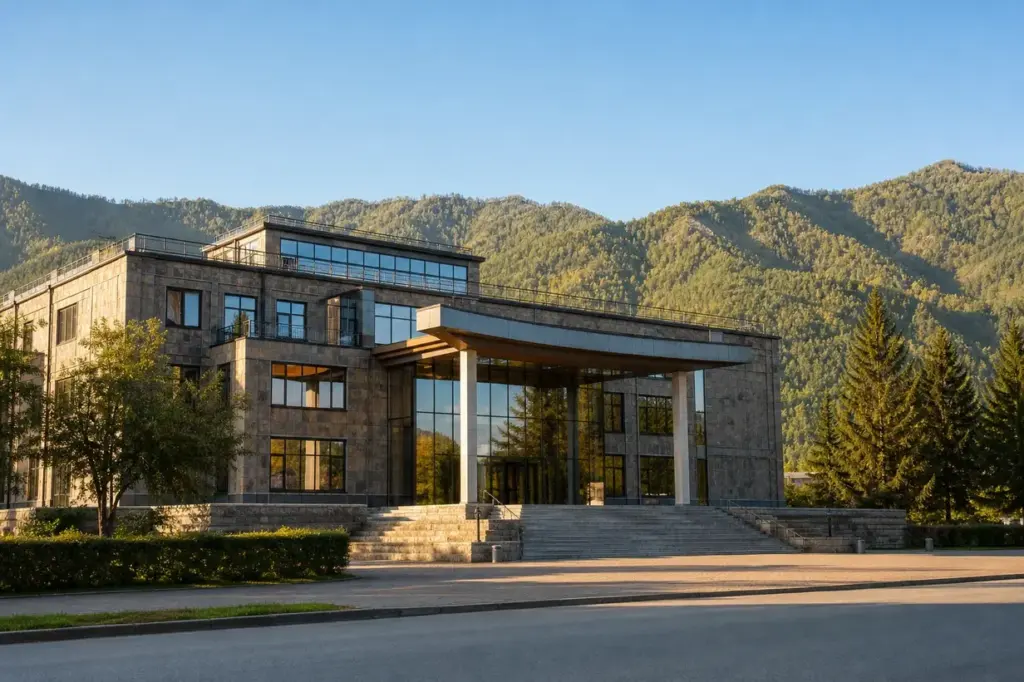
The National Museum of the Altai Republic, formally the Anokhin Museum, is located in Gorno-Altaysk, the capital of Altai Republic in southwestern Siberia. The museum is known worldwide for housing the mummified remains of the Siberian Ice Maiden, a Pazyryk-era burial discovery that ranks among the most important Russian archaeological finds of the twentieth century.
Beyond this famous artifact, the museum holds four major collections spanning paleontology, archaeology, ethnology, and decorative arts. Visitors encounter mammoth and bison bones, tools and ornaments from ancient burials, millennium-old deer stones, and regional artworks that document the region’s cultural evolution.
Quick Facts
| Russian name | Национальный музей Республики Алтай имени А.В. Анохина |
|---|---|
| Built / opened | 1920 |
| Address | Ulitsa Grigoriya Choros-Gurkina, 46, Gorno-Altaysk, Altai Republic 649000 Google MapsApple MapsYandex Maps2GIS |
| District | Gorno-Altaysk |
| Admission | ₽ |
| Best time to visit | Seasons: Summer (June through August) sees peak tourism in Gorno-Altaysk and mild weather. Spring and autumn are pleasant with fewer visitors. Winter (November through March) brings snow and cold, but indoor museums are comfortable; some travelers find this season ideal for avoiding crowds.Days and times: Weekday mornings are quietest, especially Wednesday and Thursday. Weekends and school holidays attract local families, particularly near the Ice Maiden display. If you want solitude, visit on a weekday morning.Viewing the Siberian Ice Maiden: Arrive before noon, as the mummy is typically on display only until 1:00 p.m. to limit environmental stress on the remains. |
| Website | musey-anohina.ru |
What Is (and Isn't) Part of a Visit to National Museum of the Altai Republic, Altai Mountains?
| Part | Status | Notes |
|---|---|---|
| Main museum building exhibitions | Included in the standard ticket | All galleries, the Siberian Ice Maiden, archaeological and ethnographic collections, art gallery. |
| Siberian Ice Maiden (Ukok Princess) viewing | Included in the standard ticket | Display hours are restricted; mummy is typically visible before 1 p.m. Check with staff upon arrival. |
| G.I. Choros-Gurkin Estate Museum (branch) | Separate ticket or institution | Located in the village of Anos in Chemalsky District (approximately 50 km away); requires separate ticket and travel. |
| Museum of Altai Kazakhs (branch) | Separate ticket or institution | Located in Zhana-Aul village in Kosh-Agachsky District; separate visit required. |
| Historical-Ethnographic Museum of Telengits (branch) | Separate ticket or institution | Located in Kokorya village in Kosh-Agachsky District; requires separate trip. |
| Museum café | Included in the standard ticket | On-site café serves light refreshments; access without museum admission is typically allowed. |
| Gorno-Altaysk city center attractions | Outside / not part of it | Museum is in central Gorno-Altaysk but is a distinct institution; nearby sites like St. Macarius Church and city parks are separate visits. |
Why Visit National Museum of the Altai Republic, Altai Mountains?
See the Siberian Ice Maiden: The mummified remains of this Pazyryk princess, discovered in 1993 in the remote Ukok Plateau, represent one of archaeology’s greatest finds. Her intact clothing, horse trappings, and burial contents offer an unparalleled window into ancient Siberian life.
Understand Altai’s deep history: The museum’s chronological displays begin with paleontological specimens and early human settlements, progressing through successive cultures that shaped the region. This narrative arc reveals why Altai matters to Russian and Central Asian history.
Explore material culture: The collections include everyday objects—vessels, weapons, ornaments—that show how ancient peoples lived in this mountainous frontier. The mineral and fauna specimens illustrate Altai’s natural richness.
How National Museum of the Altai Republic, Altai Mountains Is Laid Out
The museum occupies a three-story building. Ground level exhibitions focus on natural history and early prehistory. Upper floors hold archaeological collections organized by culture and period, plus ethnographic displays and fine art. The collection is densely arranged, so plan your route: start at ground level and work upward, or ask staff for an orientation. The Siberian Ice Maiden is displayed in a controlled environment visible during restricted viewing hours.
Highlights of National Museum of the Altai Republic, Altai Mountains
The Siberian Ice Maiden (Ukok Princess)
The museum's centerpiece is the mummified remains of a Pazyryk noble woman, discovered in 1993 by archaeologists at the Ukok Plateau at high altitude, where permafrost preserved her body for nearly 2,500 years. She is displayed with her elaborate tattoos, silk garments, horse gear, and grave goods intact. Viewing is limited to specific hours (typically before 1 p.m.) to protect the remains. This single artifact transformed understanding of Pazyryk society and ancient trade routes across Central Asia.
Tip: Arrive early in the day to view the mummy while display hours are still open. Check with staff at the entrance for current viewing times.
Pazyryk Burial Chamber Reconstruction
The museum recreates an actual Pazyryk kurgan (burial mound) chamber, showing how elite members were buried with their horses, weapons, and treasures. The reconstruction includes authentic artifacts—bronze vessels, wooden furniture, decorated textiles—arranged as archaeologists found them. This hands-on exhibit explains the ritual and wealth that characterized these nomadic pastoralists who dominated the Altai region between the 6th and 2nd centuries BCE.
Tip: Spend time examining the wooden furnishings and textile details; Pazyryk woodwork shows sophisticated carpentry techniques.
Paleontological Collection
Large bones and teeth from mammoth, woolly rhinoceros, and ancient bison document the megafauna that roamed Altai during ice-age epochs. These specimens show how climate and environment shaped the region long before human settlement. Some bones are immense, giving scale to creatures that have not existed for thousands of years.
Tip: Look for the mammoth tooth cross-sections, which show growth rings like trees and allow scientists to estimate age at death.
Deer Stones and Bronze Age Markers
The museum displays ancient stones carved and erected as territorial or burial markers by Bronze Age herders. These typically feature stylized deer or ibex in dynamic poses, reflecting the spiritual and artistic world of pastoral nomads. Some stand over a meter tall and weigh several tons, yet were transported and positioned across mountain terrain centuries ago.
Tip: Note the regional variations in carving style across different geographical areas of Altai.
Scythian and Nomadic Weaponry
Swords, daggers, arrowheads, and armor from the Iron Age show the martial sophistication of warrior societies. Bronze and iron blades display varying metallurgical techniques. Horse trappings—saddles, bits, stirrups—reveal the centrality of horsemanship to these cultures. Decorative elements on weapons show influences from Central Asian and Chinese aesthetic traditions.
Tip: The museum often arranges weapons by chronological development, so you can see how metallurgy and design evolved.
Ethnographic Displays on Altaian Peoples
Exhibits on traditional clothing, tools, and household items of Altaian ethnic groups document indigenous life in the mountains through the nineteenth and twentieth centuries. You see felt tents, traditional dress with characteristic embroidery, hunting equipment, and items used in shamanic practices. These objects connect the ancient past to living culture.
Tip: Ask staff about the significance of specific textile patterns; embroidery designs often mark family or clan identity.
Art by Grigory Gurkin
The museum holds paintings and sketches by Grigory Choros-Gurkin, an Altaian artist (1870–1937) who depicted mountain landscapes and local life in early modernist style. Gurkin was instrumental in founding the museum in 1918 and his works offer an important cultural perspective on the region during the Soviet transition.
Tip: His landscape paintings show Altai's dramatic mountain scenery and provide a visual complement to the archaeological collections.
Atmosphere
The museum has the thoughtful, scholarly atmosphere of a well-curated provincial institution. Display cases are clearly labeled in Russian and English. Lighting is adjusted to protect delicate artifacts. During weekday mornings, rooms are peaceful and uncrowded, allowing contemplative viewing. Staff are knowledgeable and willing to answer questions. The building itself is modern and functional—a three-story structure purpose-built in 1989 to replace cramped earlier quarters. On weekends the museum fills with local school groups and families, particularly around the Siberian Ice Maiden display. An on-site café serves drinks and light meals.
History of National Museum of the Altai Republic, Altai Mountains
Origins and Early Years (1918–1927): The Anokhin Museum’s history begins in October 1918, when artist G.I. Choros-Gurkin, chairman of the Karakorum-Altai District Council, acquired paleontological, archaeological, and mineralogical collections from N.S. Gulyaev, a renowned local historian and founder of the Society of Altai Exploration Amateurs. The official founding year is 1920, when the Gorno-Altai Department of Public Education decided to create a museum in the region. The museum lacked a permanent home for years, moving repeatedly until December 7, 1926, when it occupied a one-room stone building on Bazaar Square.
Development Under Anokhin (1920s–1930s): A.V. Anokhin, the first museum director, played a significant role in its development and initiated a local history movement in 1925–1926, establishing the Society of Friends of the Oirot Local History Museum. In 1931, the museum moved to Sovetskaya Street and occupied three rooms on the ground floor of a building also housing the Oirot Art School and Regional Archive.
Relocation and Expansion (1933–1989): From 1933 to 1989, the museum occupied an entire house that locals still call the “Old Museum.” In 1989, the museum moved into a new three-story building specially constructed for it, allowing full-scale exhibition work and the display of important items previously in storage.
Modern Era (2012 onwards): The museum was renovated and reopened in 2012 with financial support from Gazprom and is formally named after ethnographer Andrey Anokhin. The institution now serves as the primary cultural repository for the Altai Republic and hosts several branch museums across the region, including the G.I. Choros-Gurkin Estate Museum and the Museum of Altai Kazakhs.
Legends and Myths about National Museum of the Altai Republic, Altai Mountains
The Curse of the Ice Maiden
The Princess and the Frozen Kingdom
Legend – historically unreliable. Local storytellers describe the Ukok Plateau as a place where time stopped, preserved by eternal ice. The princess, according to oral tradition, was not simply buried but placed in a sacred freeze-chamber by ancient priests who knew how to seal the permafrost. This romantic narrative imagines the plateau as an intentional archive of the past, protected for future generations to rediscover.
Tickets and Booking for National Museum of the Altai Republic, Altai Mountains
| Ticket | Price | Includes |
|---|---|---|
| General adult admission | ₽ | Access to all main galleries, Siberian Ice Maiden viewing (during display hours), paleontological, archaeological, ethnographic and art collections. |
| Child and student tickets | ₽ | Reduced admission for children and verified students with ID. |
| Group tours | ₽ | Guided tours for groups (advance booking recommended); guides speak Russian and some English; tour length and cost vary by group size and language. |
₽ budget · ₽₽ moderate · ₽₽₽ upscale · ₽₽₽₽ splurge. Price levels are estimates compared with typical prices for visitors.
Tickets are purchased at the main entrance on the day of visit. Opening hours: Monday and Tuesday are closed; Wednesday through Saturday 9:30 a.m. to 6:00 p.m.; Sunday 9:30 a.m. to 5:00 p.m. (as of October 2026). The Siberian Ice Maiden is typically on display only before 1:00 p.m. to protect the mummy, so plan your visit accordingly.
For guided tours in English, contact the museum in advance at +7 (3882) 24-77-73 (tour guides) or musey_anohin@mail.ru. Tour availability depends on staff and advance notice is essential.
Note that admission prices for Russian citizens and concession holders (pensioners, students, military) differ from international visitor rates. Children under a certain age may be free or discounted. Consult the official website at musey-anohina.ru for current ticket categories and rates, as these change annually.
Plan and Book
Suggested itineraries National Museum of the Altai Republic, Altai Mountains
90 minutes
Focus on the Siberian Ice Maiden and core archaeology. Arrive by 11 a.m. to see the mummy before afternoon viewing closes. Spend 30 minutes on the Pazyryk burial reconstruction and artifacts. View the paleontological collection and Bronze Age deer stones (20 minutes). Finish with a brief look at ethnographic displays (20 minutes). This path covers the museum's most significant items without rushing.
2.5 hours
Begin with ground-floor paleontology and early prehistory. Ascend to the second floor and survey the full archaeological sequence from Bronze Age through Iron Age, spending time on Scythian and nomadic weaponry. View the Siberian Ice Maiden and Pazyryk burial context. Finish on the third floor with ethnographic displays and Grigory Gurkin's paintings. Take time to read labels and examine details.
Half day (4 hours)
Explore all three floors methodically. Begin with paleontology and progress chronologically upward, pausing at each cultural period. Study artifact details and textile decorations. View the mummy and related burials thoroughly. Spend 45 minutes on ethnographic culture (traditional dress, household life, shamanic practices) and regional art. Use the on-site café for a break midway. This allows unhurried contemplation of how Altai's environment and peoples changed over millennia.
How to Get to National Museum of the Altai Republic, Altai Mountains
The museum is located in central Gorno-Altaysk on Choros-Gurkina Street (улица Григория Чороса-Гуркина), number 46.
By public transport: Gorno-Altaysk has local bus service. Ask your hotel or hostel for the nearest bus stop to the museum address. Buses in the city are inexpensive and serve main thoroughfares; the museum is walkable from most central areas.
By taxi or ride-share: Show the driver the Russian address: Улица Григория Чороса-Гуркина, 46, or provide the GPS coordinates (51.95662, 85.94662). Journey time from the city center is 10–15 minutes depending on traffic. Standard taxi or ride-share apps used in Gorno-Altaysk will accept the address.
On foot from central Gorno-Altaysk: The museum is roughly 10 minutes’ walk from the main city square (Ploshchad Obrashcheniya). Navigate toward Choros-Gurkina Street and look for the museum’s three-story building.
From Gorno-Altaysk Airport: The airport is about 10 km south of the city center. Use a taxi or pre-arranged transfer to reach the museum (20–30 minutes depending on traffic).
Accessibility
The museum building has a modern interior with three floors accessible by stairs and lifts (elevators). Wheelchair users can access the ground and upper floors via lifts, though staff should be informed in advance so assistance can be arranged if needed.Restrooms are provided on the building. Seating is available in display areas for visitors who need to rest. The building is climate-controlled.No specific information is published regarding companion tickets for persons with disabilities, audio description services, or tactile tours. Contact the museum directly at +7 (3882) 24-77-70 to discuss accessibility needs and to arrange guides or assistance if required.
Food Nearby
The museum has an on-site café serving light meals, hot and cold drinks, and snacks. Gorno-Altaysk city center (within walking distance) has a variety of cafés, restaurants, and bakeries offering Russian and Central Asian cuisine. Nearby grocery stores and small shops sell packaged snacks. The city center is compact, so food options are easy to find and affordable for a provincial Siberian city.
What to Bring
Wear comfortable walking shoes suitable for uneven museum floors. The building is climate-controlled and comfortable year-round. In winter, dress warmly for the journey to the museum, but you will be indoors once inside. Bring a water bottle; the museum does not have water fountains, but the café sells bottled water. A notebook and pen are useful for jotting down exhibit information if you wish to research further later. Photography rules are stated at the entrance; check with staff if you plan to photograph specific artifacts.Bag security: small bags and coats are allowed inside galleries. Large bags may be checked at the entrance; staff will hold them during your visit.
Best Views and Photo Spots of National Museum of the Altai Republic, Altai Mountains
Exterior of the main building
The museum's modern three-story facade with its entrance provides a clean architectural shot. Photograph in morning light for soft shadows on the stone and glass surfaces. The building sits on Choros-Gurkina Street with surrounding urban context visible.
Best time: Early morning (8:00–9:30 a.m.) provides clear light and minimal foot traffic in front of the building.
Ground-floor paleontology gallery
Large mammoth and bison bones are dramatically lit and displayed at eye level. The scale of these ancient specimens creates compelling close-up shots of texture and bone structure. Warm gallery lighting suits natural detail photography.
Best time: Weekday mornings when galleries are less crowded and lighting is consistent. Check photography rules with staff first.
Deer Stone display
The museum's Bronze Age deer stones are arranged to show the carved animal motifs. The stones are large and textured, with regional variations visible side by side. Photograph to show the carving detail and scale.
Best time: Midday gallery lighting is even; avoid morning when side-light creates confusing shadows.
Grigory Gurkin painting gallery (third floor)
Gurkin's mountain landscape paintings capture Altai's visual character. They provide colorful, compositional shots that contextualize the museum's other collections within the region's geography.
Best time: Check photography permissions first; landscape paintings may have different rules than archaeological displays.
Choros-Gurkina Street views from museum entrance
Central Gorno-Altaysk street scene with local architecture, storefronts, and mountain backdrop in the distance. Use the museum building as foreground context for wider city views.
Best time: Late afternoon (4:00–5:00 p.m.) with sun lower in the sky, illuminating street-level details and the distant mountains.
Photography Rules
Photography policies vary by exhibit. Interior artifact photography is typically prohibited to protect delicate items and prevent unauthorized reproduction. Flash photography is forbidden everywhere. Some areas may allow non-flash photography; staff will indicate this at gallery entrances. Tripods, monopods, and professional equipment require advance permission from the museum. Drone photography is not permitted inside the building. Ask staff at the entrance for current rules; policies may change seasonally.
Family Suitability
The museum is suitable for older children and teenagers (10 and up) with an interest in history and archaeology. School-age children often visit on field trips and engage with the displays. The Siberian Ice Maiden fascinates many young visitors, though very young children may find a mummy unsettling and it is worth preparing them for what they will see.The building is stroller-accessible on the ground floor and upper levels via lifts, so families with toddlers can navigate the space, though frequent stair climbing would be tiring. Very young children (under 5) may lose interest after 45 minutes to an hour. The on-site café is family-friendly and allows a break during a longer visit.Interactive elements are limited; this is a traditional museum with cases and labels rather than hands-on exhibits. Audio guides are not mentioned in official information, so older children benefit from an adult who can explain the artifacts.
Russia Vibes Tips
- Arrive early to see the Siberian Ice Maiden while viewing hours are open. The mummy is typically displayed only until 1:00 p.m., so a morning visit ensures you won't miss this central attraction.
- Request a guided tour in advance if you want deeper context. English-language guides are available by prior arrangement and add significant value by explaining regional history and artifact significance.
- Do not miss the Pazyryk burial chamber reconstruction. It is one of the few reconstructed kurgan interiors in Russia and shows how archaeologists interpret the mummy's original context.
- Allow extra time for the ethnographic floors. Textile patterns, traditional clothing, and household items are understudied compared to the prehistoric collections but reveal how Altaian peoples lived until recently.
- The museum is least crowded on weekday mornings. If you prefer a quiet, contemplative experience, avoid weekends and school holidays.
- Check the official website (musey-anohina.ru) or call ahead before visiting. Temporary exhibitions, guided tour availability, and the mummy's display schedule can vary, and staff prefer advance notice for group visits or special needs.
Explore Nearby National Museum of the Altai Republic, Altai Mountains
Sights near National Museum of the Altai Republic, Altai Mountains
 Gorno-Altaysk, Altai Mountainsabout 1.6 km away (~26 min walk) · typical visit: 1–2 days
Main image: AI-generated illustration. It may not show the place exactly as it looks.
Related guides
 Altai Mountains: Best Places, Scenic Routes and Travel Tips
Main image: AI-generated illustration. It may not show the place exactly as it looks.
Browse more: More in Gorno-Altaysk · All Altai Mountains · All Museums · All Sightseeing · All Sightseeing in Altai Mountains
FAQ: National Museum of the Altai Republic, Altai Mountains
Is the Siberian Ice Maiden (Ukok Princess) always on display?
The mummy is displayed daily but only during restricted hours, typically until 1:00 p.m. This limited exposure protects the ancient remains from temperature and humidity stress. Plan your visit for the morning to ensure you can see it.
How long does a typical visit take?
Allow 2–3 hours for a comprehensive visit. You can spend 90 minutes on core attractions (the Ice Maiden and main archaeological galleries), or four hours if you explore all three floors methodically, including ethnographic and art collections.
Are there guided tours in English?
Yes, English-language guides are available but require advance booking. Contact the museum at +7 (3882) 24-77-73 or musey_anohin@mail.ru at least a few days before your visit.
Can I photograph the artifacts?
Photography policies vary by exhibit. Flash and tripods are forbidden. Interior artifact photography is generally prohibited. Ask staff at the entrance which areas allow photography without flash.
Are the branch museums (G.I. Choros-Gurkin Estate, Museum of Altai Kazakhs) worth visiting?
They are worthwhile if you spend multiple days in the region. Each offers specialized perspective on Altaian culture and art. The estate museum focuses on Gurkin's life and landscape art; the Altai Kazakhs museum addresses ethnic minority culture. Both require separate travel from Gorno-Altaysk.
How do I get to the museum from Gorno-Altaysk city center?
The museum is about 10 minutes' walk from the central square or a short bus ride. Show a taxi driver the address: Улица Григория Чороса-Гуркина, 46. The walk from the city center is straightforward and passes through local shops and cafés.
What makes this museum significant compared to other Russian regional museums?
The Siberian Ice Maiden is one of Russia's most important archaeological finds. The museum also holds an exceptionally well-preserved Pazyryk burial reconstruction and extensive paleontological collections unique to Altai. These collections make it a premier destination for understanding ancient Siberia and nomadic societies.
Is there a café or restaurant at the museum?
Yes, an on-site café serves light meals, snacks, and drinks. Gorno-Altaysk city center (within walking distance) also has many cafés and restaurants with affordable local and Russian cuisine.
Russia Vibes is a one-person project. A coffee keeps it going
How we research and update our guides
About this guide: AI assistance and accuracy
This guide is created with the help of AI and is based on official sources where available. Mistakes can still happen. Opening hours, prices, rules and other details are given to the best of our knowledge as of the date shown and can change without notice. It offers general recommendations only, not professional, legal or travel advice. Please confirm important details with the official source before you travel; you are responsible for your own plans and decisions.
Packing for this trip
* Affiliate link: as an Amazon Associate we earn from qualifying purchases at no extra cost to you.

Take this guide with you
Get a free PDF of this guide to print or read offline: key facts, tips and a map link on a few clean pages.
Report an issue on this page
Paying for your trip: please read
International sanctions affect payments between Russia and many other countries. In practice, cards issued in the EU, the UK, the US and several other countries often do not work in Russia, Russian cards usually do not work abroad, and some booking platforms, airlines and payment providers limit or suspend their services for Russia. The situation changes frequently.
We do not give legal or financial advice, and this site does not encourage anyone to break or circumvent sanctions. Whatever you plan, you are responsible for following the laws and regulations that apply to you, including those of your country of residence and citizenship.
Many travelers still organise their stay lawfully. It is worth asking your bank or payment provider what is currently permitted, contacting hotels, tour operators and carriers directly about the payment methods they accept, and checking which services are open to customers from your country. Clarify payment, cancellation and refund terms before you commit to a booking, and keep your plans flexible.
Partner links on this site may not be available in every country, and prices, availability and rules in our guides can differ from what you see when you book.