
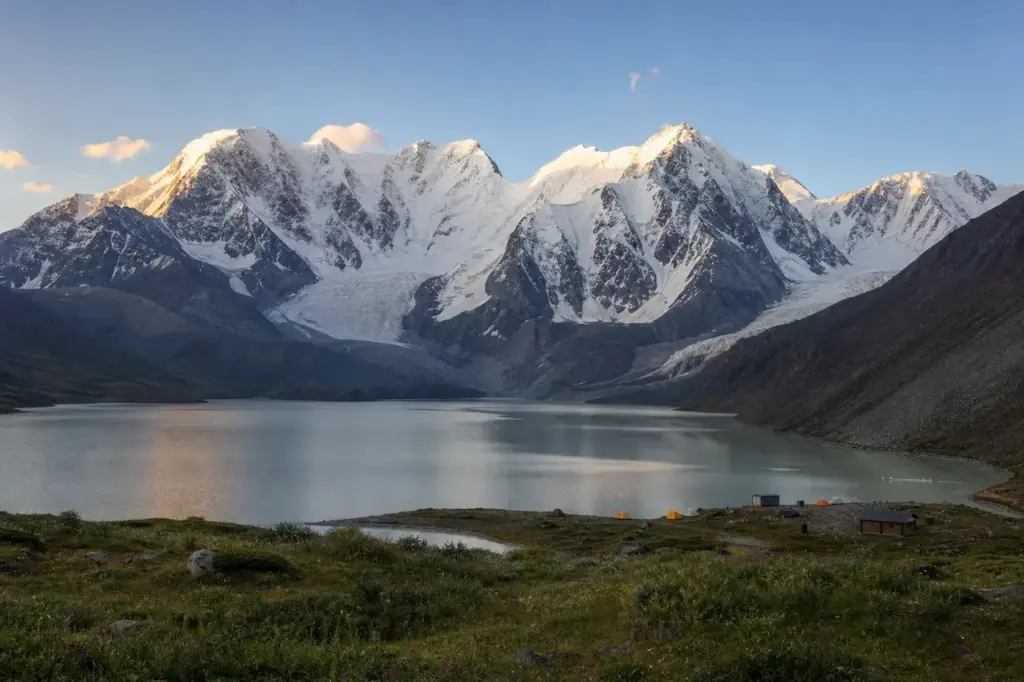
Akkem Lake is a pristine alpine lake nestled beneath Mount Belukha, the highest peak in the Russian Altai Mountains. The name means “white water” in the Altai language, referring to the milky-gray color caused by glacial sediment flowing from the Akkem Glacier above.
Situated at 2,050 metres elevation in the UNESCO-listed Golden Mountains of Altai, the lake is not accessible by road—reaching it requires a multi-day trek through mountain taiga forest and high alpine passes. The remoteness and dramatic northern face of Belukha make this one of the most sought-after destinations for trekkers and mountaineers in Siberia.
Quick Facts
| Russian name | Аккемское озеро |
|---|---|
| Address | Ust-Koksinsky District, Altai Republic Google MapsApple MapsYandex Maps2GIS |
| District | Altai Republic |
| Admission | free |
| Best time to visit | July and August: Peak season with most stable weather, warmest daytime temperatures (10–15°C at base camp), and fully melted trails. Most facilities and guides operate at full capacity. Expect other trekkers at base camp.June and early September: Shoulder seasons with possible snow at passes and higher avalanche risk. Weather is less predictable. Fewer trekkers and potentially lower prices. Trails may be muddy or partially snow-covered.Winter (November–April): Only for experienced mountaineers with specialized equipment. Extreme cold, heavy snow, avalanche hazard, and short daylight make this very high-risk. Not recommended for recreational trekking.Time of day: Early mornings offer clear skies and best views of Belukha before clouds build (typical by midday or afternoon). Start hikes at dawn. Weather deteriorates in afternoons; turn back if storms approach. |
| Recommended duration | 2–4 days (multi-day trek) |
What Is (and Isn't) Part of a Visit to Akkem Lake, Altai Mountains?
| Part | Status | Notes |
|---|---|---|
| Akkem Lake and immediate base camp area | Included in the standard ticket | The lake itself, surrounding meadows, and mountaineering facilities (rescue station, catering) are accessible to authorized trekkers. |
| Akkem Glacier | Separate ticket or institution | Requires mountaineering experience, crampons, rope, and helmet; not part of standard trekking but accessible as a day excursion with proper equipment and guides. |
| Mount Belukha summit | Separate ticket or institution | Requires technical ice-climbing skills and separate mountaineering expedition; base is the same but the climb is a separate multi-day undertaking. |
| Tomsk Camp (Tomskie Stoyanki) | Separate ticket or institution | Higher mountaineering camp at 3,000 metres; accessible by day hike from base camp but primarily used by summit climbers. |
| Valley of Seven Lakes excursion | Included in the standard ticket | Day hike from base camp, 3–4 hours round trip; included in typical trekking itineraries. |
| Yarlu Valley and Roerikh Shrine | Included in the standard ticket | Day hike from base camp, 3–4 hours round trip; included as cultural excursion in most guided treks. |
| Kucherla Lake (alternate approach) | Separate ticket or institution | Located in a parallel valley on an alternative trekking route; requires a separate multi-day trek but can be combined with Akkem Lake on longer expeditions. |
| Tyungur village (gateway) | Outside / not part of it | The departure point for all treks to Akkem Lake; located 40 km away on the Katun River; supplies and lodging are available here but this is not part of the alpine experience. |
Why Visit Akkem Lake, Altai Mountains?
Akkem Lake offers trekkers and mountaineers an unobstructed view of the Akkem Wall, the spectacular northern ice face of Mount Belukha. The lake sits directly below the glacier, making it the practical base camp for climbing Siberia’s highest mountain. Even for those not attempting the summit, the trek through steep valleys and alpine meadows provides dramatic mountain scenery. The area is part of a UNESCO World Heritage Site and supports alpine ecology found nowhere else in Russia.
Highlights of Akkem Lake, Altai Mountains
The Lower Akkem Lake
The permanent alpine lake where trekkers establish base camp. Water temperature stays below 4.5°C year-round, and the surface remains transparent less than one metre due to glacial flour from the Akkem River. In clear weather, the snow-covered north face of Belukha reflects perfectly in the cold water. The lake is surrounded by meadows and rocky terrain with mountaineering facilities on the shore.
Tip: Visit in July or August when the lake is fully unfrozen and weather is most stable for trekking; the lake freezes again in October.
Belukha's Akkem Wall
The 900-metre north face of Mount Belukha dominates the landscape from the lake. This dramatic wall of ice and rock is one of the classic alpine climbing challenges in the Russian Altai. The massif has two main peaks: the Eastern (Main) summit at 4,506 metres and the Western summit at 4,178 metres. Experienced climbers use Akkem as their staging point for ice-climbing routes via the Akkem Glacier.
Tip: The wall is best seen in the early morning or late afternoon light when sun angles highlight the ice formation; bring binoculars to study the climbing routes.
Akkem Glacier
The source of the milky-gray water flowing into the lake, this glacier spreads across 700 square kilometres of the upper massif. The river originating from it carries constant flows of glacial silt, which makes the lake opaque but also creates the striking gray-white color. Trekkers can walk up to the glacier terminus from base camp for views of ice formations and the upper climbing camps.
Tip: The glacier walk takes 2–3 hours from base camp; wear sturdy boots and stay clear of crevasses near the margins; never venture onto the glacier without ropes and experience.
Valley of Seven Lakes
A network of smaller alpine lakes in the nearby Ak-Oyuk Valley, accessible as a day hike from Akkem base camp. This scenic excursion takes 3–4 hours and gains moderate altitude through alpine meadow and rocky terrain. Each lake reflects surrounding peaks at different angles, creating multiple viewpoints of the Belukha massif.
Tip: Start early in the day and watch weather; alpine passes can cloud over rapidly in afternoon.
Yarlu Valley and Roerikh Shrine
A smaller valley near Akkem that attracts visitors interested in Eastern spirituality. A shrine dedicated to the Russian artist and philosopher Nikolai Roerikh is located here, and the valley has gained significance in contemporary New Age pilgrimage traditions. The hike to the valley takes 3–4 hours and passes through cedar forests and alpine meadows.
Tip: The shrine is modest; bring water and respect the site as a place of spiritual practice for visitors who come from across Russia.
The Upper Akkem Lake
Located 40 kilometres southeast of Tyungur village in the high passes above the lower lake, this glacial lake exists mostly during spring flood season. The upper lake drains via the Akkem River to feed the lower lake. At certain times of year, the upper basin contains only braided streams rather than a continuous water body. Alpine terrain surrounding the upper lake reaches 2,500+ metres.
Tip: The upper lake is not part of standard trekking itineraries and requires mountaineering experience and multiple acclimatization days; most visitors see only the lower lake.
Kara-Turek Pass
At 3,060 metres, this is the main mountain pass crossed during the standard approach trek to Akkem Lake base camp. The pass takes its name from Kara-Turek mountain (3,160 metres) which can be climbed for additional views. From the pass, trekkers descend into the Akkem valley with panoramic views of the entire Belukha massif and surrounding valleys. The pass marks a major acclimatization waypoint.
Tip: The crossing takes 6–7 hours of hiking with 800 metres elevation gain in the final hours; start early and be prepared for wind and sudden weather changes.
Tomsk Camp
A higher mountaineering camp at 3,000 metres located on the right moraine of Akkem Glacier. This is where technical ice climbers stage before their summit bid on Belukha. Stone huts and fixed facilities mark the site. From Tomsk Camp, the classical climbing route proceeds via the Delone Pass (col) to reach higher camps. Non-climbers can see the camp on day excursions from base camp.
Tip: The hike from Akkem base camp to Tomsk Camp takes 6–8 hours and involves glacier walking; helmet and crampons are essential, and rope may be needed in places.
Atmosphere
Akkem Lake base camp pulses with an unusual mix of energies: climbers preparing for technical ice work, trekkers recovering from multi-day slogs through forest, and spiritual seekers drawn by tales of Mount Belukha’s sacred significance. The air is thin and cold even in summer; temperatures rarely exceed 10°C at base camp. Early mornings are crystal-clear, with light turning the Belukha Wall amber and pink before clouds typically build by midday. A rescue station and small catering facility sit on the shore. At night, the sky is impossibly dark and star-filled. The sound of water from the Akkem River provides constant background noise. Visitors share tents or basic huts, creating a temporary mountain community atmosphere before most disperse to higher elevations or back down the valleys.
History of Akkem Lake, Altai Mountains
The Akkem Valley has been known to Altai people for centuries. The name derives from Altai language words for “white water,” descriptive of the glacial silt that colours the lake year-round. Russian exploration and mountaineering interest in the region grew in the 20th century as Belukha became recognized as the highest peak in the Soviet Altai.
Serious mountaineering on Belukha began in the mid-20th century. Soviet climbers established the classical approach routes and the base camp infrastructure at Akkem Lake. The discovery of multiple climbing routes—from straightforward glacier approaches to technical ice-climbing challenges on the Akkem Wall—cemented the lake’s position as the primary staging point for Belukha expeditions.
In 1998, the Golden Mountains of Altai (including the Akkem Lake area) were designated a UNESCO World Heritage Site, recognizing the region’s geological significance, biodiversity, and pristine alpine ecosystem. This designation increased international awareness and shaped management policies around visitor numbers and environmental protection.
Modern access has evolved from horse-supported expeditions to mixed trekking and mountaineering tourism. Russian mountaineering clubs, international climbing agencies, and adventure travel companies now regularly guide groups to the lake. The remote location and high altitude continue to limit visitor numbers naturally—reaching Akkem requires physical fitness, time, and logistical planning rather than simply buying a ticket.
Legends and Myths about Akkem Lake, Altai Mountains
Mount Belukha as Sacred Peak
Legend – historically unreliable. Many spiritual traditions, including followers of the Russian mystic Nikolai Roerikh, consider Mount Belukha and its surrounding valleys to be spiritually charged places of cosmic significance. The mountain is believed to be a centre of spiritual energy and higher consciousness. The nearby Yarlu Valley contains a small shrine dedicated to Roerikh, and visitors from across Russia come specifically to meditate and seek spiritual renewal. Whether this reflects documented history or contemporary spiritual belief is disputed.
White Mountain, White Water
Legend – historically unreliable. Local Altai mythology attributes the persistent white and gray coloring of both Mount Belukha and Akkem Lake to an ancient goddess or spirit of the mountains who blessed the region with eternal purity. The glacial flour that makes the lake opaque is interpreted in some tellings as her veil protecting the sacred water from defilement. This explanation predates scientific understanding of glacial processes.
Tickets and Booking for Akkem Lake, Altai Mountains
Akkem Lake is not a ticketed attraction. Access is typically arranged through trekking or mountaineering companies that organize multi-day expeditions. Most treks depart from Tyungur village (40 km away by road and trail), which serves as the logistical hub.
How to reach Akkem: Almost all routes begin with transport to Tyungur village from the regional city of Gorno-Altaysk (approximately 150 km away by road). From Tyungur, trekkers either walk directly up the Akkem River (22 km, 7–10 hours) or take a 4WD vehicle to the Kuzuyak Pass (1,513 m), then hike from the “Three Birches Glade” to the lake (22 km, 7–10 hours). Multi-day treks typically combine the Kucherla Valley approach and Kara-Turek Pass descent for a longer, more scenic route (3–4 days).
Trekking companies: International and Russian adventure travel companies organize guided expeditions. Standard packages include accommodation (tents at base camp, basic huts at way-points), meals, mountain guides, and horse support for luggage. Booking should be made weeks or months in advance, especially for summer (July–August). Independent trekkers can also arrange privately with local guides from Tyungur.
Required registration: Trekkers must register with Russian authorities; this is typically handled by organized tour companies. Foreigners need a valid Russian visa.
Best season: July and August offer the most stable weather and accessible trails. June and September are possible but involve higher avalanche and snow risk. Winter access requires specialized mountaineering skills and is rarely attempted.
Plan and Book
Suggested itineraries Akkem Lake, Altai Mountains
4 days (fast trek)
Day 1: Transport from Gorno-Altaysk to Tyungur village (10 hours by bus or van). Overnight in Tyungur base camp, sauna bath. Day 2: 4WD to Kuzuyak Pass, then hike via Three Birches Glade to Akkem River camp (22 km, 7–10 hours). Day 3: Walk up Akkem gorge to base camp at lake shore (17 km, 6–8 hours, +1,000 m elevation). Day 4: Acclimatization day and return hike to Tyungur (full day descent, 22 km, 7–8 hours). Total effort: moderate-to-high fitness required.
5–6 days (standard trek)
Day 1: Travel to Tyungur. Day 2: Hike via Kucherla Valley forest track (22 km, 7 hours). Day 3: Continue Kucherla Valley to camp at Tekelushka River junction (variable distance). Day 4: Cross Kara-Turek Pass (3,060 m) and descend to Akkem Lake base camp (18 km, 6–7 hours). Day 5: Full acclimatization day at base camp; optional day hike to Valley of Seven Lakes (3–4 hours). Day 6: Return descent via same route. Better views and easier acclimatization than fast option.
7–8 days (full Belukha region circuit)
Day 1–2: Travel to Tyungur. Day 3–5: Trek via Kucherla Lake and Kara-Turek Pass to Akkem base camp. Day 6: Acclimatization; day hike to Yarlu Valley shrine or Valley of Seven Lakes. Day 7: Radial hike to Akkem Glacier terminus and Tomsk Camp viewpoint (6–8 hours); or optional climb of nearby peak (3,291–3,370 m). Day 8–9: Return descent via multiple route options. Suitable for experienced mountain trekkers.
10–12 days (mountaineering expedition)
Days 1–6: As above, arrival and acclimatization at base camp. Days 7–10: Ascent of Mount Belukha; climb via Akkem Glacier to Tomsk Camp (3,000 m), then ice training and summit push via Delone Pass and Berelsky Saddle to 4,506 m Eastern Peak. Requires ice-climbing skills, crampons, ice axes, ropes, and previous mountaineering experience. Days 11–12: Descent and return. Only for climbers; trekkers do not attempt this.
How to Get to Akkem Lake, Altai Mountains
Air + Road: Fly into Gorno-Altaysk airport (120 km south). Regular flights connect to Moscow and regional airports. From Gorno-Altaysk, arrange ground transport (bus, minibus, or private vehicle) to Tyungur village (150 km northwest, 3–4 hours by road). This is the only road head for Akkem Lake access.
From Tyungur to Akkem Lake:
- Fast option (1 day hike): Take a 4WD vehicle from Tyungur over Kuzuyak Pass (dirt road, 1,513 m), then hike from “Three Birches Glade” meadow up the Akkem River valley to base camp (22 km, 7–10 hours total).
- Scenic option (3–4 days trek): Hike via Kucherla Valley and Kara-Turek Pass (3,060 m) for better acclimatization and views. Multi-day treks use horse support for luggage.
Accommodation and logistics: Tyungur has basic mountain base camps with bunkhouses and sauna facilities. Book trekking companies or local guides in advance. They arrange all transport, permits, meals, tents, guides, and rescue communication. Independent trekkers can hire local porters and horses but must handle their own navigation, food, and safety.
When to book: Summer season (July–August) books full 2–3 months ahead. Spring and autumn allow more flexibility but carry higher weather risk.
Accessibility
Akkem Lake is not wheelchair accessible. The trek requires multi-day hiking at altitude with significant elevation gain (1,500+ metres over several days) across mountain terrain. No maintained trails or supporting infrastructure for mobility aids exist.Physical fitness is essential. Acclimatization to altitude (2,050 m base camp) is required; people with heart conditions, lung disease, or severe altitude sensitivity should consult medical advisors before attempting the trek. Older adults and those with joint problems should assess their ability for 7–10 hour hiking days carrying personal gear.Horses and porters are available to carry bulk luggage, reducing personal load. Trekking pole use significantly eases joint stress on descents. Base camp has basic shelter; expect cold conditions even in summer.Rescue services exist (station at base camp) but evacuation via helicopter is expensive and weather-dependent; insurance is strongly recommended.
Food Nearby
Akkem Lake itself has no commercial food facilities beyond a small catering hut at base camp operated seasonally, which serves basic hot meals and hot drinks to trekkers. All trekking packages include meals prepared on site.Tyungur village has a few small shops, mountain base cafes, and sauna facilities where food is available (pelmeni, soups, basic groceries). Supplies are limited; bring food from Gorno-Altaysk if cooking independently.Trekkers should bring high-calorie snacks (nuts, chocolate, dried fruit, energy bars) for trail days. Fresh water from mountain streams is abundant but should be treated or boiled. The Akkem River provides cold water suitable for cooking.
What to Bring
Multi-day mountain trekking in alpine terrain. Bring: sturdy hiking boots (already broken in), warm layers (fleece, down), waterproof jacket and pants, insulating hat and gloves (July–August nights near freezing), sun protection (high-altitude UV), water bottle or hydration pack, high-calorie snacks, personal first aid kit, headlamp or flashlight, trekking poles, map and compass or GPS device.For mountaineers attempting Belukha: ice axe, crampons, rope, helmet, avalanche beacon, probe, shovel, technical climbing gear.Pack light; horses carry bulk. Leave valuables in Tyungur or Gorno-Altaysk. Toiletries are limited; bring your own. No formal bag checks; respect alpine environment by packing out all waste.
Best Views and Photo Spots of Akkem Lake, Altai Mountains
Base camp shore, facing Belukha
Direct view of the entire Akkem Wall with the glacier flowing down. In calm water, the reflection of the snowy peak is perfect. The water's gray-white color contrasts with surrounding dark rock and meadow.
Best time: Early morning (5–7 a.m.) for golden light on the peak; late afternoon (6–8 p.m.) for warm amber tones. Avoid midday harsh light.
Kara-Turek Pass viewpoint
Panoramic vista of the entire Belukha massif, multiple valleys, and surrounding alpine peaks. The descent from the pass framing the lake below creates compositional depth.
Best time: Clear mid-morning (8–10 a.m.) when light is strong but clouds have not yet built. After rain, the air is clearer.
Valley of Seven Lakes loop
Each lake reflects Belukha at a different angle and altitude. Alpine flowers and rocks frame the composition. Multiple vantage points along the 3-hour hike loop provide varied perspectives of the same massif from different angles.
Best time: Late morning to early afternoon (9 a.m.–2 p.m.) when lakes have best water clarity and reflections. Bring polarizing filter to cut glare.
Tomsk Camp moraine viewpoint
Closer view of Akkem Glacier texture and crevasse patterns. Fixed ropes and climbing equipment visible on the moraine create human-scale context. Belukha Wall fills the background.
Best time: Clear morning light; this is a 6–8 hour day hike so timing is flexible but visibility is key. Avoid afternoon cloud.
Akkem River delta entering the lake
Foreground: braided glacial streams in pale turquoise entering the gray water. Middle ground: meadow and rocky shore. Background: Belukha. This compositional depth is unique to this angle.
Best time: Morning or late afternoon side light. Summer peak melt (late July–August) creates the most visible blue-green water colour in the streams.
Photography Rules
Photography is unrestricted at Akkem Lake. Bring a camera and memory cards. The high altitude and snow create intense light and glare; bring sunglasses and a lens protector. Sunrise and early-morning light (5–7 a.m.) produces the best mountain illumination on Belukha's north face before clouds build. Tripods are allowed. Drones are not permitted in the UNESCO-protected area. No special permits required for personal photography.
Family Suitability
Akkem Lake is generally not suitable for families with young children due to the remoteness, altitude (2,050 m), and physical demands of the trek. Children under 10 are unlikely to complete multi-day hiking at altitude comfortably. Teenagers (14+) with good fitness and prior hiking experience may manage slower-paced 4–5 day itineraries with horse support.The trek involves 7–10 hour hiking days over rough terrain, cold nights in tents, and basic sanitation facilities. Weather is unpredictable. Emergency evacuation is possible but expensive and delayed by weather.Families interested in Altai mountains are better served by lower-altitude lakes and valleys accessible as day hikes from Tyungur or road-accessible areas. Those with teenage mountaineers and family mountaineering experience can consider guided family expeditions, but logistical planning is more complex.
Russia Vibes Tips
- Arrive in Tyungur at least 1–2 days before starting the trek. This allows time to meet guides, arrange horses, collect final supplies, and acclimatize to the slightly elevated valley floor. Many people who rush to the trailhead the same day they arrive develop altitude sickness.
- Acclimatization days at base camp (Akkem Lake) are not wasted time. Spend at least 1 full day at the lake doing light exploration or the Valley of Seven Lakes hike rather than immediately descending. Better acclimatization reduces headaches and exhaustion on return hikes.
- The standard 4-day fast trek (Tyungur to lake to Tyungur) is exhausting and does not allow true rest. If your schedule permits, aim for 5–6 days minimum. The difference between a grueling trip and a memorable one is one extra acclimatization day.
- Water is abundant but always comes from glacial melt, which carries sediment even when it looks clear. Boil water for 1 minute or use purification tablets. Drinking untreated glacial water often causes gastrointestinal upset days later, spoiling the return trip.
- The Akkem Wall is huge and distant; bring binoculars or a telephoto lens for photography if you want to study climbing routes or see details. With naked eyes or standard camera lenses, the texture and scale are diminished.
- Expect crowds in July and August. Base camp hosts 50+ trekkers on peak days. If solitude is your goal, go in June or early September, or arrive mid-week rather than weekends. The lake itself is never crowded; most trekkers stay near base camp facilities.
Explore Nearby Akkem Lake, Altai Mountains
Related guides
 Altai Mountains: Best Places, Scenic Routes and Travel Tips
Main image: AI-generated illustration. It may not show the place exactly as it looks.
 Chuya and Katun Confluence: Free Viewpoint and Sacred Altai LandmarkOpen 24 hours
Main image: AI-generated illustration. It may not show the place exactly as it looks.
 Uchar Waterfall: Hiking to Russia’s Most Remote Cascade
Main image: AI-generated illustration. It may not show the place exactly as it looks.
 Ukok Plateau: Remote Expedition Across Ancient Steppe
Main image: AI-generated illustration. It may not show the place exactly as it looks.
 Shavlo Lakes: Turquoise Waters and Glacier Peaks
Main image: AI-generated illustration. It may not show the place exactly as it looks.
Browse more: More in Altai Republic · All Altai Mountains · All Landmarks · All Sightseeing · All Sightseeing in Altai Mountains
FAQ: Akkem Lake, Altai Mountains
Can I trek to Akkem Lake without a guide or company?
Yes, independent trekking is possible. You need a Russian visa, registration with authorities (can be arranged in Tyungur), hiking experience at altitude, proper maps or GPS, and equipment. Many independent trekkers hire local porters or horses in Tyungur rather than carry everything themselves. This is cheaper than organized tours but requires more planning and self-reliance. First-timers are strongly advised to hire at least a guide for route navigation.
How long does it take to trek to Akkem Lake from Tyungur?
Minimum 1 day (fast, 22 km, 7–10 hours) via vehicle and direct hike. Scenic multi-day treks via Kucherla Valley and Kara-Turek Pass take 3–4 days to reach the lake. Most complete itineraries (including days at base camp and return) span 5–8 days total. Mountaineering expeditions to climb Belukha require 10–12 days.
What is the altitude? Will I get altitude sickness?
Base camp is at 2,050 metres. Most trekkers from sea level feel mild effects: headache, shortness of breath, fatigue. Serious altitude sickness is uncommon at this height but can occur in susceptible individuals. Acclimatization days significantly reduce risk. Descend immediately if symptoms worsen. Consult a doctor before trekking if you have heart or lung conditions.
Can I visit Akkem Lake on a day trip from Tyungur?
No. The trek is minimum 7–10 hours one way (22 km). A day trip would mean 14–20 hours of hiking with no rest, which is not realistic. You must stay at least 1 night. Most people spend 2–3 nights at or near the lake to recover and enjoy it.
What is the water temperature? Can I swim?
Water temperature is below 4.5°C year-round. Only strong swimmers in wetsuits should attempt brief dips; most people wade briefly or skip swimming. The cold shock is significant. Some base camps have sauna facilities where heated water can be brought to a warming pond, providing safer immersion.
Is climbing Mount Belukha mandatory if I trek to Akkem Lake?
No. Reaching Akkem Lake as a trekker does not require climbing Belukha. Many visitors hike to base camp, enjoy the views, do day excursions (Valley of Seven Lakes, Yarlu Valley), and descend. Only those with ice-climbing experience and separate mountaineering packages attempt the summit.
What are the main routes to Akkem Lake?
Route 1 (Fast): Vehicle to Kuzuyak Pass, then hike via Three Birches Glade and Akkem River (1 day). Route 2 (Scenic): Hike via Kucherla Valley, cross Kara-Turek Pass (3,060 m), descend to lake (3–4 days). Route 3 (Expedition): Combine Kucherla Lake circuit with multiple valleys and peaks (7+ days). Most organized tours use Route 2 for better acclimatization.
What permits or documents do I need?
Foreigners need a valid Russian visa. Trekkers must register with Russian Ministry of Emergency Situations (MES); trekking companies handle this. No special mountain permit is required. Bring copies of your passport and visa. Solo travelers should inform a contact outside Russia of your itinerary and expected return date.
Russia Vibes is a one-person project. A coffee keeps it going
How we research and update our guides
About this guide: AI assistance and accuracy
This guide is created with the help of AI and is based on official sources where available. Mistakes can still happen. Opening hours, prices, rules and other details are given to the best of our knowledge as of the date shown and can change without notice. It offers general recommendations only, not professional, legal or travel advice. Please confirm important details with the official source before you travel; you are responsible for your own plans and decisions.
Packing for this trip
* Affiliate link: as an Amazon Associate we earn from qualifying purchases at no extra cost to you.

Take this guide with you
Get a free PDF of this guide to print or read offline: key facts, tips and a map link on a few clean pages.
Report an issue on this page
Paying for your trip: please read
International sanctions affect payments between Russia and many other countries. In practice, cards issued in the EU, the UK, the US and several other countries often do not work in Russia, Russian cards usually do not work abroad, and some booking platforms, airlines and payment providers limit or suspend their services for Russia. The situation changes frequently.
We do not give legal or financial advice, and this site does not encourage anyone to break or circumvent sanctions. Whatever you plan, you are responsible for following the laws and regulations that apply to you, including those of your country of residence and citizenship.
Many travelers still organise their stay lawfully. It is worth asking your bank or payment provider what is currently permitted, contacting hotels, tour operators and carriers directly about the payment methods they accept, and checking which services are open to customers from your country. Clarify payment, cancellation and refund terms before you commit to a booking, and keep your plans flexible.
Partner links on this site may not be available in every country, and prices, availability and rules in our guides can differ from what you see when you book.