
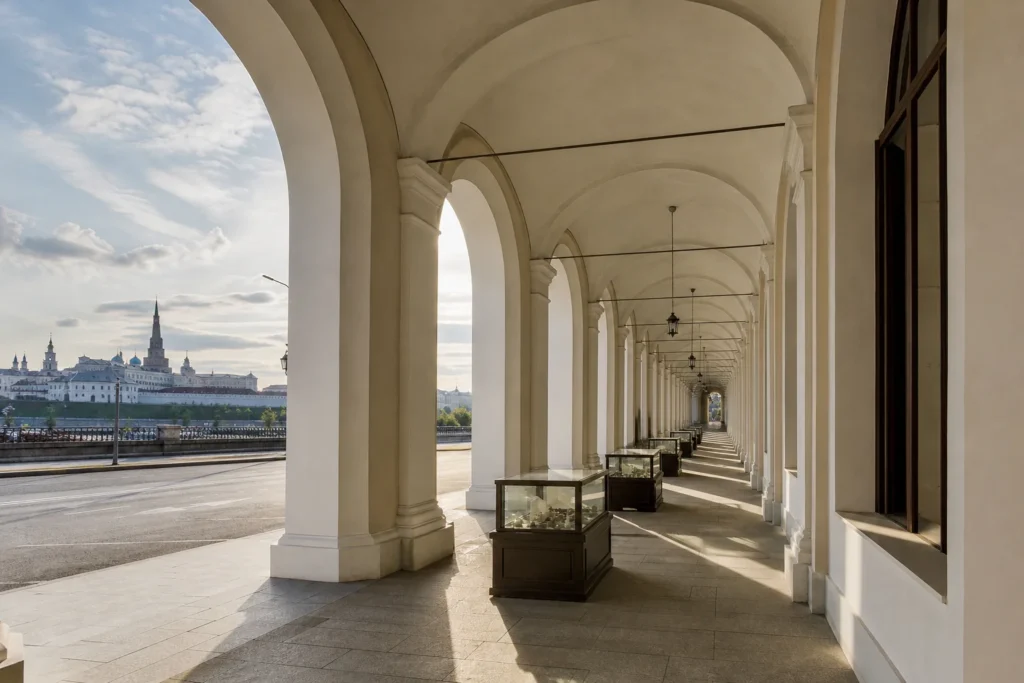
The National Museum of the Republic of Tatarstan is one of Russia’s oldest and most important regional museums. Founded in 1895 and housed in the ornate Gostiny Dvor (arcade) building directly across from Kazan Kremlin, the museum holds nearly one million objects representing the entire history and cultures of the Volga-Urals region.
The collection began with exhibits from an 1890 scientific-industrial exhibition combined with archaeologist and historian Andrey Likhachev’s private collection of 40,000 items. Today it serves as the central repository of Tatarstan’s material and spiritual heritage, with galleries devoted to prehistoric and ancient periods, medieval kingdoms, imperial Russia, and the modern republic.
Quick Facts
| Russian name | Национальный музей Республики Татарстан |
|---|---|
| Built / opened | 1895 |
| Architect(s) | Gostiny Dvor building (architect unknown; reconstructed by F. Emelyanov) |
| Address | ул. Кремлевская, д. 2, Казань, Республика Татарстан, 420111 OpenStreetMap · Google Maps |
| District | Vakhitovsky |
| Metro | Kremlevskaya (Red Line, exit toward Kremlin; 3 min walk) |
| Opening hours | Mon 10:00-18:00; Tue-Sat 10:00-20:00; Sun 10:00-18:00 |
| Admission | ₽₽ |
| Best time to visit | Weekday mornings (10:00–12:00) are optimal for avoiding crowds and appreciating exhibits without pressure. Weekends and school holidays (notably July–August and late December) see heavy foot traffic, particularly school groups in the afternoon. The first Wednesday of the month offers free admission but draws significantly more visitors. Spring and autumn provide pleasant weather for walking to the museum. Summer crowds are manageable if you arrive at opening time. Winter is quieter but offers no special advantage. Visit just after 10:00 AM opening on any weekday for the best experience. |
| Recommended duration | 2–3 hours |
| Website | tatmuseum.ru |
| Last updated | October 18, 2026 |
What Is (and Isn't) Part of a Visit to National Museum of the Republic of Tatarstan, Kazan?
| Part | Status | Notes |
|---|---|---|
| Main permanent exhibitions (Ancient history, Medieval period, 18th–19th century, Ethnography, Natural history) | Included in the standard ticket | All permanent galleries are included in standard admission; no separate tickets needed. |
| Catherine the Great's carriage | Included in the standard ticket | Housed within the main exhibition; no separate admission required. |
| Musa Dzhalil manuscripts | Included in the standard ticket | Part of permanent exhibition on Tatar culture and World War II; included in standard ticket. |
| Guided tours and excursions in Russian or Tatar | Separate ticket or institution | Museum offers specialized tours in Russian and Tatar for an additional fee; contact the museum directly to arrange. |
| Special exhibitions and rotating displays | Separate ticket or institution | Temporary exhibitions may require separate tickets or supplements; check the official website for current offerings. |
| Museum shop and bookstore | Included in the standard ticket | Museum gift shop and publication sales are within the building but are separate purchases. |
| Photography (personal use, no flash or tripods) | Included in the standard ticket | Personal photography without professional equipment is permitted in most galleries; certain delicate artifacts or temporary exhibitions may be restricted. |
| Kazan Kremlin (opposite side of street) | Outside / not part of it | The Kremlin is a separate institution with its own admission; though visible and adjacent, it is not part of this museum. |
Why Visit National Museum of the Republic of Tatarstan, Kazan?
The museum offers a complete chronological journey through Tatar history and the surrounding region’s diverse cultures. Major highlights include Catherine the Great’s ceremonial carriage (given to the city after her 1767 visit), an extensive archaeological collection from Volga Bulgaria and the Kazan Khanate, a significant numismatic collection featuring coins and monetary systems across centuries, and rare manuscripts including works by Tatar poet Musa Dzhalil. The natural history section displays taxidermied regional fauna, and the ethnographic galleries showcase traditional Tatar costumes and household items.
How National Museum of the Republic of Tatarstan, Kazan Is Laid Out
The museum occupies the entire Gostiny Dvor building, a former arcade and trading complex. The main entrance faces Kremlevskaya Street with the Kremlin directly across. Inside, galleries are arranged chronologically through multiple floors and wings, beginning with prehistoric and ancient exhibits, proceeding through medieval periods, then covering the imperial and Soviet eras, and concluding with modern Tatarstan.
The layout is broadly chronological rather than geographically divided, allowing visitors to follow a timeline from the Stone Age through the present day. Signage is primarily in Russian, though some exhibits include English labels. Visitors typically move through the building in a logical sequence, though the size and number of rooms mean a focused route helps avoid exhaustion.
Highlights of National Museum of the Republic of Tatarstan, Kazan
Catherine the Great's Carriage
The museum's most famous single object is the ornate carriage used by Empress Catherine II during her 1767 visit to Kazan. Housed in its own display, the carriage represents the height of 18th-century imperial craftsmanship and symbolizes the moment when Kazan gained formal recognition as a major city in the Russian empire. The carriage is one of only a few personal belongings of Catherine II held outside St. Petersburg.
Tip: This is typically one of the first major exhibits and draws crowds; arrive early or visit on weekday mornings to see it without queues.
Ancient Volga Bulgaria Artifacts
Extensive archaeological collections from Volga Bulgaria (7th–13th centuries) include pottery, weapons, jewelry, and religious items that illustrate the sophisticated civilization that preceded the Mongol invasions. The exhibits show trade connections across Central Asia and the Islamic world, demonstrating Kazan's role as a crossroads of commerce and culture centuries before the modern city existed.
Tip: Look for the detailed maps showing trade routes; these help contextualize individual artifacts and clarify the region's geopolitical importance.
Tatar Gold Collection
One of the museum's permanent exhibitions focuses on traditional Tatar jewelry and precious metalwork, featuring elaborate filigree, enamel work, and designs influenced by Islamic, Turkic, and Byzantine artistic traditions. The collection spans centuries and shows how Tatar craftspeople developed distinctive styles that mixed cultural influences.
Tip: Ask museum staff about the techniques; the intricate gold work is difficult to appreciate in photographs but reveals extraordinary skill when viewed in person.
Medieval Coins and Trade Routes Exhibition
The numismatic collection displays currency from across the medieval Islamic world, Central Asia, and Europe, reflecting Kazan's importance as a trading hub on the Silk Road. Coins from different kingdoms and empires illustrate how money and commerce connected distant regions. This exhibition clarifies why the Kazan Khanate attracted merchants from as far as Italy and the Ottoman Empire.
Tip: This exhibition pairs well with the maps of ancient trade routes; together they show why early Kazan became so wealthy and strategically important.
Musa Dzhalil Manuscripts
The museum holds the original manuscripts of the Moabit Notebook, poems written by Tatar poet and Soviet resistance fighter Musa Dzhalil in a Nazi prison during World War II. The fragile handwritten pages are a moving testimony to Dzhalil's courage and artistry during one of history's darkest periods. Dzhalil was executed in 1944 but became a national hero in the Soviet Union and is venerated in Tatarstan.
Tip: The English-language plaques here are more detailed than elsewhere in the museum; the context makes this exhibit particularly powerful.
Ethnographic Halls: Traditional Tatar Culture
Multiple galleries showcase traditional Tatar clothing, embroidery, household furnishings, and handicrafts from different regions of Tatarstan. The displays show regional variations in dress, the evolution of textile techniques, and the daily life of Tatar communities through the 19th and early 20th centuries. Many items are richly embroidered and show the aesthetic values of pre-Soviet society.
Tip: Photography (without flash) is typically allowed here; the textiles and costumes are visually striking and make excellent photographs against the gallery walls.
Building Architecture: The Gostiny Dvor Itself
The museum is housed in a historic Gostiny Dvor (arcade or trading gallery), a late 18th-century building from 1770 that is itself a monument of Russian commercial architecture. The arcade's classical proportions, arched galleries, and columned passages reflect the economic importance of Kazan during the imperial period. Walking through the building provides spatial context for understanding the city's history.
Tip: Pause in the main corridors and arcades to observe the architectural details; the building's symmetry and proportions are part of the museum experience itself.
Imperial Russian Period Exhibition
Galleries devoted to the 18th and 19th centuries showcase Kazan's role as a provincial capital and educational center under Russian rule. Exhibits include imperial decrees, portraits of governors, architectural drawings, and objects reflecting the lives of the Russian gentry and merchant classes who dominated the city during this era. The displays show how Russian imperial policies shaped Tatar society.
Tip: This section often goes underappreciated by visitors focused on pre-Russian periods, but it clarifies how modern Kazan developed and how Russian and Tatar cultures interacted.
Atmosphere
The museum occupies a stately 18th-century arcade, so the visual atmosphere is one of classical symmetry and quiet grandeur. High ceilings, arched corridors, and soft natural light from tall windows create a contemplative space. The pace is deliberately slow—galleries are arranged to encourage careful observation rather than rapid transit.
Weekday mornings and early afternoons see fewer visitors; weekend afternoons and the period just after school closes (mid-afternoon) draw school groups and families. The museum is largely Russian-speaking; most foreign visitors are small in number. The overall feeling is scholarly and somewhat formal, with minimal decoration and information displays organized for Russian visitors familiar with museum conventions. Noise levels are low; the building’s high ceilings and stone floors absorb sound, creating an atmosphere that feels almost peaceful even when moderately full.
History of National Museum of the Republic of Tatarstan, Kazan
The National Museum of the Republic of Tatarstan was founded in 1894 as the Kazan City Scientific-Industrial Museum and opened on April 5, 1895. Its collection began with exhibits from the 1890 scientific-industrial exhibition and Andrey Likhachev’s private collection of 40,000 items; Likhachev was a renowned archaeologist, historian, and collector in Tatarstan. The building itself—the former Gostiny Dvor—is a monument to the history and architecture of Tatarstan. This venue selection reflected Kazan’s importance as a commercial center; the arcade had served as the city’s main trading space and symbolic heart.
As of now, the museum has over 800,000 objects representing the history of the Volga and Cis-Urals region peoples from ancient times till nowadays. Over the years of its life, the museum has gathered Russia’s largest regional collection. The museum’s growth paralleled the development of Russian archaeology and regional historical consciousness in the late 19th and 20th centuries. Likhachev’s foundational collection was substantially expanded through acquisitions and excavations, establishing the museum as the premier institution for understanding the region’s pre-Russian and medieval history.
The Museum has 15 branches, its headquarters is based in the historical building of what used to be the Gostiny Dvor, the Arcade. This expansion into a network of affiliated museums reflects the institution’s evolution from a single encyclopedic collection into a comprehensive cultural and research organization covering sites and themes across Tatarstan. The branching structure allows the main museum to maintain coherence while regional and thematic collections reach beyond Kazan.
In 2020 a new exposition titled “History of Tatarstan from Ancient Times to the Present” was opened. This major reinstallation modernized the presentation and narrative, bringing curatorial practices into line with contemporary museum standards while preserving the authority of the original collection. The 2020 renovation maintained the chronological framework but enhanced interpretation and accessibility for international visitors.
Legends and Myths about National Museum of the Republic of Tatarstan, Kazan
Catherine's Gift
Legend – historically unreliable. According to museum tradition, Catherine the Great personally admired Kazan during her 1767 journey and gifted her royal carriage to the city as a mark of favor and recognition. The carriage, now the museum's centerpiece, supposedly demonstrates that Kazan received imperial blessing and was elevated to the status of a favored provincial city. While historians confirm that Catherine did visit Kazan and that the carriage is authentic to the period, the claim of a direct personal gift cannot be independently verified.
Likhachev's Secret Collection
Legend – historically unreliable. Local legend holds that archaeologist Andrey Likhachev spent decades secretly excavating and collecting artifacts across the region, keeping many of his discoveries hidden from the authorities and public to preserve them for a future proper museum. When he finally donated his 40,000-item collection, it revealed an entire hidden history of Tatarstan that had been unknown. While Likhachev was indeed a prolific collector and his donations were transformative, the "secret" nature of his work is likely romanticized.
The Building's Memory
Legend – historically unreliable. The Gostiny Dvor arcade is said to hold centuries of memory within its walls. Merchants, pilgrims, and soldiers passed through its corridors; the building witnessed Kazan's transformations across empires and eras. Some claim that walking through the galleries of what was once a commercial center while viewing objects of history creates a continuous thread connecting past and present, making the building itself a kind of time machine.
Tickets and Booking for National Museum of the Republic of Tatarstan, Kazan
| Ticket | Price | Includes |
|---|---|---|
| Adult (foreign visitors) | ₽₽ | Access to all permanent exhibitions throughout the museum. |
| Child/teen (ages 7–18 or student) | ₽ | Access to all permanent exhibitions; verification of age or student status may be required. |
| Group (10+ people) | ₽₽ | Admission for groups; advance notification and group booking recommended; contact museum for rates. |
| Free admission | Free | First Wednesday of every month; all categories of visitors admitted free on this day. |
₽ budget · ₽₽ moderate · ₽₽₽ upscale · ₽₽₽₽ splurge. Price levels are estimates compared with typical prices for visitors.
Tickets: Purchase tickets at the main entrance upon arrival. The museum does not yet require advance online booking for international visitors, though this may change. Tickets are sold until one hour before closing (ticket sales until 17:00 on Mon/Sun; until 19:00 Tue–Sat).
On-site payment: Cash (rubles) is accepted; card payment availability varies—confirm with staff. No advanced payment or deposit is typically required.
Free entry: The first Wednesday of every month offers free admission to all visitors. During these days the museum is popular and crowded; arrival early in the morning is strongly recommended.
Rates for Russian citizens and concessions (students, pensioners, military) differ significantly from foreign visitor rates. Children under age 7 are typically admitted free. For complete, current information on all ticket categories and prices, consult the official website at tatmuseum.ru; ticket costs and concession categories are subject to change.
Plan and Book
Suggested itineraries National Museum of the Republic of Tatarstan, Kazan
1 hour (highlights only)
Enter and go directly to Catherine the Great's carriage (first major exhibit). Then proceed through the ancient and medieval archaeological sections, focusing on Volga Bulgaria artifacts and medieval coins. End at the ethnographic halls to see traditional Tatar clothing and household items. This compressed route captures the museum's most distinctive pieces.
2–3 hours (standard visit)
Begin with the carriage, then move through ancient exhibits and Volga Bulgaria galleries. Spend time with the medieval coin exhibition. Progress through 18th- and 19th-century imperial Russian period displays. Explore the ethnographic halls thoroughly, observing textile work and costumes. Finish in the natural history section with taxidermied fauna. This pace allows careful observation without rushing.
3–4 hours (comprehensive)
Follow the standard itinerary above at a leisurely pace, allowing time to read plaques (in Russian and limited English) and observe details. Allocate extra time to the Musa Dzhalil manuscripts and related World War II exhibits. Review the architectural features of the Gostiny Dvor building itself. Consider brief conversations with museum guards or staff if they are receptive; their knowledge often exceeds the official displays.
Half day with guided tour
Book a specialist guided tour in English (inquire in advance; availability varies) or a Russian-language tour with translation. Tours typically last 2–2.5 hours and provide thematic or chronological narratives that individual exploration cannot replicate. Tours often include restricted-access areas or special collections not on general display. Allow time before or after the tour to explore independently.
How to Get to National Museum of the Republic of Tatarstan, Kazan
By metro: Take any metro line to Kremlevskaya station on the Red Line (Krasnaya liniya). Exit toward Kremlevskaya Street and the Kremlin. The museum is a 3–4 minute walk east from the station, directly across Kremlevskaya Street from the Kremlin’s main entrance.
Walking from Kremlevskaya metro: Follow signs toward the Kremlin. The museum is the large classical arcade building facing the Kremlin across the street; its ornate arches and columned facade are unmistakable.
By bus: Several buses serve Kremlevskaya Street; nearest stops are at “Ploshchad Pervogo Maya” (Theatre Square) or “ul. Baturina” (Baturina Street). Confirm routes with transport apps or locals, as bus lines change.
By taxi or ride-hailing: Direct the driver to “Kremlevskaya Street, 2” or “opposite the Kremlin.” The location is well-known; rides typically cost moderate fares within the city center.
Accessibility
The museum building has ground-floor access via the main Kremlevskaya Street entrance. An elevator serves some upper floors, though not all galleries are accessible via lift; floors are connected by stairs in places. Accessible restrooms are available. The Gostiny Dvor's historic architecture includes uneven floors and narrow passages that may present challenges for wheelchair users in certain sections. The museum does not publish a detailed accessibility guide; contact staff in advance (+7 843 292-89-84) to discuss specific needs.
Food Nearby
The museum building itself does not contain a cafe or restaurant. The surrounding area includes cafes and restaurants on and near Kremlevskaya Street and Bauman Street (a few minutes' walk). Nearby dining ranges from casual fast-food chains to sit-down restaurants serving Tatar and Russian cuisine. The Kremlin area has kiosks selling light snacks and beverages. Plan to eat before or after your museum visit, or take a break to explore nearby cafes.
What to Bring
Comfortable walking shoes are essential; the museum involves considerable standing and walking across multiple floors and galleries. In cold months (November–March) bring a coat, as historic buildings often lack modern heating. A camera (without flash or tripod) enhances the visit; many artifacts are visually striking. Small notebook for jotting observations may be useful. Water bottle is practical for the 2–3 hour visit. Bags and backpacks larger than a small daypack must be left at the entrance; carry valuables and documents in a small bag or pockets.
Best Views and Photo Spots of National Museum of the Republic of Tatarstan, Kazan
Entrance arcade and main gallery corridor
The classical arches, columns, and high ceilings of the Gostiny Dvor's main corridor frame an atmospheric perspective. Symmetrical architecture and filtered natural light create an elegant backdrop that captures the building's historical character.
Best time: Mid-morning (10:30–11:30) when light is bright but soft; avoid harsh direct sunlight from south-facing windows.
Catherine the Great's carriage display
The ornate 18th-century carriage, often dramatically lit, is visually striking. The craftsmanship and decorative details are best appreciated in close photographs. The scale of the carriage relative to surrounding space conveys its importance as a museum centerpiece.
Best time: During morning hours before crowds gather; the exhibit area is often less congested early in the day.
Ethnographic galleries with traditional Tatar costumes and textiles
Richly embroidered traditional clothing, with vibrant colors and intricate needlework, photographs beautifully. The textiles display regional artistic heritage and craft techniques. Close-up shots of embroidery patterns reveal extraordinary detail.
Best time: Midday when gallery lighting is most consistent; the colors of traditional garments are most saturated.
Ancient pottery and archaeological artifacts from Volga Bulgaria
Display cases with ancient ceramics, metalwork, and decorative objects create historical narratives in miniature. The textures of ancient clay and metals photograph well in the museum's controlled lighting. Artifacts against neutral backdrops are visually clean.
Best time: Afternoon (14:00–16:00) when side-lighting across cases creates dimension without glare.
Photography Rules
Personal photography without flash, tripods, or professional equipment is generally permitted in permanent exhibition galleries. Some delicate artifacts, rare manuscripts, and temporary exhibitions may be off-limits to photography; respect posted signs. Do not use flash near taxidermied specimens or ancient textiles, as light damages these materials. Museum staff will clearly indicate restrictions; ask if unsure.
Family Suitability
The museum is moderately family-friendly for children aged 8 and older with interest in history. Younger children may find the collections abstract and difficult to engage with for extended periods; the 2–3 hour recommended visit is long for small attention spans. The large, well-lit galleries are safe for older children to navigate. Stroller access is limited due to stairs and narrow corridors, particularly in upper floors; backpacks or carriers are more practical for younger children. School-age children may enjoy the archaeology and ethnography sections; guided tours in Russian with translation (if arranged) can make history more vivid. Supervision is advisable due to crowding near popular exhibits and the building's complex floor plan.
Russia Vibes Tips
- Arrive at opening time (10:00 AM) on weekday mornings to experience the museum with minimal crowds and maximum opportunity to observe details without distraction. Free admission on the first Wednesday of every month brings significant crowds; avoid this if you seek a contemplative visit.
- Focus on objects rather than attempting to read all wall plaques. Most signage is in Russian; English translations are sparse. Instead, observe the artifacts themselves and request a guided tour in English if detailed interpretation matters to you (advance booking required).
- Locate the Musa Dzhalil manuscripts and related World War II exhibits early. These personal, emotional artifacts often resonate more deeply than archaeological pieces; seeing them before fatigue sets in enhances their impact.
- The medieval coin exhibition is underappreciated; spend time there if numismatics or trade history interest you. The coins reveal connections across the Islamic world and Central Asia that clarify why early Kazan was strategically important.
- Pause to observe the Gostiny Dvor building's architecture—arches, columns, proportions, light from tall windows. The structure itself is part of Kazan's history; understanding the space enhances appreciation of the collection within it.
- Bags and backpacks must be left at the entrance; retrieve them on departure. Carry a small day bag or use pockets for essential items. This regulation is strictly enforced and is not negotiable.
Explore Nearby National Museum of the Republic of Tatarstan, Kazan
Sights near National Museum of the Republic of Tatarstan, Kazan
 Kazan Kremlin – about 100 m away (~2 min walk) · typical visit: 2–4 hours2 min on foot from Kremlyovskaya, Kazan metro, Open 24 hours
Main image: AI-generated illustration. It may not show the place exactly as it looks.
 Kul Sharif Mosque, Kazan – about 400 m away (~7 min walk) · typical visit: 1–2 hours6 min on foot from Kremlyovskaya, Kazan metro, Open daily 08:00–20:00
Main image: AI-generated illustration. It may not show the place exactly as it looks.
 Peter and Paul Cathedral, Kazan – about 350 m away (~6 min walk) · typical visit: 1.5–2 hours7 min on foot from Kremlyovskaya, Kazan metro
Main image: AI-generated illustration. It may not show the place exactly as it looks.
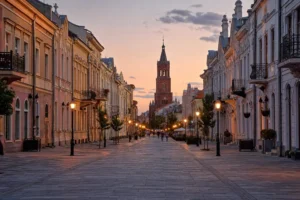 Bauman Street, Kazan – about 400 m away (~7 min walk) · typical visit: 1.5–3 hours7 min on foot from Kremlyovskaya, Kazan metro, Open 24 hours
Main image: AI-generated illustration. It may not show the place exactly as it looks.
Metro stations near National Museum of the Republic of Tatarstan, Kazan
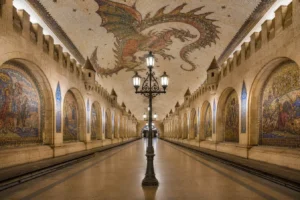 Kremlyovskaya, Kazan – about 150 m away (~3 min walk)Open daily 06:00–00:00
Main image: AI-generated illustration. It may not show the place exactly as it looks.
Restaurants and cafes near National Museum of the Republic of Tatarstan, Kazan
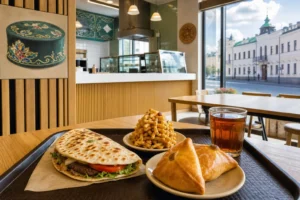 Tubatay, Kazan – about 500 m away (~8 min walk)10 min on foot from Kremlyovskaya, Kazan metro
Main image: AI-generated illustration. It may not show the place exactly as it looks.
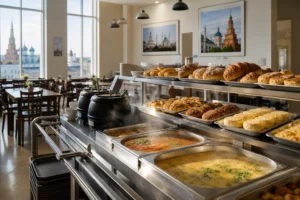 Dobraya Stolovaya, Kazan – about 650 m away (~11 min walk)9 min on foot from Ploshchad Tukaya, Kazan metro
Main image: AI-generated illustration. It may not show the place exactly as it looks.
Nightlife near National Museum of the Republic of Tatarstan, Kazan
 Nashe Mesto, Kazan – about 650 m away (~11 min walk)10 min on foot from Ploshchad Tukaya, Kazan metro
Main image: AI-generated illustration. It may not show the place exactly as it looks.
 Tangiers Lounge, Kazan – about 850 m away (~14 min walk)14 min on foot from Ploshchad Tukaya, Kazan metro
Main image: AI-generated illustration. It may not show the place exactly as it looks.
Hotels near National Museum of the Republic of Tatarstan, Kazan
 Cort Inn Kazan Kremlinabout 200 m away (~3 min walk)
Main image: AI-generated illustration. It may not show the place exactly as it looks.
 DoubleTree by Hilton Kazan City Centerabout 450 m away (~7 min walk)
Main image: AI-generated illustration. It may not show the place exactly as it looks.
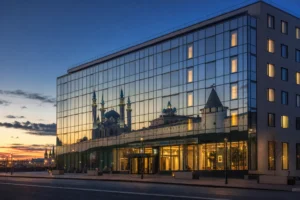 Mirage Hotel, Kazanabout 450 m away (~8 min walk)
Main image: AI-generated illustration. It may not show the place exactly as it looks.
Train stations and river piers near National Museum of the Republic of Tatarstan, Kazan
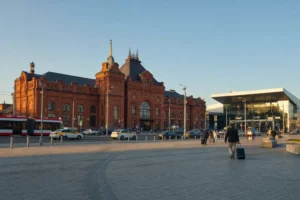 Kazan Railway Station, Kazanabout 1.0 km away (~17 min walk)
Main image: AI-generated illustration. It may not show the place exactly as it looks.
Related guides
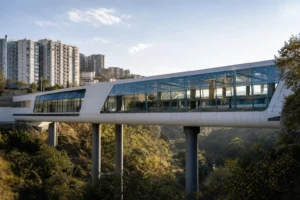 Ametyevo: Kazan’s Unique Elevated Metro Station and Architectural LandmarkOpen daily 06:00–00:00
Main image: AI-generated illustration. It may not show the place exactly as it looks.
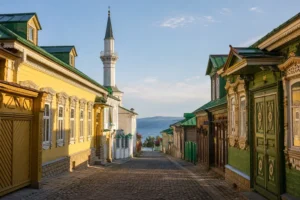 Old Tatar Quarter: Historic Streets and Tatar Heritage in Kazan
Main image: AI-generated illustration. It may not show the place exactly as it looks.
 Green Point Hostel, Kazan: Central Budget Stay with Shared Rooms
Main image: AI-generated illustration. It may not show the place exactly as it looks.
 Korston Royal Hotel, Kazan: Luxury Accommodation with On-Site Shopping and Spa
Main image: AI-generated illustration. It may not show the place exactly as it looks.
 Kazan Palace by Tasigo: Luxury Hotel in a 1910 Heritage Building
Main image: AI-generated illustration. It may not show the place exactly as it looks.
Browse more: More in Vakhitovsky · All Kazan · All Museums · All Sightseeing · All Sightseeing in Kazan
FAQ: National Museum of the Republic of Tatarstan, Kazan
Is the National Museum the same as Kazan Kremlin?
No. The National Museum is the large arcade building directly across Kremlevskaya Street from the Kremlin's main entrance. The Kremlin is a separate historical fortress and museum complex on the opposite side of the street. Both are important sites but require separate admissions and have different collections and histories.
How long does a typical visit take?
Most visitors spend 2–3 hours for a comprehensive but not exhaustive visit. Highlights-only tours take 1 hour; deep exploration with reading plaques and observing details can extend to 4 hours. Plan for 2–3 hours as a baseline unless you have specialized interests requiring additional time.
Is there English-language interpretation?
Limited English signage exists; most plaques are in Russian. Many major artifacts have brief English translations, but detailed interpretation is sparse. Guided tours in English can be arranged in advance but are not always available. Download a translation app or bring a Russian-speaking companion if language is a significant barrier.
Can I take photographs?
Yes, personal photography without flash or tripods is generally permitted in permanent galleries. Some delicate artifacts and temporary exhibitions may be restricted; respect posted signs and ask staff if unsure. Professional photography requires permission; inquire at the ticket desk.
What is the most famous object in the museum?
Catherine the Great's ceremonial carriage, which she allegedly gifted to Kazan during her 1767 visit, is the most celebrated artifact. It is prominently displayed and is the first major exhibit. Other notable pieces include medieval coins, Tatar jewelry, and the original manuscripts of poet Musa Dzhalil.
Is there a cafe or restaurant in the museum?
No. The museum building does not contain a cafe or restaurant. Nearby Kremlevskaya Street and Bauman Street (5–10 minutes' walk) have numerous cafes and restaurants. Plan to eat before arrival or take a break to explore nearby venues.
What is free admission day and how crowded does it get?
The first Wednesday of every month offers free admission to all visitors. This day is significantly busier than regular days, with school groups and families creating crowded conditions, particularly in afternoon hours. If you prefer a quieter experience, visit on other days and pay admission.
Can I leave my bag or backpack during my visit?
Bags and backpacks must be checked at the entrance; the museum does not permit large bags into galleries due to theft and congestion concerns. Use a small day bag or carry essentials in pockets. Checked bags are stored securely and returned upon exit.
Russia Vibes is a one-person project. A coffee keeps it going
Last updated: October 18, 2026.
How we research and update our guides
About this guide: AI assistance and accuracy
This guide is created with the help of AI and is based on official sources where available. Mistakes can still happen. Opening hours, prices, rules and other details are given to the best of our knowledge as of the date shown and can change without notice. It offers general recommendations only, not professional, legal or travel advice. Please confirm important details with the official source before you travel; you are responsible for your own plans and decisions.
International sanctions affect payments between Russia and many other countries. In practice, cards issued in the EU, the UK, the US and several other countries often do not work in Russia, Russian cards usually do not work abroad, and some booking platforms, airlines and payment providers limit or suspend their services for Russia. The situation changes frequently. We do not give legal or financial advice, and this site does not encourage anyone to break or circumvent sanctions. Whatever you plan, you are responsible for following the laws and regulations that apply to you, including those of your country of residence and citizenship. Many travelers still organise their stay lawfully. It is worth asking your bank or payment provider what is currently permitted, contacting hotels, tour operators and carriers directly about the payment methods they accept, and checking which services are open to customers from your country. Clarify payment, cancellation and refund terms before you commit to a booking, and keep your plans flexible. Partner links on this site may not be available in every country, and prices, availability and rules in our guides can differ from what you see when you book.Paying for your trip: please read
Report an issue on this page

Take this guide with you
Get a free PDF of this guide to print or read offline: key facts, tips and a map link on a few clean pages.