
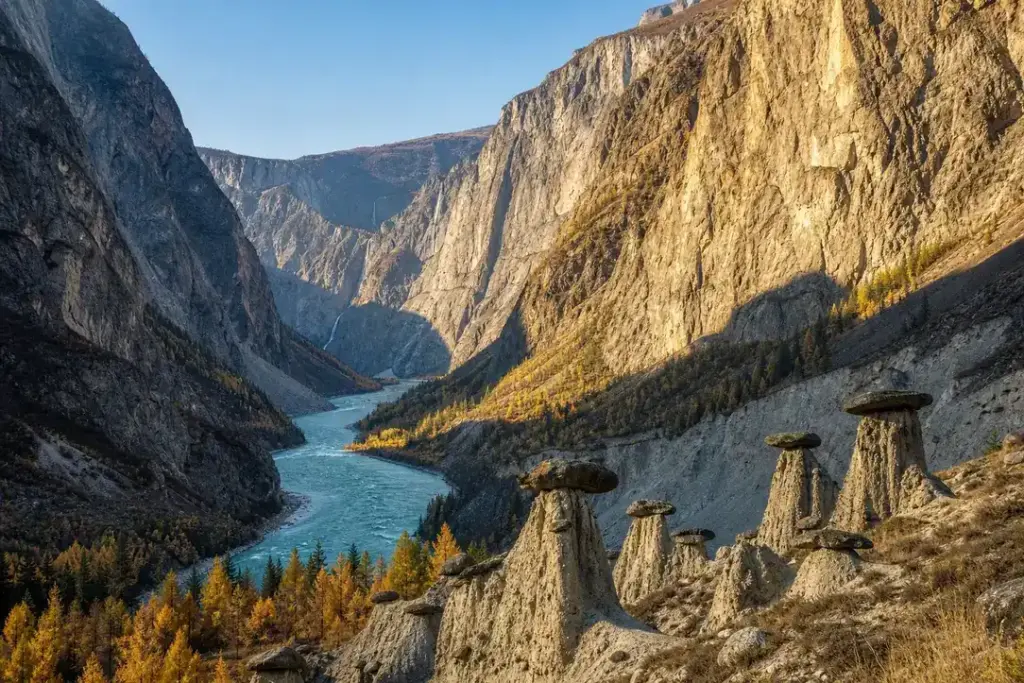
The Chulyshman Valley is one of the most geographically dramatic and remote destinations in the Altai Mountains. The valley originates from the upper sources at Lake Julukul and stretches until flowing into Lake Teletskoye, creating a gorge or canyon 135 km long surrounded by rocks of a kilometer height.
The Chulyshman River spans 240 km and for most of its length reveals its turbulent mountain nature: it is full of rapids, waterfalls and shallows. The valley is accessible only via the monumental pass Katu-Yaryk, literally cut down in the slope of the mountain, or by boat across Lake Teletskoye from the north.
Quick Facts
| Russian name | Долина Чулышмана |
|---|---|
| Address | Ulagansky District, Altai Republic Google MapsApple MapsYandex Maps2GIS |
| District | Ulagansky |
| Admission | free |
| Best time to visit | Summer (June to September) is the only safe season for most visitors. The Chulyshman River freezes up during late October through early December and stays icebound until late March through early May.June and early July: Roads are usually passable, snowmelt swells the river and waterfalls; wildflowers begin to bloom. Mid-July to August: Best overall. Weather is warmest, trails are fully dry, and all facilities are operating. Days are long (sunset after 9 pm). September: Cooler, fewer crowds, but weather becomes unpredictable; some early passes may have snow.The Katu-Yaryk pass can be impassable during heavy rain or early snow. Always check current road conditions with your tour operator or local authorities before traveling. Winter visits are possible only for expert climbers and mountaineers with specialized equipment. |
| Recommended duration | 2–5 days |
What Is (and Isn't) Part of a Visit to Chulyshman Valley, Altai Mountains?
| Part | Status | Notes |
|---|---|---|
| Chulyshman Valley canyon and river | Included in the standard ticket | The main canyon, valley floor and river access are part of your visit. |
| Stone Mushroom formations at Akkurum | Included in the standard ticket | Accessible by boat and hiking; part of the standard valley experience. |
| Uchar Waterfall | Included in the standard ticket | Requires additional hiking; typically part of multi-day visits. |
| Kurkure Waterfall | Included in the standard ticket | Easier access than Uchar; included in most valley itineraries. |
| Katu-Yaryk Pass | Included in the standard ticket | The mountain pass providing southern access; viewpoints are included. |
| Pazyryk Kurgan burial mounds | Separate ticket or institution | Located south of Katu-Yaryk pass on the approach road; separate archaeological site. |
| Lake Teletskoye | Outside / not part of it | The lake itself is a separate destination; the valley ends where the river enters it. |
| Artybash village | Outside / not part of it | Northern exit point on Lake Teletskoye; a separate settlement with its own services. |
Why Visit Chulyshman Valley, Altai Mountains?
The 200 km detour into the Chulyshman Valley is an absolute highlight with its deeply incised valley and unique vegetation due to its very mild microclimate. The main draws are the Stone Mushroom rock formations, the Uchar waterfall, the greatest one in Altai at 160 meters high, and the Kurkure waterfall on flatter terrain. Chulyshman River Valley is a UNESCO World Heritage Site. The valleys of Bashkaus, Chulyshman and Chulcha rivers are populated by Telengit people, offering a chance to meet indigenous mountain communities.
How Chulyshman Valley, Altai Mountains Is Laid Out
The valley runs south to north, beginning near the Tuvan border at Lake Dzhulukul in high elevation plateaus and descending through increasingly dramatic canyon walls until it meets Lake Teletskoye in the north. Tourist facilities and the major attractions are concentrated in the lower 30 km of the valley, between the Katu-Yaryk pass and the Akkurum tract.
The main entrance from the south is the Katu-Yaryk pass, a serpentine road carved into the mountainside that descends steeply into the valley. Akkurum, located 15 km away from Lake Teletskoye on the right bank of the river, is the hub for campsites and hiking. From here, trails lead to the Stone Mushrooms on the opposite bank and to nearby waterfalls. The northern exit is via boat across Lake Teletskoye to Artybash village.
Highlights of Chulyshman Valley, Altai Mountains
Katu-Yaryk Pass
The Katu-Yaryk observation deck is considered one of the most beautiful places in the Altai Mountains. The road goes all the way to 1600 meters high and offers tremendous panoramas on the Chulyshman River and valley. The pass is a series of hairpin bends carved directly into the mountainside. Allow time to walk the short trail to the viewpoint before descending.
Tip: Stop at the observation platforms at both the top and middle of the pass for the best canyon views; arrive early to avoid afternoon shadows.
Stone Mushrooms at Akkurum
In the Akkurum area, located 15 km from Lake Teletskoye, you can witness unusual stone formations that had appeared as a result of weathering and water erosion. Some of them are as high as 7 meters. Stone mushrooms, known in the Altai as kurums, stand by the Chulyshman River, and from the mountainside you can admire picturesque views of the valley and the river.
Tip: A boat crosses the river to reach the formations. The hike up the slope takes 1–1.5 hours; wear sturdy trekking shoes as the path is steep and loose.
Uchar Waterfall
The Uchar waterfall is 160 meters high and is the greatest one in Altai. The Uchar waterfall is 8 kilometers away from the Akkurum site. This is the valley's most impressive cascade and requires a hike from the main camping area.
Tip: The route to Uchar is longer and more strenuous. Go early in the day and allow 4–6 hours round trip from Akkurum.
Kurkure Waterfall
A smaller but accessible waterfall on flatter terrain along the river. Unlike the hike to Stone Mushrooms, the path to Kurkure is easy and level, making it a good option for visitors with limited climbing ability or time. The waterfall is surrounded by larch and spruce forest.
Tip: The walk from Akkurum is straightforward and takes about 2–3 hours round trip. This waterfall is also visible from the road in some sections.
Chulcha River Gorge
The gorge of the Chulcha River is one of three main sights tourists come to see, and is located near the Akkurum site. The Chulcha is a tributary that creates a dramatic narrow canyon of its own.
Tip: Often combined with Stone Mushroom visits as it is in the same area. Check with your local guide for current trail conditions.
Lake Teletskoye View and Northern Exit
Lake Teletskoye is 78 km long, up to 5 km wide, with a maximum depth of 325 m and surface elevation of 434 m. The Chulyshman flows into Lake Teletskoye. The confluence of river and lake is the northern end of the valley accessible by boat.
Tip: Many visitors exit the valley by crossing the lake to Artybash village rather than retracing the Katu-Yaryk pass.
Pazyryk Kurgan Burial Mounds
The Pazyryk valley contains important Pazyryk kurgans – the burial mounds sites of Scythian aristocracy that brought to the world the sensational Altai Princess Mummy. These ancient tombs lie on the approach road from the south, south of the Katu-Yaryk pass.
Tip: Located en route to the valley; easily visited when driving from Gorno-Altaysk. This is separate from the main valley itself.
Atmosphere
The Chulyshman Valley is wild and remote, with few facilities. Mountains tower nearly 1,000 m above the river, their slopes covered in sparse larch and pine at lower elevations, with bare rock and scree higher up. The river runs pale green from glacial melt, creating a constant roar in the narrow canyon. In summer, the valley fills with hikers and small tour groups, particularly near Akkurum and the Stone Mushrooms, where basic campsites operate. The light in the narrow canyon shifts dramatically through the day as the sun moves from one wall to the other. Evenings are remarkably quiet; stars fill the sky away from camp.
History of Chulyshman Valley, Altai Mountains
The name Chulyshman comes from the Altai language: ‘cholush’ means ‘criss-cross’, referring to the river’s winding path through the canyon.
The valleys of Bashkaus, Chulyshman and Chulcha rivers are populated by Telengit people, indigenous to the Altai region. The Telengit have lived in these valleys for centuries, herding livestock and using seasonal pastures in the high plateaus above.
The Pazyryk kurgan mounds represent the graves of noble nomads and tribes’ chiefs from the 6th and 7th centuries BC, suggesting the broader region has been inhabited and valued by nomadic peoples for millennia. Modern tourism infrastructure only developed in recent decades; before the 1990s, the valley remained largely inaccessible except to adventurers and the local population.
Legends and Myths about Chulyshman Valley, Altai Mountains
The Name's Criss-Cross Path
Legend – historically unreliable. The name 'cholush' in the Altai language means 'criss-cross', referring to how the river snakes back and forth through the canyon. Local guides speak of following the river's zigzag pattern, where from high points you can see the water curve like a serpent beneath steep walls.
Stone Mushrooms as Petrified Giants
Legend – historically unreliable. The thin 'stems' of these 'mushrooms' are formed of soft rocks exposed to severe weather conditions, while the 'heads' made of harder rock are more resistant to strong winds. Locals sometimes describe them as the petrified remains of giants who once guarded the valley.
Tickets and Booking for Chulyshman Valley, Altai Mountains
There is no formal admission fee to enter or hike the Chulyshman Valley itself; it is open year-round. However, accessing the valley requires either a private vehicle or a guided tour. Most international visitors book multi-day hiking and camping tours through travel agencies based in Gorno-Altaysk or online platforms, as independent travel is extremely challenging due to remote roads, logistics, and lack of established hostels in the valley.
Self-driving: A sturdy vehicle with high clearance is essential for the Katu-Yaryk pass road, especially outside summer. Rental cars are available in Gorno-Altaysk but many companies prohibit unsealed roads; expect surcharges or refusals.
Guided tours: Tours typically range from 3 to 7 days and include transport, camping, meals and a guide. Book 2–4 weeks in advance during peak season (June to September). Guides provide logistics, safety oversight and cultural context.
Boat access: From Artybash on the northern shore of Lake Teletskoye, boat tours can be arranged to reach the valley’s northern end; this is slower but avoids the Katu-Yaryk pass.
Plan your trip with a local tour operator or contact the Altai Mountain Tourism Information Center in Gorno-Altaysk for current conditions and recommendations. Exact booking details vary by operator; check their official sites directly.
Suggested itineraries Chulyshman Valley, Altai Mountains
1 day (pass viewpoint only)
Drive from Gorno-Altaysk to the Katu-Yaryk pass (5–6 hours one way). Stop at observation platforms to view the canyon and valley. Descend a short walking trail (30 minutes to 1 hour) for close-up views of the rocky terrain. Return the same day. This minimal itinerary is only suitable for those unable to stay overnight.
2–3 days
Day 1: Drive from Gorno-Altaysk to Aktash (8 hours), then Katu-Yaryk pass. Camp or stay in a basic hut near Akkurum. Day 2: Boat crossing and hike to Stone Mushrooms (2–3 hours round trip), return to camp. Short walk to Kurkure waterfall. Day 3: Return over Katu-Yaryk pass to Gorno-Altaysk.
4–5 days
Day 1: Arrive at Akkurum campsite. Day 2: Stone Mushrooms hike. Day 3: Uchar waterfall trek (full day, 4–6 hours round trip). Day 4: Explore Chulcha gorge or rest day at camp; optional Kurkure walk. Day 5: Exit via Katu-Yaryk pass or arrange boat to Artybash.
7+ days
Multi-day camping trek following the river upstream to Lake Julukul, combining valley exploration with high alpine terrain. Requires camping equipment, guides, and strong fitness. Covers approximately 30–40 km and includes river crossings.
How to Get to Chulyshman Valley, Altai Mountains
From Gorno-Altaysk: The valley is 300–400 km away; plan 8–10 hours driving time depending on your entry point and road conditions.
Southern route (Katu-Yaryk pass): Drive south on the Chuysky Highway (M-832) to Aktash (360 km from Gorno-Altaysk). Turn onto the Ulagan Highway and continue 100 km along mostly unpaved road to the Katu-Yaryk pass. The last 40–50 km are rough, requiring 4WD in wet weather. The pass itself is a series of tight hairpins; descent takes 30–45 minutes on foot or 1–2 hours by vehicle. From the pass, descend to Akkurum campsite (another 2–3 hours by vehicle or 3–5 hours on foot).
Northern route (Lake Teletskoye): Drive to Artybash village on the north shore of Lake Teletskoye (320 km from Gorno-Altaysk). Arrange a boat across the lake (78 km, 4–6 hours) to reach the valley’s northern end. This route is slower but avoids the difficult mountain pass.
Logistics: There is no public transport directly into the valley. Book a tour through a travel agency in Gorno-Altaysk, which includes vehicle transport and guide. Alternatively, hire a 4WD taxi or rent a vehicle with high clearance; petrol stations are infrequent beyond Aktash.
Accessibility
The Chulyshman Valley is not wheelchair accessible. The Katu-Yaryk pass involves steep hairpin roads and a 30–45-minute downhill hike over uneven terrain. The Stone Mushroom hike is steep, with loose ground and no railings. Kurkure waterfall is on flatter terrain but still requires crossing the river by boat.Visitors with limited mobility can view the valley from the Katu-Yaryk observation decks and rest at Akkurum campsites, but cannot reach most hiking attractions. Some basic accommodation is available at campsites, though facilities are minimal (outdoor toilets, cold water). If mobility is a concern, discuss your specific needs with a local tour operator before booking.
Food Nearby
The Akkurum campsite area has basic food service for organized tour groups; meals are typically included in tour packages. Bring additional snacks and water purification supplies if hiking independently. In Aktash (the town before the Katu-Yaryk pass), there are small shops and cafes; stock up here before driving to the pass. In Artybash village (northern access point), a few cafes and shops serve lake visitors. Once in the remote valley itself, there are no shops; all food must be brought with you or obtained through your tour operator.
What to Bring
Hiking boots with strong ankle support are essential for the Stone Mushroom trail and steep terrain. Bring a waterproof jacket, as weather changes rapidly in the canyon. A headlamp or torch is useful for early morning photography and camp navigation. Sunscreen and insect repellent are necessary in summer. Water is available from the river (purify it) and sometimes at campsites. Trekking poles help on steep descents. If self-organizing, bring a tent, sleeping bag rated for cool nights, and a camping stove. Camera gear should include a wide lens to capture the canyon walls; a polarizing filter helps with mountain reflections. Binoculars allow you to study distant rock formations and spot wildlife. Bags and tents are checked at tour operator entry points.
Best Views and Photo Spots of Chulyshman Valley, Altai Mountains
Katu-Yaryk Pass Upper Observation Deck
From the highest viewpoint at the top of the pass (1,600 m), the entire Chulyshman Valley spreads below: the river winds through a canyon with near-vertical walls rising 1,000 m on either side. Waterfalls streak down the far wall. The view is dramatic in any light but especially striking in early morning when mist rises from the river.
Best time: Early morning (6–7 am) for golden light and mist; late afternoon for warm tones on west-facing walls. Avoid midday when contrast is harsh.
Katu-Yaryk Pass Middle Observation Platform
A second viewing platform partway down the pass offers a closer perspective of the river's S-curves and the vegetation in the valley floor. Less crowded than the upper deck.
Best time: Mid-morning (8–10 am) when the sun is high enough to fill the canyon; clear visibility.
Akkurum River Bend
From the Akkurum campsite, looking north toward Lake Teletskoye, the river makes a wide, dramatic curve around wooded banks with 500–700 m cliffs in the background. Larch and spruce forests frame the shot.
Best time: Late afternoon when the sun lights the far bank and cliffs. Golden hour (6–8 pm) creates warm tones on rock.
Stone Mushrooms Slope View
From across the river at the base of the slope, the formations appear as a jumbled cluster of eroded pillars and balanced rocks, with the river in the foreground and canyon walls behind. The scale is apparent only when people stand near them.
Best time: Early morning (6–7 am) when the formations catch side-lighting and shadows define their shapes. Mid-day backlighting is also dramatic.
Uchar Waterfall
A 160 m cascade dropping down near-vertical rock faces. The waterfall is most impressive from the viewing platform at the base, where you can see the full height and the mist it generates. Surrounding forest frames the fall.
Best time: Early morning when the sun is to the side or behind you, lighting the mist. After snowmelt (late June–July) the water volume is greatest.
River Rapid sections
The Chulyshman's white-water sections, where it narrows and accelerates over boulders, create dynamic foregrounds with the dark water contrasting against the pale foam. Canyon walls tower behind.
Best time: Any clear day; the river's power is consistent. Early morning water is often cleaner and more photogenic than evening water, which may be cloudier from glacial melt.
Photography Rules
Drones are prohibited in the valley and throughout the Altai Mountains. No special permits are required for standard photography with cameras and phones. Tripods are allowed for landscape work. Flash photography is not restricted but is rarely needed in the bright daylight of the open canyon. Photographing local people (Telengit herders and villagers) requires permission. The best light for photography is early morning (6–8 am) when the sun illuminates the east-facing canyon walls, and late afternoon (6–8 pm) for west-facing slopes.
Family Suitability
The Chulyshman Valley is suited to families with older children (ages 10+) who are fit hikers and comfortable camping or staying in basic accommodation. Young children under 10 may find the long drive, steep hiking and lack of facilities challenging. The Stone Mushroom hike involves a steep uphill climb on loose ground; families should have hiking experience and good boots. Kurkure waterfall, on flatter terrain, is more suitable for younger children and families with less experience. The Katu-Yaryk pass is a dramatic sight but requires no hiking from the car; observation decks are accessible by walking 100 m from the road. Strollers and pushchairs are not practical; all terrain is uneven. Camping at Akkurum requires tents, sleeping bags and tolerance for cold, basic facilities (outdoor toilets). Tour operators sometimes provide family-friendly accommodation alternatives; ask when booking.
Russia Vibes Tips
- Arrive at Katu-Yaryk pass by 7–8 am to see the valley in morning light and avoid afternoon crowds. The observation decks fill with tour groups by mid-morning.
- Book tours 3–4 weeks in advance during June–August; popular operators sell out. Early May or September trips are cheaper and less crowded but weather is less predictable.
- The road to Katu-Yaryk becomes impassable after heavy rain. Check weather forecasts and road reports with locals before driving in; have a vehicle with high clearance and preferably 4WD.
- Bring extra cash (rubles) as there are no ATMs in the valley. Tour operators may not accept cards; confirm payment methods when booking.
- The Stone Mushroom hike is steeper than it appears from below. Start early with plenty of water and wear trekking shoes with good grip; flip-flops and casual shoes cause many slip injuries.
- Cold nights (near freezing in June and September) are common even in summer. Bring a warm sleeping bag rated below 10°C and layers, even if you travel during summer months.
Explore Nearby Chulyshman Valley, Altai Mountains
Sights near Chulyshman Valley, Altai Mountains
 Katu-Yaryk Pass, Altai Mountains – about 1000 m away (~16 min walk) · typical visit: 2–3 hours at the viewpoint, plus 2–2.5 hours driving each way from Aktash
Main image: AI-generated illustration. It may not show the place exactly as it looks.
Related guides
 Altai Mountains: Best Places, Scenic Routes and Travel Tips
Main image: AI-generated illustration. It may not show the place exactly as it looks.
 Ak-Kurum Stone Mushrooms: Natural Geological Formations in Remote Altai
Main image: AI-generated illustration. It may not show the place exactly as it looks.
 Geyser Lake: Turquoise Thermal Lake in the Altai Mountains
Main image: AI-generated illustration. It may not show the place exactly as it looks.
Browse more: More in Ulagansky · All Altai Mountains · All Parks · All Sightseeing · All Sightseeing in Altai Mountains
FAQ: Chulyshman Valley, Altai Mountains
Is Chulyshman Valley free to visit?
Yes, there is no entrance fee to the valley itself. However, reaching it requires paying for transport (vehicle rental, taxi or guided tour) and accommodation. Tours typically cost ₽₽₽₽ and include transport, camping and meals.
Can I visit the valley without a guide?
Technically yes, but it is very difficult and not recommended. The Katu-Yaryk pass road is rough and requires a 4WD vehicle. There are no marked trails, no accommodation booking system, and no shops. Most visitors book organized tours through Gorno-Altaysk agencies.
What is the best time to visit?
June to September. Summer offers the safest weather and passable roads. Late July–August is warmest and driest. June has wildflowers and high water (impressive waterfalls); September has fewer crowds but weather becomes unpredictable.
How long does it take to get there from Gorno-Altaysk?
8–10 hours driving via Katu-Yaryk pass (360 km to Aktash, then 100 km to the pass). Lake Teletskoye route is 6–7 hours driving plus 4–6 hours by boat.
Are the Stone Mushrooms hard to hike to?
Yes. The hike is steep uphill on loose ground and takes 1–1.5 hours each way. You must cross the river by boat first. It is physically demanding but not technical; good hiking boots and fitness are essential.
Is camping the only option for accommodation?
Most visits involve camping at Akkurum. Some tour operators offer basic guesthouses or gers (yurts) instead. Book through your tour operator in advance; there is no walk-up accommodation.
What should I expect from the road to Katu-Yaryk?
The Chuysky Highway is paved and reasonably maintained. From Aktash, the Ulagan Highway is partly paved, then becomes rough dirt road. The final 40 km are slow and rocky, taking 2–3 hours. In wet weather, the road becomes deeply rutted and may be impassable.
Can I visit just the pass without entering the valley?
Yes. Drive to Katu-Yaryk, view the canyon from the observation decks, and return. This is a 1–2 hour stop and can be combined with other Altai attractions on a day trip from Gorno-Altaysk.
Russia Vibes is a one-person project. A coffee keeps it going
How we research and update our guides
About this guide: AI assistance and accuracy
This guide is created with the help of AI and is based on official sources where available. Mistakes can still happen. Opening hours, prices, rules and other details are given to the best of our knowledge as of the date shown and can change without notice. It offers general recommendations only, not professional, legal or travel advice. Please confirm important details with the official source before you travel; you are responsible for your own plans and decisions.
Packing for this trip
* Affiliate link: as an Amazon Associate we earn from qualifying purchases at no extra cost to you.

Take this guide with you
Get a free PDF of this guide to print or read offline: key facts, tips and a map link on a few clean pages.
Report an issue on this page
Paying for your trip: please read
International sanctions affect payments between Russia and many other countries. In practice, cards issued in the EU, the UK, the US and several other countries often do not work in Russia, Russian cards usually do not work abroad, and some booking platforms, airlines and payment providers limit or suspend their services for Russia. The situation changes frequently.
We do not give legal or financial advice, and this site does not encourage anyone to break or circumvent sanctions. Whatever you plan, you are responsible for following the laws and regulations that apply to you, including those of your country of residence and citizenship.
Many travelers still organise their stay lawfully. It is worth asking your bank or payment provider what is currently permitted, contacting hotels, tour operators and carriers directly about the payment methods they accept, and checking which services are open to customers from your country. Clarify payment, cancellation and refund terms before you commit to a booking, and keep your plans flexible.
Partner links on this site may not be available in every country, and prices, availability and rules in our guides can differ from what you see when you book.