
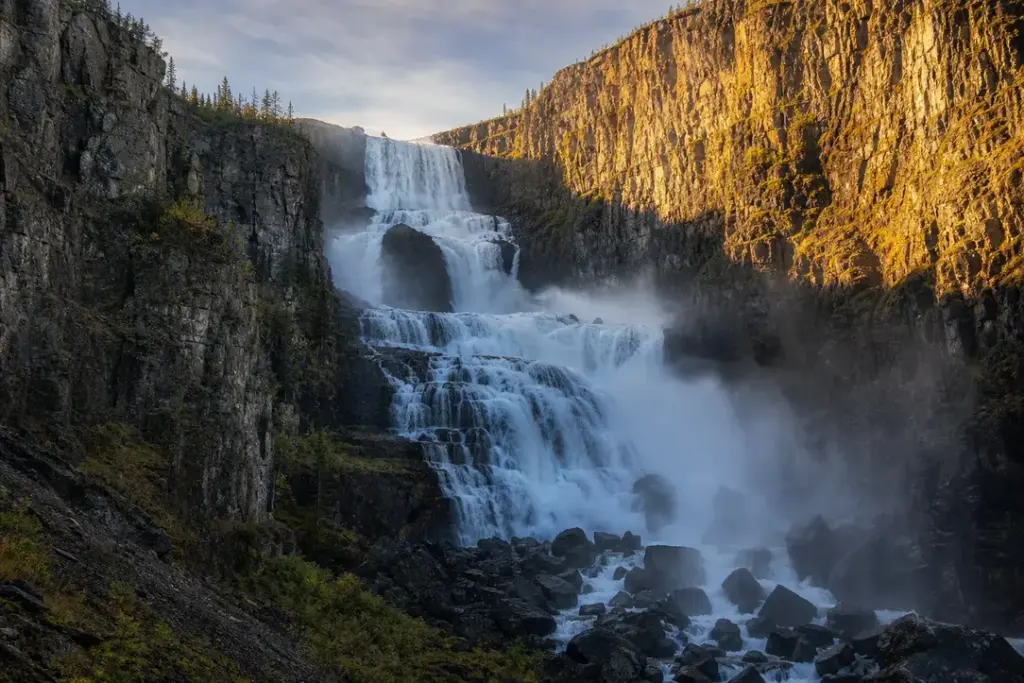
Uchar Waterfall is one of Russia’s most remote natural spectacles. Located on the Chulcha River deep within the Altai Reserve, this stepped cascade drops 160 metres over a series of rocky ledges in a stunning display of raw mountain power.
The name comes from the Altai language and means ‘flying’ or ‘inaccessible’—a fitting description for a waterfall that draws only determined hikers willing to undertake a demanding journey across unstable terrain, boulder fields, and narrow ledges with thousand-metre drops nearby.
Quick Facts
| Russian name | Водопад Учар |
|---|---|
| Address | Altai Republic, Altai Reserve, Chulcha River Google MapsApple MapsYandex Maps2GIS |
| District | Altai Republic |
| Best time to visit | July to September: The safest and most popular season. Snow and ice have melted, rivers are crossable, and trails are passable. Daytime temperatures range 15–20°C; nights can be cool. July has the longest daylight.June: Lower crowding but swollen melt-water rivers and occasional snow patches make the trail hazardous. River crossings are more difficult.October and later: Early snow, avalanche risk, and frequent weather closures make the trail dangerous and often inaccessible.Avoid: Winter (November to April) when the trail is impassable. Spring (May to June) brings high water and unstable conditions.Crowds and weather: Mid-July to mid-August is peak season; expect other hikers and more crowded camps. Late August and September offer better solitude. Afternoons often bring sudden storms; start hikes early to finish in daylight. |
| Recommended duration | 4–5 hours |
What Is (and Isn't) Part of a Visit to Uchar Waterfall, Altai Mountains?
| Part | Status | Notes |
|---|---|---|
| Waterfall viewing | Included in the standard ticket | Visitors see the cascade from an observation point; you cannot reach the base of the fall itself. |
| Trail to the waterfall | Included in the standard ticket | The 8 km hiking route from the Chulyshman River mouth (Chulcha confluence) is the standard access. |
| Altai Nature Reserve permit | Separate ticket or institution | Entry to the protected reserve requires a permit issued on-site at the reserve entrance near Artybash or pre-booked. |
| Boat crossing of Chulyshman River | Separate ticket or institution | Transport across the river to reach the trailhead is arranged locally; services operate from tourist camps at the confluence. |
| Guide service | Separate ticket or institution | A local guide is strongly recommended and often required by the reserve; guides can be arranged at camps or tourist operators. |
| Chulcha River gorge walk | Included in the standard ticket | The scenic gorge hike from Chulcha confluence to the waterfall forms the main experience. |
Why Visit Uchar Waterfall, Altai Mountains?
Uchar offers something few waterfalls can match: complete remoteness combined with extraordinary power. The sight of 160 metres of water plunging onto massive boulders, surrounded by steep gorge walls and taiga forest, justifies the physical effort required to reach it. The thunderous roar of falling water and the spray that fills the gorge create an almost overwhelming sensory experience.
The hike itself winds through one of the Altai’s most beautiful valleys, following the Chulcha River through a narrow gorge between sheer rock walls. In 2011, the Russian Tour Operators Association included Uchar among the five hardest-to-reach tourist destinations in Russia—a status that appeals to adventurers seeking something beyond standard mountain tourism.
Highlights of Uchar Waterfall, Altai Mountains
The Main Cascade
The waterfall consists of a series of stepped drops totalling 160 metres, not a single vertical fall. Water crashes down over massive boulders, creating towering plumes of spray that can reach the opposite cliff wall. The cascade stretches across a slope shaped by ancient glaciation, with the modern appearance formed by major geological events thousands of years ago.
Tip: Position yourself on the approach trail where the roar suddenly becomes deafening—this marks your arrival at the observation point.
Chulcha River Gorge
The hiking trail follows the Chulcha River through a narrow, cliff-walled gorge that is one of the most visually striking landscapes in the Altai. The gorge is sandwiched by inaccessible rock walls rising hundreds of metres above the river. The entire canyon creates a sense of being deep within untamed wilderness.
Tip: The gorge is most impressive in spring and early summer when the river is fuller from snowmelt, but the trail is safest in late July through September.
Rocky Ledge Trail with Metal Safety Hardware
The most technically demanding section involves traversing narrow ledges cut into vertical cliff faces, high above the river far below. Ropes and metal brackets have been installed in the most dangerous spots to aid climbers. This equipment is regularly maintained by the Altai Reserve and represents the only infrastructure on the entire route.
Tip: Do not attempt this section in poor visibility or after rain—wet rock becomes extremely slippery and the river can swell rapidly.
Boulder Field Sections (Kurumniki)
Much of the trail crosses unstable fields of large boulders that have fallen from above. These sections are slow going; loose rocks can shift underfoot, requiring careful footwork. The boulder fields are interspersed with sections of more solid trail but are physically exhausting.
Tip: Wear properly fitted hiking boots with ankle support and thick, corrugated soles—this is non-negotiable on Uchar.
River Crossings
The trail includes crossings of small tributaries that feed the Chulcha. These are usually shallow in summer but can swell after rain or in spring. Several crossings use basic log bridges or require wading; others have been reinforced.
Tip: Check recent trail reports before departure regarding water levels; bridges can become impassable during heavy rain or snowmelt.
Taiga Forest Surroundings
Away from the immediate gorge, the landscape is Siberian taiga—coniferous and birch forest typical of the Altai's lower elevations. Juniper scrub clings to rocky slopes. This forest provides the only relief from sun exposure, though the trail is often exposed to afternoon heat during summer months.
Tip: Start early to complete the hike in daylight; there are no shelter options beyond the starting point if you are caught out.
Atmosphere
The experience of reaching Uchar is one of progressive immersion into a primal landscape. The journey begins at the Chulyshman River near basic tourist camps, then immediately becomes isolated. The trail forces constant focus—every step demands attention to avoid loose rock, slips or falls.
The roar of the waterfall grows audible long before you can see it, building anticipation. As you approach, the sound becomes so loud that conversation is impossible. The air fills with mist and spray. The sensation is of standing before an immense, uncontrolled force of nature. The gorge walls dwarf human scale. Few modern travelers encounter environments this genuinely untamed.
History of Uchar Waterfall, Altai Mountains
Uchar Waterfall is geologically young. The stepped cascade sits on a slope created by one of the Altai’s last major glaciations. However, its modern dramatic form was shaped by a powerful earthquake dated to between 11,000 and 13,000 years ago—not the popular legend of a formation just 100–200 years ago. Geologists point to the slope’s structure and massive boulders as evidence of such ancient upheaval rather than recent collapse.
For local Altai peoples, the valley has been known and sacred for centuries, but Uchar itself remained unknown to the wider world until the 20th century. The waterfall was officially ‘discovered’ and publicized in 1981 when ordinary tourists first reached it. In 2011, the Russian Tour Operators Association recognized Uchar as one of the five hardest-to-reach tourist destinations in the Russian Federation, a status that endures.
The Altai Nature Reserve, which protects the waterfall and surrounding landscape, has gradually developed infrastructure on the trail—adding safety ropes and metal brackets to the most dangerous ledges and establishing basic campsites at the Chulyshman confluence. Despite this, Uchar has remained far less developed than other Russian natural attractions, retaining its remote character.
Legends and Myths about Uchar Waterfall, Altai Mountains
The Name's Origin
Local tradition holds that Uchar means 'inaccessible' in the Altai language, reflecting the waterfall's remote location and difficulty of access. Other sources translate it as 'flying' or 'soaring,' describing the way water leaps from the rock face. Both interpretations capture how the waterfall has been understood by those familiar with the region.
Recent Earthquake Formation
Disputed by historians. A widespread belief claims the waterfall formed only 100–200 years ago following an earthquake or sudden landslide. Local guides often repeat this story. However, geologists dispute this, pointing to evidence that the catastrophic event occurred 11,000–13,000 years ago, leaving the cascade's true age ambiguous to casual visitors.
Tickets and Booking for Uchar Waterfall, Altai Mountains
Access to the waterfall requires entry to the Altai Nature Reserve. A permit is issued to visitors on arrival at the reserve office (typically at the Artybash checkpoint on Lake Teletskoye) or pre-booked through the reserve administration. The permit cost is moderate and covers the protected territory for a set period.
From the reserve entrance, independent travel to the Chulyshman River trailhead involves overland and boat transport (roughly 490 km from Gorno-Altaysk). Tourist camps near the Chulyshman–Chulcha confluence can arrange boat crossings and provide basic accommodation.
A local guide is essential. Guides are available through camps or via tourism operators in nearby Altai towns; they know safe route timing and can assess trail conditions after rain or snow. Same-day booking is not advisable; arrange guides as part of advance trip planning.
The reserve office website (altai-reserve.ru) issues permits and provides current regulations and contact details for guide services and campsite booking.
Plan and Book
Suggested itineraries Uchar Waterfall, Altai Mountains
Full day (8–9 hours)
Depart from the Chulyshman–Chulcha camp at dawn. Cross the river by boat to the trailhead. Hike 8 km to the waterfall observation point (3–4 hours), rest and explore for 1–2 hours, then return (3–4 hours). Finish before dark. This is the standard single-day itinerary.
Two days with overnight camp
Day 1: Hike to the waterfall midday, camp near the observation point overnight. Day 2: Explore the gorge and waterfall at leisure, return to Chulyshman camp. Allows flexibility for photography and acclimatization.
Three days with exploration
Day 1: Hike partway, overnight near Chulcha gorge. Day 2: Reach waterfall, overnight at camp. Day 3: Extended time at the waterfall, return. Allows rest days and exploration of the gorge itself.
How to Get to Uchar Waterfall, Altai Mountains
Starting Point: The Chulyshman River mouth (near the Chulcha River confluence), roughly 490 km north-east of Gorno-Altaysk, the main city in the Altai region.
Route from Gorno-Altaysk: Drive or tour coach north-east via the Teletskoye Lake shore road (Chuysky Trakt highway), approximately 10–12 hours by vehicle. Buses and minivans run this route; tour operators combine road transport with accommodation.
From Lake Teletskoye: The reserve gateway is near Artybash village at the north end of the lake. Get a reserve permit here (or pre-book). Continue north-east to the Chulyshman–Chulcha camps by local road (rough terrain, 4×4 advisable) or boat transport along the lake shore from Listvyanka (the main settlement).
Final approach: From the tourist camps, cross the Chulyshman River by motorboat (locals arrange this daily for a small fee). The hike begins immediately after crossing.
Travel note: This is not a day trip from major towns. Visitors typically spend 3–4 days total including transport. Most international visitors book through tour operators in Gorno-Altaysk or Irkutsk who arrange all transport and guides as part of a package.
Accessibility
Uchar is not accessible to anyone with mobility difficulties. The trail involves climbing, scrambling over boulders, balancing on narrow ledges above steep drops, and wading through river crossings. People with knee, hip, ankle or balance issues will find it dangerous.The trailhead itself is at ground level, but immediately becomes steep and technical. There are no accessible restrooms or facilities beyond the starting camps. No strollers or wheelchair-accessible routes exist.The route demands good aerobic fitness, strong leg muscles, and psychological comfort with heights and exposure. Travellers over 60 should have regular exercise experience before attempting it.
Food Nearby
No shops, restaurants or services exist on the trail or at the waterfall. Bring all food and water from the base camps at Chulyshman–Chulcha.The camps themselves have basic cafes serving simple hot meals (soups, bread, tea) and may provide packed lunches if arranged in advance. These offer moderate-priced local options.Carry at least 2 litres of water per person; the trail is in sun-exposed sections. Bring high-calorie snacks (nuts, dried fruit, energy bars) for the 4–5 hour hike.
What to Bring
Essential: Proper hiking boots with thick, corrugated soles and ankle support (this cannot be overstressed). Lightweight backpack with rain cover. 2–3 litres water capacity. High-calorie snacks and lunch. Sunscreen and hat; exposure on cliff ledges is intense.Clothing: Layers (mornings are cool, afternoons can be warm). Wind-proof outer layer. Sturdy socks. Avoid loose or long pants that catch on rocks.Safety items: Headlamp or small flashlight (in case you are delayed). First-aid kit. Whistle.Optional: Trekking poles (helpful on steep sections and boulder fields). Camera with good battery. Binoculars for gorge exploration.Bag rules: No size restrictions, but keep pack weight under 15 kg; the route is exhausting and a heavy pack increases fall risk. Leave valuables at camp.
Best Views and Photo Spots of Uchar Waterfall, Altai Mountains
Main observation point at the cascade base
The stepped waterfall falls directly in front of you with cliff walls rising on both sides. Mist and spray create a cathedral-like effect. The scale of the drops becomes clear from this vantage.
Best time: Mid-afternoon (14:00–16:00) when sun angle creates rainbow effects in the spray. Avoid midday glare and early morning shadows.
Upper approach trail before the cascade
Looking back down the Chulcha gorge with the river far below and cliff walls framing the view. Less crowded than the main point and shows the scale of the gorge itself.
Best time: Early morning light on the gorge walls. Often clearer before afternoon clouds build.
Rocky ledge overlooks along the climb
Wide views of the Chulyshman valley and gorge. The river becomes a thin line far below. Good for landscape and context photos showing remoteness.
Best time: Clear-weather mornings before haze builds. Avoid afternoon when in shadow.
Waterfall from the spray zone (if safe)
Extreme close-up of boulder impacts and spray. The power of the falling water is overwhelming. Difficult to photograph due to constant dampness.
Best time: Brief window when sun breaks through mist. Brings out spray contrast against dark gorge walls.
Photography Rules
Photography is unrestricted. However, the mist and spray near the observation point will wet camera equipment. Use waterproof bags for electronics. Tripods are manageable on stable ground but awkward near cliff edges. Drones are prohibited within the nature reserve.The best light is late afternoon when the sun hits the cascade from the western cliff, creating rainbow effects in the spray. Plan timing accordingly.
Family Suitability
Uchar is not suitable for families with young children or anyone unfit. The trail is dangerous for children under 12 and risky even for older teens without serious hiking experience. It is not a casual walk.Teenagers aged 14+ with good fitness and hiking experience, and who are comfortable with heights and exposure, may attempt the hike with experienced adult supervision and professional guides.Infants and toddlers: absolutely unsuitable. No stroller access. Carrying a child on the cliff-edge sections is unsafe.Families interested in Altai but unable to tackle Uchar should explore alternatives: Lake Teletskoye itself (boat tours available), easier gorge walks elsewhere in the reserve, or viewpoints accessible by vehicle.
Russia Vibes Tips
- Start the hike before 07:00 to finish in daylight. The trail has no lighting and you must be off the cliff sections before dusk. Headlamps are unreliable on technical terrain.
- Book a guide at least one week in advance. The reserve and local camps maintain lists of qualified guides who know current trail conditions. Do not attempt this route without local knowledge.
- Check the trail closure status before traveling. Bad weather, landslides, or rockfall can close Uchar for days. Tour operators in Gorno-Altaysk have current information; the reserve office can confirm status.
- Avoid the temptation to scramble closer to the base of the waterfall beyond the main observation point. The spray makes rocks dangerously slippery, and the noise masks warning sounds of falling debris.
- Bring sunscreen specifically for intense mountain sun reflection off rocks. The gorge walls amplify UV exposure. Reapply after wading river crossings.
- Travel with a walking pole or pair of poles if you have any lower-body weakness. The boulder fields and loose scree demand stability, and poles reduce fall risk on descents.
Explore Nearby Uchar Waterfall, Altai Mountains
Sights near Uchar Waterfall, Altai Mountains
 Chulyshman Valley, Altai Mountainsabout 24.8 km away · typical visit: 2–5 days
Main image: AI-generated illustration. It may not show the place exactly as it looks.
 Korbu Waterfall, Altai Mountainsabout 71.3 km away · typical visit: 3–4 hours
Main image: AI-generated illustration. It may not show the place exactly as it looks.
Related guides
 Altai Mountains: Best Places, Scenic Routes and Travel Tips
Main image: AI-generated illustration. It may not show the place exactly as it looks.
 Chuya and Katun Confluence: Free Viewpoint and Sacred Altai LandmarkOpen 24 hours
Main image: AI-generated illustration. It may not show the place exactly as it looks.
 Ukok Plateau: Remote Expedition Across Ancient Steppe
Main image: AI-generated illustration. It may not show the place exactly as it looks.
 Akkem Lake: Alpine Trek to Mount Belukha’s Base
Main image: AI-generated illustration. It may not show the place exactly as it looks.
 Shavlo Lakes: Turquoise Waters and Glacier Peaks
Main image: AI-generated illustration. It may not show the place exactly as it looks.
Browse more: More in Altai Republic · All Altai Mountains · All Sightseeing · All Sightseeing in Altai Mountains · All Viewpoints
FAQ: Uchar Waterfall, Altai Mountains
Do I need a guide?
A guide is strongly recommended and typically required by the reserve. The trail is unmarked, and route-finding in mist or low visibility is difficult. Local guides know safe river-crossing times, identify hazard zones, and can turn back if conditions deteriorate. They are available through camps or tour operators.
Can you swim or bathe at the waterfall?
No. The base of the waterfall is inaccessible due to cliff walls and dangerous spray. The observation point is the closest safe approach. The water temperature is near freezing even in summer.
Is a permit required?
Yes. The waterfall is within the Altai Nature Reserve, which requires an entry permit for all visitors. Permits are issued at the reserve office (usually at Artybash near Lake Teletskoye) or can be pre-booked through the reserve administration.
How difficult is the hike really?
It is moderately difficult but with serious technical sections. The 8 km trail gains 330 metres elevation gradually but includes boulder scrambling, narrow cliff-edge ledges, and river crossings. It suits experienced hikers in good fitness; casual walkers will struggle. Expect 3–4 hours each way.
What is the waterfall's true height?
Most sources cite 160 metres as the total cascade height. However, this is disputed by some surveys, and the exact measurement remains uncertain. It is a stepped cascade, not a single vertical drop.
Is the trail open year-round?
No. The trail is typically safe and passable from late June through September. October and later bring snow and weather closures. Winter (November–April) is impassable. Check with the reserve or your operator for current conditions before departure.
How far is it from Gorno-Altaysk?
Approximately 490 km and 10–12 hours by vehicle. Most visitors spend 3–4 days total including transport. Few do it as a day trip from major towns.
What if the trail is closed when I arrive?
Tour operators sometimes substitute the Uchar hike with other waterfall routes (Kurkure, Maldanash) if weather or landslides close the main trail. Confirm in advance what options your operator offers if Uchar is inaccessible on your planned dates.
Russia Vibes is a one-person project. A coffee keeps it going
How we research and update our guides
About this guide: AI assistance and accuracy
This guide is created with the help of AI and is based on official sources where available. Mistakes can still happen. Opening hours, prices, rules and other details are given to the best of our knowledge as of the date shown and can change without notice. It offers general recommendations only, not professional, legal or travel advice. Please confirm important details with the official source before you travel; you are responsible for your own plans and decisions.
Packing for this trip
* Affiliate link: as an Amazon Associate we earn from qualifying purchases at no extra cost to you.

Take this guide with you
Get a free PDF of this guide to print or read offline: key facts, tips and a map link on a few clean pages.
Report an issue on this page
Paying for your trip: please read
International sanctions affect payments between Russia and many other countries. In practice, cards issued in the EU, the UK, the US and several other countries often do not work in Russia, Russian cards usually do not work abroad, and some booking platforms, airlines and payment providers limit or suspend their services for Russia. The situation changes frequently.
We do not give legal or financial advice, and this site does not encourage anyone to break or circumvent sanctions. Whatever you plan, you are responsible for following the laws and regulations that apply to you, including those of your country of residence and citizenship.
Many travelers still organise their stay lawfully. It is worth asking your bank or payment provider what is currently permitted, contacting hotels, tour operators and carriers directly about the payment methods they accept, and checking which services are open to customers from your country. Clarify payment, cancellation and refund terms before you commit to a booking, and keep your plans flexible.
Partner links on this site may not be available in every country, and prices, availability and rules in our guides can differ from what you see when you book.