
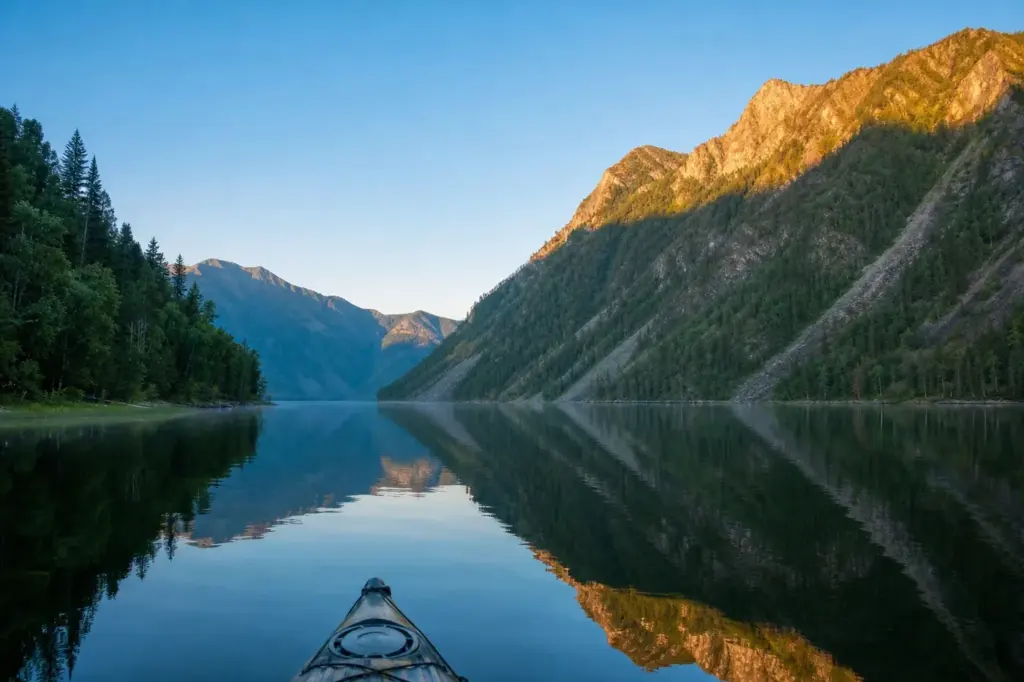
Lake Teletskoye is the largest lake in the Altai Mountains and one of Russia’s deepest bodies of freshwater. Nestled in the northeastern Altai, the lake stretches nearly 80 kilometers between the Korbu and Al-tyntu mountain ridges, with crystal-clear water and steep taiga-covered shorelines that create a landscape often compared to a miniature Lake Baikal.
This natural wonder is part of the UNESCO World Heritage Site Golden Mountains of Altai, recognized for its exceptional biodiversity and isolation. The lake draws hikers, boat travelers, and nature photographers seeking solitude among some of southern Siberia’s most dramatic scenery.
Quick Facts
| Russian name | Телецкое озеро |
|---|---|
| Built / opened | circa 20000 BC |
| Address | Artybash, Turochaksky District, Altai Republic, Russia Google MapsApple MapsYandex Maps2GIS |
| Admission | free |
| Best time to visit | Late June through early September. July and August are warmest (15–20°C on the water) and have the most frequent boat tours and services. June and September are quieter, with occasional rain and cooler mornings. Spring (May–early June) sees occasional snowmelt and swollen streams but fewer visitors. Winter (November–March) brings extreme cold (−15 to −20°C) and ice on shallow bays; the lake does not freeze solid, but boat services are minimal or nonexistent. |
| Recommended duration | full day or multi-day |
| Website | altzapovednik.ru |
What Is (and Isn't) Part of a Visit to Lake Teletskoye, Altai Mountains?
| Part | Status | Notes |
|---|---|---|
| Lake Teletskoye itself and its shoreline | Included in the standard ticket | The lake is freely accessible for viewing, photography, and boat tours from Artybash and other settlements. |
| Artybash village (northern shore) | Included in the standard ticket | The main settlement and hub for lodges, supplies, and boat tour operations; freely accessible. |
| Korbu Waterfall and eastern shore waterfalls | Included in the standard ticket | Accessible by paid boat tour; costs vary by operator and group size. |
| Altai Nature Reserve ecotourist routes | Separate ticket or institution | Six official hiking routes require permits obtained 2–3 months in advance through the Altai Nature Reserve (main office in Gorno-Altaysk); permits are free but must be obtained before arrival. |
| Chulyshman Valley and southern approach | Included in the standard ticket | Accessible by vehicle via the steep Katu-Yaryk Pass road or by multi-day trek; not a separate ticket. |
| Diving in the lake | Separate ticket or institution | Technical diving requires specialized certification and arrangements with licensed local dive operators; additional fees apply. |
Why Visit Lake Teletskoye, Altai Mountains?
Pristine wilderness: The lake’s remote location and protected status mean you will encounter untouched forests, clear mountain air, and minimal development beyond a few small settlements.
Crystal-clear water: Visibility ranges from 6 to 14 meters, making it ideal for viewing the underwater landscape and diving in summer.
Waterfalls and boat access: Most of the lake’s 78 km shoreline is roadless; boat tours from Artybash provide the only practical way to see hidden coves, remote falls like Korbu Waterfall, and the dramatic mountain backdrop.
Hiking and multi-day treks: Routes like the Chulyshman Valley approach or remote alpine trails in the adjacent Altai Nature Reserve offer days-long adventures through high meadows and pristine basins.
How Lake Teletskoye, Altai Mountains Is Laid Out
Lake Teletskoye is an elongated body of water running roughly north to south for 78 km, with an average width of 2.9 km and maximum width of 5.2 km. The lake sits at 434 meters elevation, flanked by steep mountain ridges on both sides.
Northern shore (Artybash area): The main settlement and access point for most visitors. A road runs east from Artybash for about 9 km but then ends; this is where road-based exploration stops.
Eastern and western shores: Largely roadless and accessible only by boat. The eastern shore falls within the Altai Nature Reserve buffer zone; some areas require permits.
Southern end: Accessible only by multi-day trek or boat. The Chulyshman River flows into the southern tip after descending from the high Chulyshman Valley through the dramatic Katu-Yaryk Pass.
Most visitors base themselves in or near Artybash and take boat excursions outward, rather than circumnavigating the entire lake.
Highlights of Lake Teletskoye, Altai Mountains
The lake itself: A glacial trough 78 km long
Lake Teletskoye was shaped by glaciation approximately 20,000 years ago and now fills a tectonic depression. It is 78 km long, up to 5 km wide, and reaches 325 meters deep—Russia's second-deepest lake after Baikal. The water clarity is exceptional for a large Siberian lake, with typical visibility of 6 to 14 meters. The shoreline rises steeply from the water into dense taiga and alpine slopes, creating the appearance of a Norwegian fjord transported to the Altai.
Tip: On clear days, the water reflects mountain peaks perfectly in early morning; bring a camera and expect stunning light between 7 and 9 a.m.
Korbu Waterfall: A 13-meter cascade accessible by boat
Located on the eastern shore, Korbu Waterfall is the most visited waterfall on the lake, reached by a 30-minute boat ride from Artybash. A wooden walkway leads to a viewing platform where you can feel the mist. The short trail and accessible platform make it popular with families and those with limited trekking experience.
Tip: Boat tour operators often combine a Korbu visit with stops at other waterfalls (Estyuba, Chelyush) in a half-day or full-day excursion; ask about package pricing at lodges in Artybash.
Chulyshman River inlet: The southern entry point
At the lake's southern tip, the Chulyshman River flows in after a 241 km journey through high mountains and the dramatic Chulyshman Valley. This is the approach used by trekkers descending from the interior Altai, and by boat travelers reaching the most remote stretches. The confluence offers views of forested valleys and is the start of the journey northward along the lake.
Tip: The Katu-Yaryk Pass above the river is a notoriously steep and narrow mountain road; if you reach the lake this way, do not underestimate the driving time or road conditions.
Alpine lakes and routes in the Altai Nature Reserve
The protected territory immediately east and south of Lake Teletskoye includes the Altai Nature Reserve, which contains over 1,000 alpine lakes above 1 hectare in size. The reserve's high plateaus and glaciated peaks offer trekking routes with permits. Six ecotourist routes are officially open to the public; they require permits obtained 2–3 months in advance.
Tip: Contact the main office in Gorno-Altaysk well ahead of travel to secure permits and arrange guides; some routes, such as the Chichelgansky Zigzag, offer both day-trip views of the lake and multi-day expeditions into the high mountains.
Artybash settlement: The northern gateway
Artybash is the main village and access hub on the northern shore. It offers basic lodges, guesthouses, boat tour operators, and supplies. The village sits at the lake's northern end and has remained small and relatively undeveloped, preserving the remote character of the area.
Tip: Arrive early in summer (June) or mid-summer (July) to secure boat tours and lodging; by late August, boat services become less frequent as the water cools and visitor numbers drop.
Mountain scenery: Korbu and Al-tyntu ridges
The lake is bounded by two major ridges: Korbu on the east and Al-tyntu on the west. These mountains rise steeply from the shoreline and reach elevations of nearly 2,000 meters, with patches of snow persisting into summer on north-facing slopes. The ridges create a steep, U-shaped valley typical of glacial troughs.
Tip: Bring binoculars to spot ibex (wild goats) on the rocky slopes above the western shore, especially in early morning or evening when they are most active.
Transparency and underwater visibility
The lake's exceptional water clarity—visibility often 10 to 14 meters—is unusual for a large lake and draws technical divers. The water is cold (3–4°C year-round below 30 meters) and the depths drop steeply. Divers report that at depths below 40 meters, darkness and clarity combine to create a unique visual environment.
Tip: Diving requires specialized training and equipment; arrange dive operations through licensed operators in Artybash or contact the Altai Nature Reserve for recommendations.
Seasonal ice and winter conditions
In winter, the lake does not freeze solid due to its depth, but ice forms around the edges and boat services cease. Temperatures plunge to −15°C to −20°C (5°F to −4°F), and the region becomes extremely difficult to access. Summer and early autumn are the only practical seasons for most visitors.
Tip: Plan visits between June and September; ice-out is typically late May, and by October water temperatures and shortening days make boat tours uncomfortable and less frequent.
Atmosphere
Lake Teletskoye feels remote and timeless. The water is still, reflecting the steep mountains in mirror-like calm on clear mornings. The only sounds are birdsong, lapping water, and the distant roar of the few waterfalls. Boat tours carry small groups; you may spend hours without seeing another vessel. Taiga forests crowd the shoreline, broken only by rocky outcrops and the occasional clearing where a lodge or ranger station sits.
Summer brings cool but pleasant days (15–20°C on the water), and visitors are spread thinly across lodges and camping sites. The light lingers long into the evening, creating golden hour moments from 8 p.m. onward. The air smells of pine and moss, and the water is too cold for casual swimming but clear enough to see stones on the bottom in shallow bays.
History of Lake Teletskoye, Altai Mountains
Lake Teletskoye was formed approximately 20,000 years ago at the end of the last glacial epoch, when retreating ice sculptured the Teletsk graben—a tectonic depression between the Sailughem Mountains and the Western Sayans. The glacial meltwater filled this depression, creating a U-shaped valley and the deep, elongated lake visible today. Geological evidence shows that the lake basin sits on a tectonic fault and has subsided more than 3,000 meters over its geologic history, making room for depths that now exceed 325 meters.
The indigenous Altai people, Turkic-speaking herders and hunters, have inhabited the surrounding mountains for centuries. Local legend connects the lake to spiritual traditions and names it “Altyn Kol”—Golden Lake—in the Altai language. Archaeological sites around the lake, including burial mounds and stone markers from the Turkic period, testify to ancient occupation. Russian explorers and trappers began documenting the lake in the 18th century.
The Altai Nature Reserve was established in 1932 as one of the Soviet Union‘s earliest protected areas, specifically to preserve the unique ecosystems around Lake Teletskoye and the eastern Altai. The reserve now covers 8,712 square kilometers and protects 30 kilometers of the lake’s eastern shoreline and the vast forested and alpine terrain inland.
In 1998, Lake Teletskoye and the surrounding mountains were designated a UNESCO World Heritage Site as part of the Golden Mountains of Altai, recognizing the area’s exceptional biodiversity, isolation, and geological significance. This status brought international attention and support for conservation but did not dramatically alter access or tourism, as the lake’s remoteness remains the primary limiting factor.
Legends and Myths about Lake Teletskoye, Altai Mountains
The lake's name and the treasure in the depths
Legend – historically unreliable. Local Altai people call the lake Altyn Kol (Golden Lake) and recount stories of gold and precious stones hidden in its deepest trenches, guarded by spirits of the water. Some versions claim that a golden idol or treasure chest lies at the bottom, waiting for the lake to give up its secrets. The legend likely originated from the glint of sunlight on the water's surface and the mystery surrounding depths that no person could reach in early times.
The phantom boat and evening mists
Legend – historically unreliable. Travelers and locals speak of a ghostly boat that appears in the evening mist, sailing the lake without a captain. Some say it was a hunting party caught in a sudden storm centuries ago; others claim it is the spirit of the lake itself, warning visitors to respect its power. The phenomenon likely refers to optical illusions created by fog banks and the reflection of sunset light on water—but the tale persists in the collective memory of villages along the shore.
The lake never fully freezes: ancient belief and tectonic truth
Disputed by historians. The Altai people believed that the lake's refusal to freeze solid in winter was a sign of its sacred nature and the presence of hot springs or divine warmth beneath. Modern geology confirms a partial truth: deep circulation and heat from below prevent the entire lake from freezing, even at depths. What was once interpreted as magic is now understood as the thermal and hydrodynamic properties of a deep, steep basin.
Tickets and Booking for Lake Teletskoye, Altai Mountains
Lake Teletskoye itself is free to visit and view. Costs arise from boat tours, lodging, and (if desired) permits for backcountry routes.
Boat tours: Operated by local lodges, guides, and private operators in Artybash and nearby settlements. Tours typically run June to September and range from 3–4 hour half-day excursions (such as Korbu Waterfall) to full-day cruises (12+ hours). Prices vary; inquire at your lodging or contact operators in Artybash directly. Tours are arranged on a first-come, first-served basis or through advance booking with lodges.
Permits for the Altai Nature Reserve: Free but required for any hiking on designated ecotourist routes in the reserve. Apply to the main office in Gorno-Altaysk at least 2–3 months in advance. No official online booking system; contact by phone or email through the reserve website.
Lodging and meals: Available in Artybash and other settlements; book in advance during summer peak season (July–August). Rates vary from budget guesthouses to mid-range lodges.
Plan and Book
Suggested itineraries Lake Teletskoye, Altai Mountains
Half day (4 hours)
Morning boat tour from Artybash to Korbu Waterfall and back. A short walk to the viewing platform, light picnic by the shore, return to Artybash by early afternoon.
Full day (8–10 hours)
Extended boat cruise departing Artybash at 9 a.m. Stop at Korbu Waterfall (1 hour ashore), continue south to the Estyuba or Chelyush waterfalls, explore a remote bay or village, and return by late afternoon or early evening.
2–3 days
Day 1: Arrive in Artybash, lodge stay, afternoon orientation. Day 2: Full-day boat tour of the northern and central lake. Day 3: Optional guided hike or visit to a neighboring waterfall or alpine area; return to Artybash.
4–7 days or longer
Multi-day trek from the Chulyshman Valley over the Katu-Yaryk Pass and down to the lake's southern shore, then boat or trekking northward along the shoreline; or a permit-based route in the Altai Nature Reserve from a base camp near Artybash.
How to Get to Lake Teletskoye, Altai Mountains
By air: Fly into Gorno-Altaysk Airport (about 120 km southwest of the lake). From Gorno-Altaysk, rent a car or arrange a transfer; the drive to Artybash takes 4–5 hours via the scenic Chuysky Trakt highway and mountain roads.
By road from major cities: From Barnaul (200 km), Novosibirsk (480 km), or Biysk (150 km), drive north and east to the Chuysky Trakt, then north on mountain roads to Artybash. Road conditions are variable; allow extra time in spring (snowmelt) or autumn (weather).
To the lake from Artybash: All visitors explore Lake Teletskoye by boat. A road runs east from Artybash for 9 km along the northern shore but then ends. Boat tours depart daily in summer from lodges and private operators in Artybash. Hiking trails also connect Artybash to nearby peaks and to the Chulyshman approach from the south.
Accessibility
Most of Lake Teletskoye is naturally remote and challenging to access for those with mobility restrictions. Artybash village has basic lodging and can accommodate wheelchairs in some guesthouses (verify in advance). Boat tours have open decks with steps and no accessible facilities. Hiking trails to viewpoints are steep and unimproved. Korbu Waterfall platform is accessible via a short wooden walkway from the boat landing but involves uneven ground. For detailed accessibility arrangements, contact lodges in Artybash directly; advance notice is essential.
Food Nearby
Artybash has a few small restaurants and cafes serving basic Russian and Altai cuisine. Guesthouses typically provide meals to lodgers. In remote areas, bring your own food. Fishing for local trout and grayling is possible with permits; arrangements can be made through lodges. Markets in Gorno-Altaysk (4–5 hours away) offer better variety than lakeside settlements.
What to Bring
Warm layers (fleece, wind jacket) for cool mornings and evenings on the water. Rain gear essential even in summer. Sturdy hiking boots for lakeside trails and waterfall walks. Sunscreen and hat for intense reflection off the water. A camera with weatherproof protection. Insect repellent (mosquitoes in July–August, especially in sheltered coves). Snacks and water for boat tours. Waterproof bag for valuables. Diving certification and gear if diving; rental availability is limited.
Best Views and Photo Spots of Lake Teletskoye, Altai Mountains
Artybash waterfront at sunrise
The northern shore with mountains reflected in still water. Golden light hits the ridges as clouds lift. Boats and fishing gear frame the foreground. Best in June when dawn comes early.
Best time: 5:30–7:00 a.m. on clear mornings in June or early July
Korbu Waterfall and viewing platform
The 13-meter cascade against dark rock, with mist rising and taiga forest behind. The platform gives a high angle; water spray catches the light.
Best time: Mid-morning (9–11 a.m.) or overcast afternoon for diffused light on the waterfall
Southern lake open water, mid-lake vantage (by boat)
Both mountain ridges visible across the water. The lake stretches in both directions. Mountains meet the water with no visible settlements—a sense of scale and isolation.
Best time: Clear afternoon with light from the south (12–3 p.m.). Avoid harsh midday shadows on ridge faces.
Chulyshman River inlet (southern tip)
The river entering the lake, forested hillsides, and the convergence of river current with lake water. Dramatic if approached by boat from the north.
Best time: Early evening (6–8 p.m.) when light is warm and the water is still
Eastern shore taiga and rocky outcrops
Steep forested slopes meeting vertical rock faces. Trees emerge from the water's edge. Best glimpsed from a moving boat along the eastern shore.
Best time: Midday with clear light on the cliff faces; late afternoon for shadow and texture
Photography Rules
Photography is unrestricted on the lake and surrounding areas. Drones are not permitted in the Altai Nature Reserve; check with local guides before flying near protected areas. Tripods are allowed. There is no flash restriction for daytime photography. Underwater and diving photography requires specialized equipment; arrange with dive operators. The water's clarity makes reflection photography stunning, especially at sunrise and sunset.
Family Suitability
Lake Teletskoye is suitable for older children and active families. The lake itself offers scenic boat tours accessible to children aged 5+, though boat rides are long (4–8 hours) and there are no onboard amenities beyond bench seating. Korbu Waterfall walk is moderate and family-friendly. Younger children may struggle with rough roads to reach the lake and the lack of convenient facilities in remote areas. Stroller access is limited to Artybash village only. Families should plan short boat excursions rather than full-day cruises, bring entertainment, and ensure children are comfortable on water. Lodges can arrange family-friendly meals and accommodations; advance booking is essential.
Russia Vibes Tips
- Book boat tours and lodging weeks in advance during July and August. Operators often limit daily departures and fill up quickly. Early morning (6–7 a.m.) departures are worth the early start because the water is calmest and the light is best.
- The drive from Gorno-Altaysk or Biysk is spectacular but exhausting. Many visitors break it up with a night in a smaller town like Chemal to rest and acclimatize. Do not underestimate mountain road conditions or drive after dark.
- If hiking the Chulyshman Valley or approaching from the south via Katu-Yaryk Pass, check road reports before departure. The pass is steep, narrow, and can become impassable in heavy rain. Local guides are essential if you are unfamiliar with mountain driving.
- Bring much more water and snacks than you expect to need. Boat tours make few stops, and food options at remote settlements are minimal. Lodges can pack meals on request; ask when booking.
- The lake's water is cold (3–4°C at depth) year-round. Even in summer, immersion would be life-threatening within minutes. Wear a life jacket on all boat tours, especially if traveling with children, and do not plan to swim.
- Mosquitoes and taiga flies are intense in sheltered coves during July and early August, especially in the evening. Insect repellent is essential. Stay on open water during peak bug hours (dawn and dusk) to minimize exposure.
Explore Nearby Lake Teletskoye, Altai Mountains
Related guides
 Chulyshman Valley and Katu-Yaryk Pass Route: A 5-Day Mountain Adventure
Main image: AI-generated illustration. It may not show the place exactly as it looks.
 Two Days at Lake Teletskoye: Boat Tours, Waterfalls and Mountain Views
Main image: AI-generated illustration. It may not show the place exactly as it looks.
 Gorno-Altaysk: Gateway to the Altai Mountains
Main image: AI-generated illustration. It may not show the place exactly as it looks.
Browse more: All Altai Mountains · All Parks · All Sightseeing · All Sightseeing in Altai Mountains
FAQ: Lake Teletskoye, Altai Mountains
Can I drive all the way around Lake Teletskoye?
No. A road runs 9 km east from Artybash along the northern shore and then ends. The rest of the shoreline is roadless and accessible only by boat or on foot. Most visitors base themselves in Artybash and take boat excursions.
How do I reach the lake from Gorno-Altaysk?
By car or arranged transfer: 4–5 hours northeast via the Chuysky Trakt scenic highway and mountain roads to Artybash. Rental cars are available in Gorno-Altaysk. No public bus serves the lake regularly.
What is the best time to visit?
June through September. July and August are warmest and have the most frequent boat services. June and September are quieter and less crowded. Winter is extremely cold and inaccessible for most visitors.
Do I need a permit to visit Lake Teletskoye?
Not for simply viewing or boating on the lake. You need a free permit from the Altai Nature Reserve only if you plan to hike on designated ecotourist routes in the reserve. Apply 2–3 months in advance through the reserve's main office in Gorno-Altaysk.
How much does a boat tour cost?
Prices vary by operator and group size. Half-day tours (4 hours) to Korbu Waterfall range from moderate to upscale; full-day cruises are more expensive. Ask at lodges in Artybash for current rates and availability.
Can I swim in the lake?
Technically yes, but not recommended. Water temperature is 3–4°C year-round below about 30 meters and never warms significantly. Immersion would be life-threatening within minutes. Cold-water diving with proper gear is possible.
Is the lake frozen in winter?
The lake does not freeze solid due to its depth (325 m). Ice forms around the shallow edges, but the main body remains liquid. Temperatures drop to −15 to −20°C, and boat services cease. Winter is not practical for most visitors.
What wildlife can I see?
Birds (eagles, herons, waterfowl), fish (trout, grayling), and occasionally ibex (wild goats) on the steep western slopes. Bears, lynx, and other large mammals inhabit the reserve but are rarely seen by visitors.
Russia Vibes is a one-person project. A coffee keeps it going
How we research and update our guides
About this guide: AI assistance and accuracy
This guide is created with the help of AI and is based on official sources where available. Mistakes can still happen. Opening hours, prices, rules and other details are given to the best of our knowledge as of the date shown and can change without notice. It offers general recommendations only, not professional, legal or travel advice. Please confirm important details with the official source before you travel; you are responsible for your own plans and decisions.
Packing for this trip
* Affiliate link: as an Amazon Associate we earn from qualifying purchases at no extra cost to you.

Take this guide with you
Get a free PDF of this guide to print or read offline: key facts, tips and a map link on a few clean pages.
Report an issue on this page
Paying for your trip: please read
International sanctions affect payments between Russia and many other countries. In practice, cards issued in the EU, the UK, the US and several other countries often do not work in Russia, Russian cards usually do not work abroad, and some booking platforms, airlines and payment providers limit or suspend their services for Russia. The situation changes frequently.
We do not give legal or financial advice, and this site does not encourage anyone to break or circumvent sanctions. Whatever you plan, you are responsible for following the laws and regulations that apply to you, including those of your country of residence and citizenship.
Many travelers still organise their stay lawfully. It is worth asking your bank or payment provider what is currently permitted, contacting hotels, tour operators and carriers directly about the payment methods they accept, and checking which services are open to customers from your country. Clarify payment, cancellation and refund terms before you commit to a booking, and keep your plans flexible.
Partner links on this site may not be available in every country, and prices, availability and rules in our guides can differ from what you see when you book.