
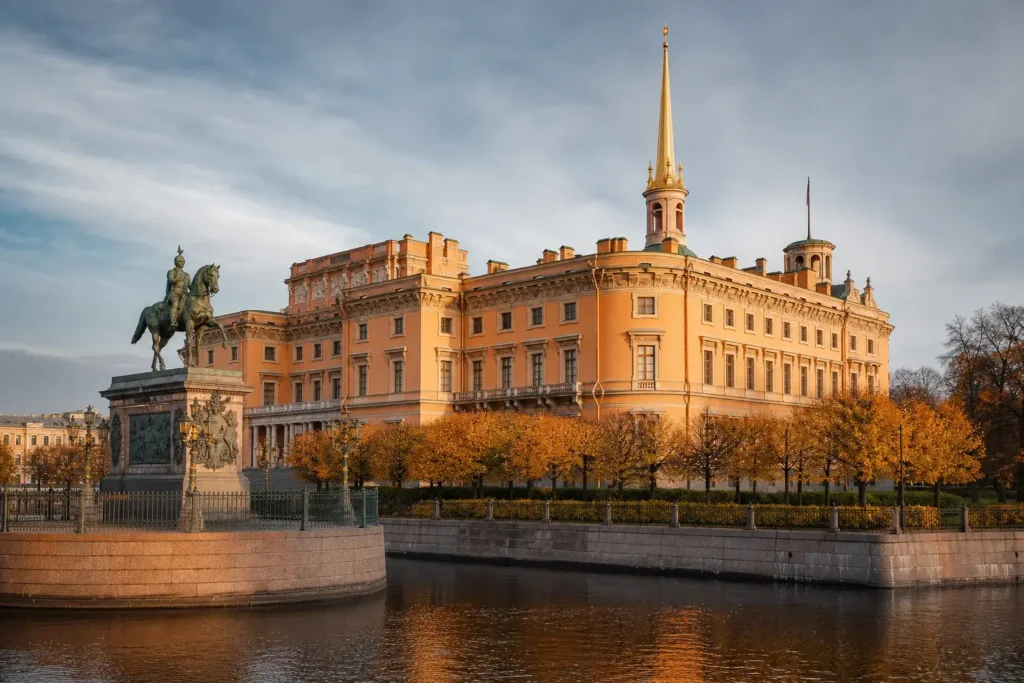
Saint Michael’s Castle is the palace Emperor Paul I built for himself in the heart of Saint Petersburg, and it looks like nothing else in the city. Gothic, French classical and Italian Renaissance elements are mixed, so that each façade shows a different face. Paul lived here for only about forty days before he was killed in March 1801.
Today the castle is a branch of the Russian Museum and houses its portrait gallery, restored state rooms and rooms of the empress. This page explains what you can see, how it differs from the main Russian Museum nearby, and how to reach it from Nevsky Prospect by metro or on foot.
Quick Facts
| Russian name | Михайловский (Инженерный) замок |
|---|---|
| Built / opened | 1801 |
| Architect(s) | Vincenzo Brenna and Vasily Bazhenov, to the concept of Emperor Paul I |
| Address | Санкт-Петербург, Садовая ул., 2 OpenStreetMap · Google Maps |
| District | Central District |
| Metro | Gostiny Dvor (Line 3, about 15 minutes on foot along Sadovaya Street) Nevsky Prospect (Line 2, about 15 minutes on foot) |
| Opening hours | Closed on Tuesdays. The castle's exact opening hours on other days could not be confirmed, so check the Russian Museum website before you go. The Eastern Pavilion on Inzhenernaya Street opens from 12:00 to 18:00 and is also closed on Tuesdays (as of October 2026 – check the official site). |
| Admission | A standard entry ticket (₽₽); some categories enter free. |
| Best time to visit | Weekday mornings are usually calmer for museum visits, but crowd levels were not verified. The castle is closed on Tuesdays, so plan around that. Spring to early autumn is best for the walk round the outside; autumn leaves frame the building well. |
| Recommended duration | 1.5–2 hours |
| Website | new.en.rusmuseum.ru/museums/mikhailovsky-castle |
| Last updated | October 16, 2026 |
What Is (and Isn't) Part of a Visit to Saint Michael's Castle, Saint Petersburg?
| Part | Status | Notes |
|---|---|---|
| Saint Michael's Castle interiors and Portrait Gallery | Included in the standard ticket | The main visit: restored rooms, the apartments of Maria Feodorovna and the portrait collection. |
| Eastern Pavilion (10 Inzhenernaya Street) | Separate ticket or institution | A separate Russian Museum building for museum education and children's creativity, with its own hours. |
| Mikhailovsky Palace and the Benois Wing | Separate ticket or institution | The main Russian Museum art collection is in a different building and needs its own ticket. |
| Monument to Peter the Great | Outside / not part of it | Stands in front of the castle and can be seen from outside at any time. |
| Summer Garden | Outside / not part of it | A separate site a few minutes away, also managed by the Russian Museum. |
| Church of the Savior on Spilled Blood | Outside / not part of it | A different monument nearby with its own ticket. |
Why Visit Saint Michael's Castle, Saint Petersburg?
The castle is one of the most unusual buildings in Saint Petersburg, designed largely by the emperor himself and built on the site of Empress Elizabeth’s wooden Summer Palace. It was named for the Archangel Michael, patron saint of the Romanov dynasty, and later nicknamed the Engineers’ Castle after the military school that moved in.
Inside, you see portraits of Russian rulers and dignitaries, restored interiors recreated close to how they looked under Paul, and sculpture from the Summer Garden. The history is dramatic and short, and the building is compact enough to see in about two hours.
How Saint Michael's Castle, Saint Petersburg Is Laid Out
The castle stands on a former island between the Fontanka and Moika rivers, a few minutes from the Summer Garden, with Engineers’ Square in front of it. In Paul’s day, canals ringed the building and a drawbridge was raised at night; the canals have mostly gone, but traces remain in the layout.
The main building is the castle itself, which is where the portrait gallery and the restored interiors are. In front, two pavilions line Inzhenernaya Street: the Eastern Pavilion at number 10 belongs to the Russian Museum as a centre for museum education and children’s creativity, with its own hours.
The equestrian monument to Peter the Great stands in front of the castle and is visible from outside. A sensible route is: see the monument and the façades, enter the castle for the interiors and the portrait gallery, then walk round the outside and continue to the Summer Garden or the Church of the Savior on Spilled Blood.
Highlights of Saint Michael's Castle, Saint Petersburg
The four façades
The castle was designed to look different from every side, mixing Gothic, French classical and Italian Renaissance elements. Vincenzo Brenna and Vasily Bazhenov worked on it between 1797 and 1801 from sketches by Paul I. Walk all the way round the building before going in to see how the character changes from façade to façade.
The building stands at the junction of the Fontanka and Moika, so the water around it is part of the original idea.
Tip: Make the full circle outside first; the Summer Garden side looks different from the entrance side.
The Portrait Gallery
The castle houses the Portrait Gallery of the Russian Museum: official portraits of emperors, empresses, courtiers and other well-known figures from the late seventeenth to the early twentieth century. The gallery lets you follow Russian history through the faces of its rulers, and the ceremonial rooms make a fitting setting.
This is the part of the Russian Museum's collection that is shown here, not the main art collection in the Mikhailovsky Palace.
Tip: Read the captions to match faces with reigns; it makes the rest of the city's history easier to follow.
Restored state rooms
Many interiors were restored in time for the city's 300th anniversary and recreated close to how they looked under Paul. They show his taste for ceremony and the luxury of the court; contemporaries described the castle as the epitome of luxury and taste. Some interiors were designed by Brenna, with input from his young assistant Carlo Rossi.
Which rooms are open can change, so check the museum before you go.
Tip: Look up at the ceilings and doorways; the detail is in the decoration.
Apartments of Empress Maria Feodorovna
The museum shows the apartments of Maria Feodorovna, Paul's wife, restored as part of the interiors. They give a more domestic side of life in the palace, in contrast to the ceremonial rooms.
The empress and her family moved into the castle with Paul in early 1801, only weeks before his death, so this is a snapshot of the court's last days here.
Tip: Visit these rooms after the state rooms; the contrast in scale is the point.
Sculpture from the Summer Garden
The castle displays sculpture from the Summer Garden, which is also managed by the Russian Museum. The sculptures are shown indoors in the castle's rooms, protected from the weather, and make an easy link with the garden a few minutes away.
It is a useful place to see originals if you plan to walk the garden later.
Tip: See the sculpture here before the garden so you recognise the figures outside.
Remains of the old fortifications
During restoration, fragments of the Resurrection Canal and the Three-Span Bridge that once surrounded the castle were uncovered and opened to view. They show how the castle was cut off from the city by water, with a chained drawbridge raised at night.
It is a small but telling detail that explains the original plan of the building.
Tip: Ask at the entrance whether the excavated section is open on the day of your visit.
Monument to Peter the Great
An equestrian monument to Peter the Great stands in front of the castle. It was placed there in 1800, and it is the first thing most visitors see as they approach from Sadovaya Street. It stands outside the museum building, so you can see it for free at any time.
It is a good meeting point and a classic view of the castle's main façade.
Tip: Use it as your landmark when you come from the metro.
Atmosphere
The castle feels more like a fortress than a palace. Its walls are solid and its façades are varied, standing at the edge of Engineers’ Square with water close by and trees round the outside. In autumn the leaves frame the building well.
Inside, the mood is quieter and more formal than in the big museums nearby. Rooms are restored but not crowded, and visitors tend to move slowly through the portrait gallery and the state rooms. The story of Paul’s short stay hangs over the whole visit, and the interior is as much about that story as about the art on the walls.
History of Saint Michael's Castle, Saint Petersburg
A wooden Summer Palace, designed by Francesco Bartolomeo Rastrelli for Empress Elizabeth in the 1740s, once stood on this spot. Paul I had it taken down immediately after the death of his mother, Catherine the Great, in 1796. The idea for the castle and its first sketches came from Paul himself, and design work had started as early as 1784. The castle was originally planned for Gatchina, and architects including Violle, Vincenzo Brenna and Vasily Bazhenov contributed at different stages.
The first stone was laid in November 1796, and construction continued between 1797 and 1801 under Brenna and Bazhenov. The castle was named after the Archangel Michael, patron saint of the House of Romanov, and consecrated on 8 November 1800, the saint’s day, though work on the interiors continued until March 1801. Water ringed the building on all sides: the Fontanka, the Moika and two specially dug canals, with a chained drawbridge raised at night.
Paul moved in with his family on 1 February 1801 and lived in the castle for only about forty days. He was murdered in the night of 11 to 12 March 1801. His successor returned the court to the Winter Palace, and the castle lost its role as an imperial residence. For roughly two decades it housed private tenants, officials and various offices.
In 1823 the building was handed to the Main Engineering School. Because of this, it became known as the Engineers’ Castle, a name that is still in common use. Until 1917 it housed the Main Engineering Department. The castle was damaged by shelling and bombing between 1941 and 1944, and several restoration campaigns followed, the last timed for the city’s 300th anniversary in 2003.
In the 1990s the castle was transferred to the Russian Museum. Today it is a branch of the museum with the Portrait Gallery, restored interiors including the apartments of Maria Feodorovna and sculpture from the Summer Garden. During restoration, fragments of the old canal and the Three-Span Bridge that once surrounded the building were also uncovered.
Its unusual character comes from its history: the most personal project of an emperor who feared for his life, built in just a few years and lived in for just over a month.
Legends and Myths about Saint Michael's Castle, Saint Petersburg
The ghost of Paul I
Legend – historically unreliable. A well-known Petersburg story says that the unquiet spirit of Emperor Paul I still walks the corridors of the castle where he was killed in 1801. The tale has been retold for generations in guides and local lore, but there is no historical evidence for it, and it is best read as folklore attached to a dramatic death.
The vision of the Archangel Michael
Legend – historically unreliable. According to a popular account, a sentry on guard at the site of Elizabeth's old palace saw the Archangel Michael, and Paul took this as a sign to build a church and castle named after the saint. Historians do not confirm the story, which appears in popular retellings of the castle's origins rather than in documented sources.
Tickets and Booking for Saint Michael's Castle, Saint Petersburg
| Ticket | Price | Includes |
|---|---|---|
| Standard entry ticket | ₽₽ | Entry to the castle's exhibitions, including the Portrait Gallery and restored interiors. |
| Free categories | Free | Certain categories of visitors enter free; the museum lists them on its website, and occasional free-admission days are announced. |
₽ budget · ₽₽ moderate · ₽₽₽ upscale · ₽₽₽₽ splurge. Price levels are estimates compared with typical prices for visitors.
Tickets are sold by the Russian Museum at the castle’s ticket office and through the museum’s official website. Choose the Saint Michael’s Castle ticket rather than the one for the main museum building, which is a different site.
- Check the museum site for current availability and ticket types.
- How far in advance online sales open is not stated in the sources checked, so look at the booking page for dates.
- Occasional free-admission days are announced on the museum’s website.
Rates for Russian citizens and concession categories differ from the standard rate, and some categories enter free. The Russian Museum lists all categories and current prices on rusmuseum.ru.
Plan and Book
Suggested itineraries Saint Michael's Castle, Saint Petersburg
1.5 hours
Start at the Peter the Great monument, walk round the façades, then enter the castle for the Portrait Gallery and the restored state rooms. Finish with the apartments of Maria Feodorovna.
2.5 hours
See the castle and its interiors, then spend a little time at the excavated fragments of the old canal if they are open. Walk across to the Summer Garden to see the sculpture you saw inside.
Half day
Visit the castle, then walk to the Church of the Savior on Spilled Blood and on to the Russian Museum in the Mikhailovsky Palace. Allow a break for lunch near Nevsky Prospect.
How to Get to Saint Michael's Castle, Saint Petersburg
By metro: the closest stations are Gostiny Dvor (Line 3, green) and Nevsky Prospect (Line 2, blue). From Gostiny Dvor it is about 15 minutes’ walk along Sadovaya Street to the castle, which stands behind Engineers’ Square.
On foot: the castle is in the historic centre, a short walk from the Summer Garden, the Church of the Savior on Spilled Blood and the Fabergé Museum.
By taxi: ask for Sadovaya Street, 2 (Садовая, 2), or for the Mikhailovsky Castle.
Accessibility
The museum's website lists accessibility by zone, covering the entrance, internal routes, toilets and parking, with a separate page for visitors with limited mobility. The status of each zone was not confirmed, so check the page or contact the Eastern Pavilion administrator before you visit if you need step-free access.
Food Nearby
There are no verified cafes inside the castle. Cafes and restaurants line Sadovaya Street and the streets towards Nevsky Prospect, and the area around the Church of the Savior on Spilled Blood has more options.
What to Bring
Comfortable shoes for museum floors, a layer for cool interiors, and a rain jacket for the outside walk. Follow the instructions at the entrance on bags.
Best Views and Photo Spots of Saint Michael's Castle, Saint Petersburg
Front of the castle from Engineers' Square
The main façade with the Peter the Great monument in the foreground and trees on either side, giving the clearest view of the castle's mix of styles.
Best time: Late afternoon light; autumn for colour.
Summer Garden side
A different façade with a calmer, more classical look, seen across the greenery of the garden.
Best time: Morning, when the light falls on the façade.
Along the canal and river edges
Walking round the outside lets you see how the water once surrounded the building, with the castle reflected where the water remains.
Best time: Calm evenings.
Monument to Peter the Great
The bronze rider against the castle wall, a classic composition that links the building with the city's founder.
Best time: Early morning, before groups arrive.
Photography Rules
No photography rules were verified for the castle. The Russian Museum publishes visiting rules, so check them before you go. Look for signs in the rooms, avoid flash near paintings unless allowed, and ask staff if unsure. Drone rules were not verified.
Family Suitability
Suitable for older children who enjoy history and stories of palaces; the short, dramatic story of Paul's reign usually holds attention. The portrait gallery is quiet and may bore small children. Stroller and step-free access were not verified, so check the museum's accessibility page before you go.
Russia Vibes Tips
- Do not confuse this castle with the main Russian Museum: the art collection is in the Mikhailovsky Palace, a different building with a separate ticket.
- Walk all the way round the building outside before going in; the four façades are the best introduction to the architecture.
- Learn the two names: Mikhailovsky or Saint Michael's Castle (the original) and Engineers' Castle (after the military school that moved in). Locals use both.
- Combine the castle with the Summer Garden next door; seeing the sculpture inside first makes the garden more meaningful.
- Check whether the excavated canal and bridge fragments are open on the day of your visit; they are easy to overlook.
Explore Nearby Saint Michael's Castle, Saint Petersburg
Sights near Saint Michael's Castle, Saint Petersburg
 Summer Garden, Saint Petersburgabout 500 m away (~8 min walk) · typical visit: 1–2 hours
Main image: AI-generated illustration. It may not show the place exactly as it looks.
 State Russian Museum, Saint Petersburg · typical visit: 3–4 hours for the main building
Main image: AI-generated illustration. It may not show the place exactly as it looks.
 Church of the Savior on Spilled Blood, Saint Petersburg · typical visit: 1 hour inside, plus time to walk around the outside
Main image: AI-generated illustration. It may not show the place exactly as it looks.
 Fabergé Museum, Saint Petersburg · typical visit: 1–2 hours
Main image: AI-generated illustration. It may not show the place exactly as it looks.
 Nevsky Prospekt, Saint Petersburg · typical visit: 2–4 hours for the main stretch; a full day with stops
Main image: AI-generated illustration. It may not show the place exactly as it looks.
 Russian Ethnographic Museum, Saint Petersburgabout 300 m away (~5 min walk) · typical visit: 2–3 hours
Main image: AI-generated illustration. It may not show the place exactly as it looks.
Metro stations near Saint Michael's Castle, Saint Petersburg
 Gostiny Dvor Metro Station, Saint Petersburgabout 700 m away (~12 min walk)
Main image: AI-generated illustration. It may not show the place exactly as it looks.
 Nevsky Prospekt Metro Station, Saint Petersburgabout 800 m away (~13 min walk)
Main image: AI-generated illustration. It may not show the place exactly as it looks.
Train stations and river piers near Saint Michael's Castle, Saint Petersburg
 Moskovsky Railway Station, Saint Petersburgabout 1.8 km away (~29 min walk)
Main image: AI-generated illustration. It may not show the place exactly as it looks.
Related guides
 Best White Nights Experiences, Saint Petersburg: 10 Night Highlights
Main image: AI-generated illustration. It may not show the place exactly as it looks.
 Best Parks and Gardens, Saint Petersburg: 8 Green Escapes in the City
Main image: AI-generated illustration. It may not show the place exactly as it looks.
 Best Churches and Religious Sites, Saint Petersburg: 9 Places to See
Main image: AI-generated illustration. It may not show the place exactly as it looks.
 Best Museums, Saint Petersburg: 9 Picks and What to See
Main image: AI-generated illustration. It may not show the place exactly as it looks.
 State Memorial Museum of the Defense and Siege of Leningrad: Guide
Main image: AI-generated illustration. It may not show the place exactly as it looks.
Browse more: More in Central District · All Museums · All Saint Petersburg · All Sightseeing · All Sightseeing in Saint Petersburg
FAQ: Saint Michael's Castle, Saint Petersburg
Is Saint Michael's Castle the same as the Russian Museum?
It is a branch of it. The castle houses the Portrait Gallery, while the main art collection is in the Mikhailovsky Palace nearby. The two buildings are separate visits.
Why is it also called the Engineers' Castle?
After Paul I's death, the building was given to the Main Engineering School in 1823. The name Engineers' Castle stuck and is still used alongside Mikhailovsky Castle.
Who built Saint Michael's Castle?
Vincenzo Brenna and Vasily Bazhenov built it between 1797 and 1801, to the concept and first sketches of Emperor Paul I.
How long did Paul I live in the castle?
Only about forty days. He moved in on 1 February 1801 and was killed on the night of 11 to 12 March 1801.
What is inside the castle?
The Portrait Gallery of the Russian Museum, restored state rooms, the apartments of Maria Feodorovna and sculpture from the Summer Garden.
Which day is the castle closed?
Tuesday. The museum's other days and hours should be checked on the Russian Museum site before you go.
How do I get to the castle by metro?
Take Line 3 to Gostiny Dvor or Line 2 to Nevsky Prospect and walk about 15 minutes along Sadovaya Street.
Was the castle really surrounded by water?
Yes. The Fontanka, the Moika and two dug canals surrounded it, with a chained drawbridge raised at night. Most of the canals no longer exist, but fragments have been uncovered.
Russia Vibes is a one-person project. A coffee keeps it going
Last updated: October 16, 2026. Found an error or something out of date? Report it and we will check and fix it.
How we research and update our guides
About this guide: AI assistance and accuracy
This guide is created with the help of AI and is based on official sources where available. Mistakes can still happen. Opening hours, prices, rules and other details are given to the best of our knowledge as of the date shown and can change without notice. It offers general recommendations only, not professional, legal or travel advice. Please confirm important details with the official source before you travel; you are responsible for your own plans and decisions.
International sanctions affect payments between Russia and many other countries. In practice, cards issued in the EU, the UK, the US and several other countries often do not work in Russia, Russian cards usually do not work abroad, and some booking platforms, airlines and payment providers limit or suspend their services for Russia. The situation changes frequently. We do not give legal or financial advice, and this site does not encourage anyone to break or circumvent sanctions. Whatever you plan, you are responsible for following the laws and regulations that apply to you, including those of your country of residence and citizenship. Many travelers still organise their stay lawfully. It is worth asking your bank or payment provider what is currently permitted, contacting hotels, tour operators and carriers directly about the payment methods they accept, and checking which services are open to customers from your country. Clarify payment, cancellation and refund terms before you commit to a booking, and keep your plans flexible. Partner links on this site may not be available in every country, and prices, availability and rules in our guides can differ from what you see when you book.Paying for your trip: please read

Take this guide with you
Get a free PDF of this guide to print or read offline: key facts, tips and a map link on a few clean pages.