
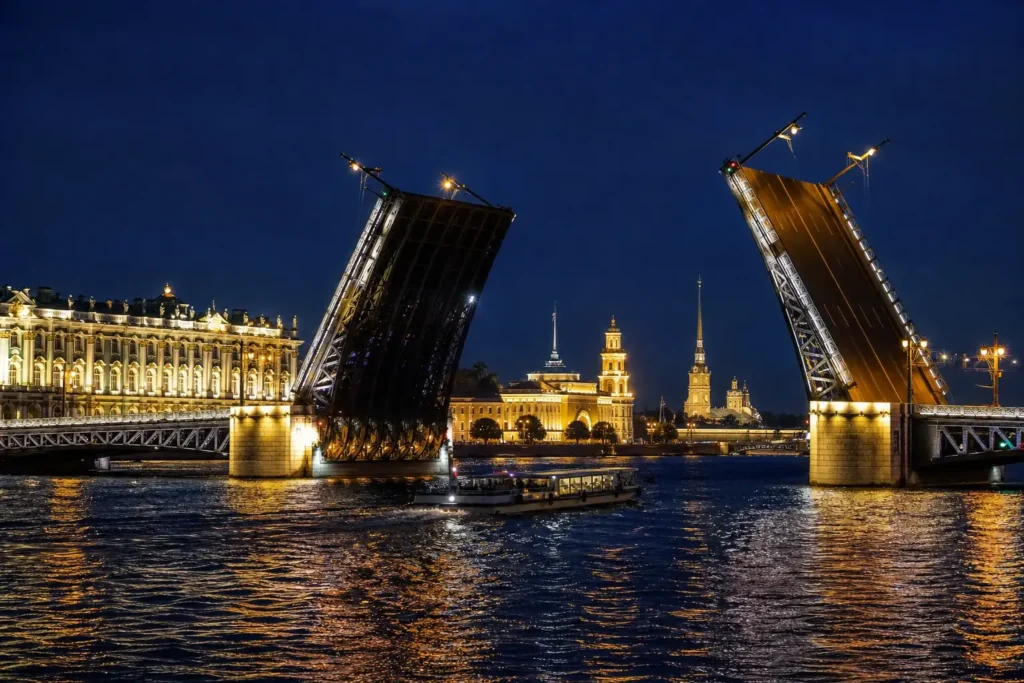
Palace Bridge crosses the Neva between Palace Square and the Strelka of Vasilievsky Island, and its two huge leaves rising into the night sky have become the symbol of the city. It was opened in 1916, and it is still one of the main crossings between the historic centre and Vasilievsky Island.
This page explains when the bridge rises in the 2026 season, where to watch from, how the bridge was built and how to avoid being stranded on the wrong bank. The bridge is free to visit and is always accessible except during the night raisings.
Current access notice: Bridge raisings take place only during the navigation season. The 2026 season on the Neva ends on 30 November, so there are no raisings from December until the spring of 2027.
Quick Facts
| Russian name | Дворцовый мост |
|---|---|
| Built / opened | 1916 |
| Architect(s) | Andrey Pshenitsky (engineer), Robert Melzer (architect); bascule span designed by the Scherzer Rolling Lift Bridge Company |
| Address | Санкт-Петербург, Дворцовый проезд (между Дворцовой набережной и Биржевой площадью) OpenStreetMap · Google Maps |
| District | Central District |
| Metro | Admiralteyskaya (Line 5, about 15 minutes on foot via Palace Square) Nevsky Prospect (Line 2, about 20 minutes on foot via Palace Square) |
| Opening hours | Open to pedestrians and traffic around the clock, except while the bridge is raised during the navigation season. In 2026 the bridge is closed to traffic from 01:10 to 02:50 and from 03:10 to 04:55; the 2026 navigation season on the Neva runs from 10 April to 30 November. Daytime raisings occur only at special events (as of October 2026 – check the live schedule). |
| Admission | Free |
| Best time to visit | The raising happens only at night in the navigation season, which runs from 10 April to 30 November in 2026. In early summer the white nights keep the sky light, which makes for a gentler view; in autumn the nights are dark and crowds are thinner, but it is cold. In the daytime the bridge is best in clear, low light for views along the river. |
| Recommended duration | 30–45 minutes; allow 1.5–2 hours if you wait for the night raising |
| Last updated | October 16, 2026 |
What Is (and Isn't) Part of a Visit to Palace Bridge, Saint Petersburg?
| Part | Status | Notes |
|---|---|---|
| Walking across the bridge | Included in the standard ticket | Free at any time except while the bridge is raised. |
| Night raising of the bridge | Included in the standard ticket | Free to watch from the embankments in the navigation season. |
| Night boat cruises under the raised bridges | Separate ticket or institution | Run by private operators and paid. |
| Singing Bridges show | Separate ticket or institution | A special weekend programme in the summer season, announced each year. |
| Hermitage and Palace Square | Outside / not part of it | Separate sites on the south bank, reached on foot in a few minutes. |
Why Visit Palace Bridge, Saint Petersburg?
Palace Bridge has one of the most recognisable views in Russia: the Hermitage and the Admiralty on one side, the Strelka and the Peter and Paul Fortress on the other, with the raised leaves framing the spire in between. It is also a major piece of engineering, with a bascule span that is one of the largest in the world.
The raising is a free show every night in the navigation season, and you can combine it with a walk along the Neva embankments or a night boat trip. Even outside the raising hours, the bridge offers a fine view of the river and the skyline.
How Palace Bridge, Saint Petersburg Is Laid Out
The bridge runs north to south, from Palace Embankment between the Winter Palace and the Admiralty to Birzhevaya Square on Vasilievsky Island. It has five spans, and the bascule section in the middle is the part that lifts. Pavements run along both sides, so you can walk across at any time except during a raising.
The best viewing points are on the embankments rather than on the bridge itself: Palace Embankment by the Hermitage on the south bank, and the Strelka on the north bank. From the south bank you look across the river to the Strelka and the Rostral Columns, and from the Strelka you look back at the Hermitage and the Admiralty.
If you want to watch the raising, choose your bank before the bridge closes and plan your route back, because the other Neva bridges are also raised at night. The Palace Bridge is raised first, so tour boats can leave the central Neva before larger ships enter it.
Highlights of Palace Bridge, Saint Petersburg
The raised leaves at night
In the navigation season the two leaves of the bascule span rise in two sessions each night. In 2026 the bridge is closed to traffic from 01:10 to 02:50 and from 03:10 to 04:55. Ships can then pass, and the raised leaves frame the view towards the Peter and Paul Fortress. Each leaf weighs about 700 tonnes and is lifted by a mechanism with huge gears and counterweights.
The first raising is the main show, because boats queue to pass through it.
Tip: Arrive at least half an hour early to get a place on the embankment.
The engineering
The bridge is a cast-iron bascule bridge with five spans, 260 metres long and about 28 metres wide. The central span was designed by an American firm, the Scherzer Rolling Lift Bridge Company, and built by the French firm Batignolles between 1912 and 1916. The two-leaf span is one of the largest of its type in the world.
The design was kept deliberately plain so that it would not spoil the view from the embankment towards the Kunstkamera and the Academy of Arts.
Tip: Look at the original gears and mechanism descriptions on guided tours of the bridge's engineering, if you can book one.
The view from Palace Embankment
From the south bank you see the whole bridge against the Strelka, the Rostral Columns and the spire of the Peter and Paul Fortress. It is one of the most photographed views in the city, particularly when the leaves are raised.
The embankment is also the easiest place to reach from Palace Square, and it is free.
Tip: Stand towards the Admiralty side for a wider view.
The view from the Strelka
On the Vasilievsky Island side the Strelka and Birzhevaya Square give you the opposite perspective: the Hermitage and the Admiralty lit up across the river, with the bridge in the foreground. It is a good spot if you want the lit façades of the Winter Palace behind the raised leaves.
Remember that you may need to stay on this bank until the bridges are lowered.
Tip: Decide which bank you will sleep on before the raising starts.
A night cruise under the leaves
Boat companies run night trips that pass beneath the raised bridges. The Palace Bridge is raised first so that the tour boats can get out before large cargo ships arrive. From the water you see the raised leaves from below, which is a different view from the shore.
These cruises are run by private operators and are paid.
Tip: Book in advance in high season, and dress warmly: it is cold on the river at night.
The Singing Bridges show
On weekends in the summer season, the Palace Bridge is raised to a programme of classical music connected with the city. It is a special event rather than a nightly feature, and the dates and times are announced each season.
Check the programme if you want to catch it; it ran on weekends from 1 May to 30 September in 2026.
Tip: The show season is over for 2026, so plan ahead for next summer.
Atmosphere
By the river the evening has a festive air: crowds gather along the embankments an hour or so before the raising, boats move out onto the dark water and the lights of the Hermitage and the Admiralty reflect in the Neva. Conversation drops as the first leaf begins to lift, and then there are phones held up all along the embankment.
During the day the bridge is a busy but calm crossing, with the wide river on both sides and the skyline of the centre in view. In autumn the nights are dark, the air is cold and the crowds thinner than in the white nights of early summer, when the sky is still light at raising time.
History of Palace Bridge, Saint Petersburg
For more than a century after the founding of Saint Petersburg, no fixed bridge crossed the Neva, because Peter the Great had forbidden them. After Nicholas I lifted the ban, a temporary pontoon bridge was set up about 50 metres downstream from where the Palace Bridge stands today. It was opened in 1850.
A permanent crossing in front of the Winter Palace was a delicate matter. An architectural competition was announced in 1901, and 54 designs were rejected between 1901 and 1911. The design had to be strictly controlled so as not to block the view from Palace Embankment towards the Kunstkamera, the Academy of Arts and the other buildings on Vasilievsky Island.
Construction began in 1912 to a design by the engineer Andrey Pshenitsky, with Robert Melzer as architect. The bascule span was designed by the American Scherzer Rolling Lift Bridge Company and built by the French firm Société de Construction des Batignolles. The First World War delayed the work, and the bridge was opened on 23 December 1916. Its artistic decoration was never fully completed.
In October 1917 the insurgents of the October Revolution seized the bridge, as one of the key points for controlling the city, and took it without fighting. After the revolution it was renamed Republican Bridge, and the original name was restored later; sources give 1944 or 1952.
The bridge was repaired in 1967, and the tram tracks were removed in 1998. Each of the two leaves of the central span weighs about 700 tonnes and is moved by motors, huge gears, some of them original, and counterweights of a thousand tonnes. The mechanism works reliably, but small incidents occur: in October 2002 a gear tooth broke in the middle of a raising, delaying ships.
Today the bridge is raised around 400 times a season: in 2025 it was raised 417 times, more than any other bridge in the city. The 2026 navigation season on the Neva runs from 10 April to 30 November.
Tickets and Booking for Palace Bridge, Saint Petersburg
The bridge and the raising are free and need no booking. Night boat cruises are sold by private operators.
- Book a cruise in advance for high-season weekends.
- Check that the departure time suits the raising schedule: the Palace Bridge is raised from 01:10.
- Choose a pier near the centre so that your return trip is short.
Rates for Russian citizens and for international visitors usually do not differ for boat cruises, but check with the operator.
Plan and Book
Suggested itineraries Palace Bridge, Saint Petersburg
30 minutes
Walk from Palace Square to Palace Embankment, cross the bridge on foot to the Strelka and look back at the Hermitage and the Admiralty.
2 hours
Spend the evening on Palace Embankment, then stay for the first raising from 01:10. Choose your bank, watch the leaves lift and plan how you will get home before the other bridges rise.
Night out
Take a night boat cruise to pass under the raised bridges from the water, and finish on the embankment for the second raising, 03:10 to 04:55.
How to Get to Palace Bridge, Saint Petersburg
By metro: the closest stations are Admiralteyskaya (Line 5) and Nevsky Prospect (Line 2). From either, walk through Palace Square to Palace Embankment and the bridge, about 15 to 20 minutes.
On foot: the bridge is a few minutes from Palace Square and the Hermitage, and a short walk from the Admiralty.
By taxi: ask for Palace Bridge (Дворцовый мост) or for Dvortsovy Proyezd.
Accessibility
The bridge has pavements on both sides and is a level crossing, so it is easy to cross on foot. Kerbs and the surface of the embankment viewing areas were not verified, so check on site if you use a wheelchair or stroller. Remember that you cannot cross while the bridge is raised.
Food Nearby
There are no verified cafes on the bridge itself. Cafes and restaurants line Nevsky Prospect and the streets near the Admiralty, and the Strelka side has options near Birzhevaya Square; most close well before the night raisings.
What to Bring
Warm clothes and a windproof layer, since the wind from the Neva is cold at night, and comfortable shoes for waiting on the embankment. Bring a charged phone and a power bank for photos, and check your route home before the bridges rise.
Best Views and Photo Spots of Palace Bridge, Saint Petersburg
Palace Embankment by the Hermitage
The raised leaves with the Strelka, the Rostral Columns and the Peter and Paul Fortress spire in the background.
Best time: During the first raising, from 01:10; in summer at dusk.
The Strelka and Birzhevaya Square
The Hermitage and the Admiralty lit up across the river, framed by the raised bridge in the foreground.
Best time: Night, during a raising.
Admiralty side of the embankment
A wider view along the Neva with the bridge and the Strelka together.
Best time: Blue hour, just after sunset.
A night boat on the Neva
The raised leaves from below, with the lights of the embankments reflected in the water.
Best time: Between 01:00 and 03:00 in the navigation season.
Photography Rules
Photography from the bridge and the embankments is free and common. A tripod helps at night, though crowds can make it awkward. Drone rules were not verified; avoid flying one in the historic centre without checking local restrictions.
Family Suitability
Suitable for families with children who can stay up late; the raising begins after 01:00, which is too late for many younger children. In the daytime the bridge and embankments are an easy short walk. Keep a close eye on children near the embankment edge and on the crowded night raisings.
Russia Vibes Tips
- Decide which bank you will spend the night on before the raising begins. The central Neva bridges rise during the night, so crossing between the centre and Vasilievsky Island may not be possible for hours.
- Arrive at least half an hour early to get a place on the embankment. The best spots fill up quickly in summer.
- Check the live raising schedule on the day. Times can change for events and technical reasons; the city bridge authority publishes them online and in its app.
- Dress warmly, even in summer. The wind along the Neva is cold after midnight.
- For a different perspective, watch from a boat; the Palace Bridge is raised first so that tour boats can leave the central Neva in time.
Explore Nearby Palace Bridge, Saint Petersburg
Sights near Palace Bridge, Saint Petersburg
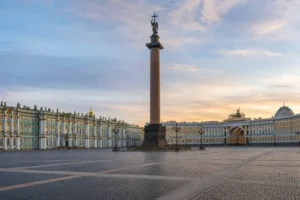 Palace Square, Saint Petersburg · typical visit: 30–60 minutes, more with the Hermitage
Main image: AI-generated illustration. It may not show the place exactly as it looks.
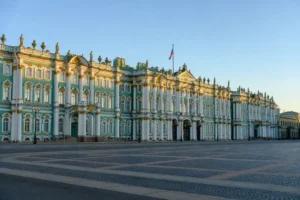 State Hermitage Museum, Saint Petersburg · typical visit: 3-5 hours for the main highlights
Main image: AI-generated illustration. It may not show the place exactly as it looks.
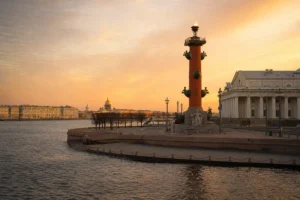 Spit of Vasilyevsky Island, Saint Petersburgabout 300 m away (~5 min walk) · typical visit: 1–2 hours, plus time for any museum
Main image: AI-generated illustration. It may not show the place exactly as it looks.
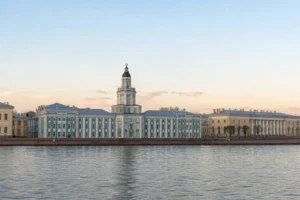 Kunstkamera, Saint Petersburgabout 200 m away (~4 min walk) · typical visit: 2 hours
Main image: AI-generated illustration. It may not show the place exactly as it looks.
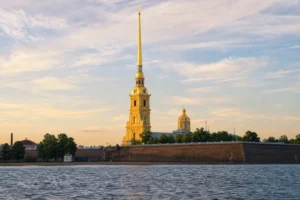 Peter and Paul Fortress, Saint Petersburg · typical visit: 2–4 hours
Main image: AI-generated illustration. It may not show the place exactly as it looks.
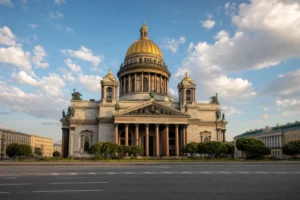 Saint Isaac's Cathedral, Saint Petersburg – about 800 m away (~13 min walk) · typical visit: 1.5–2 hours for the cathedral interior; allow another 45–60 minutes for the colonnade.
Main image: AI-generated illustration. It may not show the place exactly as it looks.
Metro stations near Palace Bridge, Saint Petersburg
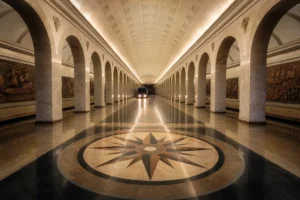 Admiralteyskaya Metro Station, Saint Petersburgabout 650 m away (~11 min walk)
Main image: AI-generated illustration. It may not show the place exactly as it looks.
Train stations and river piers near Palace Bridge, Saint Petersburg
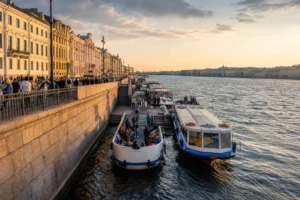 Rumyantsev Descent Pier, Saint Petersburgabout 850 m away (~14 min walk)
Main image: AI-generated illustration. It may not show the place exactly as it looks.
Related guides
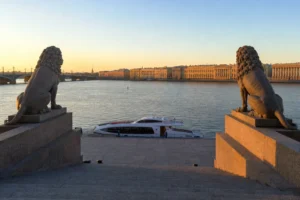 Lions‘ Descent Pier, Saint Petersburg: Meteor Boats to Peterhof
Main image: AI-generated illustration. It may not show the place exactly as it looks.
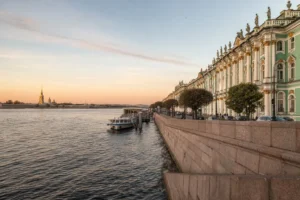 Palace Pier, Saint Petersburg: Boat Trips on the Neva
Main image: AI-generated illustration. It may not show the place exactly as it looks.
 State Memorial Museum of the Defense and Siege of Leningrad: Guide
Main image: AI-generated illustration. It may not show the place exactly as it looks.
 Russian Ethnographic Museum, Saint Petersburg: Visitor Tips
Main image: AI-generated illustration. It may not show the place exactly as it looks.
 Saint Michael’s Castle, Saint Petersburg: Hours and Interiors
Main image: AI-generated illustration. It may not show the place exactly as it looks.
Browse more: More in Central District · All Landmarks · All Saint Petersburg · All Sightseeing · All Sightseeing in Saint Petersburg
FAQ: Palace Bridge, Saint Petersburg
When is Palace Bridge raised in 2026?
In the navigation season, which runs from 10 April to 30 November, the bridge is raised from 01:10 to 02:50 and from 03:10 to 04:55. Check the live schedule for changes.
Is the bridge raised in winter?
No. Raisings take place only during the navigation season on the Neva. After 30 November there are none until the spring.
Can I walk across during the raising?
No. The bridge is closed to traffic and pedestrians for the whole raising period, so you must be on the bank you want to stay on before it begins.
Where is the best place to watch?
Palace Embankment by the Hermitage and the Strelka of Vasilievsky Island are the main viewing points. A night boat gives a view from the water.
Who built the bridge?
Andrey Pshenitsky designed it, with Robert Melzer as architect. The French firm Batignolles built it between 1912 and 1916 using a span design by an American firm.
How long is the bridge?
About 260 metres long and 28 metres wide, with five spans. The central bascule span has two leaves, each weighing about 700 tonnes.
Why are the Neva bridges raised?
They are raised at night so that ships can pass, including vessels coming from the Volga-Baltic canal. The Palace Bridge is raised first so that tour boats can leave the central river.
What is the Singing Bridges show?
A weekend show in the summer season in which the Palace Bridge is raised to classical music connected with the city. It ran from 1 May to 30 September in 2026.
Russia Vibes is a one-person project. A coffee keeps it going
Last updated: October 16, 2026. Found an error or something out of date? Report it and we will check and fix it.
How we research and update our guides
About this guide: AI assistance and accuracy
This guide is created with the help of AI and is based on official sources where available. Mistakes can still happen. Opening hours, prices, rules and other details are given to the best of our knowledge as of the date shown and can change without notice. It offers general recommendations only, not professional, legal or travel advice. Please confirm important details with the official source before you travel; you are responsible for your own plans and decisions.
International sanctions affect payments between Russia and many other countries. In practice, cards issued in the EU, the UK, the US and several other countries often do not work in Russia, Russian cards usually do not work abroad, and some booking platforms, airlines and payment providers limit or suspend their services for Russia. The situation changes frequently. We do not give legal or financial advice, and this site does not encourage anyone to break or circumvent sanctions. Whatever you plan, you are responsible for following the laws and regulations that apply to you, including those of your country of residence and citizenship. Many travelers still organise their stay lawfully. It is worth asking your bank or payment provider what is currently permitted, contacting hotels, tour operators and carriers directly about the payment methods they accept, and checking which services are open to customers from your country. Clarify payment, cancellation and refund terms before you commit to a booking, and keep your plans flexible. Partner links on this site may not be available in every country, and prices, availability and rules in our guides can differ from what you see when you book.Paying for your trip: please read

Take this guide with you
Get a free PDF of this guide to print or read offline: key facts, tips and a map link on a few clean pages.