
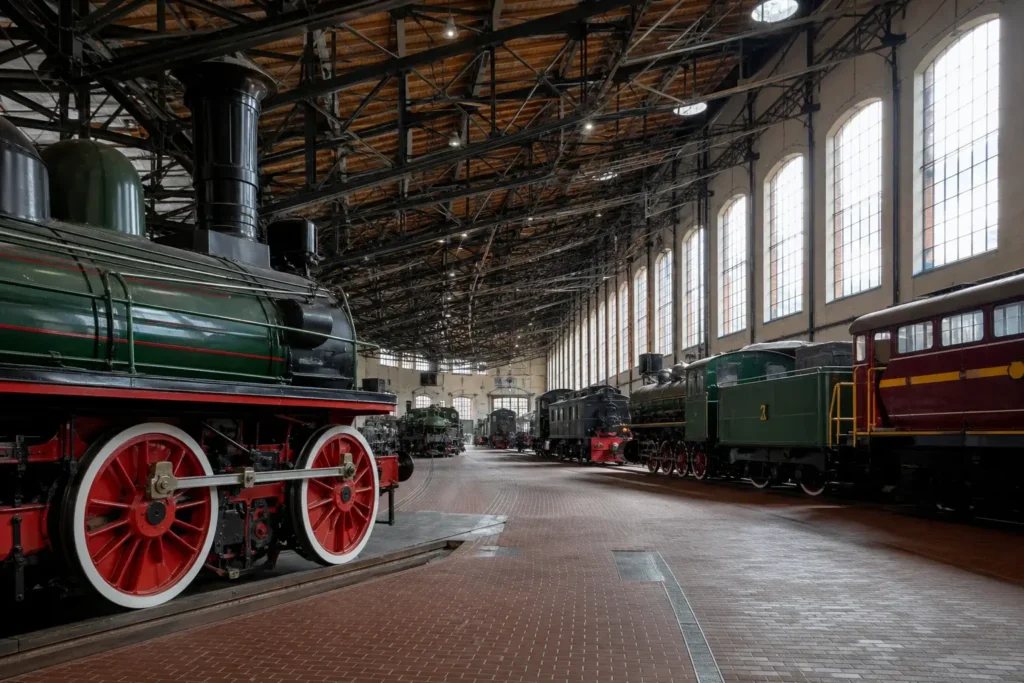
The Russian Railway Museum fills the old locomotive depot beside the Baltic Station with historic locomotives, carriages and models. It opened in its present form on 30 October 2017 and is one of the largest railway museums in Europe, with indoor halls and an open-air collection that includes a railway missile module and a railway gun.
It is a good visit for families and for anyone who likes trains, with a driver-simulator, a kids’ centre and a road train. This page covers the opening hours, ticket types, what to see and how to get there from Baltiyskaya metro, and flags the closure on 16 October and the restrictions in the days around it.
Current access notice: The museum is closed on 16 October 2026, and block H is closed on 12–15 and 17 October. The rest of the museum, including the open-air exhibition, remains open on those days.
Quick Facts
| Russian name | Музей железных дорог России |
|---|---|
| Built / opened | 2017 |
| Architect(s) | Housed in the reconstructed locomotive depot of the Baltiysky railway station |
| Address | Санкт-Петербург, Библиотечный переулок, 4, корп. 2 (у Балтийского вокзала) OpenStreetMap · Google Maps |
| District | Admiralteysky District |
| Metro | Baltiyskaya (Line 1, about 7 minutes on foot) |
| Opening hours | Thursday to Monday 10:00–18:00, Wednesday 12:30–20:30, closed on Tuesdays. Entry ends an hour before closing and viewing of the exhibition ends 15 minutes before closing. The museum is closed on 16 October 2026, and on 12–15 and 17 October block H is closed (as of October 2026 – check the official site). |
| Admission | A regular ticket (₽₽); schoolchildren, full-time students and senior citizens pay half (₽). Package tickets covering halls 5 and 6 and family tickets cost more. |
| Best time to visit | Weekday afternoons and Wednesday evenings (the museum stays open until 20:30 on Wednesdays) are usually calmer than weekends. Because the exhibition is mostly indoors, any season works; the open-air area and road train are best in dry weather. The museum is closed on Tuesdays. |
| Recommended duration | 2–3 hours |
| Website | rzd-museum.ru/en |
| Last updated | October 16, 2026 |
What Is (and Isn't) Part of a Visit to Russian Railway Museum, Saint Petersburg?
| Part | Status | Notes |
|---|---|---|
| Indoor exhibition halls and rolling stock | Included in the standard ticket | The main exhibition in the former locomotive depot. |
| Open-air exhibition | Included in the standard ticket | Includes the Molodets missile module and the railway gun; best in dry weather. |
| Halls 5 and 6 | Separate ticket or institution | Covered by the package ticket rather than the regular ticket. |
| Locomotive-driver simulator | Separate ticket or institution | Tickets are sold separately on the museum's website. |
| Road train ride | Separate ticket or institution | A short paid ride of about 15 minutes; not run in rain or on Tuesdays and Wednesdays. |
| Guided tours | Separate ticket or institution | Mixed-group and private tours are paid in addition to entry. |
Why Visit Russian Railway Museum, Saint Petersburg?
The museum shows the whole story of railways in Russia, from the first steam locomotives to high-speed trains, with real vehicles you can stand next to and in some cases board. Highlights include the diesel locomotive TEP80 that set a world speed record, the first Soviet mainline diesel locomotive and the last passenger steam locomotive built in the USSR.
It also works as a place for children: there are quest cards, workshops, a driving simulator and a themed cafe in a dining car. Because the exhibits are large and mostly indoors, it is a good choice for rainy days.
How Russian Railway Museum, Saint Petersburg Is Laid Out
The museum is built in and around the former locomotive depot of the Baltic Station, on Bibliotechny Lane, just beside the station. It has indoor halls, organised in blocks (the museum’s own plan refers to blocks such as R and H), and an open-air exhibition outside, where the largest and heaviest items stand on tracks.
The indoor halls cover the history of railways chronologically, from the first rails and steam locomotives to modern trains, and include two large HO model layouts: one of Russia’s first passenger railway, the Tsarskoye Selo line, and one of Vladivostok station. Most locomotives and cars can only be viewed from outside, but some can be boarded.
The museum provides a floor plan, a free mobile app with audio guides and 3D models, and descriptions in Russian and English. Plan the indoor halls first, then the open-air area, which is weather dependent.
Highlights of Russian Railway Museum, Saint Petersburg
The locomotive record-holder TEP80
The passenger diesel locomotive TEP80-0002 was built at the Kolomna works in 1990 and is the most powerful single-section Soviet passenger diesel locomotive, with 6,000 horsepower. On 5 October 1993 it set the world speed record for diesel locomotives, 271 km/h, on the Saint Petersburg to Moscow line.
It is one of the best-known exhibits in the museum.
Tip: Look at its streamlined nose, built for high speed.
The first Soviet mainline diesel locomotive
The diesel locomotive designed by Yakov Gakkel was built in Leningrad in 1924 at the Baltic Shipyard together with the Red Putilovite Plant. It has an electric transmission and was the first Soviet-built mainline diesel locomotive.
It is a key piece for understanding how Russian railways moved beyond steam.
Tip: Compare it with the steam locomotives nearby to see the change in technology.
Steam locomotives
The collection includes the passenger steam locomotive S68, built in 1917 and among the most widespread pre-revolutionary passenger locomotives, and the P36-0251, built in 1956 as the last passenger steam locomotive made in the USSR. A Chinese Eastern Railway service car of 1902–04 and a fireless locomotive of 1928 add variety.
The cab of the trophy steam locomotive TE-6769 has also been opened for viewing.
Tip: Check which locomotives and cars can be boarded on the day.
High-speed trains
The museum shows the electric train ER200-1, built in 1973 and used on the Leningrad to Moscow line from 1984 to 2008, and the experimental Sokol-250, built in 1999–2000 for a design speed of 250 km/h. Only one Sokol-250 was ever built and it never entered regular service.
They show how Russia's attempts at fast rail developed.
Tip: Read the captions on speeds and years; they put the trains in context.
The open-air exhibition
Outside, the museum shows the railway artillery mount TM-3-12 of 1938, which used guns originally made for battleships, and a module of the Molodets railway missile system, a strategic missile train put on combat alert in 1987. These are among the most unusual railway exhibits in Europe.
The open-air area is best in dry weather.
Tip: Visit the open-air area first on a clear day, then go indoors if it rains.
Models and interactive features
Two large HO railway models show Russia's first passenger railway, the Tsarskoye Selo line, and Vladivostok station. Interactive features include a locomotive-driver simulator, a kids' centre, quest cards and virtual-reality games launched in September 2026.
Tickets for the simulator are sold separately on the museum's website.
Tip: Book the simulator early if you want a specific time.
Atmosphere
Inside the old depot, the space is tall and industrial, with real locomotives lined up on tracks under the roof and light falling on dark steel and bright paint. Visitors walk between wheels taller than themselves, and children run from engine to engine. The sound of the road train and of audio guides mixes with the quieter hum of model railways.
The open-air area feels more like a rail yard, with large machines standing in the weather and the Baltic Station nearby. The overall mood is lively and family-friendly rather than hushed, and the museum suits visitors who like to see things up close.
History of Russian Railway Museum, Saint Petersburg
Railways in Russia began in 1837 with the line from Saint Petersburg to Tsarskoye Selo. The museum itself is much younger. In 1974 the trade union and management of the Oktyabrskaya Railway decided to set up a museum for the company’s staff, and the first exhibition opened in 1978 in the centre of Leningrad, on Liteyny Avenue.
A group of railway enthusiasts then proposed preserving historical rolling stock, and the railway provided a site in the southern outskirts at Shushary. That open-air museum opened to the public in 1991 with about 40 exhibits, including 18 locomotives.
In 2001 the Varshavsky station was closed to scheduled passenger services and the most valuable part of the collection was placed along its platforms. The new site opened in August 2001 with about 80 pieces of historic rolling stock on 20,000 square metres, and visitor numbers increased sixfold. Visitors could even ride a train pulled by a retro steam locomotive. But the station building was used for commercial purposes, so the museum had no indoor exhibition, and the tracks were due to be removed for housing.
A project for a new site was drawn up between 2007 and 2012, and construction was completed by late 2017. On 30 October 2017, linked to the 180th anniversary of Russian railways, the museum opened in the reconstructed locomotive depot of the Baltic Station. It now has indoor and outdoor exhibitions with around 35,000 historical artifacts, including 118 pieces of rolling stock.
In 2019 the museum was nominated for the European Museum of the Year Award. It is a branch of the Oktyabrskaya Railway and keeps growing: in 2026 the cab of the trophy steam locomotive TE-6769 was opened for viewing and a series of virtual-reality games was launched.
Note that this is a different institution from the older Central Museum of Railway Transport on Sadovaya Street, which was founded in 1813.
Tickets and Booking for Russian Railway Museum, Saint Petersburg
| Ticket | Price | Includes |
|---|---|---|
| Regular ticket | ₽₽ | Entry to the museum for adults and foreign visitors. |
| Special rate ticket | ₽ | Entry for schoolchildren, full-time students and senior citizens. |
| Package ticket (weekdays and weekends) | ₽₽ | Museum entry plus entry to halls 5 and 6; weekend and holiday prices are higher. |
| Family ticket | ₽₽₽ | Two adults and one child under 18, with proof of kinship. |
| Road train ride | ₽ | A 15-minute ride on the museum's road train. |
₽ budget · ₽₽ moderate · ₽₽₽ upscale · ₽₽₽₽ splurge. Price levels are estimates compared with typical prices for visitors.
Tickets, including those for the driver simulator, are sold on the museum’s official ticket site and at the ticket office. Online sales open about two weeks ahead.
- Entry ends an hour before closing, and viewing ends 15 minutes before closing.
- Guided tours in mixed groups of up to five people run from 11:00 each day and are sold at the ticket office; private tours need prior request.
- A free mobile app offers audio guides and 3D models and is worth downloading before you go.
Rates for Russian citizens and foreign visitors are the same regular ticket, and special-rate and family categories apply; see the museum’s price list for details.
Plan and Book
Suggested itineraries Russian Railway Museum, Saint Petersburg
1.5 hours
See the main locomotive hall and the highlights: the TEP80, the Gakkel diesel and the steam locomotives. Finish with the open-air exhibition if the weather is dry.
3 hours
Follow the halls in order, try the driver simulator and look at the HO model layouts. Break for lunch in the dining-car cafe, then do the open-air area.
Half day with children
Take a guided tour or use quest cards, ride the road train in dry weather and add a workshop at the kids' centre.
How to Get to Russian Railway Museum, Saint Petersburg
By metro: take Line 1 to Baltiyskaya. The museum is about a 7-minute walk, beside the Baltic Station. Narvskaya (Line 1) and Frunzenskaya (Line 5) are also within reach.
By bus: several bus and trolleybus routes stop nearby, including trolleybuses 3 and 8; see the museum’s site for the full list.
By car: there is a car park in the Gatchina yard. By taxi: ask for Bibliotechny Lane, 4 (Библиотечный переулок, 4).
Accessibility
The museum states that its environment is designed to be accessible, and the exhibits have descriptions in Russian and English. Most locomotives can only be viewed from the outside, and some areas have restrictions at times, such as block H in mid-October 2026. Check with the museum about step-free routes and which cars can be boarded.
Food Nearby
The museum has a themed cafe in a dining car (Vagon-restoran). More cafes and shops can be found around the Baltic Station and along the Obvodny Canal embankment.
What to Bring
Comfortable shoes for concrete floors and open-air tracks, a layer for the open-air area, and a phone with the museum's app and headphones if you want audio guides. Bring your ticket on your phone if you booked online.
Best Views and Photo Spots of Russian Railway Museum, Saint Petersburg
Main locomotive hall
Rows of historic locomotives under the high roof of the former depot, with dramatic light and the wheels in the foreground.
Best time: Weekday mornings, when it is quieter.
The TEP80 and high-speed trains
The streamlined diesel and electric trains side by side, showing the change in design.
Best time: Any time inside.
Open-air tracks
The missile module and the railway gun against the sky, with the Baltic Station behind.
Best time: Clear afternoons.
Model railway layouts
Detailed HO models of the Tsarskoye Selo line and Vladivostok station, good for close-ups.
Best time: Whenever the layout is running.
Photography Rules
Visitor photography rules were not verified; the museum offers paid photo and video shooting as a service, so check the rules and ask at the entrance before using a tripod or professional equipment. Drone use was not verified.
Family Suitability
Very good for families. Children can see real locomotives, use quest cards, try the driver simulator and ride the road train, and there is a kids' centre with workshops and lessons. Family tickets are available. Strollers are workable in most areas, but check with the museum about step-free routes.
Russia Vibes Tips
- Check the date before you go: the museum is closed on 16 October 2026 and block H is closed on 12–15 and 17 October.
- Do not confuse it with the Central Museum of Railway Transport on Sadovaya Street, an older separate museum. This one is next to the Baltic Station.
- Arrive at least an hour and a half before closing: entry ends an hour before the museum closes.
- Download the free app first. It has audio guides and 3D models of the exhibits.
- Book the driver simulator in advance if you want to try it; those tickets are sold separately online.
Explore Nearby Russian Railway Museum, Saint Petersburg
Sights near Russian Railway Museum, Saint Petersburg
 Yusupov Palace, Saint Petersburg – about 2.5 km away · typical visit: 1.5–2 hours for a standard palace route; approximately 2.5–3 hours for a comprehensive visit including the Rasputin exhibition.
Main image: AI-generated illustration. It may not show the place exactly as it looks.
 Central Naval Museum, Saint Petersburgabout 2.7 km away · typical visit: 2–3 hours
Main image: AI-generated illustration. It may not show the place exactly as it looks.
 New Holland Island, Saint Petersburgabout 2.7 km away · typical visit: 1.5–2 hours
Main image: AI-generated illustration. It may not show the place exactly as it looks.
Metro stations near Russian Railway Museum, Saint Petersburg
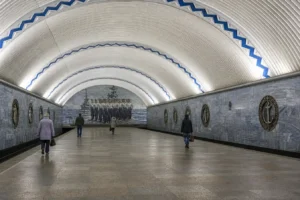 Baltiyskaya Metro Station, Saint Petersburgabout 200 m away (~3 min walk)
Main image: AI-generated illustration. It may not show the place exactly as it looks.
Train stations and river piers near Russian Railway Museum, Saint Petersburg
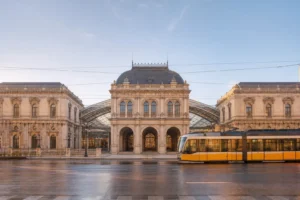 Baltiysky Railway Station, Saint Petersburgabout 100 m away (~2 min walk)
Main image: AI-generated illustration. It may not show the place exactly as it looks.
Related guides
 Vitebsky Railway Station, Saint Petersburg: Art Nouveau Terminus
Main image: AI-generated illustration. It may not show the place exactly as it looks.
 Zvenigorodskaya Metro Station, Saint Petersburg: Line 5 Interchange
Main image: AI-generated illustration. It may not show the place exactly as it looks.
 English Embankment Pier, Saint Petersburg: Quiet Neva Boat Trips
Main image: AI-generated illustration. It may not show the place exactly as it looks.
 Lions‘ Descent Pier, Saint Petersburg: Meteor Boats to Peterhof
Main image: AI-generated illustration. It may not show the place exactly as it looks.
 Senate Pier, Saint Petersburg: Boat Trips by the Bronze Horseman
Main image: AI-generated illustration. It may not show the place exactly as it looks.
Browse more: More in Admiralteysky District · All Museums · All Saint Petersburg · All Sightseeing · All Sightseeing in Saint Petersburg
FAQ: Russian Railway Museum, Saint Petersburg
Where is the Russian Railway Museum?
On Bibliotechny Lane, 4, building 2, next to the Baltic Station and about a 7-minute walk from Baltiyskaya metro.
When is it open?
Thursday to Monday 10:00–18:00 and Wednesday 12:30–20:30, closed on Tuesdays. Entry ends an hour before closing.
Is it open on 16 October 2026?
No. The museum is closed on 16 October, and block H is closed on 12–15 and 17 October.
How much is a ticket?
A regular ticket is moderately priced, half price for schoolchildren, students and seniors. Package, family and simulator tickets cost more.
What are the main exhibits?
The record-setting TEP80 diesel locomotive, the Gakkel diesel locomotive of 1924, steam locomotives, high-speed trains and the open-air Molodets missile module.
Is it good for children?
Yes. There is a kids' centre, quest cards, a driver simulator and a road train, and family tickets are available.
Is this the same as the museum on Sadovaya Street?
No. The Central Museum of Railway Transport on Sadovaya Street, founded in 1813, is a separate, older museum.
Can I board the locomotives?
Some can be boarded, but most can only be viewed from the outside. Check on the day which ones are open.
Russia Vibes is a one-person project. A coffee keeps it going
Last updated: October 16, 2026. Found an error or something out of date? Report it and we will check and fix it.
How we research and update our guides
About this guide: AI assistance and accuracy
This guide is created with the help of AI and is based on official sources where available. Mistakes can still happen. Opening hours, prices, rules and other details are given to the best of our knowledge as of the date shown and can change without notice. It offers general recommendations only, not professional, legal or travel advice. Please confirm important details with the official source before you travel; you are responsible for your own plans and decisions.
International sanctions affect payments between Russia and many other countries. In practice, cards issued in the EU, the UK, the US and several other countries often do not work in Russia, Russian cards usually do not work abroad, and some booking platforms, airlines and payment providers limit or suspend their services for Russia. The situation changes frequently. We do not give legal or financial advice, and this site does not encourage anyone to break or circumvent sanctions. Whatever you plan, you are responsible for following the laws and regulations that apply to you, including those of your country of residence and citizenship. Many travelers still organise their stay lawfully. It is worth asking your bank or payment provider what is currently permitted, contacting hotels, tour operators and carriers directly about the payment methods they accept, and checking which services are open to customers from your country. Clarify payment, cancellation and refund terms before you commit to a booking, and keep your plans flexible. Partner links on this site may not be available in every country, and prices, availability and rules in our guides can differ from what you see when you book.Paying for your trip: please read

Take this guide with you
Get a free PDF of this guide to print or read offline: key facts, tips and a map link on a few clean pages.