
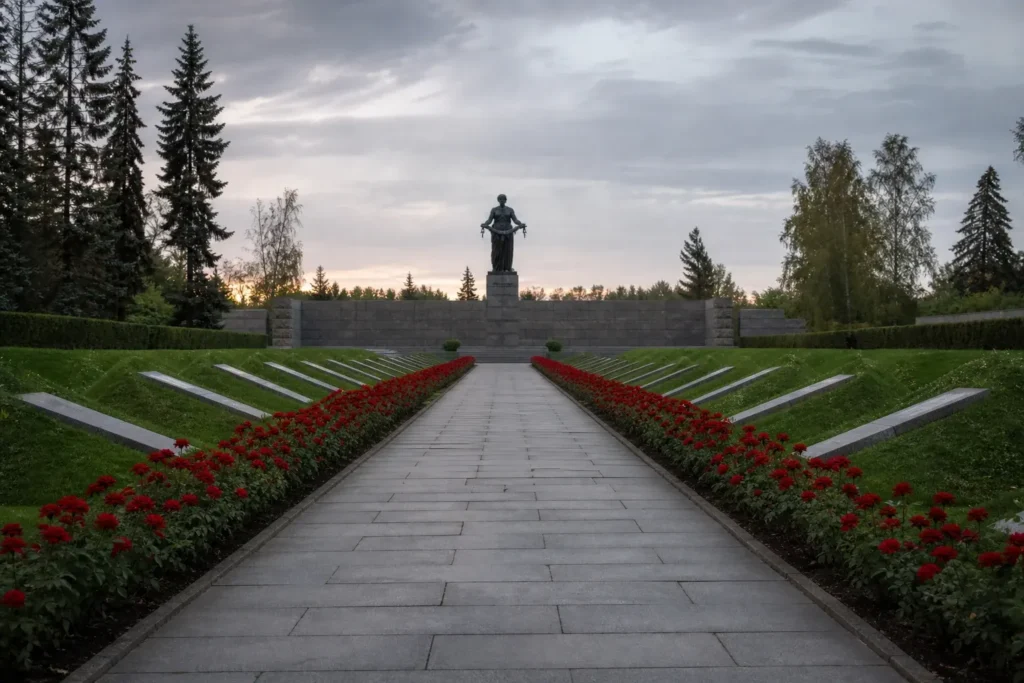
Piskaryovskoye Memorial Cemetery is the largest burial ground of the siege of Leningrad and the city’s main place of remembrance for the 872 days of the blockade. It lies in the north-east of Saint Petersburg, on Nepokorennykh Prospekt, and entry is free every day.
Hundreds of thousands of civilians and soldiers lie here in 186 mass graves, most of them unnamed. Visitors walk from an Eternal Flame down a long alley of grass mounds to a bronze Motherland figure and a granite wall carrying a famous epitaph. This guide explains the layout, what the museum pavilion at the gate shows, how to reach it by metro and bus, and how to behave in a place that is still used for mourning.
Quick Facts
| Russian name | Пискарёвское мемориальное кладбище |
|---|---|
| Built / opened | 1960 |
| Architect(s) | Alexander Vasiliev and Yevgeny Levinson (architects); Vera Isaeva and Robert Taurit (the Motherland sculpture); Boris Kaplyansky, Alexander Malakhin, Moisei Vainman and Maria Kharlamova (reliefs) |
| Address | Санкт-Петербург, проспект Непокорённых, 72 OpenStreetMap · Google Maps |
| District | Kalininsky District |
| Metro | Ploshchad Muzhestva (Line 1, then buses 80, 123 or 138; the bus stops are about 250 m from the station exit) Akademicheskaya (Line 1, then buses 61 or 178 to the stop named after the cemetery) |
| Opening hours | The memorial grounds are open every day of the year without days off: in the spring and summer period from 09:00 to 21:00, in the autumn and winter period from 09:00 to 18:00. The museum pavilion opens daily from 09:00 to 18:00. The archive keeps separate appointment hours and is not part of a sightseeing visit. Access can be limited around major commemoration ceremonies (as of October 2026 – check the official site). |
| Admission | Free: entering the grounds, visiting the museum pavilion and the memorial's guided tours cost nothing. |
| Best time to visit | The grounds stay open until the evening in the spring and summer period, when long light and the red roses make the alley especially striking. The days of the main ceremonies, 27 January, 8 May, 9 May, 22 June and 8 September, bring wreath-laying and large crowds, so choose another day if you want quiet. Winter visits are stark, cold and windy, but equally moving. |
| Recommended duration | 1.5–2 hours |
| Website | pmemorial.ru |
| Last updated | October 16, 2026 |
What Is (and Isn't) Part of a Visit to Piskaryovskoye Memorial Cemetery, Saint Petersburg?
| Part | Status | Notes |
|---|---|---|
| Memorial grounds: Eternal Flame, central alley, mass graves, Motherland monument and memorial wall | Included in the standard ticket | Free to enter every day; this is the main visit. |
| Museum pavilion (ground floor of the right-hand pavilion) | Included in the standard ticket | A small exhibition of photographs and film, free and open daily. |
| Guided tours and the digital tour | Included in the standard ticket | Free; tours are booked through the official site, and QR plaques on the grounds let you follow the history on your own. |
| Archive in the service building | Separate ticket or institution | Handles questions about burials, by appointment, and is not part of a sightseeing visit. |
| Church of the Resurrection of Christ near the cemetery | Outside / not part of it | A separate parish church next to the memorial. |
| Memorial Children of War | Outside / not part of it | A separate monument near the guest car park. |
| State Memorial Museum of the Defense and Siege of Leningrad | Outside / not part of it | A different museum in the city centre, in Solyanoy Lane, with its own hours. |
| Road of Life and Breakthrough of the Siege museums | Outside / not part of it | Separate sites outside the city, run by other institutions. |
Why Visit Piskaryovskoye Memorial Cemetery, Saint Petersburg?
No other place in Saint Petersburg conveys the scale of the siege so directly. Instead of objects behind glass, you see the graves themselves: long green mounds, each marked only with a granite slab bearing a year. The memorial was designed as a single walk, from the Eternal Flame to the Motherland figure and the memorial wall, and it is still where the city holds its main wreath-laying ceremonies.
It is also practical to visit: entry and guided tours are free, a small museum pavilion explains the history with photographs and film, and accessible routes are marked. Plan it as a quiet, unhurried stop rather than a sight to tick off.
How Piskaryovskoye Memorial Cemetery, Saint Petersburg Is Laid Out
The memorial is arranged along one axis. You enter through the main gate between two pavilions, the propylaea. The right-hand pavilion holds the museum exhibition on its ground floor, and the excursion department works in the same building.
Beyond the pavilions a terrace holds the Eternal Flame, with a white memorial pool, obelisks and fountains set into the retaining wall. Steps lead down from the terrace to the central alley, roughly 300 metres long and lined with red roses. Mass graves, numbered from 1 to 186, lie to the left and right, and individual military plots run along the side paths.
At the far end stand the bronze Motherland figure and the memorial wall. Ponds, a pergola and the Memory Alley lie along the edges and are worth a short detour. The sensible order is museum first for context, then the Flame, the alley and the Motherland monument.
Highlights of Piskaryovskoye Memorial Cemetery, Saint Petersburg
The propylaea pavilions and museum
Two matching pavilions frame the entrance, and a poem by Mikhail Dudin runs along their friezes. The museum fills the ground floor of the right-hand pavilion and is built mainly from documentary photographs of the blockade. During the day it shows films assembled from footage shot in the besieged city, along with a documentary titled Blockade Album.
It is small, but it gives you the facts you need before you walk down to the graves.
Tip: Visit the museum first, then walk the alley, so the slabs mean something when you reach them.
The Eternal Flame terrace
On the upper terrace, directly beyond the pavilions, the Eternal Flame burns in memory of all victims of the siege and its defenders. It was lit when the memorial opened on 9 May 1960. Around it you see a white memorial pool, obelisks with bronze vases and fountains in the arches of the retaining wall.
This is where most visitors pause for a moment of silence, and where wreaths are placed during ceremonies.
Tip: Ramps lead up to the terrace, so the Flame is reachable without steps.
The central alley and the mass graves
From the terrace the central alley runs straight ahead, lined with red roses. On both sides, long grass mounds mark the mass graves, each with a granite slab. The slab shows the year of burial, oak leaves for courage, a hammer and sickle for civilians or a five-pointed star for soldiers, and the grave number on its side.
The repetition of the slabs and the years makes the scale clearer than any figure.
Tip: Read the years on the slabs: most carry 1941 or 1942, the hardest months of the siege.
The Motherland monument
At the end of the alley, a bronze figure called Motherland (sculptors Vera Isaeva and Robert Taurit) stands on a tall pedestal against the sky. She holds an oak-leaf garland tied with a mourning ribbon, and she appears to walk slowly towards the graves to lay it down.
This is the place where flowers are laid and where the city's main wreath ceremonies take place.
Tip: Approach from the lower platform; the figure reads best against open sky.
The memorial wall and its epitaph
Behind the Motherland figure, a granite wall completes the ensemble. Six bas-reliefs show scenes of life in the besieged city, with sailors, soldiers, workers and civilians standing side by side. In the centre is the epitaph by the poet Olga Bergholz, which ends with the line that nobody and nothing is forgotten.
The lowered mourning banners and torches carved at the sides of the wall are symbols of extinguished life.
Tip: Stand back to read the central text, then look closely at the reliefs on either side.
The Memory Alley
Along the eastern edge of the cemetery runs the Memory Alley, set up under a city order of 2002. It carries memorial plaques from Russian cities and regions, from other countries and from organisations that worked in besieged Leningrad.
It gives a quieter, more personal counterpart to the main axis and is easy to miss.
Tip: Walk back along this path for a different view of the monument.
Ponds, pergola and planting
The Big Pond and Small Pond, a pergola, stone benches and around 46 species of trees and shrubs soften the ensemble. Over the memorial, mournful orchestral music is played. The garden gates and fences include stems turned downwards, a symbol of ended life.
These details explain why the place feels like a park as well as a cemetery.
Tip: Sit by the ponds for a few minutes before you leave.
Special plots and individual graves
Besides the mass graves, the site includes about 6,000 individual military burials, a plot for sailors of the cruiser Kirov, a commanders' platform and a monument to those who died in the Soviet-Finnish war of 1939–1940. A mass grave for staff and students of the Polytechnic Institute is also marked.
They are a reminder that the memorial holds soldiers as well as civilians.
Tip: Stay on the paths and do not step onto the graves or the mounds.
Atmosphere
The place is wide, open and quiet. The central alley is long enough that the figure at the end seems to approach slowly, and the mounds on either side are green and regular, each with its small stone slab. Mournful orchestral music plays over the grounds, and the wind usually carries it across the open space.
Visitors come with flowers, in small groups or alone, and talk in low voices. Red roses line the alley, and trees and ponds break up the long lines of the graves. In summer the light stays long into the evening, when the memorial is calm and the stone turns warm. In winter it is stark, with bare trees and snow along the slabs.
History of Piskaryovskoye Memorial Cemetery, Saint Petersburg
The cemetery was founded in 1939 on the northern outskirts of Leningrad and named after the nearby village of Piskaryovka. It was meant as an ordinary city burial ground. Everything changed with the siege, which began on 8 September 1941 and lasted until 27 January 1944.
During those years the cemetery became the main place of mass burial for residents who died of hunger, cold, illness, bombing and shelling, and for soldiers of the Leningrad Front. The dead were laid in long trenches, most of them without names. By the end of the war there were 186 mass graves.
After the war it was decided to turn the site into a national memorial. A competition was held in 1945, and the architect Alexander Vasiliev won it that February. The architect Yevgeny Levinson later worked on the design, which was approved in 1948. Building took from the mid-1950s until 1960, with sculptors Vera Isaeva and Robert Taurit creating the Motherland figure and several other sculptors the reliefs. The memorial was opened on 9 May 1960, the 15th anniversary of Victory, and the Eternal Flame was lit from a torch brought from the Field of Mars.
In April 1961 a decree declared the memorial the main monument to the heroes who gave their lives for the country, ordered city excursions to include it and charged the Museum of the History of Leningrad with creating an exhibition on the ground floors of the two pavilions. The exhibition has been updated several times and now occupies the ground floor of the right pavilion.
The mass graves were shaped into grass mounds, thousands of trees, shrubs and red roses were planted, and each grave received a slab marked with the year. Along the eastern edge, the Memory Alley was set up under a city order of 2002 to hold plaques from cities, countries and organisations.
Today the memorial holds 186 mass graves and about 6,000 individual military graves. According to the official website, about 420,000 residents of Leningrad and 70,000 soldiers lie here, although older sources quote different totals. Every year, on 27 January, 8 May, 22 June and 8 September, solemn ceremonies of wreath-laying take place at the Motherland monument. The memorial is run by a state institution and remains a living place of mourning.
Tickets and Booking for Piskaryovskoye Memorial Cemetery, Saint Petersburg
There is nothing to buy: entering the grounds, visiting the museum pavilion and joining a guided tour are free for every visitor. You can walk in at any time during opening hours without booking.
- For a guided tour, send a request through the booking form on the official website or contact the memorial’s excursion department.
- Plaques with QR codes around the grounds let you follow the history, objects and artistic design on your phone.
- A separate digital tour is offered on the official website.
Because everything is free, there are no separate rates for foreign visitors, Russian citizens or concession categories. The official website, pmemorial.ru, has the booking form and the current information on visiting.
Plan and Book
Suggested itineraries Piskaryovskoye Memorial Cemetery, Saint Petersburg
1 hour
Enter through the pavilions, spend ten minutes in the museum, then pause at the Eternal Flame. Walk down the central alley to the Motherland monument and memorial wall and return along the side path.
2 hours
Start in the museum and watch one of the films, then walk the full axis from the Flame to the Motherland figure. Continue to the ponds and pergola and finish along the Memory Alley.
Half day
Visit the memorial in the morning, taking a booked guided tour if you want the stories behind the monuments. Afterwards travel to the centre for the State Memorial Museum of the Defense and Siege of Leningrad in Solyanoy Lane to see the wider history.
How to Get to Piskaryovskoye Memorial Cemetery, Saint Petersburg
By metro and bus: take Line 1 to Ploshchad Muzhestva and change to bus 80, 123 or 138 to the stop named Piskarevskoe memorial cemetery. Alternatively, ride Line 1 to Akademicheskaya and take bus 61 or 178 to the same stop. The bus stops are about 250 m from the Ploshchad Muzhestva exit.
At the stop: the memorial stands across Nepokorennykh Prospekt from the stop. Use the signal-controlled crossing, then walk to the main gate; the pavilions are about 130 metres from the stop.
By taxi: ask for Nepokorennykh Prospekt, 72 (проспект Непокорённых, 72).
By car: there is a guest car park in front of the pavilions, with reserved spaces for visitors with disabilities.
Accessibility
The official site publishes accessibility passports for the memorial. Ramps lead to the museum entrance (three), to the Eternal Flame terrace (two) and to the Motherland monument terrace (two), and an alternative route runs along the central alley. Paths are asphalt, the road crossing has lowered kerbs and signals, and low-floor buses serve the stops. Accessible toilets are in the service building and at the guest car park, and call buttons for staff are on the fence left of the left pavilion. Reserved parking is in front of the pavilions.
Food Nearby
There is no verified cafe on the memorial grounds. Shops and cafes can be found along Nepokorennykh Prospekt and near the Ploshchad Muzhestva and Akademicheskaya metro stations, so plan to eat before or after the visit.
What to Bring
Flowers to lay at the Eternal Flame or the Motherland monument; Russian custom is an even number of stems for the dead, which most florists near the metro will know. Dress for the weather: the site is open and exposed, and the walk down the alley takes time.
Best Views and Photo Spots of Piskaryovskoye Memorial Cemetery, Saint Petersburg
Upper terrace by the Eternal Flame
A view back along the full central alley, with the lines of mounds converging towards the Motherland figure.
Best time: Late afternoon or summer evening, when the low light is softest.
Midpoint of the central alley
Rows of roses and slabs on both sides lead the eye straight to the monument.
Best time: Overcast mornings, which keep the stone evenly lit.
Lower platform in front of the Motherland figure
The bronze figure and the wall against open sky, with the reliefs just behind.
Best time: Clear days at midday or evening.
Pond and pergola area
A quieter composition of water, pergola and trees, with the monument visible beyond.
Best time: Summer evenings, when reflections are strongest.
Photography Rules
The detailed visiting rules are published as a PDF on the official website, so check them before you go. As a matter of courtesy, avoid photographing people laying flowers or grieving, keep your voice low and do not step onto the mounds. Drone rules were not verified.
Family Suitability
Suitable for older children and teenagers who know something about the siege, and a quiet place to talk about it. The subject is heavy, so parents may want to prepare younger children. Strollers are workable on the asphalt paths and ramps, and the walk from the gate to the monument is a few hundred metres. There is nothing interactive, and the visit depends on calm behaviour.
Russia Vibes Tips
- Walk in this order: museum, Flame, alley, Motherland. The reverse leaves the context until the end and you will walk the alley without it.
- Check which side of the avenue you are on. The bus stop is across the road from the memorial, and the crossing with signals is a short walk.
- Read the slabs as you walk. Each shows only a year, and the grave number is on its side, which is what turns an abstract total into a visible one.
- Choose a spring or summer evening if you can. The grounds stay open until 21:00, the light is low and the paths are quieter.
- Pair this visit with the museum in Solyanoy Lane on another day. The cemetery shows the cost of the siege; the museum shows how the city lived and defended itself.
- Use the QR plaques instead of paying for a guide if you prefer to go alone. They explain the monuments and the symbols as you reach them.
Explore Nearby Piskaryovskoye Memorial Cemetery, Saint Petersburg
Related guides
 Finlyandsky Railway Station, Saint Petersburg: Lenin Square Terminus
Main image: AI-generated illustration. It may not show the place exactly as it looks.
Browse more: More in Kalininsky District · All Saint Petersburg · All Sightseeing · All Sightseeing in Saint Petersburg · All Soviet Russia
FAQ: Piskaryovskoye Memorial Cemetery, Saint Petersburg
Is Piskaryovskoye still a working cemetery?
Mainly it is a memorial, but there are also plots of individual civilian burials, and relatives are asked to keep them in order. Behave as you would in any cemetery, stay on the paths and keep your voice low.
Is the museum at the entrance the same as the Siege of Leningrad museum?
No. The small exhibition in the right-hand pavilion belongs to the memorial itself. The larger State Memorial Museum of the Defense and Siege of Leningrad is a separate institution in Solyanoy Lane in the centre.
How many people are buried here?
According to the official website, about 420,000 residents of Leningrad and 70,000 soldiers lie in 186 mass graves and about 6,000 individual military graves. Older sources give somewhat different totals, because many of the dead were never identified.
What do the symbols on the slabs mean?
Each slab shows the year of burial, oak leaves for courage and endurance, and the grave number on the side. A hammer and sickle marks a civilian grave, and a five-pointed star marks a soldiers' grave.
Can I lay flowers?
Yes. Visitors lay flowers at the Eternal Flame and at the Motherland monument, and wreath ceremonies are held there on remembrance days. Put them down quietly and do not leave them on the mounds.
Do I need a guide?
No. The grounds are simple to walk and QR plaques explain the monuments. A guide adds personal stories and context, and the memorial's tours are free, though they need to be booked through the official website.
How long does the visit take?
Plan for around one and a half to two hours on site. Add time for the bus ride from the metro station, which is the slowest part of the journey.
Why is it called Piskaryovskoye?
It takes its name from Piskaryovka, a village that stood nearby on the northern edge of the city when the cemetery was founded in 1939.
Russia Vibes is a one-person project. A coffee keeps it going
Last updated: October 16, 2026. Found an error or something out of date? Report it and we will check and fix it.
How we research and update our guides
About this guide: AI assistance and accuracy
This guide is created with the help of AI and is based on official sources where available. Mistakes can still happen. Opening hours, prices, rules and other details are given to the best of our knowledge as of the date shown and can change without notice. It offers general recommendations only, not professional, legal or travel advice. Please confirm important details with the official source before you travel; you are responsible for your own plans and decisions.
International sanctions affect payments between Russia and many other countries. In practice, cards issued in the EU, the UK, the US and several other countries often do not work in Russia, Russian cards usually do not work abroad, and some booking platforms, airlines and payment providers limit or suspend their services for Russia. The situation changes frequently. We do not give legal or financial advice, and this site does not encourage anyone to break or circumvent sanctions. Whatever you plan, you are responsible for following the laws and regulations that apply to you, including those of your country of residence and citizenship. Many travelers still organise their stay lawfully. It is worth asking your bank or payment provider what is currently permitted, contacting hotels, tour operators and carriers directly about the payment methods they accept, and checking which services are open to customers from your country. Clarify payment, cancellation and refund terms before you commit to a booking, and keep your plans flexible. Partner links on this site may not be available in every country, and prices, availability and rules in our guides can differ from what you see when you book.Paying for your trip: please read

Take this guide with you
Get a free PDF of this guide to print or read offline: key facts, tips and a map link on a few clean pages.