
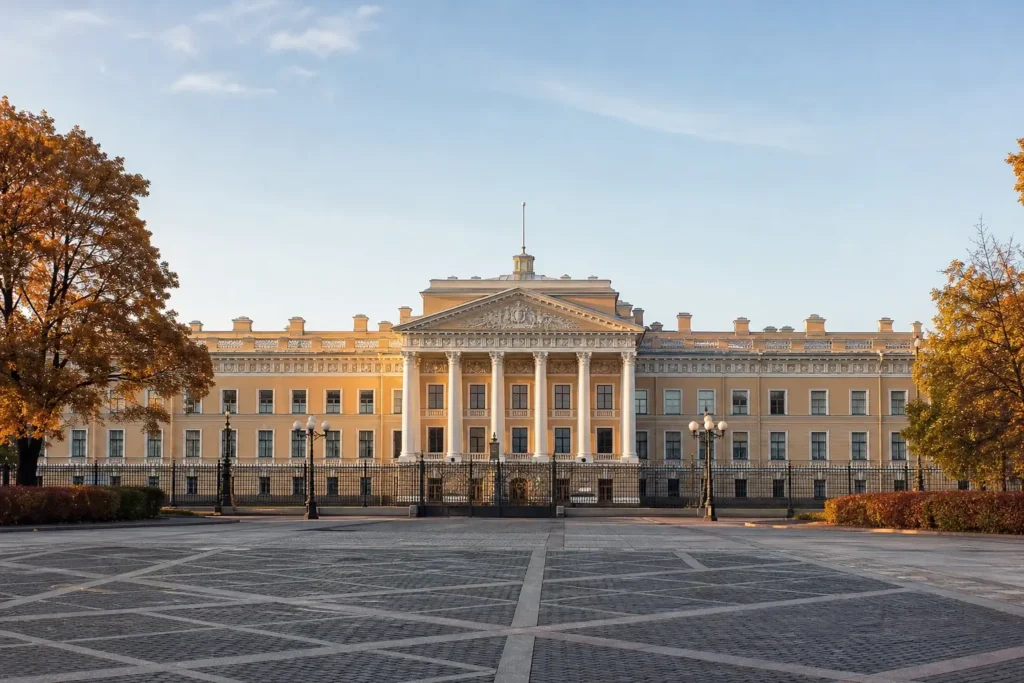
The State Russian Museum in Saint Petersburg is the place to see the full sweep of Russian art, from medieval icons to the early twentieth century and beyond. The main building is the Mikhailovsky Palace on the Square of Arts in the Central District, a few minutes’ walk from Nevsky Prospekt.
It is much more than one building. The museum is a complex of palaces, a castle and two gardens, and each part has its own address and ticket rules. This guide explains what is in the main building, what is a branch, and how to choose.
Quick Facts
| Russian name | Государственный Русский музей |
|---|---|
| Built / opened | 1898 |
| Architect(s) | Carlo Rossi (Mikhailovsky Palace); Leontiy Benois and Sergei Ovsyannikov (Benois Wing) |
| Address | Инженерная улица, 4, Санкт-Петербург |
| District | Central District |
| Metro | Nevsky Prospekt (Line 2, Walk north via Mikhailovskaya Street toward the Square of Arts) Gostiny Dvor (Line 3, Walk north via Mikhailovskaya Street toward the Square of Arts) |
| Opening hours | Closed one day a week (reported as Tuesday); other days the museum opens in the morning and closes in the early evening, with a later closing on some days. Hours differ between the main building and the branches (as of October 2026 – check the official site). |
| Admission | Paid entry. A single-building ticket (₽₽) or a combined ticket for several branches (₽₽₽). |
| Best time to visit | Go on a weekday morning for quieter halls. The museum is a good choice in bad weather. Check the closed day before you plan. |
| Recommended duration | 3–4 hours for the main building |
| Website | rusmuseum.ru |
| Last updated | October 15, 2026 |
What Is (and Isn't) Part of a Visit to State Russian Museum, Saint Petersburg?
| Part | Status | Notes |
|---|---|---|
| Mikhailovsky Palace | Included in the standard ticket | The main permanent exhibition of Russian art. |
| Benois Wing | Included in the standard ticket | Connected to the palace and part of the main display; check whether it needs a separate ticket. |
| Stroganov Palace | Separate ticket or institution | A branch on Nevsky Prospekt with its own displays and ticket rules. |
| Marble Palace | Separate ticket or institution | A branch on Millionnaya Street, not on the same walk. |
| Mikhailovsky Castle | Separate ticket or institution | A branch on Sadovaya Street. |
| Summer Garden and Summer Palace | Separate ticket or institution | Part of the museum complex with its own rules. |
| Russian Museum of Ethnography | Outside / not part of it | A neighbouring institution at 4A Inzhenernaya Street, independent since 1934. |
| State Hermitage Museum, Saint Petersburg | Outside / not part of it | A different museum, mostly European art, across the centre. |
Why Visit State Russian Museum, Saint Petersburg?
The museum shows Russian art as a continuous story rather than as a set of famous names. The main retrospective runs from icons to the avant-garde and covers painting, sculpture and graphic art.
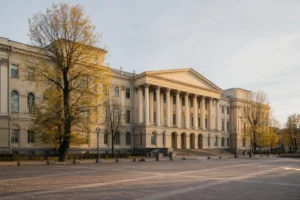
The setting is part of the visit: the palace was built by Carlo Rossi between 1819 and 1825 for Grand Duke Michael Pavlovich, and it is a clear example of Russian Empire style.
It is also a good counterweight to the Hermitage, which is mostly European art. Here you see the national school: Brullov, Aivazovsky, Repin and others.
How State Russian Museum, Saint Petersburg Is Laid Out
The main exhibition is in two connected buildings on Inzhenernaya Street: the Mikhailovsky Palace and the Benois Wing, which was built in 1914–1919 as an exhibition pavilion for the Academy of Arts. The Rossi Wing is also part of the main display.
The other buildings are separate branches in different streets: the Stroganov Palace on Nevsky Prospekt, the Marble Palace on Millionnaya Street and the Mikhailovsky Castle on Sadovaya Street.
The museum complex also includes the Summer Garden with the Summer Palace of Peter I, the Mikhailovsky Garden and the Cabin of Peter the Great.
For a first visit, focus on the Mikhailovsky Palace and the Benois Wing, and treat the branches as separate trips.
Highlights of State Russian Museum, Saint Petersburg
The Mikhailovsky Palace
Carlo Rossi built the palace between 1819 and 1825 for Grand Duke Michael Pavlovich, the youngest son of Paul I. It is the centrepiece of an Empire-style ensemble that includes a square and a street.
Inside, the palace was adapted for the museum in 1895–1898, and its grand halls hold the main retrospective of Russian art.
Tip: Look at the facade from the Square of Arts first; the colonnade and the proportions are the point.
The Benois Wing
The wing was built in 1914–1919 by Leontiy Benois and Sergei Ovsyannikov as an exhibition pavilion of the Academy of Arts. It is connected to the palace.
It holds later art, from the late nineteenth century to the early twentieth century and the avant-garde.
Tip: Plan time for it separately; it can feel like a second museum.
Brullov's Last Day of Pompeii
A huge canvas by Karl Brullov is among the best-known works in the museum's Russian collection. It shows the destruction of Pompeii in an epic scale.
It is a good example of the grand academic style that dominated Russian art in the early nineteenth century.
Tip: Step back to see the whole composition before looking at details.
Aivazovsky's The Ninth Wave
Ivan Aivazovsky's sea painting is one of the most famous Russian works. It shows survivors clinging to wreckage after a storm, with the light breaking through the waves.
It is one of the museum's crowd-pleasers.
Tip: Look at the colour of the water and the sky, which is the real subject.
Repin's Ceremonial Sitting of the State Council
Ilya Repin's monumental group portrait shows the State Council in session. It is a record of the imperial elite and a feat of composition.
The museum is also a leading centre for Repin's work.
Tip: Check the museum's plan for the current display of this painting.
The branches
The Stroganov Palace on Nevsky Prospekt, the Marble Palace on Millionnaya Street and the Mikhailovsky Castle on Sadovaya Street are all part of the Russian Museum but are separate sites.
They have different displays and need separate planning, though a combined ticket may cover several of them.
Tip: Pick one branch rather than trying to see them all on the same day.
Atmosphere
The main building is spacious and quiet by comparison with the Hermitage. The halls are large and well lit, and you can stand in front of a canvas for a long time.
Visitors are a mix of locals, school groups and tourists, and the Square of Arts outside is a calm space with trees and benches. In the morning the museum is nearly empty. Around midday groups arrive, and the busiest areas are in front of the famous paintings.
History of State Russian Museum, Saint Petersburg
The Mikhailovsky Palace was built between 1819 and 1825 to the design of Carlo Rossi for Grand Duke Michael Pavlovich, the youngest son of Paul I. The palace belonged to the grand duke’s family for decades.
The idea of a national museum of Russian art was supported by Alexander III. After his death, Nicholas II signed a decree in 1895 establishing the Russian Museum of Emperor Alexander III and giving it the Mikhailovsky Palace with its outbuildings and garden. The statute was adopted on 3 May 1895.
In May 1895 the architect Vasily Svinyin began adapting the palace interiors for the museum. The museum opened to the public on 19 March (7 March, Old Style) 1898.
The Benois Wing, designed by Leontiy Benois and Sergei Ovsyannikov, was built in 1914–1919 as an exhibition pavilion for the Academy of Arts. The Ethnographic Department set up in 1902 later became an independent museum.
In the early 1930s the Mikhailovsky Palace became fully part of the museum, and over the following decades the museum acquired more buildings. The Marble Palace was assigned to the museum in 1994, and the complex now also includes the Stroganov Palace, the Mikhailovsky Castle, the Summer Garden with Peter I’s Summer Palace and the Mikhailovsky Garden.
The collection now numbers over 400,000 items, covering the history of Russian art from the tenth to the twenty-first century.
Tickets and Booking for State Russian Museum, Saint Petersburg
| Ticket | Price | Includes |
|---|---|---|
| Main building ticket | ₽₽ | The Mikhailovsky Palace and, depending on the ticket, the Benois Wing. |
| Combined branch ticket | ₽₽₽ | Several branches of the museum, reported as valid for a few days. |
| Children and free categories | Free | Free admission applies to some categories; check the official ticket page for your own. |
₽ budget · ₽₽ moderate · ₽₽₽ upscale · ₽₽₽₽ splurge. Price levels are estimates compared with typical prices for visitors.
Buy tickets from the museum’s official website or at its ticket offices. Some displays and exhibitions are reported to be sold only at the ticket offices of the main building, so check before relying on online sales.
- Rates differ for Russian citizens and concession groups.
- Combined tickets for several branches may be available; the validity period and included sites should be checked.
- Bring ID where a reduced or free ticket applies.
Use the museum’s official website (rusmuseum.ru) as the single source for ticket types and current rules.
Plan and Book
Suggested itineraries State Russian Museum, Saint Petersburg
2 hours
Look at the palace facade from the Square of Arts, then spend the time in the main halls of the Mikhailovsky Palace, focusing on Brullov, Aivazovsky and Repin.
3 hours
See the main retrospective in the palace, then cross to the Benois Wing for later art and the avant-garde. Finish in the Mikhailovsky Garden.
Half day
Add one branch, such as the Stroganov Palace on Nevsky Prospekt, with a stop for lunch on the way. Keep the Marble Palace and the castle for another visit.
How to Get to State Russian Museum, Saint Petersburg
The nearest metro stations are Nevsky Prospekt (Line 2) and Gostiny Dvor (Line 3). From either, walk north along Mikhailovskaya Street to the Square of Arts, about ten minutes.
- The main building is at Inzhenernaya Street 4.
- A taxi to the Square of Arts is easy from the centre.
Accessibility
The museum's official website has information for visitors with disabilities; contact the museum in advance to ask about lifts, ramps and assistance in the building you plan to visit, since the older palace buildings differ.
Food Nearby
Cafes and restaurants are close to the Square of Arts and along Nevsky Prospekt. The area around the Griboedov Canal has more choice.
What to Bring
Comfortable shoes and a light layer. Expect a security check at the entrance.
Best Views and Photo Spots of State Russian Museum, Saint Petersburg
The Square of Arts
The palace facade with its colonnade, framed by the garden square and trees.
Best time: Morning light.
The Mikhailovsky Garden
The back of the palace with the garden in front, which works well in autumn.
Best time: Autumn afternoon.
The grand halls
Wide perspectives through the Empire-style rooms, where permitted.
Best time: Early, before groups arrive.
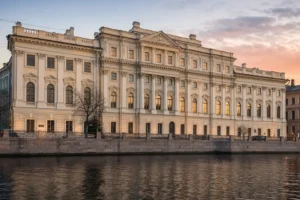
The Griboedov Canal embankment
A distance view of the palace and garden beside the canal.
Best time: Evening.
Photography Rules
Photography rules differ by hall and are set by the museum. Follow posted signs, avoid flash and ask staff if unsure.
Family Suitability
Suitable for older children interested in art. The halls are large and calm, but younger children may tire quickly. Check the official site for stroller and cloakroom arrangements.
Russia Vibes Tips
- Decide in advance between the main building and one branch; trying to see all branches in one day is not realistic.
- Start with the palace's grand halls and then move on to the Benois Wing, rather than the other way round.
- Combine the museum with the Mikhailovsky Garden, which is a quiet green space behind the palace.
- Look for the museum's plan at the entrance and mark three paintings you want to see.
- Check the closed day, which is not the same as at the Hermitage.
Explore Nearby State Russian Museum, Saint Petersburg
Sights near State Russian Museum, Saint Petersburg
 Church of the Savior on Spilled Blood, Saint Petersburg · typical visit: 1 hour inside, plus time to walk around the outside
Main image: AI-generated illustration. It may not show the place exactly as it looks.
 Saint Michael's Castle, Saint Petersburg · typical visit: 1.5–2 hours
Main image: AI-generated illustration. It may not show the place exactly as it looks.
 Nevsky Prospekt, Saint Petersburg · typical visit: 2–4 hours for the main stretch; a full day with stops
Main image: AI-generated illustration. It may not show the place exactly as it looks.
 Summer Garden, Saint Petersburg · typical visit: 1–2 hours
Main image: AI-generated illustration. It may not show the place exactly as it looks.
Related guides
 Best Things to Do, Saint Petersburg: 10 Sights, Boats and Views
Main image: AI-generated illustration. It may not show the place exactly as it looks.
 Nevsky Prospekt Metro Station, Saint Petersburg: Exits Guide
Main image: AI-generated illustration. It may not show the place exactly as it looks.
 State Memorial Museum of the Defense and Siege of Leningrad: Guide
Main image: AI-generated illustration. It may not show the place exactly as it looks.
 Russian Ethnographic Museum, Saint Petersburg: Visitor Tips
Main image: AI-generated illustration. It may not show the place exactly as it looks.
 Fabergé Museum: Imperial Eggs, Hours and How to Find It
Main image: AI-generated illustration. It may not show the place exactly as it looks.
Browse more: More in Central District · All Museums · All Saint Petersburg · All Sightseeing · All Sightseeing in Saint Petersburg
FAQ: State Russian Museum, Saint Petersburg
Is the Russian Museum the same as the Hermitage?
No. The Hermitage is mostly European art in the Winter Palace, while the Russian Museum is devoted to Russian art. They are separate museums with separate tickets.
What is the main building?
The Mikhailovsky Palace on Inzhenernaya Street, together with the Benois Wing. The other palaces and the castle are branches.
Is the Summer Garden part of it?
Yes, the Summer Garden and Peter I's Summer Palace are part of the museum complex but have their own rules.
Which famous paintings are here?
Brullov's The Last Day of Pompeii, Aivazovsky's The Ninth Wave and Repin's Ceremonial Sitting of the State Council are among the best known.
Do I need a guide?
Not strictly. A plan and a short list of priorities are enough for most visitors.
How much time do I need?
About three hours for the main building, more if you add the Benois Wing.
Is the Ethnography Museum part of it?
No. The Russian Museum of Ethnography is a separate institution next door.
Where do I buy tickets?
On the museum's official website or at its ticket offices. See the booking section for details.
Russia Vibes is a one-person project. A coffee keeps it going
Last updated: October 15, 2026. Found an error or something out of date? Report it and we will check and fix it.
How we research and update our guides
About this guide: AI assistance and accuracy
This guide is created with the help of AI and is based on official sources where available. Mistakes can still happen. Opening hours, prices, rules and other details are given to the best of our knowledge as of the date shown and can change without notice. It offers general recommendations only, not professional, legal or travel advice. Please confirm important details with the official source before you travel; you are responsible for your own plans and decisions.
International sanctions affect payments between Russia and many other countries. In practice, cards issued in the EU, the UK, the US and several other countries often do not work in Russia, Russian cards usually do not work abroad, and some booking platforms, airlines and payment providers limit or suspend their services for Russia. The situation changes frequently. We do not give legal or financial advice, and this site does not encourage anyone to break or circumvent sanctions. Whatever you plan, you are responsible for following the laws and regulations that apply to you, including those of your country of residence and citizenship. Many travelers still organise their stay lawfully. It is worth asking your bank or payment provider what is currently permitted, contacting hotels, tour operators and carriers directly about the payment methods they accept, and checking which services are open to customers from your country. Clarify payment, cancellation and refund terms before you commit to a booking, and keep your plans flexible. Partner links on this site may not be available in every country, and prices, availability and rules in our guides can differ from what you see when you book.Paying for your trip: please read

Take this guide with you
Get a free PDF of this guide to print or read offline: key facts, tips and a map link on a few clean pages.