
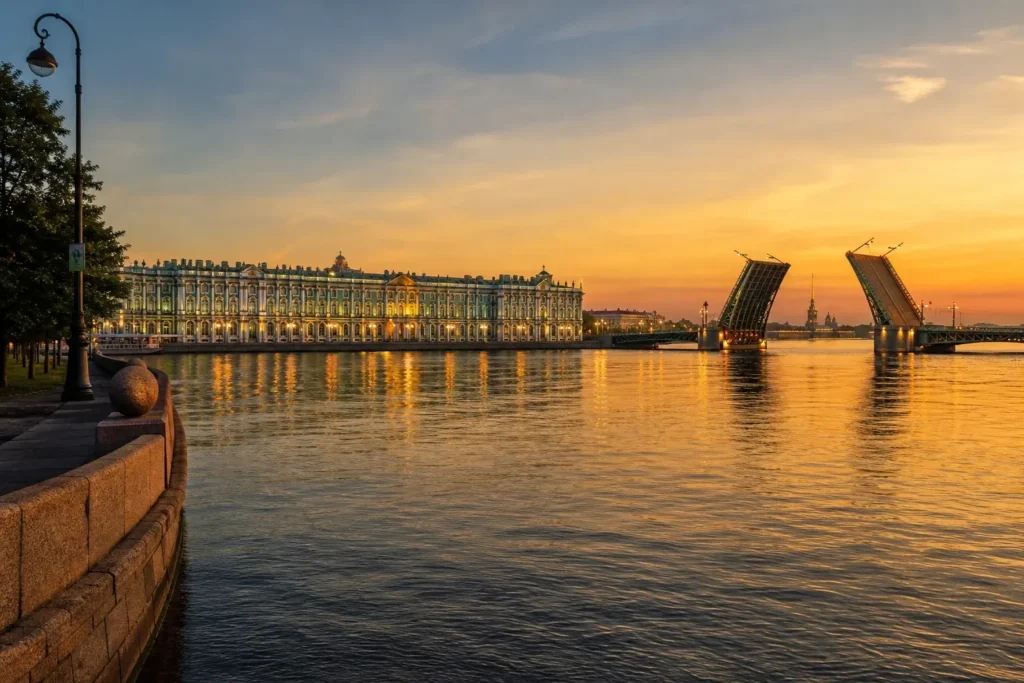
This Saint Petersburg travel guide is for first-time visitors who want to know what the city offers and how to plan the trip. Peter the Great founded Saint Petersburg in 1703, and its center is a flat, walkable grid of palaces, canals and wide avenues along the Neva river.
Most visitors build their days around a handful of areas: the Hermitage and Palace Square, Nevsky Prospekt, the churches and cathedrals, and the Peter and Paul Fortress across the river. Opening hours, tickets and transport details change, so check the official source for each place before you go.
Quick Facts
| Russian name | Санкт-Петербург |
|---|---|
| Address | OpenStreetMap · Google Maps |
| Best time to visit | Late May to mid-July is the White Nights season, when the sky stays light late into the night and the city is at its busiest. The official White Nights period runs roughly from mid-June to early July, according to a travel source, so book accommodation and transport early. Spring and autumn are calmer, and winter is cold with short days, which suits visitors who prefer museums and quieter streets. |
| Recommended duration | 3 to 4 days |
| Website | gov.spb.ru |
| Last updated | October 13, 2026 |
Why Visit Saint Petersburg?
Saint Petersburg is a planned imperial capital, so its center feels more orderly than most Russian cities, with long avenues, squares and embankments that you can cover on foot. The Winter Palace, once the official residence of the Russian monarchs, is now part of the Hermitage art museum.
The city also has a distinct natural rhythm. It lies at about 60 degrees north, so summer nights stay light and the Neva bridges are raised after dark, a sight many visitors plan their trip around. Day trips to palaces and gardens on the Gulf of Finland, such as Peterhof, extend a stay.
Highlights of Saint Petersburg
The Hermitage and the Winter Palace
The Winter Palace was the official residence of the Russian monarchs from 1732 to 1917, according to a travel source, and it is now part of the Hermitage, one of the largest art museums in the world. The building stands on Palace Square, and the interiors are as much of a draw as the collections. The museum is large, so plan a half day.
Tip: Check the official site for the current opening days and which buildings belong to the Hermitage, since the museum has more than one.
Palace Square
The huge open square in front of the Winter Palace is the ceremonial heart of the city, framed by the palace on one side and the curving General Staff Building opposite, with a central column in the middle. It is free to walk, and it connects the Hermitage with Nevsky Prospekt and the Neva embankment.
Tip: Come early in the morning or in the evening for photographs with fewer people.
Nevsky Prospekt
The main avenue of Saint Petersburg runs through the historic center, lined with shops, cafes and churches, and it crosses several canals. Kazan Cathedral, with its curving colonnade, stands along it, and you can walk much of its length in an hour or two. It is the easiest way to see how the city is laid out.
Tip: Walk one side out and the other side back, and look up at the facades.
Church of the Savior on Spilled Blood
The church stands on the Griboedov Canal, on the spot where Emperor Alexander II was fatally wounded in 1881, and its colorful domes recall older Russian churches. The exterior and the interior are covered in mosaics. It is a museum rather than a working parish church, so check the official site for visiting rules.
Tip: See the exterior from across the canal, then go in if you have time.
Saint Isaac's Cathedral
One of the largest cathedrals in the city, with a golden dome that is visible from many parts of the center. The building dates from the 19th century and was designed by the architect Auguste de Montferrand. Inside there is a museum, and a colonnade around the dome is open as a viewing platform, so check the official site for current access.
Tip: Go up to the colonnade on a clear day for a view over the city.
Peter and Paul Fortress
This is the original citadel of the city, founded by Peter the Great in 1703 on an island in the Neva. The cathedral inside the fortress holds the tombs of almost all the Russian emperors and empresses from Peter the Great to Nicholas II, and its slim gilded spire is a city landmark. The fortress also has several museums.
Tip: Allow a few hours, and check which museums in the fortress need their own ticket.
The Neva bridges at night
In the warm season the drawbridges over the Neva are raised at night to let ships pass, and many visitors come to watch them open after dark. The best-known view is of the Palace Bridge with the Hermitage in the background. The best time for it is during the White Nights, when the sky stays light.
Tip: Check the bridge schedule for the current season and plan how you will get back, since the bridges stay up for a while.
Peterhof
A palace and park complex on the Gulf of Finland, known for its fountain park and gardens, reached from the city by road or by boat in season. It is outside Saint Petersburg and needs its own day or half day. Check the official site for the current opening times, tickets and which parts are open.
Tip: Plan the transport in advance, since the way back can be slow in summer.
Atmosphere
The center of Saint Petersburg feels open and orderly. Wide avenues run between pastel-colored palaces, and canals and the broad Neva river give long views and reflections. The scale is large, with squares that can feel empty even when visitors fill them, and the streets are mostly flat, so walking is easy.
The mood changes with the season. In late spring and summer the evenings last very late and the embankments are busy after dinner. In winter the days are short, the light is low and soft, and the city is quieter, with many visitors spending more time in museums and theaters.
History of Saint Petersburg
Peter the Great founded Saint Petersburg on 27 May 1703, on the site of a captured Swedish fortress, as he built a new port and city on the marshy banks of the Neva. The city was named after the apostle Saint Peter. The first citadel, the Peter and Paul Fortress, was built on an island in the river at the same time.
In 1712 the capital of the Russian state moved from Moscow to the new city, and it remained the capital for just over two centuries. During this period it grew into an imperial center with palaces, avenues and canals laid out by foreign and Russian architects. The Winter Palace served as the official residence of the Russian monarchs from 1732 to 1917.
In 1914 the city was renamed Petrograd. After the revolutions of 1917 the government moved back to Moscow in 1918, and the city lost its status as the capital. It was renamed Leningrad in 1924.
During the Second World War, the city endured a long blockade between 1941 and 1944. It is remembered in Russia as a period of great suffering and endurance, and memorials across the city commemorate it. After the war the city was rebuilt, and many palaces and monuments were restored.
In 1991 the city regained its historic name, Saint Petersburg. Its historic center and related monuments were inscribed on the UNESCO World Heritage list in 1990, according to a general source that should be checked. Today it is Russia’s second-largest city and a major center of culture and tourism.
For visitors, this history is visible in the layout of the city: the fortress where it began, the palaces and squares of the imperial period, and the memorials of the 20th century. Details of the city’s later history and the many restorations of its buildings go beyond this guide, so check the websites of individual museums for in-depth accounts.
Tickets and Booking for Saint Petersburg
Arriving by air. The main airport is Pulkovo, about 17 km south of the city center, according to a travel source. The transfer to the center usually combines a bus with a Metro line, or a taxi, but routes, times and fares change, so check them with the official operators.
Arriving by train. Moskovsky Railway Station is the arrival point for trains from Moscow, including the fast Sapsan service, which takes about four hours, according to travel sources. Other long-distance trains use different stations, so check which station your ticket names.
Confirm before you go. Schedules, ticket types and entry conditions for transport and sights depend on the operator and can change. Always confirm times and tickets with the official operator or the official website of each place, and keep your booking confirmations offline.
How to Get to Saint Petersburg
Most visitors arrive by air or by train from Moscow.
- By air: Pulkovo Airport (LED) is about 17 km south of the center. A bus to the Metro and a taxi are the usual ways to the center, according to travel sources; check the current options and times with the official operators.
- By train from Moscow: fast Sapsan trains take about four hours, and slower and overnight trains also run. Trains arrive at Moskovsky Station, which is close to the start of Nevsky Prospekt.
- By plane from Moscow: flights between the two cities are shorter, but airports are outside both cities, so compare the total journey time.
Check routes, schedules and booking steps with the official operators, and save your hotel address offline in Latin letters and in Russian.
Accessibility
Accessibility differs from one building to the next, and many historic palaces, churches and museums have steps, cobbles and older entrances. Check the official website of each sight for lifts, ramps and support for visitors with reduced mobility, and plan extra time. Public transport and the Metro have stations with different levels of access, so confirm with the operator.
Food Nearby
The center has a wide range of cafes, bakeries and restaurants, especially along Nevsky Prospekt and around the canals, with Russian, Georgian and international cuisine. Many museums and palaces have their own cafes, and food halls and markets offer quicker meals. Specific venues were not verified here, so check opening hours and menus before you go.
What to Bring
Bring comfortable walking shoes, since distances in the center are long and some pavements are uneven. In summer pack a light jacket for the evening and a sleep mask if you are sensitive to light; in winter pack warm layers, a hat and gloves. A portable charger and offline maps are useful, and large bags may need to go in a cloakroom at museums.
Photography Rules
Rules differ between museums, palaces and churches, and many restrict flash, tripods or photography of certain rooms. Check the signs at each entrance and ask staff if you are unsure. Drone rules also apply in cities, so check the current regulations with the official source before you use one.
Family Suitability
Saint Petersburg suits families who like walking, boat trips and parks, and the palace gardens at Peterhof are popular with children in summer. Big museums can be long for younger children, so plan shorter visits. Many streets have cobbles and curbs, which can be awkward for strollers, so check access at each sight.
Russia Vibes Tips
- Group sights by area: Hermitage, Palace Square and Nevsky Prospekt on one day, the Peter and Paul Fortress and the Petrograd Side on another.
- Walk from Palace Square to the Neva embankment to see the city's scale before you go inside any museum.
- In the White Nights season, book your hotel and trains well ahead, since the busiest weekends fill early.
- Plan Peterhof as a separate day trip instead of squeezing it into a day with the Hermitage.
- If you stay late to watch the bridges, check how you will get back to your hotel, since public transport is limited at night.
- If you also visit Moscow, a daytime Sapsan train works well as a way to see the countryside between the two cities.
Explore Nearby Saint Petersburg
Browse more: All Cities · All Landmarks
FAQ: Saint Petersburg
How many days do I need in Saint Petersburg?
Three days covers the main sights, such as the Hermitage, the Church of the Savior on Spilled Blood, Saint Isaac's Cathedral and the Peter and Paul Fortress, according to a travel source. Add a day or two for Peterhof and other palaces.
What is the best time to visit?
Many visitors go in the White Nights season, from late May to mid-July, when evenings stay light. It is also the busiest and most expensive time, so book early, or choose spring or autumn for fewer crowds.
How do I get from Moscow to Saint Petersburg?
The fast Sapsan train takes about four hours, and slower and overnight trains also run. Flights are shorter, but airports are outside the cities. Check schedules and booking steps with the official operators.
How do I get from the airport to the center?
Pulkovo Airport is about 17 km south of the center. Many visitors use a bus plus the Metro or a taxi, but routes and times change, so check the current options with the official operators.
Is Saint Petersburg walkable?
Yes, the historic center is compact and mostly flat, and many of the main sights are linked on foot. Distances are longer than they look on a map, so wear comfortable shoes and use the Metro for longer hops.
Is Peterhof in the city?
No, Peterhof is a separate palace and park complex on the Gulf of Finland, outside the city center. It needs its own half day or day, and the transport and tickets are separate from city sights.
Are the Neva bridges raised all year?
No, the bridges are raised during the warm season, not all year. Check the schedule for the current season, and plan your return, since the bridges stay up for a while.
Do I need a guide?
Not necessarily, but a guide can help in big museums such as the Hermitage. Many sights have audio guides or information in English, so check each official site, and pick a licensed provider if you want a tour.
Last updated: October 13, 2026. Found an error or something out of date? Report it and we will check and fix it.
About this guide: AI assistance and accuracy
This guide is created with the help of AI and is based on official sources where available. Mistakes can still happen. Opening hours, prices, rules and other details are given to the best of our knowledge as of the date shown and can change without notice. It offers general recommendations only, not professional, legal or travel advice. Please confirm important details with the official source before you travel; you are responsible for your own plans and decisions.
International sanctions affect payments between Russia and many other countries. In practice, cards issued in the EU, the UK, the US and several other countries often do not work in Russia, Russian cards usually do not work abroad, and some booking platforms, airlines and payment providers limit or suspend their services for Russia. The situation changes frequently. We do not give legal or financial advice, and this site does not encourage anyone to break or circumvent sanctions. Whatever you plan, you are responsible for following the laws and regulations that apply to you, including those of your country of residence and citizenship. Many travelers still organise their stay lawfully. It is worth asking your bank or payment provider what is currently permitted, contacting hotels, tour operators and carriers directly about the payment methods they accept, and checking which services are open to customers from your country. Clarify payment, cancellation and refund terms before you commit to a booking, and keep your plans flexible. Partner links on this site may not be available in every country, and prices, availability and rules in our guides can differ from what you see when you book.Paying for your trip: please read
 Ask Masha