
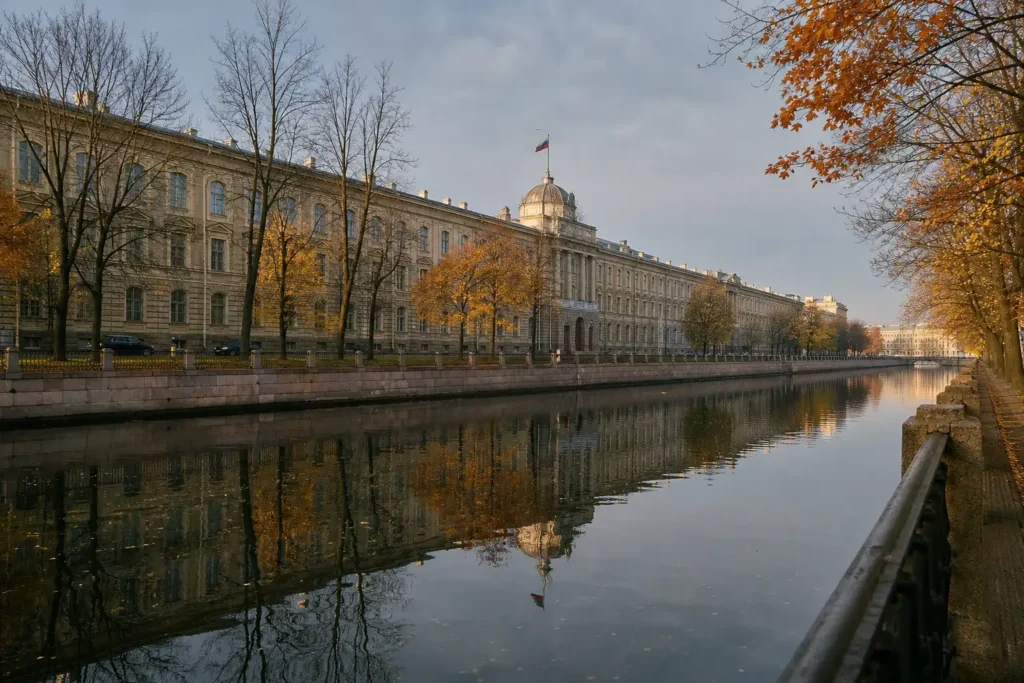
The Central Naval Museum is one of the oldest museums in Russia and one of the largest maritime museums in the world. Its roots go back to the Model Chamber that Peter the Great set up in 1709, and its collection now numbers more than 700,000 items, from ship models and flags to paintings and navigation instruments.
Since 2013 the museum has occupied the former Kryukov Naval Barracks on Truda Square, a short walk from the Mariinsky Theatre. This page explains what you can see, how it differs from the cruiser Aurora and the other branches, what a ticket costs and how to find the entrance, which is on the Kryukov Canal side.
Quick Facts
| Russian name | Центральный военно-морской музей имени императора Петра Великого |
|---|---|
| Built / opened | 2013 |
| Architect(s) | Housed in the historic Kryukov (Naval) Barracks on Truda Square |
| Address | Санкт-Петербург, площадь Труда, 5 (вход со стороны набережной Крюкова канала) OpenStreetMap · Google Maps |
| District | Admiralteysky District |
| Metro | Sadovaya (Line 5, about 1.4 km on foot) Spasskaya (Line 4, about 1.5 km on foot) Sennaya Ploshchad (Line 2, about 1.6 km on foot) |
| Opening hours | Exhibition halls open from 10:00 to 18:00 and the museum is closed on Tuesdays. The ticket office stops selling tickets at 17:15, and admission ends 45 minutes before closing (as of October 2026 – check the official site). |
| Admission | A museum ticket (₽₽); schoolchildren, students and pensioners pay less (₽), and preschool children enter free. Entry is reported to be free on the last Wednesday of each month. |
| Best time to visit | Weekday mornings are usually quieter. Because the museum is indoors, it works in any season, and it is a good choice for rainy or cold days. The museum is closed on Tuesdays, and the last tickets are sold at 17:15. |
| Recommended duration | 2–3 hours |
| Website | eng.navalmuseum.ru |
| Last updated | October 16, 2026 |
What Is (and Isn't) Part of a Visit to Central Naval Museum, Saint Petersburg?
| Part | Status | Notes |
|---|---|---|
| Permanent exhibition halls | Included in the standard ticket | The main collection in the Kryukov Naval Barracks, covering the history of the Russian fleet. |
| Temporary exhibitions | Separate ticket or institution | Shown at times in the halls and atrium; check whether a separate ticket is needed. |
| Cruiser Aurora | Separate ticket or institution | A branch of the museum moored on the Neva, with its own ticket and hours. |
| Submarine D-2 Narodovolets | Separate ticket or institution | Another branch in Saint Petersburg, with its own hours and closing days. |
| Kryukov Canal embankment | Outside / not part of it | Free to walk; the visitor entrance is on this side. |
Why Visit Central Naval Museum, Saint Petersburg?
The museum tells the story of the Russian fleet from Peter the Great to the present through the objects themselves. Highlights include the Botik of Peter the Great, Catherine II’s marine throne, trophies of naval battles and a collection of about 2,000 ship models, plus paintings by Ivan Aivazovsky and other marine artists.
It is a good choice for anyone interested in ships, naval history or Russian history in general, and it is a large indoor visit that works well on rainy days. The halls are organised by theme and period, so you can see the whole sweep or pick out the eras that interest you.
How Central Naval Museum, Saint Petersburg Is Laid Out
The museum occupies the former Kryukov Naval Barracks, a large building at the junction of Bolshaya Morskaya Street, the Kryukov Canal embankment and Truda Square. The visitor entrance is from the canal side, although the official address is Truda Square, 5.
The permanent exhibition is spread over many halls, numbered in sequence; the museum’s own report mentions a hall 19 devoted to the modern Russian Navy, and the exhibition covers about 8,000 square metres. There is also an atrium, where special displays are sometimes shown, and a house church inside the building.
Plan to follow the halls in order, since they run roughly chronologically from the founding of the fleet. If you are short of time, choose the halls on Peter the Great’s fleet and the models, which are the best-known parts of the collection.
Highlights of Central Naval Museum, Saint Petersburg
The Botik of Peter the Great
The museum's permanent display includes the Botik of Peter the Great, the small boat associated with the beginnings of the Russian fleet. It is one of the museum's best-known relics and a good starting point for the story of the navy.
The boat is displayed with material on Peter's shipbuilding and the founding of the fleet.
Tip: See it early in your visit, before turning to the later halls.
The ship models
The museum's collection of ship models, about 2,000 in all, is its pearl and goes back to the Model Chamber of 1709. The models show how Russian warships developed from sailing vessels to modern ships, and many are finely detailed.
The halls display them by period, so you can follow the changes in design.
Tip: Look closely at the rigging and decks on the older models; the detail is remarkable.
Catherine II's marine throne
Among the relics is the marine throne of Catherine II, an object that links the fleet with court ceremony. It shows how closely the navy was tied to the identity of the empire under Catherine.
It is displayed alongside other items from the imperial period.
Tip: Combine it with the portraits and trophies in the same halls to see the eighteenth-century fleet in context.
Marine paintings
The collection includes paintings by Ivan Aivazovsky, Alexey Bogolyubov, Lev Lagorio and other marine artists, together with ship sculpture and navigational instruments from the seventeenth to the twentieth centuries. The paintings show famous sea battles and views of the fleet.
They add a more artistic side to a museum of ships and weapons.
Tip: Check the captions for the battles depicted; they often explain the historical background.
Flags and trophies
The museum holds a 1693 flag of the Russian tsar, described as the oldest surviving Russian flag, and trophies captured in sea battles, including flags captured in the Second World War. Personal belongings of prominent naval commanders are also displayed.
These objects make the history concrete and personal.
Tip: Look at the dates on the flags; they show the long history of the collection.
The modern navy and the atrium
The last halls cover the Russian Navy of the twentieth and twenty-first centuries, with models of Soviet and Russian ships such as the cruiser Kirov. The atrium of the building is used for special displays and events.
These halls show how the museum continues the story to the present.
Tip: If you are short of time, begin here and work backwards.
Atmosphere
The museum is quiet and orderly, with high halls, glass cases and the soft hum of voices. Model ships gleam in their cases, large paintings of storms and battles fill the walls and staff watch the rooms closely. The building feels like a former barracks turned into a museum: solid, spacious and formal.
Visitors include school groups, families and enthusiasts, and weekday mornings are calm. The tone is respectful and educational, with a strong focus on tradition and naval pride, and the atmosphere is more that of a traditional museum than a modern interactive one.
History of Central Naval Museum, Saint Petersburg
The museum traces its origins to the Model Chamber, a store for models and drawings related to shipbuilding, first mentioned in a letter of Peter the Great in January 1709. That date is the museum’s official birthday.
In 1805 Alexander I merged the Model Chamber with the library of the Admiralty College and renamed it the Maritime Museum (Morskoy Museum). It later became the Naval Museum in 1867, took the name of Peter the Great in 1908 and received its present title, Central Naval Museum, in 1924. Nicholas I is said to have regarded the museum as pointless.
After the revolution of 1917 the museum was given the building of the former stock exchange on the Strelka of Vasilyevsky Island. It was relocated there in August 1939, opened in February 1941 and was interrupted four months later by the German invasion. It reopened only in July 1946 and stayed in the Exchange until 2010.
In 2007 the authorities began to consider moving the museum from the Exchange, and the site chosen was the Kryukov Naval Barracks on Truda Square, at the junction of Bolshaya Morskaya Street and the Kryukov Canal. In 2013 the museum settled in the restored building, which allowed it to show its collections more fully. In 2016 it was named Museum of the Year.
The barracks building has its own history: in September 1913 the Naval Junker classes and the Naval Club opened there, and the building also contains a house church dedicated to the Annunciation.
Today the museum has more than 700,000 items and a number of branches, including the cruiser Aurora on the Neva, the submarine D-2 Narodovolets, the Road of Life museum on Lake Ladoga, the Kronstadt Fortress and museums of the Baltic and Black Sea fleets.
Tickets and Booking for Central Naval Museum, Saint Petersburg
| Ticket | Price | Includes |
|---|---|---|
| Adult ticket | ₽₽ | Entry to the permanent exhibition in the main building. |
| Schoolchildren, students and pensioners | ₽ | A reduced ticket for the same visit. |
| Preschool children | Free | Free entry for young children. |
₽ budget · ₽₽ moderate · ₽₽₽ upscale · ₽₽₽₽ splurge. Price levels are estimates compared with typical prices for visitors.
Tickets are sold at the museum and through the museum’s website. The ticket office stops selling tickets at 17:15, and admission ends 45 minutes before closing.
- Buying online can save time on busy days.
- Entry is reported to be free on the last Wednesday of each month; confirm this on the official site.
- The museum is a separate site from the cruiser Aurora, which sells its own tickets.
Rates for Russian citizens and for foreign visitors, and the list of concession and free categories, should be checked on the museum’s website.
Plan and Book
Suggested itineraries Central Naval Museum, Saint Petersburg
1.5 hours
Focus on the early halls: the Botik of Peter the Great, the ship models and the eighteenth-century fleet. Finish at the marine paintings.
3 hours
Follow the halls in order from Peter the Great to the modern navy, pausing at the models, the throne and the flags, and finish in the atrium.
Half day
Visit the museum in the morning, then walk to Saint Nicholas Naval Cathedral and the Mariinsky Theatre area for lunch and a stroll along the Kryukov Canal.
How to Get to Central Naval Museum, Saint Petersburg
By metro: the nearest stations are Sadovaya (Line 5), Spasskaya (Line 4) and Sennaya Ploshchad (Line 2), each about 1.4 to 1.6 km away. A bus from each of these stations to the Ploshchad Truda stop is listed in one source; check the route before you go.
On foot: the museum is a short walk from Saint Nicholas Naval Cathedral and the Mariinsky Theatre, along the Kryukov Canal.
By taxi: ask for Truda Square, 5 (площадь Труда, 5) and the entrance from the Kryukov Canal side.
Accessibility
The museum runs a special version of its website for visitors with additional needs, and the building is a restored barracks. Which halls are step-free and whether lifts serve all floors were not verified, so check with the museum before you visit if you use a wheelchair or stroller.
Food Nearby
There are no verified cafes inside the museum. Cafes and restaurants can be found along Bolshaya Morskaya Street, near the Mariinsky Theatre and around Nikolskaya Square, within a short walk.
What to Bring
Comfortable shoes for several hours of walking, a light layer for the halls, and your ticket on your phone if you booked online. Follow the instructions at the entrance regarding bags.
Best Views and Photo Spots of Central Naval Museum, Saint Petersburg
Kryukov Canal embankment
The long façade of the Naval Barracks along the canal, with the water in the foreground.
Best time: Morning light.
The museum atrium
The interior of the former barracks with displays and the building's architecture, where photography may be permitted.
Best time: Whenever quiet; ask staff first.
Model halls
Cases of ship models against the museum's warm lighting, suitable for close-up detail shots if allowed.
Best time: Weekday mornings.
Nearby Nikolskaya Square
The blue and white Saint Nicholas Naval Cathedral and its bell tower, a short walk away.
Best time: Late afternoon.
Photography Rules
Photography rules were not verified. Visitors report that staff remind guests of the rules at the entrance, so ask at the ticket office before using a camera, flash or tripod. Drone rules do not apply inside the museum.
Family Suitability
Good for children who like ships, flags and history, and for rainy days. The ship models and the Botik hold attention, but long text labels may be difficult for younger children. Preschool children enter free. Stroller and step-free access were not verified.
Russia Vibes Tips
- Do not confuse the main museum with the cruiser Aurora. Aurora is a branch on the Neva with its own ticket, hours and closing days.
- Use the Kryukov Canal side to find the entrance; the official address on Truda Square can be confusing.
- Arrive well before closing. The ticket office stops at 17:15, and admission ends 45 minutes before the museum closes.
- Check the free-entry day on the official site before you go; it is reported to be the last Wednesday of the month, and it will be busier.
- Combine the visit with Saint Nicholas Naval Cathedral, which is a short walk away along the canal.
Explore Nearby Central Naval Museum, Saint Petersburg
Sights near Central Naval Museum, Saint Petersburg
 Saint Nicholas Naval Cathedral, Saint Petersburg · typical visit: 30–45 minutes
Main image: AI-generated illustration. It may not show the place exactly as it looks.
 Mariinsky Theatre, Saint Petersburg · typical visit: An evening: about 3 hours for a performance
Main image: AI-generated illustration. It may not show the place exactly as it looks.
 New Holland Island, Saint Petersburgabout 300 m away (~5 min walk) · typical visit: 1.5–2 hours
Main image: AI-generated illustration. It may not show the place exactly as it looks.
 Cruiser Aurora, Saint Petersburgabout 3.7 km away · typical visit: 1–1.5 hours
Main image: AI-generated illustration. It may not show the place exactly as it looks.
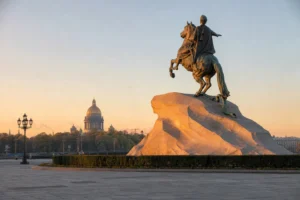 Bronze Horseman, Saint Petersburg · typical visit: 20–40 minutes
Main image: AI-generated illustration. It may not show the place exactly as it looks.
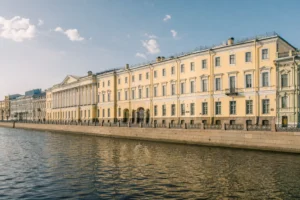 Yusupov Palace, Saint Petersburg – about 350 m away (~5 min walk) · typical visit: 1.5–2 hours for a standard palace route; approximately 2.5–3 hours for a comprehensive visit including the Rasputin exhibition.
Main image: AI-generated illustration. It may not show the place exactly as it looks.
Train stations and river piers near Central Naval Museum, Saint Petersburg
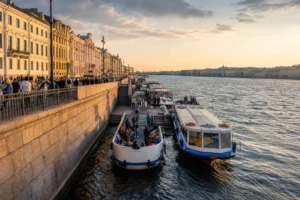 Rumyantsev Descent Pier, Saint Petersburgabout 900 m away (~15 min walk)
Main image: AI-generated illustration. It may not show the place exactly as it looks.
Related guides
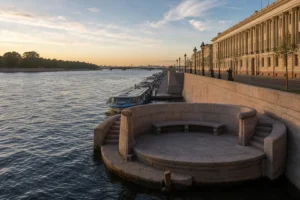 English Embankment Pier, Saint Petersburg: Quiet Neva Boat Trips
Main image: AI-generated illustration. It may not show the place exactly as it looks.
 Lions‘ Descent Pier, Saint Petersburg: Meteor Boats to Peterhof
Main image: AI-generated illustration. It may not show the place exactly as it looks.
 Senate Pier, Saint Petersburg: Boat Trips by the Bronze Horseman
Main image: AI-generated illustration. It may not show the place exactly as it looks.
 Baltiysky Railway Station, Saint Petersburg: Trains to Peterhof
Main image: AI-generated illustration. It may not show the place exactly as it looks.
 Zvenigorodskaya Metro Station, Saint Petersburg: Line 5 Interchange
Main image: AI-generated illustration. It may not show the place exactly as it looks.
Browse more: More in Admiralteysky District · All Museums · All Saint Petersburg · All Sightseeing · All Sightseeing in Saint Petersburg
FAQ: Central Naval Museum, Saint Petersburg
What is the Central Naval Museum?
A museum of the Russian fleet founded in 1709 from Peter the Great's Model Chamber. It has more than 700,000 items and is one of the largest maritime museums in the world.
Where is it located?
In the former Kryukov Naval Barracks at Truda Square, 5, with the entrance on the Kryukov Canal side. It moved there in 2013 from the Old Stock Exchange.
When is the museum open?
From 10:00 to 18:00, closed on Tuesdays. The ticket office closes at 17:15, and admission ends 45 minutes before closing.
How much is a ticket?
A moderate price for adults, with reduced rates for schoolchildren, students and pensioners and free entry for preschool children. The last Wednesday of the month is reported to be free.
What are the main exhibits?
The Botik of Peter the Great, Catherine II's marine throne, about 2,000 ship models, marine paintings and the 1693 tsar's flag.
Is the cruiser Aurora part of the same ticket?
No. The cruiser Aurora is a branch with its own ticket and hours. It lies on the Neva at Petrogradskaya Embankment.
Why did the museum leave the Stock Exchange?
The authorities decided to move it, work began in 2010, and in 2013 it settled in the Kryukov Naval Barracks, which gave more space for the exhibition.
How do I get there?
Take the metro to Sadovaya, Spasskaya or Sennaya Ploshchad and walk about 1.4 to 1.6 km, or walk from the Mariinsky Theatre along the Kryukov Canal.
Russia Vibes is a one-person project. A coffee keeps it going
Last updated: October 16, 2026. Found an error or something out of date? Report it and we will check and fix it.
How we research and update our guides
About this guide: AI assistance and accuracy
This guide is created with the help of AI and is based on official sources where available. Mistakes can still happen. Opening hours, prices, rules and other details are given to the best of our knowledge as of the date shown and can change without notice. It offers general recommendations only, not professional, legal or travel advice. Please confirm important details with the official source before you travel; you are responsible for your own plans and decisions.
International sanctions affect payments between Russia and many other countries. In practice, cards issued in the EU, the UK, the US and several other countries often do not work in Russia, Russian cards usually do not work abroad, and some booking platforms, airlines and payment providers limit or suspend their services for Russia. The situation changes frequently. We do not give legal or financial advice, and this site does not encourage anyone to break or circumvent sanctions. Whatever you plan, you are responsible for following the laws and regulations that apply to you, including those of your country of residence and citizenship. Many travelers still organise their stay lawfully. It is worth asking your bank or payment provider what is currently permitted, contacting hotels, tour operators and carriers directly about the payment methods they accept, and checking which services are open to customers from your country. Clarify payment, cancellation and refund terms before you commit to a booking, and keep your plans flexible. Partner links on this site may not be available in every country, and prices, availability and rules in our guides can differ from what you see when you book.Paying for your trip: please read

Take this guide with you
Get a free PDF of this guide to print or read offline: key facts, tips and a map link on a few clean pages.