
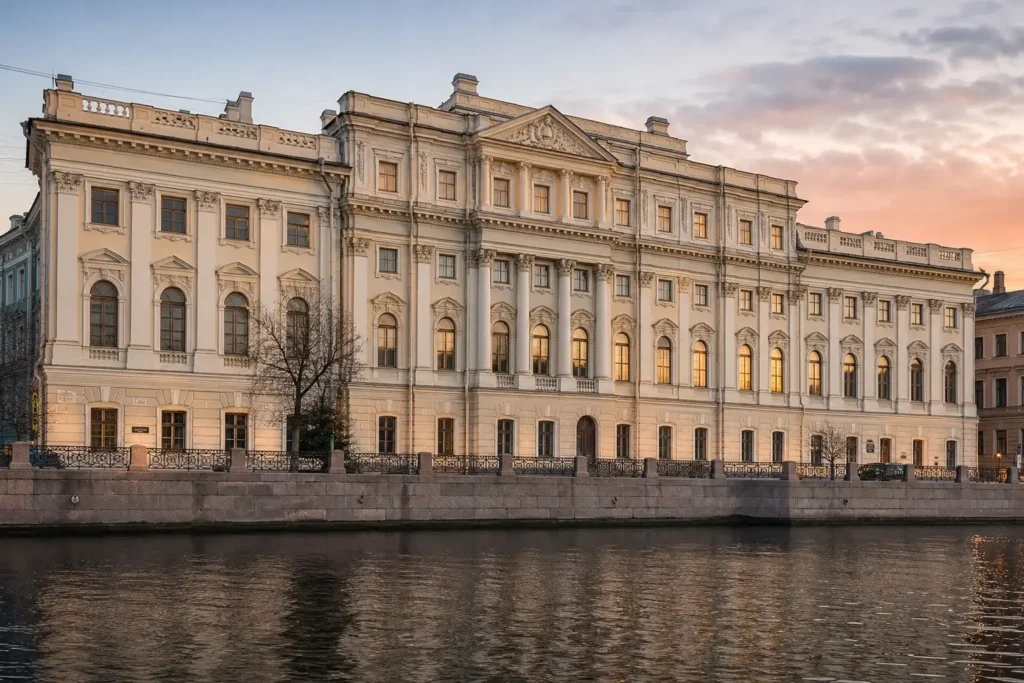
The Fabergé Museum in Saint Petersburg is a small, rich museum in the Shuvalov Palace on the Fontanka River Embankment, a short walk from Nevsky Prospekt in the Central District. It describes itself as holding the world’s largest collection of works by Carl Fabergé.
The best-known objects are nine imperial Easter eggs made for the last two Russian emperors, but the museum is wider than the eggs: jewellery, silver, objects of fantasy and the palace interiors are part of the visit. This guide explains what to look for, how to find the entrance and how to plan the time.
Quick Facts
| Russian name | Музей Фаберже |
|---|---|
| Built / opened | 2013 |
| Address | набережная реки Фонтанки, 21, Санкт-Петербург |
| District | Central District |
| Metro | Gostiny Dvor (Line 3, About 10 minutes on foot along Nevsky Prospekt toward the Anichkov Bridge) Mayakovskaya (Line 3, About 15 minutes on foot, or a short bus ride) Ploshchad Vosstaniya (Line 1, About 15 minutes on foot, or a short bus ride) |
| Opening hours | Open seven days a week, with the museum opening at 10:00 and closing in the evening; the ticket office opens at 9:30, and the exhibition halls close 15 minutes before the museum's closing time (as of October 2026 – check the official site). |
| Admission | Paid entry (₽₽). A guided tour and an audio guide are optional extras. |
| Best time to visit | Go in the morning or in the evening, since the museum stays open late. Weekdays are quieter. The museum is a good choice for rain or cold. |
| Recommended duration | 1–2 hours |
| Website | fabergemuseum.ru/en |
| Last updated | October 15, 2026 |
What Is (and Isn't) Part of a Visit to Fabergé Museum, Saint Petersburg?
| Part | Status | Notes |
|---|---|---|
| Permanent exhibition in the Shuvalov Palace | Included in the standard ticket | The main display, including the imperial eggs, is covered by the museum ticket. |
| Temporary exhibitions | Included in the standard ticket | Shown in the museum; check the official site for the current programme and for any separate ticket. |
| Guided tours | Separate ticket or institution | Offered as an extra; see the museum's website for individual tours. |
| Audio guide | Separate ticket or institution | An optional extra offered by the museum. |
| Cafe and gift shop | Separate ticket or institution | On the premises; purchases are separate from entry. |
| The Hermitage | Outside / not part of it | A different museum with its own tickets, across the centre. |
Why Visit Fabergé Museum, Saint Petersburg?
The museum is compact and focused. According to its official website, the collection of over 4,000 items covers everything the House of Fabergé made: Easter masterpieces, fantasy objects, jewellery, small items, silverware, home decor and objects of worship.
The nine imperial Easter eggs are linked to the reigns and personal lives of Alexander III and Nicholas II, so they work as historical documents as well as jewels.
The setting adds to it: the Shuvalov Palace is one of the more beautiful historic palaces in the centre, and a visit takes an hour or two, which makes it easy to combine with Nevsky Prospekt.
How Fabergé Museum, Saint Petersburg Is Laid Out
The museum occupies the Shuvalov Palace, an eighteenth-century building on the Fontanka. The exhibition is spread over several rooms of the palace, and the museum publishes an exhibition layout page on its website for planning.
The imperial eggs are the focus, and their display is treated as the heart of the visit. Other galleries show jewellery, silver and decorative objects, and the palace interiors, which were restored, are part of the experience.
There is also a gift shop and a cafe on the premises. For a sensible route, go first to the eggs while you are fresh, then walk through the other galleries and finish with the cafe or shop.
Highlights of Fabergé Museum, Saint Petersburg
The nine imperial Easter eggs
The official website calls the nine eggs the items of greatest value in the collection. They were made by craftsmen of the House of Fabergé for Alexander III and Nicholas II, the last two Russian emperors.
They are examples of the highest skill in jewellery and are tied to the reigns and personal lives of the imperial family.
Tip: Come at opening or in the evening, when the rooms around the eggs are quieter.
The Imperial Coronation Egg
One of the best-known eggs in the museum is the Imperial Coronation Egg, made in 1897 for Nicholas II, according to press coverage of the museum's opening.
It is a good example of how the eggs commemorated personal and state events.
Tip: Look for the miniature surprise that goes with the egg.
Fantasy objects and small items
The museum shows objects of fantasy, which are small decorative pieces, alongside jewellery and small items.
They show the range of the House of Fabergé beyond the eggs.
Tip: Allow time for these cases; they are easy to rush past.
Jewellery and silverware
The collection includes jewellery and silverware made by the House of Fabergé and also works by contemporaries, according to the museum's description.
The silver and decor show the firm's everyday and household work.
Tip: Look at the finish on the silver, which is part of the firm's reputation.
The Shuvalov Palace interiors
The museum is in the Shuvalov Palace, which the official site describes as one of the most beautiful palaces in Saint Petersburg and a historical landmark.
The building was restored for the museum, and the rooms themselves are part of the visit.
Tip: Look up at the ceilings and doorways between galleries.
The cafe and gift shop
The museum has a cafe with a colourful interior and works by contemporary artists, serving mainly Russian and European dishes, according to the official site.
The gift shop sells souvenirs, replicas of collection items and books.
Tip: Use the cafe as a rest stop after the main galleries.
Atmosphere
The museum feels small and quiet, with low light around the cases and the soft sound of footsteps on the floors. People move slowly, bending toward the glass to look at small details.
In the morning it is calm and the rooms are easy to see. Around midday groups arrive and the crowds gather near the eggs. The palace around the cases is warm and decorated, and the contrast between the quiet rooms and the busy Fontanka outside is strong.
History of Fabergé Museum, Saint Petersburg
The Fabergé Museum is a recent institution. It was established by the Link of Times Foundation, created by Viktor Vekselberg, in order to bring Russian cultural valuables back to Russia.
In 2004 the foundation bought a collection of Fabergé works that had belonged to the American publisher Malcolm Forbes, and it forms the core of the museum’s holdings.
The Shuvalov Palace, an eighteenth-century building on the Fontanka River Embankment, was selected as the home of the museum. The foundation started restoring the palace in 2006, and the museum opened to the public in November 2013.
The museum’s own website explains that the collection was assembled by the foundation and contains over 4,000 items. It includes the nine imperial Easter eggs, made by craftsmen of the House of Fabergé for the emperors Alexander III and Nicholas II.
The House of Fabergé was the jewellery firm of Peter Carl Fabergé, and the imperial Easter eggs were its best-known commissions. The surviving eggs are scattered across the world, and nine of them are shown in Saint Petersburg.
Today the museum runs a permanent exhibition, temporary exhibitions, a gift shop, a cafe and a programme of tours, and it publishes an audio guide and a virtual tour.
Tickets and Booking for Fabergé Museum, Saint Petersburg
| Ticket | Price | Includes |
|---|---|---|
| Museum entry ticket | ₽₽ | The permanent exhibition in the Shuvalov Palace. |
| Guided tour | ₽₽ | A guided visit to the collection, bought as an extra. |
₽ budget · ₽₽ moderate · ₽₽₽ upscale · ₽₽₽₽ splurge. Price levels are estimates compared with typical prices for visitors.
Buy tickets on the museum’s official ticket page or at the ticket office, which opens at 9:30. Same-day tickets are generally available, but a time of visit may be chosen online, so check the official page.
- Rates differ for Russian citizens and concession groups.
- Extras: guided tours and an audio guide are offered separately.
- Planning: the museum publishes an exhibition layout and a guidebook on its website.
Use the museum’s official website (fabergemuseum.ru) as the single source for current ticket types and rules.
Plan and Book
Suggested Itineraries for Fabergé Museum, Saint Petersburg
1 hour
Go straight to the imperial eggs, then walk through the jewellery and silver galleries and look at the palace rooms on your way out.
2 hours
Take the audio guide, see the eggs first, then the fantasy objects and silverware, and finish in the cafe.
Half day
Combine the museum with a walk along the Fontanka to the Anichkov Bridge and a stroll along Nevsky Prospekt, finishing at the State Russian Museum, Saint Petersburg.
How to Get to Fabergé Museum, Saint Petersburg
The museum’s official directions give two main routes.
- From Gostiny Dvor (Line 3): walk about ten minutes along Nevsky Prospekt toward the Anichkov Bridge. Just before the bridge, turn left onto the Fontanka embankment and walk about 100 metres.
- From Mayakovskaya (Line 3) or Ploshchad Vosstaniya (Line 1): walk about fifteen minutes along Nevsky Prospekt, or take bus 7, 24 or 27 or trolleybus 10 to the first stop. Cross the bridge, turn right and walk about 100 metres.
Accessibility
The city's official tourism portal marks the museum as accessible for people with disabilities, including people with mental disabilities, blind and visually impaired visitors and people with hearing loss. The museum also publishes an accessible-environment page on its website; contact the museum in advance for specific needs.
Food Nearby
The museum has its own cafe serving mainly Russian and European dishes. Nevsky Prospekt, a short walk away, has many other cafes and restaurants.
What to Bring
A light layer and comfortable shoes. Expect a bag check at the entrance.
Best Views and Photo Spots of Fabergé Museum, Saint Petersburg
The Fontanka embankment outside
The palace facade seen from the embankment with the water in front.
Best time: Morning.
The Anichkov Bridge
A view along the Fontanka toward the palace, with the bridge in the foreground.
Best time: Evening.
The palace interiors
Doorways and decorated ceilings, where photography is allowed.
Best time: When the rooms are quiet.
The museum cafe
A colourful interior with works by contemporary artists.
Best time: Mid-afternoon.
Photography Rules
Photography rules are set in the museum's rules page on its website. Follow posted signs, avoid flash and ask staff if you are unsure.
Family Suitability
Suitable for older children interested in jewellery and history. The museum has a section for kids on its website, and the visit is short enough for young visitors. Check the museum's page for stroller arrangements.
Russia Vibes Tips
- Start with the eggs rather than saving them for the end; the rest of the visit is easier once you have seen them.
- Use the museum's audio guide to avoid crowding around a tour group.
- Take the walk along the Fontanka to the Anichkov Bridge on the way in or out.
- Combine the museum with a walk on Nevsky Prospekt, since the two are a few minutes apart.
- Check the temporary exhibition programme before you go; it can change the visit.
Explore Nearby Fabergé Museum, Saint Petersburg
Sights near Fabergé Museum, Saint Petersburg
 Nevsky Prospekt, Saint Petersburg · typical visit: 2–4 hours for the main stretch; a full day with stops
Main image: AI-generated illustration. It may not show the place exactly as it looks.
 State Russian Museum, Saint Petersburg · typical visit: 3–4 hours for the main building
Main image: AI-generated illustration. It may not show the place exactly as it looks.
 Church of the Savior on Spilled Blood, Saint Petersburg · typical visit: 1 hour inside, plus time to walk around the outside
Main image: AI-generated illustration. It may not show the place exactly as it looks.
Related guides
 Palace Square: What to See and How It Fits Together
Main image: AI-generated illustration. It may not show the place exactly as it looks.
 Kazan Cathedral: Colonnade, Entrance and What to See
Main image: AI-generated illustration. It may not show the place exactly as it looks.
 State Hermitage Museum: What to See and How to Plan
Main image: AI-generated illustration. It may not show the place exactly as it looks.
Browse more: More in Central District · All Museums · All Saint Petersburg · All Sightseeing · All Sightseeing in Saint Petersburg
FAQ: Fabergé Museum, Saint Petersburg
How many imperial eggs are there?
The museum's official website says its most valuable items are nine Easter eggs made for the last two Russian emperors.
Is the museum part of the Hermitage?
No. It is a separate, privately run museum established by the Link of Times Foundation, with its own tickets.
Where is it?
In the Shuvalov Palace at Fontanka River Embankment 21, a short walk from Nevsky Prospekt.
Is it open every day?
The museum's website says it is open seven days a week. See the opening hours section for the times.
Do I need a guide?
No. An audio guide and a guidebook are available, and the collection is easy to follow on your own.
Is there a cafe?
Yes. The museum has its own cafe with Russian and European dishes.
Is it only about eggs?
No. The collection also includes jewellery, silverware, fantasy objects and decorative items.
How long does a visit take?
Between one and two hours for most visitors.
Russia Vibes is a one-person project. A coffee keeps it going
Last updated: October 15, 2026. Found an error or something out of date? Report it and we will check and fix it.
How we research and update our guides
About this guide: AI assistance and accuracy
This guide is created with the help of AI and is based on official sources where available. Mistakes can still happen. Opening hours, prices, rules and other details are given to the best of our knowledge as of the date shown and can change without notice. It offers general recommendations only, not professional, legal or travel advice. Please confirm important details with the official source before you travel; you are responsible for your own plans and decisions.
International sanctions affect payments between Russia and many other countries. In practice, cards issued in the EU, the UK, the US and several other countries often do not work in Russia, Russian cards usually do not work abroad, and some booking platforms, airlines and payment providers limit or suspend their services for Russia. The situation changes frequently. We do not give legal or financial advice, and this site does not encourage anyone to break or circumvent sanctions. Whatever you plan, you are responsible for following the laws and regulations that apply to you, including those of your country of residence and citizenship. Many travelers still organise their stay lawfully. It is worth asking your bank or payment provider what is currently permitted, contacting hotels, tour operators and carriers directly about the payment methods they accept, and checking which services are open to customers from your country. Clarify payment, cancellation and refund terms before you commit to a booking, and keep your plans flexible. Partner links on this site may not be available in every country, and prices, availability and rules in our guides can differ from what you see when you book.Paying for your trip: please read
 Ask Masha