
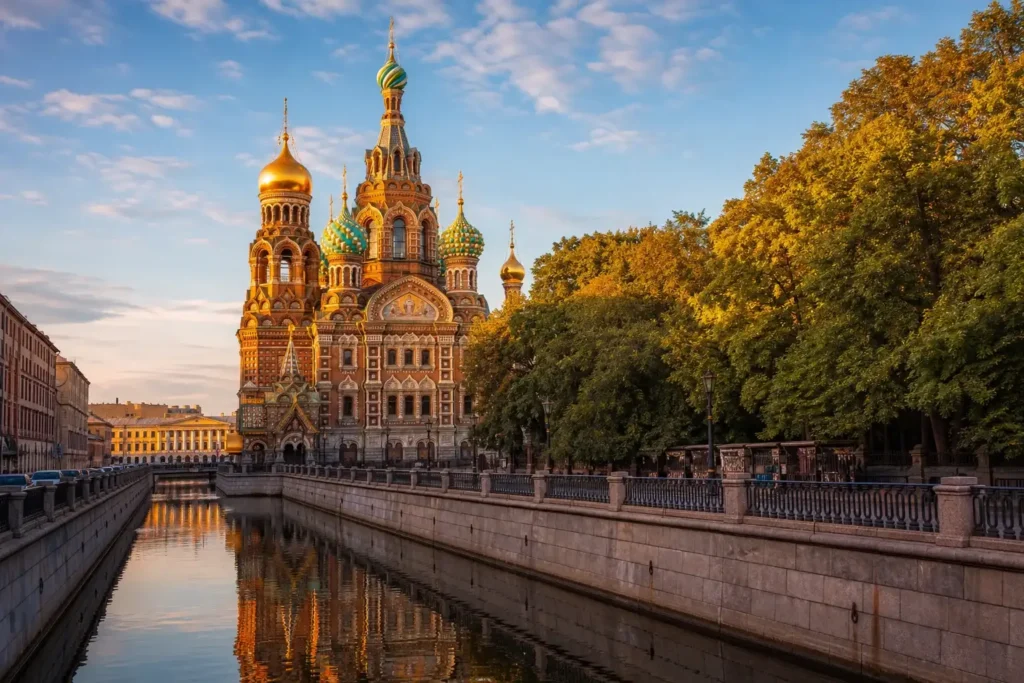
The Church of the Savior on Spilled Blood is the one building in Saint Petersburg that looks as if it belongs in Moscow. Its tent-roofed towers and onion domes rise over the Griboedov Canal in the Central District, a short walk from Nevsky Prospekt, and the colour comes as a shock among the pale baroque and neoclassical facades around it.
Today it is run as a museum, not as a parish church. The museum’s own address is Griboedov Canal Embankment 2B, and the reason to go inside is the mosaic decoration, which covers the walls and vaults almost without a gap. The sections below explain what the ticket covers, what stands across the road, and how to avoid the usual confusion with St Isaac’s Cathedral.
Quick Facts
| Russian name | Музей-памятник «Спас на Крови» |
|---|---|
| Built / opened | 1907 |
| Architect(s) | Alfred Parland, with Archimandrite Ignatius (Malyshev) |
| Address | набережная канала Грибоедова, 2Б, лит. А, Санкт-Петербург |
| District | Central District |
| Metro | Nevsky Prospekt (Line 2, Exit towards Griboedov Canal) Gostiny Dvor (Line 3, Short walk via Nevsky Prospekt) |
| Opening hours | Open daily except Wednesday and 1 January, from 10:00 to 18:00; the ticket office closes at 17:30.
From 1 May to 30 September there is an evening session from 18:00 to 21:30, with entry and the ticket office from 18:00 to 21:00, closed on Wednesday. On school holidays (other than summer) and public holidays other than 1 January the museum works without a day off. Hours can change for technical reasons (as of October 2026 – check the official site). |
| Admission | Paid entry: a full ticket (₽₽) and a reduced rate with an ISIC card (₽); children under 7 are free. Evening entry is a separate ticket (₽₽) and the Chapel-museum across the road has its own ticket (₽). |
| Best time to visit | Go early in the day or in the evening session in the warmer months, when the interior is calmer. Midday brings the largest tour groups. The exterior looks best in low sunlight and in winter snow. |
| Recommended duration | 1 hour inside, plus time to walk around the outside |
| Website | eng.cathedral.ru |
| Last updated | October 15, 2026 |
What Is (and Isn't) Part of a Visit to Church of the Savior on Spilled Blood, Saint Petersburg?
| Part | Status | Notes |
|---|---|---|
| The church interior and mosaics | Included in the standard ticket | This is what the standard ticket covers. |
| The place where Alexander II was wounded | Included in the standard ticket | It is preserved inside the church, so it is part of the normal visit. |
| Chapel-museum at number 2A | Separate ticket or institution | It has its own ticket and is listed separately on the official site. |
| Evening session in the warmer months | Separate ticket or institution | Evening entry has its own ticket rate. |
| St Isaac's Cathedral | Separate ticket or institution | It belongs to the same museum organisation but needs its own ticket. |
| Mikhailovsky Garden | Outside / not part of it | A public park behind the church, not part of the museum. |
| Griboedov Canal embankment | Outside / not part of it | You can view the exterior from the street without a ticket. |
Why Visit Church of the Savior on Spilled Blood, Saint Petersburg?
The interior is the main event. According to the city’s official tourism portal, the mosaics cover more than seven thousand square metres and form one of the largest collections of monumental mosaic in Europe.
The building also marks a precise moment in Russian history: it was raised on the spot where Emperor Alexander II was fatally wounded in 1881, and the place of the injury is preserved inside the church.
It is compact, easy to reach on foot from the main sights, and photogenic from the canal bridge at any time of day. Because it is small, a visit fits easily between the Hermitage and a walk along Nevsky Prospekt.
How Church of the Savior on Spilled Blood, Saint Petersburg Is Laid Out
The site is two buildings facing each other across a short stretch of embankment. The church itself stands directly on the Griboedov Canal, with its main mass of domes toward the city side and a tall bell tower near the entrance side.
The Chapel-museum is a separate small building at number 2A, opposite the church, and it has its own ticket. The Mikhailovsky Garden lies right behind the church, and the approach through the garden gives the classic full view of the domes.
For a sensible route, look at the exterior from the canal bridge first, walk past the facade to see the mosaic panels outside, then go in for the interior and finish with the Chapel-museum if you want the extra display.
Highlights of Church of the Savior on Spilled Blood, Saint Petersburg
The domes and façade
The church was designed in a deliberate Russian-revival style, with a central tent roof and a ring of smaller domes in enamel and gold. It borrows from medieval Moscow architecture, which is why it often reminds visitors of St Basil's Cathedral.
Look at the exterior panels and the patterned brick and tile. They are as decorated as the inside and are free to see from the street.
Tip: Walk to the nearby canal bridge for a clean angle, with the water in the foreground.
The mosaics inside
The official city tourism portal gives the total mosaic area as 7,056 square metres, enough to cover almost every wall, pillar and vault. The scenes are biblical, and from a distance they read as painted icons rather than tiles.
Take your time looking up, and then look closely at the brightly coloured surfaces on the lower walls, where individual tesserae can be seen.
Tip: Stand still for a minute in the centre to take in the whole space before you start examining details.
The place where the tsar was wounded
The church was built over the spot on the embankment where Alexander II was mortally wounded on 1 March 1881. According to the city's tourism portal, the designers kept this place inside the church so that it forms the centre of the building.
It explains the name and the unusual placement of the church, which projects over the canal bank.
Tip: Ask at the entrance or consult the museum's audio guide, which is available in English, to identify the spot.
The symbolic proportions
The city tourism portal notes that the height of the central structure is 81 metres, recalling the year of the assassination, and that the second-largest dome is 63 metres, recalling the emperor's age.
These figures are worth knowing because they turn the skyline into a monument, not only a decoration.
Tip: Look back at the church from the far side of the canal, where both main volumes are visible together.
The Chapel-museum across the road
Opposite the church, at Griboedov Canal Embankment 2A, stands the Chapel-museum, listed on the museum's website as a separate site with its own ticket.
Visitors often assume it is included, but it is a different admission. It is a modest extra if you want to see more of the museum's displays.
Tip: Decide before you queue whether you want the extra ticket, so you buy it in one visit.
The canal embankment
The embankment in front of the church is part of the experience. It is a short stretch of canal with a bridge nearby, trees, and a view that changes with the season and the light.
Tour boats on the canal pass directly beside the church, which makes it a good place to watch the building from the water side as well.
Tip: Visit at the end of the day, when the domes catch low light, even if you have already been inside.
Atmosphere
From the canal the church is loud in colour and quiet in mood: gold and blue domes, glazed tile, and brick that glows in low light. Inside, the effect changes to a dim, shimmering interior where the walls seem to be made of glass and gold.
Groups arrive in waves around midday, and the building feels calmer in the first hour after opening and again in the evening session in the warmer months. Most people speak in low voices, and the soft echo of the vaulted space makes conversation feel hushed. Outside, street musicians and souvenir sellers fill the pavement during the day.
History of Church of the Savior on Spilled Blood, Saint Petersburg
On 1 March 1881 Emperor Alexander II, known for the reforms of his reign, was attacked on the embankment of what was then the Catherine Canal. A bomb thrown at his carriage wounded him fatally. He was taken to the Winter Palace and died a few hours later.
His son, Alexander III, decided to build a memorial church on the exact spot. Construction began in 1883. The project is credited to the architect Alfred Parland and to Archimandrite Ignatius (Malyshev), the prior of a monastery near the capital, who worked together to create a church in a self-consciously Russian style that kept the place of the injury inside the building.
The work took more than two decades. The church was consecrated in 1907, in the reign of Nicholas II, and it is known officially as the Church of the Resurrection of Christ, while the popular name refers to the blood spilled there.
After the 1917 Revolution the church suffered damage and the loss of valuables. In the early 1930s it was closed, and in the following decades the building was used for other purposes and fell into poor condition. During the Siege of Leningrad it served as a makeshift morgue.
The building received protected status in 1968 and became a branch of the St Isaac’s Cathedral museum in 1970. A long restoration followed, and the interior was reopened to visitors in the late 1990s.
Today the church is part of the State Museum ‘St Isaac’s Cathedral’, which also runs the Chapel-museum across the road. The city treats it as one of its key historic landmarks, and the mosaics remain the main reason to go inside.
Legends and Myths about Church of the Savior on Spilled Blood, Saint Petersburg
The shell that did not explode
Legend – historically unreliable. A widely repeated story says that a German shell struck the main dome during the Siege of Leningrad and failed to explode, remaining lodged there for years until it was removed.
The story is well known in guidebooks and local retellings, but it is not backed by a confirmed official record that this editor verified, so it is better treated as folklore.
Tickets and Booking for Church of the Savior on Spilled Blood, Saint Petersburg
| Ticket | Price | Includes |
|---|---|---|
| Full ticket | ₽₽ | Entry to the church during daytime hours. |
| ISIC card ticket | ₽ | Reduced rate for holders of an ISIC card, with the card shown at entry. |
| Children under 7 | Free | Free entry for the child when accompanied by an adult. |
| Evening ticket | ₽₽ | Entry during the evening session in the warmer months, without guided tours. |
| Chapel-museum ticket | ₽ | Entry to the Chapel-museum across the road only. |
₽ budget · ₽₽ moderate · ₽₽₽ upscale · ₽₽₽₽ splurge. Price levels are estimates compared with typical prices for visitors.
Buy tickets on the museum’s official website or at its ticket office. Online booking is run through the museum’s ticketing system, and the ticket office closes half an hour before the church does.
- Rates differ for Russian and Belarusian citizens and for several concession groups, so check the ticket page for your category.
- Bring ID where a reduced rate or free entry applies, and your ISIC card if you use it.
- Audio guides are offered in several languages, including English.
Ticket rules, rates and free-entry days change, so use the museum’s official website (eng.cathedral.ru) as the single source for all categories.
Plan and Book
Suggested Itineraries for Church of the Savior on Spilled Blood, Saint Petersburg
1 hour
See the exterior from the canal bridge, then walk to the entrance and spend about 40 minutes inside looking at the mosaics and the preserved place of the injury. Finish with a short look from the embankment.
2 hours
Start in the Mikhailovsky Garden for the classic front view, go inside the church, then cross to the Chapel-museum. End with a coffee on Nevsky Prospekt.
Half day
Combine the church with Palace Square and the State Hermitage Museum. Visit the church first, walk through the Mikhailovsky Garden, then continue toward the Hermitage.
How to Get to Church of the Savior on Spilled Blood, Saint Petersburg
The nearest metro station is Nevsky Prospekt (Line 2), with an exit toward the Griboedov Canal, according to the museum’s official directions. Gostiny Dvor (Line 3) is a short walk along Nevsky Prospekt, and the two stations are linked underground.
From the street, follow the canal embankment to the church; its domes are visible from the bridge.
- Buses 3, 7, 22 and 27 and trolleybuses 1, 5, 7, 10, 11 and 22 are listed by the museum as nearby routes.
- From Palace Square it is an easy walk, and a taxi works well in bad weather.
Accessibility
The museum's official site says it provides tactile albums for visitors with low vision and a special route for blind and low-vision visitors called 'Seeing the Invisible' in this church. A service called 'City from a Bird's Eye View' is offered to wheelchair users, and the museum has places for guide dogs on the surrounding grounds.
A department for visitors with reduced mobility handles requests, and contact details are given on the accessibility page. Contact the museum in advance to arrange assistance.
Food Nearby
The streets around the church, Nevsky Prospekt and the Mikhailovsky Garden area have cafes and restaurants of every kind. Choose a place a couple of blocks from the church for lower prices and shorter waits, since the cafes right on the canal tend to be the busiest.
What to Bring
Comfortable shoes for the embankment, a layer for the cool interior, and an ID if you plan to claim a reduced ticket. Check the museum's visitor rules before bringing large bags.
Best Views and Photo Spots of Church of the Savior on Spilled Blood, Saint Petersburg
The canal bridge opposite the church
A direct, uncluttered view of the main domes with the canal in front of them, and the best framing of the whole building.
Best time: Late afternoon light, or early morning when it is quiet.
Mikhailovsky Garden
A softer view from behind trees, with the domes appearing above the foliage, which is especially good in autumn.
Best time: Autumn and spring, mid-morning.
The embankment by the entrance
A close view of the decorated facade, with tile patterns and mosaic panels visible at eye level.
Best time: Overcast days, when colours stay saturated.
A canal boat
A view from the water, with the church seen across the canal and its reflection in the water.
Best time: Summer evenings.
Photography Rules
Photography rules are set by the museum's visitor rules, so check them at the entrance or on the official website. Flash and tripods are commonly restricted in museums; ask staff if you are unsure.
Family Suitability
Children under 7 enter free, and the compact size makes it a manageable visit. Younger children may be restless inside, so a short visit works best. The interior is a single large space rather than a maze of rooms, and the mosaics usually hold the attention of older children. Check the official page for stroller and cloakroom arrangements.
Russia Vibes Tips
- Look at the building from both sides: the canal side shows the church in profile, while the garden side gives the full front view.
- Pause outside before you enter and find the tall central tent roof, then count the smaller domes around it so you can recognise the layout once you are inside.
- If you travel in the warmer months, consider the evening session, which tends to be calmer and the light through the windows changes the mood.
- Combine the church with the Mikhailovsky Garden for a quiet walk after the interior, since the park is directly behind the church.
- Do not confuse the church with the larger St Isaac's Cathedral; the two share the same museum organisation but are different buildings with separate tickets.
Explore Nearby Church of the Savior on Spilled Blood, Saint Petersburg
Related guides
Browse more: More in Central District · All Churches · All Sightseeing
FAQ: Church of the Savior on Spilled Blood, Saint Petersburg
Is the Church of the Savior on Spilled Blood the same as the Church of the Resurrection of Christ?
Yes. The official name is the Church of the Resurrection of Christ, while the popular name refers to the blood of Alexander II spilled on the spot. Both names refer to the same building on the Griboedov Canal.
Why is it called 'on Spilled Blood'?
The church was built over the place where Emperor Alexander II was mortally wounded in 1881. The name points to that event, and the site is preserved inside the church.
Is the Chapel-museum included in the church ticket?
No. It stands opposite the church and is listed on the museum's website with its own ticket, so you need a separate admission if you want to see it.
Is St Isaac's Cathedral included?
No. St Isaac's Cathedral belongs to the same museum organisation, but it is a separate building and the official site lists its tickets separately.
Do I need a guide?
Not necessarily. Audio guides are offered in several languages, including English, and the interior is a single large space, so it is easy to explore on your own.
How does it compare with St Basil's Cathedral?
They look similar from a distance because both use a medieval Russian style with onion domes and tent roofs. The Saint Petersburg church is a late nineteenth-century building, and its main feature is the mosaic interior.
How much time do I need inside?
About an hour is enough for most visitors. Allow extra time if you also want the Chapel-museum or plan to photograph the exterior from several angles.
Is it a working church?
It is run as a museum, although the museum's website has a worship schedule page, so occasional services may take place. Check the official site before you go if this matters to you.
Russia Vibes is a one-person project. A coffee keeps it going
Last updated: October 15, 2026. Found an error or something out of date? Report it and we will check and fix it.
How we research and update our guides
About this guide: AI assistance and accuracy
This guide is created with the help of AI and is based on official sources where available. Mistakes can still happen. Opening hours, prices, rules and other details are given to the best of our knowledge as of the date shown and can change without notice. It offers general recommendations only, not professional, legal or travel advice. Please confirm important details with the official source before you travel; you are responsible for your own plans and decisions.
International sanctions affect payments between Russia and many other countries. In practice, cards issued in the EU, the UK, the US and several other countries often do not work in Russia, Russian cards usually do not work abroad, and some booking platforms, airlines and payment providers limit or suspend their services for Russia. The situation changes frequently. We do not give legal or financial advice, and this site does not encourage anyone to break or circumvent sanctions. Whatever you plan, you are responsible for following the laws and regulations that apply to you, including those of your country of residence and citizenship. Many travelers still organise their stay lawfully. It is worth asking your bank or payment provider what is currently permitted, contacting hotels, tour operators and carriers directly about the payment methods they accept, and checking which services are open to customers from your country. Clarify payment, cancellation and refund terms before you commit to a booking, and keep your plans flexible. Partner links on this site may not be available in every country, and prices, availability and rules in our guides can differ from what you see when you book.Paying for your trip: please read
 Ask Masha