
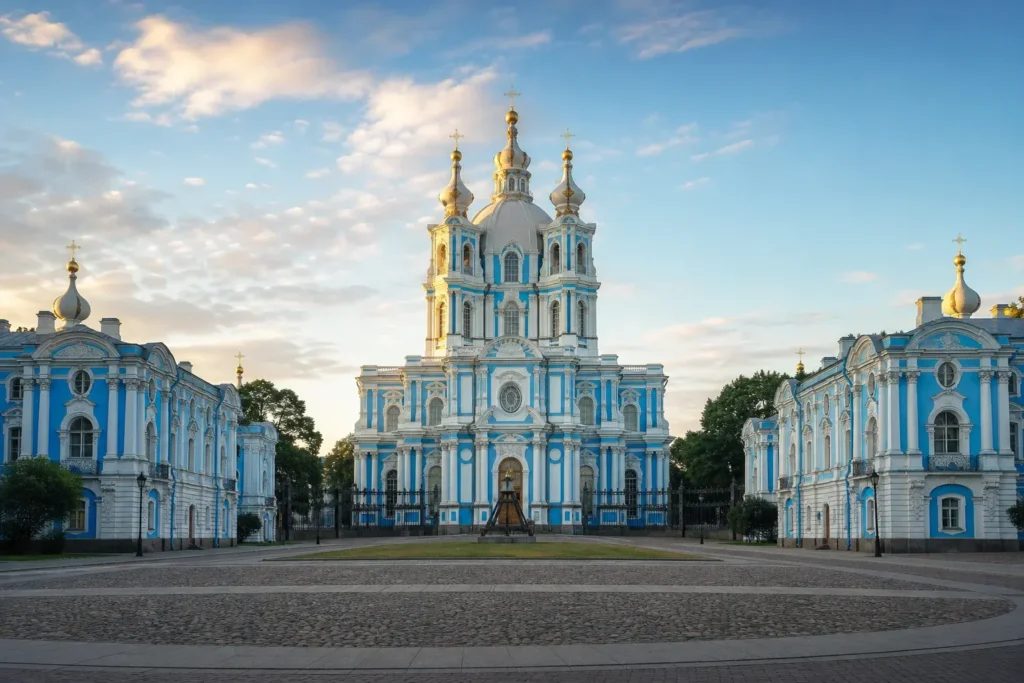
Smolny Cathedral is one of the most recognisable silhouettes in Saint Petersburg: a blue and white Baroque church with five domes, rising above the Neva on the left bank. It is a working Orthodox church, free to enter, and its belfry doubles as one of the highest public viewpoints in the city centre.
Empress Elizabeth, Peter the Great’s daughter, ordered it built in 1748, but it took 87 years to complete. This page explains what you can see inside and outside, how the belfry visit works and how to reach it, so you can fit the cathedral into a day of sightseeing.
Quick Facts
| Russian name | Воскресенский Смольный собор |
|---|---|
| Built / opened | 1835 |
| Architect(s) | Francesco Bartolomeo Rastrelli (design); Vasily Stasov (interior and completion) |
| Address | Санкт-Петербург, площадь Растрелли, 1 OpenStreetMap · Google Maps |
| District | Central District |
| Metro | Chernyshevskaya (Line 1, about 20 minutes on foot) Ploshchad Vosstaniya (Line 1, longer walk; interchange with Mayakovskaya on Line 3) |
| Opening hours | Cathedral: reported daily from about 08:00 to 20:00. Belfry observation deck: reported daily from about 08:00 to 19:30. Services are held daily and guided visits run on a schedule, so times can change (as of October 2026 – check the official site). |
| Admission | Entering the cathedral is free. The belfry observation deck (₽) and guided visits (₽) are paid. |
| Best time to visit | Clear days give the best belfry view, and morning or late afternoon light is best on the façades. Spring to early autumn is the most comfortable season for walking round the courtyard; in summer long evenings extend the daylight. Services run daily, so inside the cathedral it is quietest outside service times. |
| Recommended duration | 1–2 hours |
| Website | smolnyspb.ru |
| Last updated | October 16, 2026 |
What Is (and Isn't) Part of a Visit to Smolny Cathedral, Saint Petersburg?
| Part | Status | Notes |
|---|---|---|
| Smolny Cathedral interior | Included in the standard ticket | Free to enter; it is an active church with services held daily. |
| Belfry observation deck | Separate ticket or institution | Paid visit reached from inside the cathedral by about 280 steps. |
| Guided visits of the cathedral | Separate ticket or institution | Paid and run on a schedule; check the official site for times. |
| Convent buildings around the cathedral | Outside / not part of it | Mostly in other use and not part of a visit. |
| Smolny Institute | Outside / not part of it | A separate historic building nearby, known as the Bolshevik headquarters in 1917 and later a seat of government. |
Why Visit Smolny Cathedral, Saint Petersburg?
Smolny Cathedral is a masterpiece of Elizabethan Baroque by Francesco Bartolomeo Rastrelli, the architect of the Winter Palace. Its façades are densely detailed in blue and white, and the building seems to rise upwards as you approach it. The contrast with the plain white interior is part of the story: Rastrelli fell from favour before he could design it.
The belfry gives a wide view over the Neva, the Peski district and the city centre from a height of about 50 metres. It is also a living church with daily services, so you see a cathedral in use rather than a museum.
How Smolny Cathedral, Saint Petersburg Is Laid Out
The cathedral stands in the middle of a square courtyard on Rastrelli Square, with the low, two-storey convent buildings surrounding it on all sides. Most visitors walk around the outside first, because the façades are the main attraction.
You enter the cathedral by its main doors. The belfry is entered from inside the cathedral, and the climb is by stairs only. The surrounding convent buildings are in other use and are not part of a visit, so do not expect to wander through them.
A simple order works well: circle the cathedral outside, step in to see the white interior, then climb the belfry for the view if the weather is clear. Leave the belfry for last, so that you can compare the building from above with what you have just seen from the ground.
Highlights of Smolny Cathedral, Saint Petersburg
The blue-and-white façades
Rastrelli designed Smolny Cathedral in the 1740s as the centrepiece of a convent, in the exuberant style of Elizabethan Baroque. Look for the blue walls, white columns and sculptural detail that leave almost no flat surface, and for the five domes that combine the traditional Russian pattern with European Baroque. The building appears to soar, which is a deliberate effect of its proportions.
The courtyard is open, so you can walk all the way round it.
Tip: Walk round the outside before going in; the angles change completely from corner to corner.
The interior
The cathedral was consecrated in 1835, 87 years after its foundation. Rastrelli's interior was never built, and the interior was designed in the early nineteenth century by Vasily Stasov. The result is a calm, light space with white walls, in strong contrast to the colourful outside.
It is a working church, with services held daily, so behave as you would in any active church.
Tip: Modest dress is customary, and quiet is expected during services.
The belfry observation deck
The belfry offers a panoramic view from about 50 metres up. You see the Neva, the historic Peski district and, on clear days, the skyline of the city centre and beyond. Reaching the top means climbing roughly 280 steps, so allow time and energy.
The climb starts inside the cathedral. The deck is a separate paid visit.
Tip: Check the weather first: haze or low cloud flattens the view.
The convent ensemble
The cathedral was planned as the heart of a convent for the empress's retirement and for the education of noble girls. The low buildings around it were built in the 1750s and 1760s, and in 1764 part of the complex became the Smolny Institute, Catherine the Great's school for noble girls. Today the buildings are mostly in other use.
They give the courtyard its calm, symmetrical shape.
Tip: Look at how the plain convent walls make the cathedral's decoration stand out.
The unbuilt bell tower
Rastrelli planned a huge bell tower, which would have been the tallest building in the city and in Russia at the time. It was never built. Elizabeth died in 1762, funding ran out and the project stopped; work only resumed decades later.
The belfry you can climb today is not that giant tower, but it has become one of the best viewpoints in the area.
Tip: Imagine the missing tower when you stand at the foot of the cathedral; it explains why the silhouette feels unfinished.
Atmosphere
The courtyard is open and symmetrical, and the cathedral’s blue and white seems to glow in daylight. The mood is calm: footsteps on stone, a few visitors circling the building, bells and services drifting from inside. Low convent walls frame the cathedral so that it stands out, and the surrounding streets are quieter than central Petersburg.
Morning and late afternoon give the best light on the façades, and in summer long evenings extend the daylight well into the night. Inside, the plain white walls feel sober after the colourful outside. Visitors include worshippers, tour groups and people who have come for the belfry view, and the atmosphere stays unhurried.
History of Smolny Cathedral, Saint Petersburg
The name Smolny comes from the pitch, or smola in Russian, that was boiled here for shipbuilding in the early days of Saint Petersburg. Empress Elizabeth, Peter the Great’s daughter, had lived at a small palace on the Smolny yard, and when she took the throne she decided to build a convent here. The foundation stone of the cathedral was laid on 30 October 1748. Francesco Bartolomeo Rastrelli, who also designed the Winter Palace, drew up the plans.
Rastrelli imagined an ensemble with a five-domed cathedral at its centre, low convent buildings around it and a giant bell tower that would have been the tallest structure in the city and in Russia. The foundations were laid, bells were cast and designs for the iconostases were prepared. But Elizabeth died in 1762, funds ran dry and Rastrelli lost favour. The bell tower was never built and the cathedral stood unfinished.
In 1764 Catherine the Great opened the Smolny Institute for noble girls in the convent buildings, the first school of its kind in Russia. The empty cathedral was left to decay for roughly 70 years: cracks appeared in the vaults and the cellars filled with water.
In the 1830s Emperor Nicholas I ordered the cathedral completed. Vasily Stasov designed the interior and finished the building, and the cathedral was consecrated on 20 July 1835, 87 years after the foundation stone had been laid. It became the church of the educational institutions in memory of Empress Maria Feodorovna.
In 1922 the cathedral was closed. In the Soviet and early post-Soviet decades it was used for secular purposes, including a concert hall for classical music. The Smolny Institute next door became famous in 1917 as the headquarters of the Bolshevik revolution, which is why the name Smolny is often used for the building and for the later seat of local government. That building is a separate site from the cathedral.
In 2001 a hurricane brought down a heavy cross from the dome, and major restoration followed. The belfry reopened to visitors in the 2000s. In the mid-2010s the cathedral was returned to the Russian Orthodox Church, and it is now an active church with services held daily.
Legends and Myths about Smolny Cathedral, Saint Petersburg
Elizabeth's convent plan
Disputed by historians. A popular story says that Elizabeth, before she became empress, planned to retire as a nun in a convent on this very spot, and that she gave up the idea when she was offered the throne. Historians treat the account cautiously. What is documented is that she founded the convent as empress and ordered the cathedral to be built in 1748.
Tickets and Booking for Smolny Cathedral, Saint Petersburg
| Ticket | Price | Includes |
|---|---|---|
| Belfry observation deck | ₽ | The climb of about 280 steps and the view from the deck. |
| Guided visit of the cathedral | ₽ | A scheduled guided tour of the cathedral; guides usually also tell the story of the convent. |
₽ budget · ₽₽ moderate · ₽₽₽ upscale · ₽₽₽₽ splurge. Price levels are estimates compared with typical prices for visitors.
The cathedral is free to enter. The belfry and guided visits are paid, and tickets are sold through the cathedral’s official website and at the site.
- Belfry tickets are sold for set times and group sizes are limited, so a time slot may be unavailable on busy days.
- How far ahead online sales open is not clearly stated; check the website for current dates.
- Enter through the cathedral; the belfry climb starts inside.
Rates for Russian citizens and concession categories may differ from the rates for international visitors. For current ticket categories and the schedule, see smolnyspb.ru.
Plan and Book
Suggested itineraries Smolny Cathedral, Saint Petersburg
1 hour
Walk round the cathedral's exterior, then step into the white interior. Spend a few quiet minutes inside, then finish with a short stroll round the courtyard.
2 hours
Circle the cathedral outside, visit the interior, then climb the belfry for the view of the Neva and the Peski district. Come back down and look at the façade once more from the courtyard.
3 hours
Do the two-hour visit, then walk the riverside and nearby streets towards Tauride Garden. Add a guided visit if you want the story of the convent and the Smolny Institute.
How to Get to Smolny Cathedral, Saint Petersburg
By metro: the nearest stations are Chernyshevskaya (Line 1) and Ploshchad Vosstaniya (Line 1, interchange with Mayakovskaya on Line 3). From either you walk, roughly 20 minutes or more, so wear comfortable shoes.
By taxi or bus: ask for Rastrelli Square (площадь Растрелли). Using the Russian name on your phone helps when speaking to a driver.
From the centre: the cathedral lies on the left bank of the Neva, north-east of Nevsky Prospect, in the Central District.
Accessibility
The tourist information portal lists the cathedral as accessible for people with disabilities. The belfry is reached only by stairs, about 280 steps, so the observation deck is not accessible for wheelchair users or visitors who cannot manage a long climb. If you need step-free access, contact the cathedral before your visit.
Food Nearby
There are no verified cafes inside the courtyard. Ordinary cafes and bakeries can be found on the streets towards Chernyshevskaya metro and around Tauride Garden; plan on eating before or after your visit.
What to Bring
Comfortable shoes for the stairs and cobbles, a layer for the windy belfry, and modest clothing for the church. Follow the instructions at the entrance.
Best Views and Photo Spots of Smolny Cathedral, Saint Petersburg
Courtyard in front of the main façade
A direct view of the blue-and-white façade and the five domes, with the low convent walls framing the cathedral from both sides.
Best time: Morning or late afternoon light.
Corner of the courtyard
A diagonal view shows the cathedral's full volume, with the domes stepped against the sky.
Best time: Mid-morning, when the façade is evenly lit.
Belfry observation deck
A panorama of the Neva, the Peski district, the Bolsheokhtinsky Bridge and the city centre, with the cathedral's domes close by.
Best time: Clear afternoons; avoid hazy days.
Riverside near the cathedral
From the Neva embankment the cathedral appears behind the water, which gives a softer, wider composition.
Best time: Late afternoon or evening.
Photography Rules
No photography rules were verified for the cathedral or the belfry. Look for signs at the entrance, avoid photographing worshippers and services, and ask staff if unsure. Drones were not verified; avoid flying one over the site.
Family Suitability
Good for children who like climbing and views; the belfry stairs are a challenge for younger ones and not suitable for strollers. The courtyard and the cathedral interior are easy to visit, but it is a working church, so children should be quiet inside. Check with the cathedral if you need step-free access.
Russia Vibes Tips
- Check visibility before you climb. Haze or low cloud takes most of the point out of the belfry view.
- Do not skip the walk round the outside: the façade changes at every corner, and it is the main reason to come.
- Services are held daily, so the atmosphere inside depends on the time. The schedule is on smolnyspb.ru.
- Do not expect a Baroque interior: the inside is plain and white, which is part of the building's history.
- Combine the cathedral with a walk towards Tauride Garden and the riverside for a relaxed half day.
Explore Nearby Smolny Cathedral, Saint Petersburg
Sights near Smolny Cathedral, Saint Petersburg
 Alexander Nevsky Lavra, Saint Petersburgabout 2.9 km away · typical visit: 1.5–3 hours
Main image: AI-generated illustration. It may not show the place exactly as it looks.
Related guides
 Admiralteyskaya Metro Station, Saint Petersburg: Deepest in Russia
Main image: AI-generated illustration. It may not show the place exactly as it looks.
 State Memorial Museum of the Defense and Siege of Leningrad: Guide
Main image: AI-generated illustration. It may not show the place exactly as it looks.
 Russian Ethnographic Museum, Saint Petersburg: Visitor Tips
Main image: AI-generated illustration. It may not show the place exactly as it looks.
 Palace Bridge, Saint Petersburg: Raising Times and Views
Main image: AI-generated illustration. It may not show the place exactly as it looks.
 Saint Michael’s Castle, Saint Petersburg: Hours and Interiors
Main image: AI-generated illustration. It may not show the place exactly as it looks.
Browse more: More in Central District · All Churches · All Saint Petersburg · All Sightseeing · All Sightseeing in Saint Petersburg
FAQ: Smolny Cathedral, Saint Petersburg
Is Smolny Cathedral free to enter?
Yes, entering the cathedral is free. Only the belfry observation deck and guided visits are paid. See the tickets section for what each includes.
Can you climb the belfry?
Yes. The belfry has an observation deck about 50 metres up, reached by roughly 280 steps from inside the cathedral. It is a separate paid visit.
Is Smolny Cathedral a church or a museum?
It is an active Orthodox church with services held daily. For several decades it was used as a concert hall, and it was returned to the church in the mid-2010s.
Why is the interior so plain?
Rastrelli's interior was never built because the empress died and money ran out. The interior was designed decades later by Vasily Stasov, in a calmer, plainer style.
Is the Smolny Institute part of the cathedral?
No. The Smolny Institute is a separate historic building nearby. It was a school for noble girls and later became the Bolshevik headquarters in 1917.
Who designed Smolny Cathedral?
Francesco Bartolomeo Rastrelli designed it, and Vasily Stasov designed the interior and completed the building. It was consecrated in 1835.
Do I need a guide?
Not for a basic visit. A guided visit adds the story of the convent and the school, and is optional and paid.
How do I get there by metro?
The nearest stations are Chernyshevskaya and Ploshchad Vosstaniya on Line 1. Both are a walk of 20 minutes or more from the cathedral.
Russia Vibes is a one-person project. A coffee keeps it going
Last updated: October 16, 2026. Found an error or something out of date? Report it and we will check and fix it.
How we research and update our guides
About this guide: AI assistance and accuracy
This guide is created with the help of AI and is based on official sources where available. Mistakes can still happen. Opening hours, prices, rules and other details are given to the best of our knowledge as of the date shown and can change without notice. It offers general recommendations only, not professional, legal or travel advice. Please confirm important details with the official source before you travel; you are responsible for your own plans and decisions.
International sanctions affect payments between Russia and many other countries. In practice, cards issued in the EU, the UK, the US and several other countries often do not work in Russia, Russian cards usually do not work abroad, and some booking platforms, airlines and payment providers limit or suspend their services for Russia. The situation changes frequently. We do not give legal or financial advice, and this site does not encourage anyone to break or circumvent sanctions. Whatever you plan, you are responsible for following the laws and regulations that apply to you, including those of your country of residence and citizenship. Many travelers still organise their stay lawfully. It is worth asking your bank or payment provider what is currently permitted, contacting hotels, tour operators and carriers directly about the payment methods they accept, and checking which services are open to customers from your country. Clarify payment, cancellation and refund terms before you commit to a booking, and keep your plans flexible. Partner links on this site may not be available in every country, and prices, availability and rules in our guides can differ from what you see when you book.Paying for your trip: please read

Take this guide with you
Get a free PDF of this guide to print or read offline: key facts, tips and a map link on a few clean pages.