
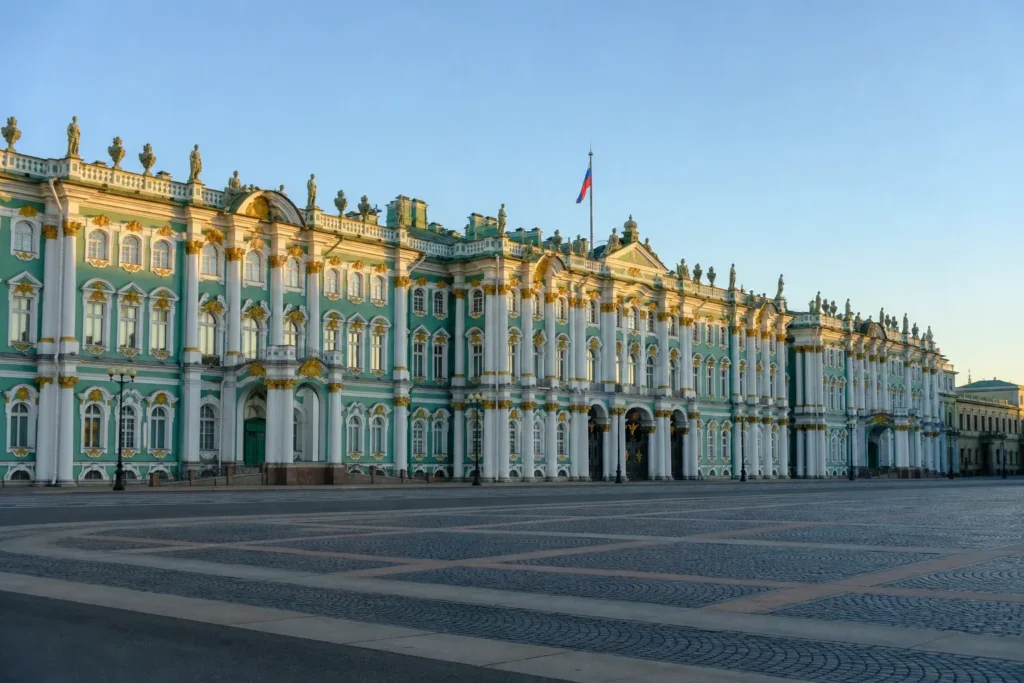
The State Hermitage Museum is the reason many travellers come to Saint Petersburg. Its main complex stands on Palace Embankment in the Central District, with the green-and-white Winter Palace facing Palace Square, and it holds some of the world’s largest collections of art and antiquities.
The scale is the main thing to plan around. Rather than trying to see everything, choose a few halls and masterpieces, and treat the palace interiors as part of the exhibition. This guide explains how the buildings fit together, what to prioritise, and which parts of the wider museum need a separate visit.
Quick Facts
| Russian name | Государственный Эрмитаж |
|---|---|
| Built / opened | 1764 |
| Architect(s) | Francesco Bartolomeo Rastrelli (Winter Palace) |
| Address | Дворцовая площадь, 2, Санкт-Петербург |
| District | Central District |
| Metro | Admiralteyskaya (Line 5, About 10 minutes on foot toward Palace Square) Nevsky Prospekt / Gostiny Dvor (Line 2 / Line 3, Longer walk along Nevsky Prospekt and Bolshaya Morskaya) |
| Opening hours | Closed on Mondays. On other days the museum opens in the late morning and closes in the evening, with late opening on some days of the week (as of October 2026 – check the official site). |
| Best time to visit | Visit early in the day for calmer halls. The palace is heated in winter and is a good choice in poor weather. Check opening days before planning, as the museum is closed on Mondays. |
| Recommended duration | 3-5 hours for the main highlights |
| Website | hermitagemuseum.org |
| Last updated | October 15, 2026 |
What Is (and Isn't) Part of a Visit to State Hermitage Museum, Saint Petersburg?
| Part | Status | Notes |
|---|---|---|
| Winter Palace state rooms and galleries | Included in the standard ticket | This is the core of the main ticket. |
| Small, Old and New Hermitage buildings | Included in the standard ticket | They are connected to the palace and form one continuous museum. |
| General Staff Building (eastern wing) | Separate ticket or institution | Part of the Hermitage across the square; check whether your ticket covers it. |
| Menshikov Palace | Separate ticket or institution | A separate site of the museum, not on the same walk. |
| Staraya Derevnya storage centre | Separate ticket or institution | A separate location in another part of the city. |
| Palace Square | Outside / not part of it | A public square in front of the palace, free to enter. |
| The whole collection | Outside / not part of it | Only a small part of the collection is on permanent display. |
Why Visit State Hermitage Museum, Saint Petersburg?
The buildings are as much a reason to visit as the art. The Winter Palace was built by Rastrelli between 1754 and 1762, and its ceremonial halls remain among the most elaborate interiors in the city.
The collections range from European painting, including works by Leonardo, Rembrandt and Titian, to antiquities and art of the East. The museum also has a role in the story of the city itself: its collection began under Catherine the Great in 1764 and grew through the imperial period into today’s public museum.
How State Hermitage Museum, Saint Petersburg Is Laid Out
The main complex is a chain of connected buildings along the Neva: the Winter Palace, the Small Hermitage, the Old Hermitage, the New Hermitage and the Hermitage Theatre, with the palace facing the square on one side and the river on the other. Locals often call the whole chain ‘the Winter Palace’.
Across Palace Square, the eastern wing of the General Staff Building is also part of the museum, and some collections that were once in the palace have been shown there.
For orientation, think of three levels: the ground floor with antiquities, the first floor with the state rooms and Western European art, and upper floors with later painting. Pick one wing per visit rather than crossing the whole complex.
Highlights of State Hermitage Museum, Saint Petersburg
The Winter Palace exterior
Rastrelli's baroque palace, built between 1754 and 1762, was the ceremonial residence of the Russian emperors. Its facade is covered in columns, statues and vases, and each side has a different rhythm.
The square-facing side is the most formal, with arches leading to the courtyard.
Tip: Look at it from the middle of Palace Square before entering, to see the three-arch gateway.
The state rooms
The palace's ceremonial halls and chambers form a large part of the exhibition. They show the imperial court's taste in marble, gilded ceilings and parquet floors.
The official city tourism portal describes the palace as containing ceremonial halls and chambers alongside antiquities and European and Oriental art.
Tip: Treat the rooms as exhibits and look up at the ceilings as well as at the objects.
European painting
The collection includes works by leading European masters, with Leonardo, Rembrandt and Titian among the names usually listed for the museum.
The New Hermitage and the Old Hermitage hold much of the painting. Choose a few galleries and spend time in front of key works rather than racing through.
Tip: Check the floor plan on arrival and pick two or three halls to avoid fatigue.
The Peacock Clock
A famous mechanical clock featuring a golden peacock is among the most recognised objects in the museum.
It is displayed in the Small Hermitage area, and the figures animate at scheduled times, which draws a crowd.
Tip: Ask at the information desk about display times, since the movement is shown on set schedule.
The General Staff Building
Facing the palace across the square, the eastern wing of the General Staff Building is part of the Hermitage. The museum has used it to show nineteenth- and twentieth-century collections that were moved out of the palace.
Visitors often miss it because it looks like a separate building.
Tip: Check the official site whether your ticket covers it before you cross the square.
The wider Hermitage sites
Beyond the main complex, the museum includes the Menshikov Palace, a porcelain museum and a storage and restoration centre at Staraya Derevnya.
These sites are separate locations that need their own planning and are not reached on the same walk.
Tip: Add them only if you have a spare day, and check which ticket covers them.
Atmosphere
The building announces itself from the square, and inside the sense of scale is physical: wide staircases, long enfilades of rooms and high painted ceilings. The noise level changes from hall to hall, with tour groups crowded in the entrance areas and near famous works, and calm in the quieter galleries.
Light from the Neva windows gives the river-facing rooms a different mood from the courtyard side. Early in the day the rooms are calmer, and by midday the main routes are busy.
History of State Hermitage Museum, Saint Petersburg
The Hermitage began as the private collection of Catherine the Great, who acquired paintings in 1764. The name refers to a place of retreat, and the collection grew around a small private gallery beside the palace.
The Winter Palace, designed by Francesco Bartolomeo Rastrelli in the baroque style and built between 1754 and 1762, served as the main ceremonial residence of the Russian emperors for around a century and a half.
The neighbouring buildings were added over time. The Old Hermitage dates from the later eighteenth century, and the New Hermitage from the mid-nineteenth century, when the collection was opened to the public in 1852.
After the 1917 Revolution the imperial collections were nationalised and the palace complex was declared a state museum, which expanded its public role.
In more recent decades the museum has extended beyond the main complex: the eastern wing of the General Staff Building, the Menshikov Palace, a porcelain museum and a restoration and storage centre at Staraya Derevnya are all part of the Hermitage today.
The museum remains one of the largest in the world, with a collection of millions of items, only a small part of which is on permanent display. For a visitor the practical consequence is simple: you will see a fraction, and choosing carefully matters.
Legends and Myths about State Hermitage Museum, Saint Petersburg
The Hermitage cats
Legend – historically unreliable. Cats live in the museum's basements and are an old local tradition. A popular story traces them back to cats brought to the court in the eighteenth century to deal with mice.
The cats are real, but the exact origin of the tradition is part of local lore rather than verified history.
Tickets and Booking for State Hermitage Museum, Saint Petersburg
Buy tickets only on the museum’s official website or at its ticket offices, and avoid resellers that add fees.
- Rates differ for Russian citizens and concession groups, so check your category.
- Plan ahead by looking at the official ticket page for current sales rules, available dates and entrances, which are not confirmed here.
- Bring ID where a reduced or free ticket applies.
Use the museum’s official website (hermitagemuseum.org) as the single source for ticket types and current rules.
Plan and Book
Suggested itineraries State Hermitage Museum, Saint Petersburg
2 hours
Pick one theme: the ceremonial state rooms, or one floor of European painting. Enter, follow the route to your chosen halls, and leave time to look at the facade from Palace Square afterwards.
3 hours
Start with the state rooms of the Winter Palace, add a handful of painting galleries in the New and Old Hermitage, and finish near the river-facing windows for the view.
Half day
Combine the palace rooms and a European painting route, then take a break in the museum cafe. If energy remains, cross to the General Staff Building to see the later collections.
How to Get to State Hermitage Museum, Saint Petersburg
The nearest metro station is Admiralteyskaya (Line 5), about 670 metres from the museum according to the map listing, followed by a walk toward Palace Square.
Nevsky Prospekt and Gostiny Dvor are also reachable on foot, though further away.
- The main entrance faces Palace Square at Palace Square 2.
- Private cars cannot park at the palace, so use public transport or a taxi.
Accessibility
The city's official tourism portal marks the Winter Palace as accessible for people with disabilities, including support for people with mental disabilities. Check the museum's official accessibility page for lifts, entrance arrangements and companion rules before you go.
Food Nearby
The streets around Palace Square and Nevsky Prospekt have a wide range of cafes and restaurants. Choose a place a few blocks from the square to avoid the busiest and most expensive options.
What to Bring
Comfortable shoes, a layer for changing temperatures, and a charged phone. Expect a security check at entry.
Best Views and Photo Spots of State Hermitage Museum, Saint Petersburg
Palace Square
A wide view of the whole palace facade with the arch and column in front.
Best time: Early morning or late afternoon.
The Palace Embankment
A river-side view of the palace along the Neva.
Best time: Sunset.
The Winter Palace courtyard
A view of the facade from inside the courtyard, with the arches and stonework close up.
Best time: Overcast days.
Palace Bridge
A distance view of the palace and the river, with the Admiralty also in view.
Best time: Evening.
Photography Rules
Photography rules vary by hall and by object, so follow posted signs. Flash and tripods are usually restricted in museums; ask staff if unsure.
Family Suitability
The museum can be tiring for young children because of the distances and crowds. Short, focused visits to a few rooms work best with older children. Check the official site for stroller and cloakroom arrangements.
Russia Vibes Tips
- Do not try to see everything. Pick two or three themes and plan a route before you enter.
- Look out of the river-facing windows as you walk: the views of the Neva are part of the palace experience.
- Visit the General Staff Building only if you have time left; it is easy to overlook.
- Allow time to walk around the palace exterior and the square before or after your visit.
- Use the museum's official floor plan and mark your priorities, then return another day for more.
Explore Nearby State Hermitage Museum, Saint Petersburg
Sights near State Hermitage Museum, Saint Petersburg
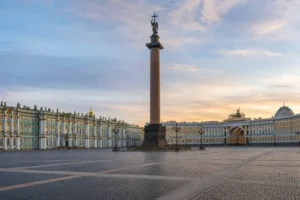 Palace Square, Saint Petersburg · typical visit: 30–60 minutes, more with the Hermitage
Main image: AI-generated illustration. It may not show the place exactly as it looks.
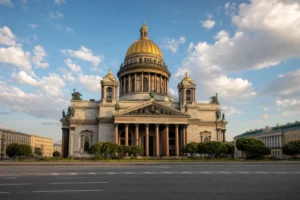 Saint Isaac's Cathedral, Saint Petersburg · typical visit: 1.5–2 hours for the cathedral interior; allow another 45–60 minutes for the colonnade.
Main image: AI-generated illustration. It may not show the place exactly as it looks.
Related guides
 Lions‘ Descent Pier, Saint Petersburg: Meteor Boats to Peterhof
Main image: AI-generated illustration. It may not show the place exactly as it looks.
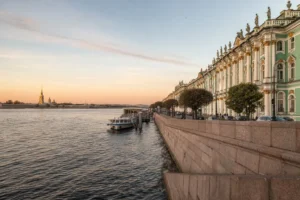 Palace Pier, Saint Petersburg: Boat Trips on the Neva
Main image: AI-generated illustration. It may not show the place exactly as it looks.
 Pulkovo International Airport, Saint Petersburg: Getting to Town
Main image: AI-generated illustration. It may not show the place exactly as it looks.
 Admiralteyskaya Metro Station, Saint Petersburg: Deepest in Russia
Main image: AI-generated illustration. It may not show the place exactly as it looks.
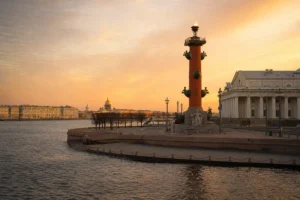 Spit of Vasilyevsky Island: Rostral Columns and Views
Main image: AI-generated illustration. It may not show the place exactly as it looks.
Browse more: More in Central District · All Museums · All Saint Petersburg · All Sightseeing · All Sightseeing in Saint Petersburg
FAQ: State Hermitage Museum, Saint Petersburg
Is the Winter Palace part of the Hermitage?
Yes. The Winter Palace is the main building of the Hermitage complex, and locals often use the name for the whole chain of connected buildings along the river.
Is the General Staff Building part of the museum?
Yes. Its eastern wing is part of the Hermitage, and some collections from the palace have been shown there. Check the official site for what your ticket covers.
Can I see the whole museum in one day?
No. Only a small part of the collection is on display, and even that takes far more than a day. Choose a theme and plan a route.
Do I need a guide?
Not necessarily. A guide helps with orientation, but you can explore independently with a floor plan and a clear list of priorities.
Is the Hermitage only an art museum?
No. It combines art, antiquities and palace interiors, so the building is part of the exhibition.
Are the Menshikov Palace and the storage centre on the same walk?
No. They are separate sites in other parts of the city and require separate planning.
Is the museum suitable for children?
It is possible with short, focused visits. The size and crowds can tire younger children.
Where do I buy tickets?
Only on the museum's official website or at its ticket offices. See the booking section for details.
Russia Vibes is a one-person project. A coffee keeps it going
Last updated: October 15, 2026. Found an error or something out of date? Report it and we will check and fix it.
How we research and update our guides
About this guide: AI assistance and accuracy
This guide is created with the help of AI and is based on official sources where available. Mistakes can still happen. Opening hours, prices, rules and other details are given to the best of our knowledge as of the date shown and can change without notice. It offers general recommendations only, not professional, legal or travel advice. Please confirm important details with the official source before you travel; you are responsible for your own plans and decisions.
International sanctions affect payments between Russia and many other countries. In practice, cards issued in the EU, the UK, the US and several other countries often do not work in Russia, Russian cards usually do not work abroad, and some booking platforms, airlines and payment providers limit or suspend their services for Russia. The situation changes frequently. We do not give legal or financial advice, and this site does not encourage anyone to break or circumvent sanctions. Whatever you plan, you are responsible for following the laws and regulations that apply to you, including those of your country of residence and citizenship. Many travelers still organise their stay lawfully. It is worth asking your bank or payment provider what is currently permitted, contacting hotels, tour operators and carriers directly about the payment methods they accept, and checking which services are open to customers from your country. Clarify payment, cancellation and refund terms before you commit to a booking, and keep your plans flexible. Partner links on this site may not be available in every country, and prices, availability and rules in our guides can differ from what you see when you book.Paying for your trip: please read

Take this guide with you
Get a free PDF of this guide to print or read offline: key facts, tips and a map link on a few clean pages.