
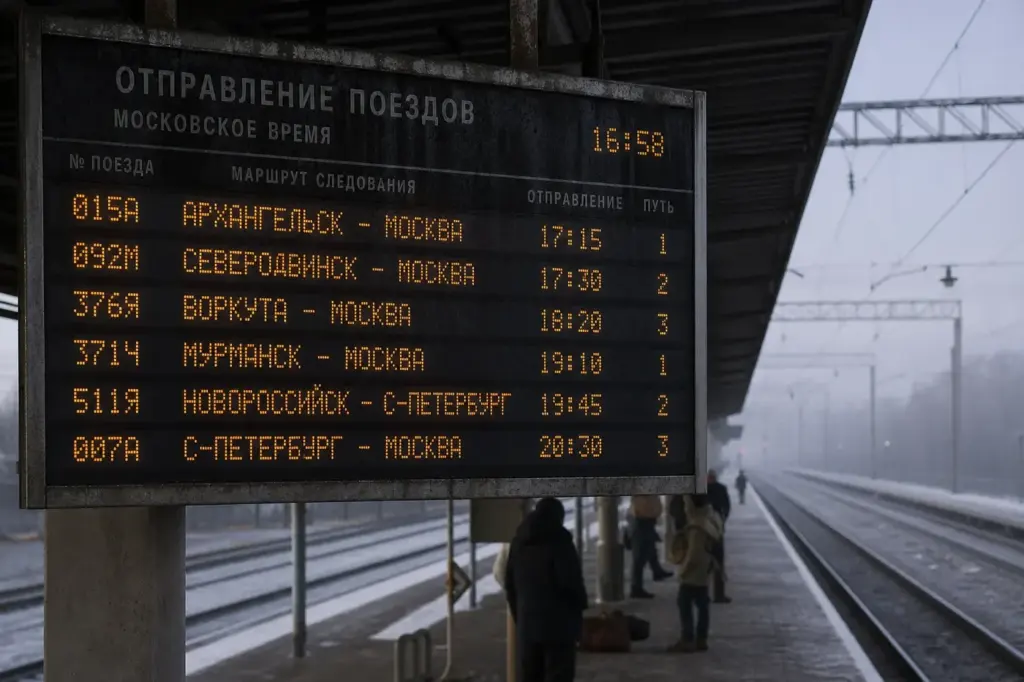
Traveling the Trans-Siberian Railway presents a unique challenge: the journey covers 9,289 kilometres across eight time zones, yet every clock on the train, every station sign, and every published timetable shows Moscow time. This creates a deliberate disconnect between what your watch says and what the sun outside is doing—a source of confusion for first-time travellers trying to understand arrival times, stopovers, and daily rhythms.
This guide explains the system, how to convert times accurately, how to read arrival times at intermediate stops, and practical strategies for managing sleep and meal schedules across time zones. You’ll leave understanding why trains stay on Moscow time and how to use this knowledge to make your journey smoother.
Quick answer: All Trans-Siberian trains operate on Moscow time from start to finish. Write down Moscow time offsets for each planned stop before boarding. When booking tickets, always check whether times are shown in Moscow time or local time, then convert departure and arrival times to your destination's local time. Set your watch to the destination's time zone after boarding and use the station clock at arrival to verify timing. Total planning time: 15–30 minutes before you book.
At a Glance
| Total time | 15–30 minutes to prepare; ongoing throughout the journey |
|---|---|
| Typical cost | free |
What You Need Before You Start
- Ticket confirmation with departure and arrival times (Moscow time)
- Printed list of all intermediate stops with Moscow-time arrivals
- Time zone offsets for Moscow and each planned stop
- Watch or phone to track both Moscow and local time
- Platform number and station name for your departure point
- Provodnitsa (carriage attendant) contact information
Compare Your Options
| Option | Duration | Price | Notes |
|---|---|---|---|
| Rossiya (Train 001/002) – Moscow time throughout | 6–7 days continuous, or 2–4 weeks with stops | ₽₽ | The flagship service, running daily in both directions year-round. The flagship service is the Rossiya №001/002, a year-round long-distance train that takes roughly six days end to end with dozens of intermediate stops. All times are published in Moscow time. Recommended for first-time travellers because the system is well-established and predictable. |
| Regular trains (061/062) – Moscow time, slightly faster | 7 nights; about 3 hours faster than Rossiya | ₽ | Depart 3 times a week. Older carriages than Rossiya but less crowded. Also run on Moscow time with the same schedule conversion rules. Good for budget travellers who don't mind older facilities. |
| Segment travel – book separate tickets between major cities | Flexible; e.g., 24 hours Moscow–Yekaterinburg, then 2–5 days in a city, then 30 hours to next stop | ₽₽ | Book individual tickets rather than one continuous journey. If you prefer to stay in the cities passed through during the trip for 1-2 days, it usually takes from 14 to 20 days. Each segment is on Moscow time, but you have time to adjust your body clock between legs. Easier for travellers who prefer to explore cities without rushing. |
| Trans-Mongolian (Moscow–Ulaanbaatar via Ulan-Ude) – Moscow time in Russia, local time in Mongolia | About 5 days to Ulaanbaatar | ₽₽ | There's no change for trains in Mongolia, China and the 'Stans', which have long used their national time zone. Trains switch to Mongolian time (MT+5) when they cross the border. Requires more time-zone juggling but reaches a different destination. Best for travellers with time and interest in Central Asia. |
| Booking site with local-time display option | Same as chosen train | Some commercial booking websites (RussianTrain.com, Seat61.com) allow you to toggle between Moscow time and local-time display. If your hotel or tour operator books for you, request they send times in both Moscow and local time to avoid confusion. |
₽ budget · ₽₽ moderate · ₽₽₽ upscale · ₽₽₽₽ splurge. Price levels are estimates compared with typical prices for visitors.
Step-by-Step Instructions
Step 1: Understand Moscow time is the system standard
All trains in Russia run on Moscow Time (MT). In Russia all timetables, station clocks and train clocks remain in Moscow time, while in Mongolia and China they revert to local time. Even when travelling east through Siberia, where local time is several hours ahead of Moscow, the train clocks and all published schedules show Moscow time. This applies whether you are on the Rossiya (the flagship train) or any other service.
Tip: Moscow time does not change seasonally—Russia currently observes Moscow time year-round.
Step 2: Note the time zones you will cross
Major stops along the Moscow–Vladivostok route pass through these time zones: Yekaterinburg (MT+2), Novosibirsk (MT+3), Krasnoyarsk (MT+4), Irkutsk (MT+5), Ulan-Ude (MT+5), and Vladivostok (MT+7). Russia has ten time zones and the Trans-Siberian route crosses eight of them, so check timetables and tickets very carefully. Write these offsets on a small card to carry with you throughout the journey.
Tip: When the train is in Moscow, the offset is zero. As you travel east, add hours to the listed Moscow time to find local time.
Step 3: Check the time-display method when booking tickets
The train tables all were on Moscow time, but this site also had the option of displaying local times for departure and arrival locations. There was another link that showed all intermediate stops, and that list only showed Moscow times. When you buy tickets online or from a ticket office, look carefully at column headers: times may be in Moscow time only, or the website may offer a toggle to show local time. If in doubt, ask the ticket seller explicitly.
Tip: Keep your confirmation email or printed ticket; you will need the exact Moscow-time arrival to know when to wake up for a stop.
Step 4: Convert departure time if boarding east of Moscow
If you are joining the train at a stop east of Moscow—for example, Yekaterinburg—the published departure time will be in Moscow time, not local Yekaterinburg time. Yekaterinburg is MT+2, so a departure shown as 14:00 Moscow time is actually 16:00 local time in Yekaterinburg. For every city you plan to visit, it is crucial to know the local time as well as the time in Moscow. Suppose you want to leave Vladivostok at 6 a.m. on Sept. 7, traveling west. Instead of entering the 7th as your departure date, you should enter Sept. 6 at 11 p.m., since Moscow is seven hours earlier than Vladivostok.
Tip: Always verify your booking confirmation shows the correct date and time for your time zone.
Step 5: Print a stops list with Moscow-time arrivals
My solution was to go on the website and print a list of all the stops. The schedule showed the arrival time at each, using Moscow time. I then wrote in the arrival time for each stop according to the time zone of my next destination. Create a simple spreadsheet or handwritten chart: stop name, Moscow-time arrival, your destination's time offset, and local arrival time. Laminate it or put it in a pocket where you can access it easily from your bunk.
Tip: Update this list when the train runs late—station staff or the provodnitsa can tell you how far behind schedule you are.
Step 6: Set your watch to the destination's time zone after boarding
After boarding the train, I set my watch to the time zone of my destination. If you are heading to Irkutsk (MT+5), set your watch to Moscow time +5 hours. This makes it easier to judge how much sleep you have before your stop without constantly doing mental arithmetic. Your watch will no longer match the train's clock, but it will match the town clock at the next station, reducing confusion.
Tip: Inform your carriage mates what time zone your watch is on to avoid miscommunication.
Step 7: Ask the provodnitsa for morning wake-up calls
Route timetables that hang somewhere near the provodnitsa's office tell you exactly how long each train stop should be. Provodnitsas do not let you get off if the stop duration is less than five minutes. If you plan to disembark at a stop for a few hours, give the carriage attendant (provodnitsa) your stop name and ask for a knock on your compartment door 30 minutes before arrival, or when the train enters the station. Offer a small tip—they appreciate being asked directly.
Tip: Do not rely on an alarm; the provodnitsa's knock is more reliable and ensures you don't sleep through a brief stop.
Step 8: Monitor the station clock at each major stop
At each intermediate stop where I could verify the location, I compared my watch time to the anticipated arrival time I had penned in. When the train pulls in, look at the station clock and compare it to your watch. The station clock shows local time; your watch (if set to local time) should match. This verification gives you confidence that you have read the schedule correctly and arrived when expected.
Tip: Do not depend on the platform announcement; use the clock and your printed list instead.
Step 9: Understand that stations use different time interpretations
In towns and cities along the route, station clocks show local time. However, all trains in Russia run on Moscow Time (MT). Siberian time zones are listed throughout the route guide; major cities include Novosibirsk (MT+3), Irkutsk (MT+5), Khabarovsk (MT+7) and Vladivostok (MT+7). The gap between the train's clock (Moscow time) and the town's clock (local time) widens as you travel east, but this is normal and expected.
Tip: If a station announcement gives times, assume it is in local time, not Moscow time.
Common Mistakes to Avoid
- Forgetting that all timetables show Moscow time and arriving too late at the platform. If your ticket shows 23:45, that is 23:45 Moscow time. If you are in Yekaterinburg and the local time is 01:45 (MT+2), you are actually only 2 hours away from departure, not 24 hours.
- Setting your watch to local time before boarding, then getting confused by the train's clocks. The train clock always shows Moscow time; if you set your watch to local time immediately, you will second-guess every arrival time shown on platform signs. Wait until you reach your first major stop, verify the local time, then adjust.
- Not accounting for time differences when booking connection trains. If you arrive in Irkutsk on the Rossiya at 09:00 Moscow time, the local time is 14:00 (MT+5). A connecting train departing at 14:00 Moscow time will actually leave at 19:00 local time—5 hours later. Always convert both times before booking onward travel.
- Assuming the provodnitsa will wake you. Carriage attendants are not required to provide wake-up calls. Ask politely when you board and offer a tip. Without explicit instruction, they assume you will monitor the schedule yourself.
- Relying on a phone that doesn't auto-update time zones. Older phones or phones set to manual time might not shift time zones as the train crosses regions. Set your phone to auto-update and carry a simple watch as backup, set to local time at each major stop.
- Missing a planned stop because you didn't check the duration. At longer stops, don't stray far from the train as it will move off without a whistle or other signal (except in China) and passengers can be left behind. If the train is running late, longer stops can be cut short. Always look at the timetable to see how long the train stops; if it is less than 10 minutes, stay near the train.
Tickets, Payment and Booking
Where to book: Official RZD (Russian Railways) website (rzd.ru), international booking agents like RussianTrain.com, or ticket offices at Moscow Yaroslavsky Station and other major stations. Foreign visitors can book online using a foreign credit card on most sites.
Payment methods: Credit cards (Visa, Mastercard) accepted on international booking platforms. Payment systems and currency may be restricted by your country’s sanctions rules; check with your bank or payment provider before booking.
Important: Ignore unofficial resellers and touts offering cheaper tickets outside stations. Always book through official channels. Prices and availability vary by season; book at least 60–90 days in advance for summer travel or holidays.
Russia Vibes Tips
- Print the full stops list before boarding. Internet connectivity on the train is limited, so downloading or printing the official timetable with all intermediate stops, Moscow times, and local-time offsets gives you a reference sheet that never needs charging. Laminate it if possible.
- Tell your carriage mates what time zone your watch is on. If you mention "I'm on Irkutsk time" or show them your watch, Russian travellers will understand and help you stay on schedule. This also prevents social confusion if someone asks what time it is.
- Eat and sleep by local time, not Moscow time. Once you are on the train headed to Irkutsk, mentally adopt Irkutsk time for meals and rest, even though the train's clocks show Moscow time. This helps your body adjust faster and reduces jet-lag-like fatigue.
- Set multiple alarms if you have a short stop. If the train stops for only 20 minutes and you want to get off, set an alarm on your phone for 10 minutes before arrival (in Moscow time, converted to your watch's local time) and ask the provodnitsa for a knock. Double coverage prevents accidents.
- Verify arrival time with the station master at major stops. If the train is running late, station staff can tell you how far behind you are. Ask the provodnitsa or look for a station office. A 20-minute delay affects whether you have time to explore during a 30-minute stop.
- Use sunrise and sunset as reality checks. Even if you are confused about the time on the clocks, the sun's position is always accurate. In summer on the Trans-Siberian, it barely sets; in winter, daylight is brief. If the sun contradicts your clocks, trust the sun and re-examine your time-zone math.
Explore Nearby How to Manage Time Zones and Train Schedules, Trans-Siberian Railway
Sights near How to Manage Time Zones and Train Schedules, Trans-Siberian Railway
 Olkhon Island, Lake Baikal · typical visit: 2–3 days
Main image: AI-generated illustration. It may not show the place exactly as it looks.
 Listvyanka, Lake Baikal · typical visit: 2–3 days
Main image: AI-generated illustration. It may not show the place exactly as it looks.
Related guides
 How to Book Trans-Siberian Railway Tickets, Trans-Siberian Railway: Booking Guide
Main image: AI-generated illustration. It may not show the place exactly as it looks.
 Lake Baikal: Where to Go, What to See and How to Visit
Main image: AI-generated illustration. It may not show the place exactly as it looks.
Browse more: All How-To · All How-To in Trans-Siberian Railway · All Metro and Trains · All Trans-Siberian Railway
FAQ
Why do trains run on Moscow time if it is not the local time where the train is?
All trains in Russia run on Moscow Time (MT). A single, unified time system across the entire 9,289-kilometre route makes scheduling, dispatching, and coordination simpler for the railway operator. Without it, the same train would have to show different times at every major stop, complicating connections and timetables. Moscow time is the administrative standard nationwide, even in remote Siberia.
What time zone do the platforms and station clocks show?
Platform clocks and station clocks show the local time of that city or town. Yekaterinburg's platform clock shows MT+2; Irkutsk's shows MT+5. This is why you must convert: the printed schedule is in Moscow time, but the platform clock is in local time. They will usually differ by hours.
If I miss a stop by 5 minutes, can the train stop and let me off?
No. At longer stops, don't stray far from the train as it will move off without a whistle or other signal (except in China) and passengers can be left behind. The train does not wait or signal; it departs as scheduled. Passengers who miss stops may face a lengthy and expensive journey to reach the next station where they can board a return or connecting train.
How do I know how long a train stops at each station?
Where the train stops at a station the duration of the stop is indicated by: l (1-6 mins) ll (7-14 mins) lll (15-24 mins) lll + (25 mins and over). Route timetables that hang somewhere near the provodnitsa's office tell you exactly how long each train stop should be. When you board, ask to see the timetable; many provodnitsa display it in their office. Write down stop durations next to the arrival times on your chart.
Do children need to understand time zones, or can they just come along?
Young children do not need to manage time zones actively. However, explain the concept simply—"the train's clock shows Moscow time, but the town's clock shows local time"—so they are less confused or frightened by discrepancies. Let older children (10+) help track the schedule; it is a practical lesson in geography and time.
What happens if the train runs late—does the Moscow time change?
No. Moscow time does not change; it is the standard. If a train runs 2 hours late, the station clocks in towns are unaffected, but all subsequent arrivals are delayed. The provodnitsa or a station announcement will tell you how late the train is running. Add that delay to your original Moscow-time arrival estimate to get the new arrival time.
Can I set my phone to local time and use the train's clocks as a reference?
It is not recommended. Your phone's local-time display will not match the train's Moscow-time clock, creating constant confusion. Instead, set your phone to auto-update for local time at each major stop, carry a separate watch showing your destination's time, and use the train's clock only to check your position in the Moscow-time schedule.
What if I book a ticket showing Moscow time but the website accidentally showed local time?
Always confirm your booking by checking the ticket document carefully against the website or ticket office before boarding. If there is any doubt, contact the booking agent or ticket office immediately—ideally before your travel date—to clarify. Ambiguous bookings can cause you to miss your train or arrive at the wrong time.
Russia Vibes is a one-person project. A coffee keeps it going
Get a free PDF of this guide to print or read offline: key facts, tips and a map link on a few clean pages.
Take this guide with you
Report an issue on this page
Paying for your trip: please read
International sanctions affect payments between Russia and many other countries. In practice, cards issued in the EU, the UK, the US and several other countries often do not work in Russia, Russian cards usually do not work abroad, and some booking platforms, airlines and payment providers limit or suspend their services for Russia. The situation changes frequently.
We do not give legal or financial advice, and this site does not encourage anyone to break or circumvent sanctions. Whatever you plan, you are responsible for following the laws and regulations that apply to you, including those of your country of residence and citizenship.
Many travelers still organise their stay lawfully. It is worth asking your bank or payment provider what is currently permitted, contacting hotels, tour operators and carriers directly about the payment methods they accept, and checking which services are open to customers from your country. Clarify payment, cancellation and refund terms before you commit to a booking, and keep your plans flexible.
Partner links on this site may not be available in every country, and prices, availability and rules in our guides can differ from what you see when you book.
How we research and update our guides
About this guide: AI assistance and accuracy
This guide is created with the help of AI and is based on official sources where available. Mistakes can still happen. Opening hours, prices, rules and other details are given to the best of our knowledge as of the date shown and can change without notice. It offers general recommendations only, not professional, legal or travel advice. Please confirm important details with the official source before you travel; you are responsible for your own plans and decisions.
* Affiliate link: as an Amazon Associate we earn from qualifying purchases at no extra cost to you.