
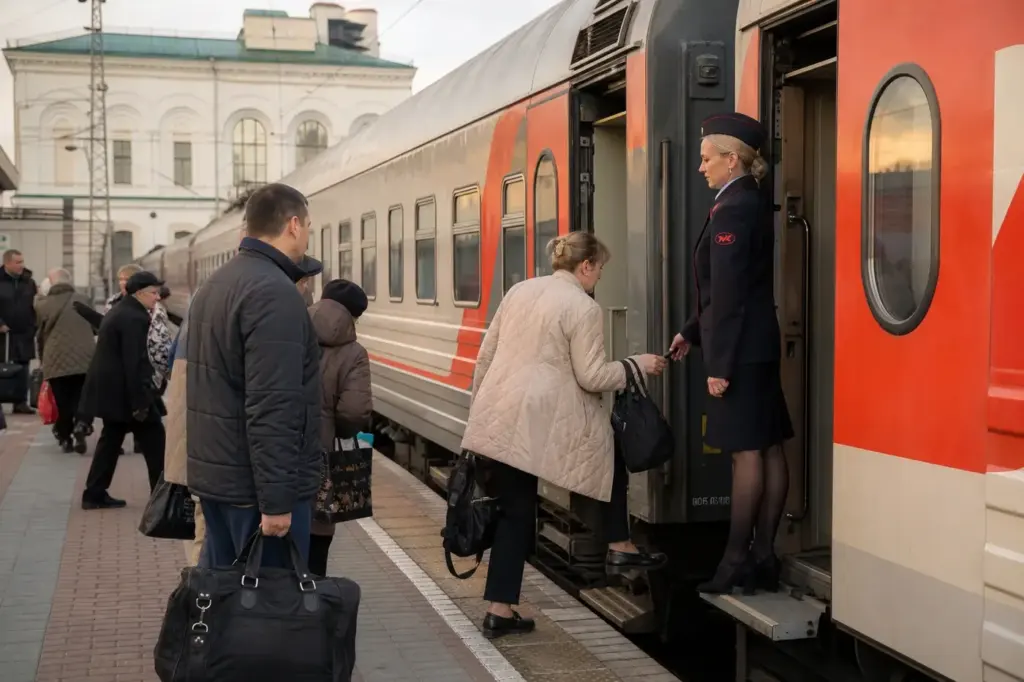
If you have booked a ticket on a Trans-Siberian or other long-distance Russian train and are ready to depart, you need to know the boarding procedure and what happens at the platform. This guide walks you through finding your carriage, showing your documents, and getting to your assigned bunk.
The key to smooth boarding is understanding that how to board a Russian long-distance train differs slightly depending on whether you have an electronic ticket with registration or a paper ticket, and knowing your train, carriage, and berth numbers in advance. The recommended approach is to arrive at the platform 30–40 minutes early, find your carriage by its number, and present your passport to the conductor.
Quick answer: Arrive 30–40 minutes before departure, locate your carriage by number on the platform, show your passport and ticket to the conductor at the carriage entrance, and board with your luggage. The entire boarding process takes 5–10 minutes.
At a Glance
| Total time | 5–10 minutes (arrival to cabin) |
|---|---|
| Typical cost | ₽₽₽ (included in ticket price; no separate boarding fee) |
What You Need Before You Start
- Valid passport (or identity document matching your ticket)
- Train ticket (electronic with registration, electronic without registration, or paper)
- Train number, carriage number, and berth number from your ticket
- Luggage within reasonable limits (no specific weight restrictions are published)
- Ticket printed out (advisable even if you have electronic registration)
- Knowledge of Moscow Time if travelling in Siberia (all Russian train schedules use Moscow Time)
- Familiarity with your seat/berth number and class (first class, kupe/second class, or platskartny/third class)
Compare Your Options
| Option | Duration | Price | Notes |
|---|---|---|---|
| Electronic ticket with automatic registration (recommended) | Book online 45+ days ahead | ₽₽₽ | Most convenient option. You do not need to print anything—just show your passport when boarding. The system checks you in automatically. Works for most domestic routes and many international routes. Book through RussianTrain or RZD.ru (requires MIR card or VPN). Supported by major long-distance trains including Rossiya. |
| Electronic ticket without registration | Must validate before boarding | ₽₽₽ | You must validate the ticket at a machine or ticket office before boarding, or print it. Less convenient than automatic registration. Available on some routes; check during booking whether online registration is offered for your specific train and carriage. |
| Paper ticket (especially international routes) | Pick up at ticket office | ₽₽₽ | Required for some international trains (Russia–Mongolia). Must be collected in advance at a ticket office in Moscow, Irkutsk, or other major city. Requires showing passport at collection. Not valid without showing the physical document. |
| Buy tickets at station upon arrival | Flexible but risky | ₽₽₽ | Possible if you do not book in advance, but popular trains and better classes sell out quickly. Staff speak limited or no English. Schedules posted at stations are in Moscow Time. Advisable only for short distances or off-peak times. Less predictable. |
| Book through a travel agency (Real Russia, etc.) | Arranged in advance | ₽₽₽₽ | Convenient for international visitors who want support. Includes help obtaining visas and accommodation. Costs more due to commission but eliminates language and payment barriers. Useful if you want a complete package or multi-leg itinerary arranged. |
₽ budget · ₽₽ moderate · ₽₽₽ upscale · ₽₽₽₽ splurge. Price levels are estimates compared with typical prices for visitors.
Step-by-Step Instructions
Step 1: Arrive at the station 40 minutes before departure
Go to the main hall of the station (for Trans-Siberian trains departing Moscow, this is Yaroslavsky Station). Check the electronic departure boards for your train number and assigned platform. When travelling from a terminus, the train is usually positioned at the platform and ready for boarding 40 minutes before departure. Listen for announcements of your train number and platform number.
Tip: Write down your train number, carriage number, and berth number on a piece of paper in case you need to ask for directions.
Step 2: Go to the correct platform
Follow signs to the platform number shown on the departure board. On busy stations with multiple trains departing around the same time, paying attention to the train number is essential. Walk to the area where your carriage will be positioned. Platform staff may direct you or you can ask other passengers.
Tip: Platforms are usually long; arrive early to find your carriage without rushing.
Step 3: Locate your carriage by number
Each carriage is numbered on the first or last window of the car. Look for the number matching your ticket (for example, carriage 5, 7, or 10). The numbers are large and clearly visible. Stand near your carriage and wait for the final call.
Tip: If the train is not yet at the platform, station staff will direct you to where it will stop; do not board until the final boarding announcement.
Step 4: Present your documents to the conductor
A conductor (provodnik or provodnitsa) will be waiting at the entrance to each carriage. Show your passport or identity document first. Usually they only check your identity document when you board; the conductor checks your ticket status in their system beforehand. Have your ticket or boarding pass visible, though you may not need to hand it over.
Tip: Make sure the name on your passport matches exactly what is printed on your ticket, character by character. One wrong digit in your passport number will prevent boarding.
Step 5: Climb aboard with your luggage
The carriage entrance may have a step up of approximately 30–60 cm. The conductor will greet you after checking your identity. Hand over your luggage to the conductor if needed, or place it yourself in the compartment. Sometimes the conductor takes one page of your paper ticket or tears the edge of it. Keep any remaining ticket pages with you until you leave the country.
Tip: Large backpacks can be bulky on the narrow steps; if you have help nearby, hand luggage up before climbing.
Step 6: Find your compartment inside the carriage
Once inside, compartments are numbered sequentially along the carriage hallway. Each compartment has a small number plaque on the door or wall. Find the number matching your berth assignment. The carriage layout is linear: you walk down a hallway with compartments on both sides. Toilets are usually at one end, and a hot water urn is at the other.
Tip: If you cannot find your compartment number, ask the conductor for help; they know the carriage layout.
Step 7: Enter your compartment and stow luggage
Open the compartment door (it may be locked or unlocked depending on who is already inside). Stow large luggage underneath the lower berths. Smaller bags can go on the upper bunks during the day or in storage racks if available. In some classes, compartments are private; in third class, they are open sections shared with other passengers.
Tip: Keep valuables and documents with you in a small day pack; do not leave them unattended, especially in third-class open berths.
Step 8: Make up your bed if required
Depending on your class, bedding may already be made or you may need to make it yourself. All classes include fresh bed linen, a blanket, pillow, and mattress, usually included in the ticket price. First-class compartments often have ready-made beds. Second-class (kupe) may require you to set up the linens. Third-class passengers typically receive basic linen to arrange themselves.
Tip: Ask the conductor if you are unsure about the bedding; they can show you how it works.
Step 9: Introduce yourself to your compartment-mates
In second and third-class compartments, you will share space with other passengers. A brief greeting and politeness go a long way. Many long-distance travellers are friendly and will help with luggage or directions. In first-class, you may be alone or with one travelling partner.
Tip: Learning a few Russian phrases like 'Здравствуйте' (hello) and 'Спасибо' (thank you) helps build rapport.
Step 10: Wait for final announcements before departure
Stay in or near your compartment as the departure time approaches. A final bell or announcement will indicate the train is about to leave. Do not leave the train unless you plan to get off at that station. If you leave to get air or buy snacks at a stop, remember there is no bell to announce departure and stops vary in length from 2 minutes to an hour; watch the platform carefully.
Tip: Set a phone alarm if you plan to disembark at intermediate stops to ensure you are back on time.
Common Mistakes to Avoid
- Writing your name differently on the ticket than it appears in your passport. Russian Railways matches the exact spelling, including initials and patronymics. One mistyped character will prevent boarding. Always copy your name exactly from your passport page.
- Forgetting that all Russian train schedules display Moscow Time, even in Siberia (8–10 time zones ahead locally). If your train shows departure at 15:00 Moscow Time but you are in Vladivostok, 15:00 Moscow Time is actually 01:00 the next day locally. Always check what time zone the schedule uses.
- Not arriving early enough. Trains depart on schedule, and conductors do not wait for late passengers. Arriving 5 minutes before departure risks missing the train. Arrive at least 30–40 minutes early.
- Leaving valuables or documents unattended in third-class (platskartny) open berths. These compartments are more social but offer no privacy or security. Keep money, passport, and phone with you or in a locked bag.
- Trying to board a train without a ticket or with an unregistered electronic ticket when registration is required. Always register online if available, or collect a printed boarding pass at a ticket office in Russia before your journey.
- Not keeping a ticket stub after the conductor tears or takes part of your paper ticket. If you have an international ticket, keep any remaining pages until you exit the country; they may be needed at customs or if the train is checked again.
Tickets, Payment and Booking
Official ticket purchase: Buy tickets through the official Russian Railways website (rzd.ru, requires VPN for international access and a MIR card). For foreign visitors, use authorized third-party agents: RussianTrain (accepts international payment cards; real official e-tickets), Tutu.ru, or RW.by. These sell the same official RZD tickets, not vouchers.
Ticket types: Electronic tickets with automatic registration (show passport only at boarding), electronic tickets without registration (must print or validate before boarding), or paper tickets (especially for international routes; collect at ticket office in Russia).
Payment methods: cards issued outside Russia do not work, so pay in cash at a station ticket office. RZD.ru requires a Russian MIR card. Most agencies accept PayPal or bank transfers.
Important: Foreign visitors cannot book directly on rzd.ru without a Russian payment card or VPN plus MIR card. Use authorized agents instead. Avoid resellers and unofficial websites; they may sell invalid vouchers. Always book direct with RZD or a named authorized partner.
Russia Vibes Tips
- Book 60–90 days in advance if possible. Tickets for popular routes (Moscow–Vladivostok, Moscow–Beijing via Mongolia) sell out 45–60 days ahead, especially for better classes and summer travel. First-class and second-class berths go fastest.
- Print your e-ticket even if you have automatic registration. While a printout is technically not required, having a physical copy reduces hassles and helps if there are system issues or if you need to show proof to station staff. It takes 30 seconds at the station printer.
- Learn the Cyrillic alphabet and write your compartment details on paper in Cyrillic. This helps you ask staff for directions and avoids confusion with transliteration. Numbers are the same; focus on learning how to write and recognize station names and compartment numbers.
- Avoid boarding during peak summer (July–August) if you travel solo or prefer quieter compartments. Off-peak months (April–May, September–October) have fewer passengers and a more relaxed atmosphere, though schedules may vary slightly.
- Do not leave the train at intermediate stops without noting the local stopping time. Some stops last only 2 minutes; others 30–60 minutes. Ask the conductor how long the stop will be, or watch other passengers and conductors to judge if it is safe to exit. There is no audible warning bell when the train is about to depart.
- If you have electronic registration, you can cancel or change your reservation online up to a certain time before departure. Check the RZD website or your booking confirmation for the exact cancellation deadline, which varies by route and train.
Explore Nearby How to Board a Russian Long-Distance Train, Trans-Siberian Railway
Related guides
 How to Book Trans-Siberian Railway Tickets, Trans-Siberian Railway: Booking Guide
Main image: AI-generated illustration. It may not show the place exactly as it looks.
 Trans-Siberian Railway: Route, Stops and Travel Guide
Main image: AI-generated illustration. It may not show the place exactly as it looks.
Browse more: All How-To · All How-To in Trans-Siberian Railway · All Metro and Trains · All Trans-Siberian Railway
FAQ
What is the difference between electronic tickets with and without registration?
Electronic tickets with automatic registration require only your passport at boarding—you do not need to print anything. Without registration, you must print the ticket or validate it at a machine before boarding. Most modern trains support automatic registration. Check during booking whether your specific train and carriage offer it.
Can I board with my e-ticket on my phone, or do I need to print it?
For automatic registration, you do not need a printout; show your passport. For tickets without registration or paper tickets, you must have a physical document. Printing is advisable as a backup even with automatic registration to avoid disputes or system errors.
What if my passport name has a different spelling or middle name than my ticket?
This will prevent boarding. Russian Railways matches names character-by-character. If you made an error when booking, contact the ticket agent or RZD immediately to correct it. One wrong letter or missing patronymic can result in denial of boarding.
Does the train really depart on time, or is there a grace period for late passengers?
Russian trains depart on schedule, especially long-distance trains. There is no grace period. If you are late, you miss the train and lose your ticket. Arrive at the platform at least 30–40 minutes early.
Can I change my seat or compartment after boarding if I do not like it?
In theory, yes, but it is complicated and not guaranteed. Speak to the conductor immediately after boarding; they may be able to move you if seats are available. Second-class and third-class compartments are fixed assignments and cannot usually be changed. First-class may offer more flexibility.
What luggage restrictions are there for boarding?
No official weight limit is published by RZD. Luggage must fit under the lower berth or in compartment storage. Very large items (e.g. large bikes, skis without cases) may be refused. Ask the conductor if you are unsure.
Is boarding different for children, elderly passengers, or passengers with disabilities?
Boarding procedure is the same for all passengers. Some trains have designated compartments for disabled passengers; inform the conductor at booking. Children must have a ticket and be registered. Elderly and disabled passengers can usually get assistance from the conductor, but have your documents ready.
What happens if I have a connecting train and my first train is delayed?
You are responsible for your own connections. If you book separate tickets, delayed arrival may cause you to miss the next train. If you buy a multi-leg through-ticket, inform RZD of your connection; they may rebook you. Arrive with a buffer of at least 2–3 hours between trains in the same city.
Russia Vibes is a one-person project. A coffee keeps it going

Take this guide with you
Get a free PDF of this guide to print or read offline: key facts, tips and a map link on a few clean pages.
Report an issue on this page
Paying for your trip: please read
Payments and bookings between Russia and many other countries are currently restricted. In practice, cards issued in the EU, the UK, the US and several other countries often cannot be used in Russia, Russian cards usually cannot be used abroad, and some booking platforms, airlines and payment providers limit or pause their services for Russia. The situation changes frequently.
We do not give legal or financial advice, and this site does not encourage anyone to break any rule that applies to them. Whatever you plan, you are responsible for following the laws and regulations that apply to you, including those of your country of residence and citizenship.
Many travelers still organise their stay without problems. It is worth asking your bank or payment provider what is currently possible, contacting hotels, tour operators and carriers directly about the payment methods they accept, and checking which services are open to customers from your country. Clarify payment, cancellation and refund terms before you commit to a booking, and keep your plans flexible.
Partner links on this site may not be available in every country, and prices, availability and rules in our guides can differ from what you see when you book.
How we research and update our guides
About this guide: AI assistance and accuracy
This guide is created with the help of AI and is based on official sources where available. Mistakes can still happen. Opening hours, prices, rules and other details are given to the best of our knowledge as of the date shown and can change without notice. It offers general recommendations only, not professional, legal or travel advice. Please confirm important details with the official source before you travel; you are responsible for your own plans and decisions.
* Affiliate link: as an Amazon Associate we earn from qualifying purchases at no extra cost to you.