
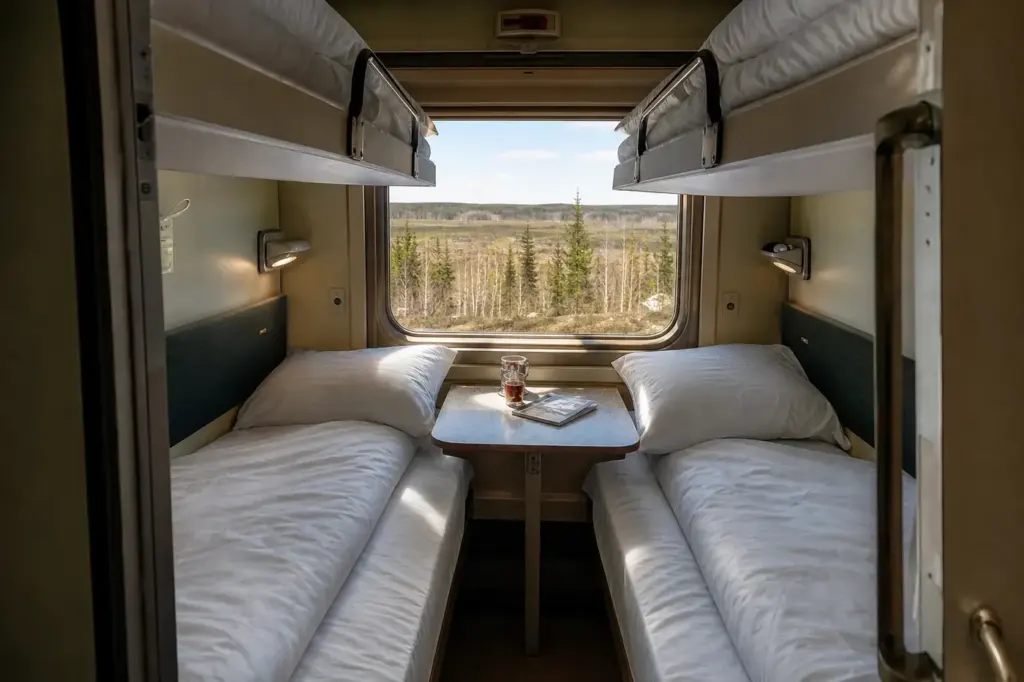
The Trans-Siberian Railway offers three main sleeper classes, each designed for different travel styles and budgets. This guide helps you choose the right one for a journey across Russia.
Most visitors travel as couples or small groups and find kupé (2nd class)—a lockable 4-berth compartment—offers the best balance of comfort, privacy and cost. However, if you prioritize solitude or travel solo, SV provides a quieter 2-berth cabin; if you want to meet locals and save money, platskartny offers an open 54-berth dormitory. After reading this guide, you’ll understand what to expect in each class and how to decide which fits your journey.
Quick answer: Book kupé (4-berth compartment) for the most practical choice—it gives privacy from a locked door, space for four people (or two couples), and reasonable cost. Journey time is 6–7 days Moscow to Vladivostok. Cost for kupé runs ₽₽, platskartny ₽, and SV ₽₽₽, depending on season and how far in advance you book.
At a Glance
| Total time | 6–7 days (Moscow to Vladivostok full route) |
|---|---|
| Typical cost | ₽₽ (kupé, mid-range); ₽ (platskartny, budget); ₽₽₽ (SV, upscale) |
What You Need Before You Start
- Valid passport and any required visa for Russia
- Confirmed train ticket showing class, carriage and berth number
- Bedding (usually included but confirm when booking)
- Comfortable slip-on shoes (for moving between compartments)
- Tea mug or cup (samovars provide free hot water)
- Toiletries (compartments have washbasins but most trains lack showers)
Compare Your Options
| Option | Duration | Price | Notes |
|---|---|---|---|
| Kupé (2nd class, 4-berth compartment) | 6–7 days Moscow–Vladivostok | ₽₽ | Lockable door, 2 upper and 2 lower berths, small table, mirror, reading lights and storage under lower berths. Most practical for couples and small groups. Recommended for first-time Trans-Siberian travelers seeking a balance of comfort, privacy and reasonable cost. Communal toilet and washing facilities at carriage end. |
| Platskartny (3rd class, 54-berth open dormitory) | 6–7 days Moscow–Vladivostok | ₽ | No compartment doors, open-plan layout, berths in bays of 4 plus 2 side berths per bay. Cheapest option, most sociable, genuine cultural immersion. Ideal for solo travelers seeking to meet locals, young travelers on a budget, and those comfortable with communal living. Rowdier in evenings; families with young children less common. Lower berths convert to shared tables and seating. |
| SV (1st class, 2-berth compartment) | 6–7 days Moscow–Vladivostok | ₽₽₽ | Private lockable compartment for 2 people (or book both berths for solo privacy), two lower berths at opposite sides of the compartment, small fold-out table, mirror and wash basin inside the compartment. Most expensive and quietest option. Suitable for couples wanting privacy, solo travelers who prioritize sleep over socializing, and business travelers. Bedding may be pre-made. |
| SV with private berth booking (solo privacy) | 6–7 days Moscow–Vladivostok | ₽₽₽ | Book both berths of an SV compartment to travel alone. Gives complete privacy, guaranteed quiet, secure luggage storage and personal wash basin. Significantly more expensive than sharing but removes uncertainty about compartment-mates. Best for travelers who sleep poorly, need solitude, or travel at off-peak times when discounts are higher. |
| Double occupancy kupé (group booking) | 6–7 days Moscow–Vladivostok | ₽₽ | Book all 4 berths of a kupé compartment for 2–3 people traveling together. Provides private compartment at same price level as standard kupé, giving you control over compartment-mates (only your group). Ideal for friends, families or couples wanting guaranteed privacy without paying SV prices. More costly than sharing but cheaper than SV. |
₽ budget · ₽₽ moderate · ₽₽₽ upscale · ₽₽₽₽ splurge. Price levels are estimates compared with typical prices for visitors.
Step-by-Step Instructions
Step 1: Understand the three classes
SV (первый класс, first class) has 2 berths per compartment, both usually lower. Kupé (второй класс, second class) has 4 berths (2 upper, 2 lower) per compartment. Platskartny (третий класс, third class) is open-plan with 54 berths in bays—no compartment doors. All have communal toilets and access to free hot water for tea.
Tip: Ask the provodnitsa (carriage attendant) to help you find your compartment—they sit near the carriage entrance.
Step 2: Decide on privacy vs. cost
SV compartments lock and fit 2 people; they cost roughly 2–3 times more than kupé. Kupé compartments lock and fit up to 4 people; they're the middle ground. Platskartny has no doors, no privacy and minimal cost. Consider whether you're traveling solo, as a couple or in a group, and whether privacy matters more than meeting other passengers.
Tip: On older trains, the practical difference between cupé and SV may be smaller than the price difference—inspect photos before booking if possible.
Step 3: Assess social atmosphere
Platskartny attracts a mix of Russian laborers, students and budget travelers; shared meals, card games and conversation happen throughout the day and evening in the open space. Kupé is quieter; you share your compartment with 2–3 strangers or travel mates. SV is the quietest and most private—you travel with just one other person or alone if you book both berths.
Tip: Platskartny offers the most authentic Russian rail experience and is often safer than it seems because of the open, populated environment.
Step 4: Check berth position if it matters
Lower berths turn into seats and a table during the day; upper berths are fixed beds. If you prefer afternoon naps or want to avoid shared seating, book an upper berth. Lower berths offer easier access but require you to move your bedding and share daytime seating. Most booking systems let you select upper or lower when you reserve.
Tip: Upper berths in cupé give you solitude during the day without privacy from your compartment-mates.
Step 5: Account for luggage space
SV compartments have generous storage. Kupé compartments fit luggage under lower berths and in overhead racks. Platskartny has no secure luggage storage—keep your bag with you or chain it to a fixed object. Soft bags are easier to fit than hard suitcases in smaller compartments.
Tip: Bring a small backpack for frequent stops; large suitcases stay in your compartment or under the berth.
Step 6: Verify amenities before booking
Ask whether the train has a restaurant car (most Trans-Siberian trains do) and whether your ticket includes bedding and a basic meal. Newer trains may offer WiFi or power outlets; older trains do not. Verify the carriage has working toilets and that the samovar (hot water urn) functions—these vary by train.
Tip: Bring instant noodles and tea; the samovars are reliable but food car hours vary and may not coincide with your hunger.
Step 7: Choose gender-mixed or gender-sensitive compartment if available
Most Trans-Siberian kupé and SV compartments are mixed-gender (men and women together). Some newer trains offer female-only or male-only compartments, sometimes at a higher price. Request this when booking if it's important to you.
Tip: Mixed compartments are the standard; request gender-sensitive options early when booking, as availability is limited.
Step 8: Book at least 2–4 weeks in advance
Russian Railways (RZD) uses dynamic pricing that increases as the departure date approaches and seats sell. Peak summer (June–August) fills fastest. Booking 3–6 weeks early typically gives better fares than booking a week before. Winter has lower demand and lower prices.
Tip: Check prices across multiple booking platforms—some foreign operators add fees but offer clearer instructions in English.
Common Mistakes to Avoid
- Booking platskartny without understanding it's open-plan and fully communal—many first-time travelers expect compartments and are surprised by the dormitory layout. If you need privacy, choose kupé or SV.
- Overestimating the comfort gap between kupé and SV on older trains—on Soviet-era rolling stock, the difference is mainly privacy, not mattress quality or cleanliness. Check train photos before upgrading for comfort alone.
- Expecting a shower on standard Trans-Siberian trains—most regular trains lack shower facilities; only newer luxury cars or specific tourist trains have them. Plan a stopover (Yekaterinburg, Irkutsk) if a shower is essential.
- Booking SV thinking you'll be alone—unless you book both berths, you'll share your 2-berth compartment with one stranger. SV means fewer people, not no people; for guaranteed solo travel, book both berths.
- Choosing platskartny purely for cost without speaking Russian—while safe, you'll have limited conversation if you don't speak the language, and the communal culture relies partly on Russian social norms. Kupé is more comfortable if you're a solo non-Russian speaker.
- Assuming female-only or male-only compartments are always available—these are offered on some newer trains but not all; book early and confirm with the operator if this is essential for you.
- Packing large hard suitcases for platskartny—luggage goes under or beside your berth with limited security. Use a soft bag and keep valuables close; large rigid cases create obstacles in the open bay layout.
Tickets, Payment and Booking
Trans-Siberian tickets are sold directly through Russian Railways (RZD) via their English-language website and smartphone app, as well as through authorized travel agencies worldwide. Foreign visitors can book tickets online and pay by international credit card.
Official channels:
- RZD official website (english language booking available)
- Licensed ticket agencies in your home country (higher cost but often clearer customer service)
- Third-party platforms that resell RZD tickets (convenient but add markups and middleman fees)
Important: Avoid unofficial touts and street sellers; buy only from official RZD channels or licensed agencies. Prices use dynamic pricing, so fares rise as the departure date approaches. Booking 2–6 weeks ahead typically offers better rates. Cancellation and change policies vary by booking platform and ticket type; read terms carefully before confirming payment.
Helpful Links
Advertisement: these are partner links. If you book or buy through them, we may earn a commission at no extra cost to you.
Russia Vibes Tips
- Book the Moscow to Vladivostok full journey rather than hopping on and off—fares per day drop significantly on longer segments. Consider the Rossiya (#001/002 train westbound, #001/002 eastbound) for the classic experience; it's reliable and frequently used by travelers.
- On platskartny, daytime lower-bunk seating is non-negotiable—all day travelers, including upper-bunk sleepers, sit at your converted lower bunk. Bring headphones and accept the communal rhythm. Upper berths give more quiet during daylight hours without isolation.
- Request a window berth when booking—it offers light, views, and a sense of space in kupé or SV compartments. On platskartny, window-side berths (the 2 side berths per bay) are highly sought after for this reason.
- Bring your own toilet paper—communal supplies are unpredictable. Carry a small pack in your day bag. Station stops (up to 20 minutes) are ideal times to use better facilities onshore if available.
- Make friends with the provodnitsa early—the carriage attendant can answer questions, arrange tea, help with tickets and provide advice on stops. A small gift (chocolate, instant coffee) is appreciated and may earn goodwill.
- Pack slip-on shoes for walking between compartments and to the toilet. You'll change shoes multiple times daily, and laces are annoying in tight spaces. Keep your main shoes in luggage storage.
Explore Nearby How to Choose Between Sleeper Classes, Trans-Siberian Railway
Sights near How to Choose Between Sleeper Classes, Trans-Siberian Railway
 Listvyanka, Lake Baikal · typical visit: 2–3 days
Main image: AI-generated illustration. It may not show the place exactly as it looks.
Related guides
 How to Book Trans-Siberian Railway Tickets, Trans-Siberian Railway: Booking Guide
Main image: AI-generated illustration. It may not show the place exactly as it looks.
 Trans-Siberian Railway: Route, Stops and Travel Guide
Main image: AI-generated illustration. It may not show the place exactly as it looks.
 Lake Baikal: Where to Go, What to See and How to Visit
Main image: AI-generated illustration. It may not show the place exactly as it looks.
Browse more: All How-To · All How-To in Trans-Siberian Railway · All Metro and Trains · All Trans-Siberian Railway
FAQ
Is platskartny really as chaotic as it sounds?
Platskartny is lively, not chaotic. It's the default for Russian commuters and contains families, workers and students. Yes, people drink and socialize in the evenings, but theft is actually less common because of the open layout and constant witnesses. Bring earplugs and accept the atmosphere as part of the experience.
Can I book just one berth and not know my compartment-mates in advance?
Yes—that's the standard. You book one berth, and RZD randomly assigns your compartment-mates from other single-berth bookings. You'll meet them when you board. For guaranteed privacy or control, book multiple berths or choose SV and book both berths.
Do I make up my own bed, or is it done for me?
In kupé and platskartny, bedding is provided but you make your own berth (the provodnitsa won't do it unless you pay extra). In SV, bedding is usually pre-made. Always check when booking—some luxury or newer trains include this service.
Is it safe to travel alone in kupé or platskartny?
Yes, both are generally safe for solo travelers. Kupé is quieter and more secure because the compartment locks. Platskartny is more open but crowded—safety comes from the public atmosphere and the presence of families and workers. Use common sense: lock your valuables, don't leave expensive items unattended, and trust your instincts about your compartment-mates.
How early should I book to get a good price?
Book 3–6 weeks in advance for mid-range prices. RZD uses dynamic pricing; early summer and winter holidays fill quickly and cost more. Winter (November–February) is cheapest. Booking a week or less before departure usually means higher prices, unless last-minute discounts are released.
What if I need a compartment for only women or men?
Gender-specific compartments exist on some newer trains but are not guaranteed. Request this when booking and expect a higher price. Confirm availability before paying—some booking platforms may not offer this option.
Can I upgrade from platskartny to kupé after I've booked?
Yes, contact RZD or your booking agent and request a change. Availability depends on how close to departure you are and train occupancy. You'll pay the price difference. This is easiest if done weeks in advance; upgrades close to departure are rare and costly.
Do I need to speak Russian to travel in any of these classes?
No. English is not common on trains, but basic gestures and translation apps work. Platskartny is the most social but fewer English speakers may be present. Kupé and SV are quieter, so you need less interaction. Learn a few Russian phrases beforehand if it eases your mind.
Russia Vibes is a one-person project. A coffee keeps it going
How we research and update our guides
About this guide: AI assistance and accuracy
This guide is created with the help of AI and is based on official sources where available. Mistakes can still happen. Opening hours, prices, rules and other details are given to the best of our knowledge as of the date shown and can change without notice. It offers general recommendations only, not professional, legal or travel advice. Please confirm important details with the official source before you travel; you are responsible for your own plans and decisions.
Packing for this trip
* Affiliate link: as an Amazon Associate we earn from qualifying purchases at no extra cost to you.

Take this guide with you
Get a free PDF of this guide to print or read offline: key facts, tips and a map link on a few clean pages.
Report an issue on this page
Paying for your trip: please read
International sanctions affect payments between Russia and many other countries. In practice, cards issued in the EU, the UK, the US and several other countries often do not work in Russia, Russian cards usually do not work abroad, and some booking platforms, airlines and payment providers limit or suspend their services for Russia. The situation changes frequently.
We do not give legal or financial advice, and this site does not encourage anyone to break or circumvent sanctions. Whatever you plan, you are responsible for following the laws and regulations that apply to you, including those of your country of residence and citizenship.
Many travelers still organise their stay lawfully. It is worth asking your bank or payment provider what is currently permitted, contacting hotels, tour operators and carriers directly about the payment methods they accept, and checking which services are open to customers from your country. Clarify payment, cancellation and refund terms before you commit to a booking, and keep your plans flexible.
Partner links on this site may not be available in every country, and prices, availability and rules in our guides can differ from what you see when you book.