
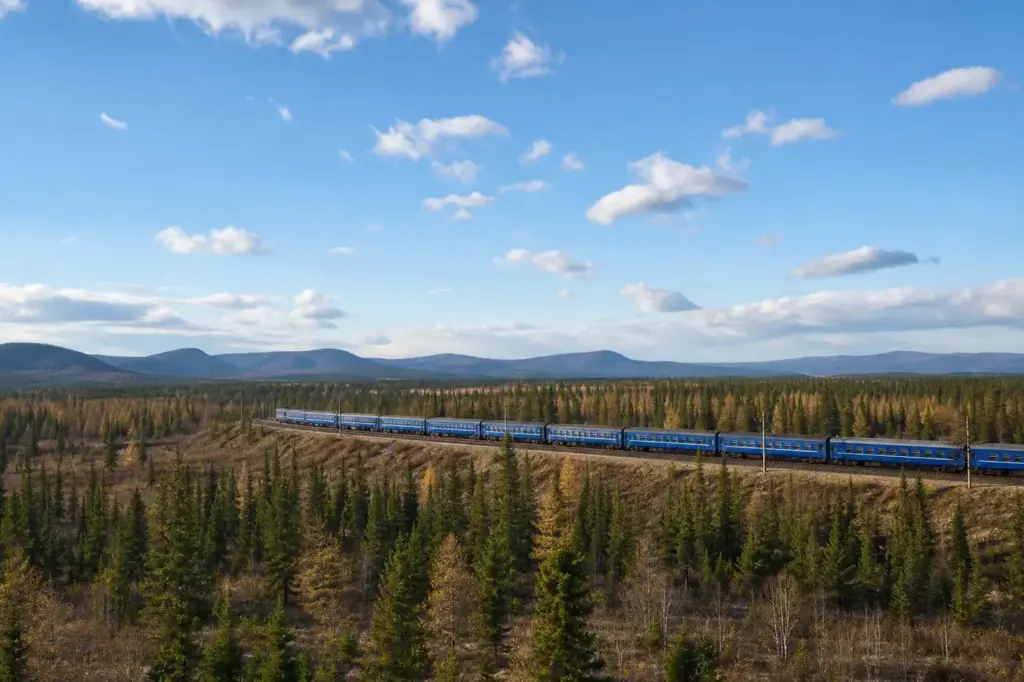
The Trans-Siberian is not one single railway line but rather a network with multiple routes branching from a common trunk. All three routes follow the same main line from Moscow as far as Ulan-Ude in southern Siberia, near Lake Baikal. From there they diverge dramatically: one continues east to the Pacific, one heads south through Mongolia to Beijing, and one splits much earlier to take a northern route past Baikal’s shores.
This guide helps you understand which route matches your plans, how long each takes, what visas you’ll need, and what landscape and cities you’ll see. Your choice depends on whether you want to stay entirely in Russia, visit Mongolia or China, or experience remote Siberian wilderness.
Quick answer: The Trans-Siberian Railway is the longest railway line in the world, spanning over 9,289 kilometers from Moscow to Vladivostok. Your route choice determines whether you travel 6 to 7 days to the Pacific, add another country and complexity, or take a remote northern path. Most first-time visitors choose the classic Moscow–Vladivostok route for simplicity and direct access.
At a Glance
| Total time | Planning time: 2–4 weeks before departure. Journey time: 6–7 days for Moscow–Vladivostok; up to 8–9 days for routes extending to Beijing or north to Sovetskaya Gavan. |
|---|---|
| Typical cost | ₽₽ |
What You Need Before You Start
- Valid passport (required for all routes)
- Russian visa (for all routes passing through Russia)
- Mongolia visa (if taking Trans-Mongolian route to Beijing)
- China visa or railway ticket confirmation (if going to Beijing)
- Flexibility with time (shortest full journey is 6 days minimum)
- Luggage under bed space limits (small lockers provided in most berths)
- Tolerance for shared compartments (sleeper cars typically have 2–4 berths per room)
Compare Your Options
| Option | Duration | Price | Notes |
|---|---|---|---|
| Trans-Siberian proper (Moscow–Vladivostok) | 6–7 days | ₽₽ | Two trains go through the whole route; the 'Rossiya' train goes daily from Moscow to Vladivostok and from Vladivostok to Moscow. No visa changes after Russia. Passes through major Siberian cities and Lake Baikal shoreline. Most popular for first-time visitors. Available year-round. Best for: solo travellers, budget-conscious visitors, those with only Russian visa. |
| Trans-Mongolian Railway (Moscow–Beijing via Ulaanbaatar) | 8–9 days | ₽₽ | The Trans-Mongolian to Beijing works with two train changes. Requires Russia, Mongolia, and China visas. Shares the main line to Ulan-Ude, then branches south through Mongolian steppe to Ulaanbaatar. Includes 1–2 night stops in Mongolia for customs. Fewer departures than main line. Best for: those interested in Mongolia and China, travellers with extended time, cultural enthusiasts. |
| Baikal-Amur Mainline (BAM, Tayshet or Irkutsk–Sovetskaya Gavan) | 9–11 days | ₽₽ | The BAM splits from Trans-Siberian at Tayshet, some 700 km west of Baikal lake, and passes the Baikal from the north at Severobaikalsk. Only Russian visa required. Remote route through taiga, permafrost, and tundra. Fewer trains, less developed infrastructure, more adventure. Eastern terminus is Sovetskaya Gavan (not Vladivostok). Best for: experienced travellers, photographers, those seeking wilderness, travellers with flexible schedules. |
| Vladivostok stopover route (Moscow–Vladivostok with extended stops) | 10–14 days | ₽₽ | Book segments separately to stop in Yekaterinburg (Urals), Novosibirsk (major city), Irkutsk (Lake Baikal gateway), and Ulan-Ude (Buryatia) for 1–3 days each. Costs more than through-ticket but allows exploration. Only Russian visa required. Best for: those wanting to see Russia beyond the train window, travellers with more time and budget. |
| Northern Russia bypass (Saint Petersburg–Yekaterinburg–Vladivostok) | 8–9 days | ₽₽ | Saint Petersburg could be reached by train from Finland and Baltic countries. From there, you can either go to Moscow or take the northern Trans-Siberian route, circumventing Moscow, via Vologda and Yekaterinburg. Skips Moscow entirely. Useful if arriving from Baltic countries. Requires separate segments and connection at Yekaterinburg. Best for: those based in Saint Petersburg or Northern Europe, those avoiding Moscow. |
₽ budget · ₽₽ moderate · ₽₽₽ upscale · ₽₽₽₽ splurge. Price levels are estimates compared with typical prices for visitors.
Step-by-Step Instructions
Step 1: Confirm your final destination
Decide whether you want to reach Vladivostok on Russia's Pacific coast, or continue to Beijing, or explore the remote BAM route. This single choice eliminates most alternatives. Most travellers choose Vladivostok (simplest, no border crossings after Russia). If interested in Central Asia or China, Beijing requires a second visa and adds 1–2 days to your journey.
Tip: Beijing routes require early visa planning—some visas take weeks. Vladivostok requires only a Russian visa.
Step 2: Check current geopolitical status of your chosen route
As of October 2026, the Moscow to Vladivostok train operates daily without border changes, the Trans-Mongolian to Beijing works but with two train changes, and the Trans-Manchurian is suspended. Verify on the official Russian Railways website (rzd.ru) which routes are currently operating, as international services change due to circumstances beyond the railway's control.
Tip: The Baikal-Amur Mainline (BAM) operates year-round but is less developed than the main line. Check recent traveller reports on seasonal disruptions before booking.
Step 3: Compare journey times and stopping points
The Trans-Siberian proper crosses from Moscow via Perm, Yekaterinburg, Omsk, Novosibirsk, Irkutsk, Ulan Ude, Chita and Khabarovsk to Vladivostok. The Trans-Mongolian coincides with the Trans-Siberian as far as Ulan-Ude on Lake Baikal's eastern shore, then heads south to Ulaanbaatar before making its way southeast to Beijing. The BAM departs much earlier near Tayshet, passes Lake Baikal's north shore at Severobaikalsk, and terminates at Sovetskaya Gavan on the Pacific rather than Vladivostok.
Tip: Each major city on the route (Yekaterinburg, Irkutsk, Ulan-Ude) offers stopovers if you book segments separately rather than one through-ticket.
Step 4: Understand visa requirements for each route
Moscow–Vladivostok: only Russian visa required. Trans-Mongolian to Beijing: Russian visa, Mongolia transit visa (usually free or minimal fee, check your nationality), and China visa. Trans-Manchurian: same as Trans-Mongolian (currently suspended). BAM: only Russian visa, but most start from Irkutsk and may need Moscow–Irkutsk segment. Check with your country's embassy for current requirements—visa rules change and depend on nationality.
Tip: Apply for Russia's visa first and allow at least 10 days. For Mongolia and China, submit applications only after your Russian visa is confirmed.
Step 5: Evaluate landscape and stopovers
The BAM splits from the Trans-Siberian at Tayshet and passes Lake Baikal from the north at Severobaikalsk, then goes parallel to the Trans-Siberian all the way to the Pacific Ocean. You can expect great landscapes, admirable views of Lake Baikal and a lot of high bridges and tunnels. The main line crosses the famous Baikal shoreline at Listvyanka and Bolshoi Kamen; the BAM sees fewer international tourists and offers remote wilderness. Beijing routes add Mongolian steppe (Trans-Mongolian) or Chinese landscapes (Trans-Manchurian).
Tip: If Lake Baikal is a priority, all three routes pass or parallel it, but the BAM and main line have better views from the train.
Step 6: Book tickets through official channels
Purchase tickets from Russian Railways (rzd.ru) or authorized travel agents. Do not book from resellers or social media. Each route has different train numbers: main line uses trains 001/002 (Rossiya) or 061/062; BAM requires separate booking; Trans-Mongolian uses designated international services with specific carriage numbers. Foreign visitors can book online with an international payment method or through a travel agency.
Tip: Book 4–8 weeks ahead for main line trains (especially summer). BAM trains have fewer departures—plan 6–8 weeks ahead.
Step 7: Decide on compartment class and sleeping arrangements
Russian trains offer four classes: platskart (open dormitory, budget), kupe (shared 4-berth compartment, moderate), spalny vagon (2-berth sleeper, upscale), and luxury suites on branded trains. Platskart is most social; kupe offers privacy and comfort. Spalny vagon is expensive but private. Most foreign visitors choose kupe for a balance of cost and comfort.
Tip: Platskart compartments can be noisy and crowded; spalny vagon compartments lock and have private facilities. Kupe offers a good middle ground.
Step 8: Choose one-way or segment-by-segment
You can buy a through-ticket Moscow–Vladivostok or book segments (Moscow–Irkutsk, Irkutsk–Ulan-Ude, Ulan-Ude–Vladivostok). Segment booking costs more overall but allows you to stop, rest, and change trains without losing your booking. Through-tickets are cheaper but lock you into one train and one class; stopovers are not included.
Tip: If booking through Beijing, expect mandatory overnight stops in Ulaanbaatar or at the China border due to gauge changes and customs formalities.
Step 9: Verify seasonal and weather conditions
Summer (June–August) is peak season with warmer weather, but trains are crowded and tickets harder to find. Winter (December–February) is cold but offers fewer tourists and clearer views of Siberia. Spring and autumn are ideal for avoiding crowds and cold, with pleasant weather. The BAM is passable year-round but winter services are less frequent and less comfortable.
Tip: Lake Baikal is partially frozen in winter (spectacular views) but train windows fog up. Summer offers clear views but shoulder seasons (May, September) are ideal.
Step 10: Finalize your choice and book
Write down your priority: (1) destination (Vladivostok, Beijing, or Sovetskaya Gavan), (2) visa requirements you can meet, (3) travel dates, (4) comfort level and budget, (5) must-see stopovers. Check these against the rzd.ru schedule or contact a travel agent specializing in Trans-Siberian routes. Pay via international card or bank transfer as instructed.
Tip: Once you've chosen, book immediately—popular dates sell out 8–12 weeks in advance, especially for compartments and sleeper classes.
Common Mistakes to Avoid
- Confusing 'Trans-Siberian' with a single train. The Trans-Siberian is a network of routes; you must choose which line to take. The most common mistake is assuming all routes go to Vladivostok—the BAM terminates at Sovetskaya Gavan, 600 km west, with different transport onward.
- Booking the Trans-Manchurian or assuming it operates. As of October 2026, the Trans-Manchurian route is suspended. Many websites and agents still advertise it. Always verify current status on rzd.ru before booking.
- Underestimating visa timelines. All three international routes require visas. Applying late (less than 4 weeks) risks rejection or delays. Mongolia and China visas depend on your nationality and consulate workload. Start visa applications 8–10 weeks before travel.
- Booking only through travel agencies without understanding costs. Travel agencies add markup (sometimes 20–50%). If you have a Russian bank account or international card and read Russian, booking directly on rzd.ru is cheaper. Use agencies only if you need visa support or language help.
- Choosing the BAM without understanding its remoteness. The BAM is beautiful but has fewer trains, longer intervals between stations, less developed stations, and fewer food and comfort options than the main line. It's best suited to experienced travellers, not those seeking comfort.
- Booking the cheapest platskart without understanding the experience. Platskart compartments are open dormitories with 40–60 bunks, shared bathrooms, and constant noise. Acceptable for budget travellers comfortable with Russian student culture; uncomfortable for those seeking sleep or privacy. Kupe (4-berth) is only slightly more expensive and far more comfortable.
- Not confirming dates and times before purchasing. Train numbers, departure times, and routes change seasonally. Verifying on rzd.ru 1–2 weeks before travel prevents missed trains or wrong dates.
Tickets, Payment and Booking
Official booking: Book directly through Russian Railways (RZD) at rzd.ru or through authorized travel agents. Payment methods for foreign visitors: international credit/debit card, PayPal (in some regions), or bank transfer. You will receive a booking confirmation and printed ticket at the station or by email.
Ticket resale warning: Do not buy from resellers, social media sellers, or unofficial agents. Fraudulent tickets are common and will not be honoured at the station. Only buy through rzd.ru or official partner travel agencies listed on the RZD website.
Payment notes: Your country’s sanctions rules may restrict use of Russian banks and payment services. Check with your own government and financial institution before booking. Citizens of countries under travel restrictions may face additional barriers; verify your eligibility before purchasing.
Booking windows: Tickets typically become available 60 days in advance. Peak summer dates (June–August) sell out 8–12 weeks ahead. Book as soon as your dates and visa are confirmed. For BAM routes, book 6–8 weeks ahead due to fewer trains.
Helpful Links
Advertisement: these are partner links. If you book or buy through them, we may earn a commission at no extra cost to you.
Russia Vibes Tips
- Book your route before your visa application. Some countries' consulates want to see your train ticket and accommodation before issuing a visa. Have your RZD booking confirmation or payment receipt ready when applying.
- The main line passes Lake Baikal at night in winter (frozen and striking under moonlight) but in daylight in summer. If Baikal views matter, book summer dates, but expect crowds and higher prices.
- Segment booking saves money on food costs. By stopping in Irkutsk (2–3 days) you can rest properly, buy fresh food cheaply at local markets, and see the city—otherwise you're eating pricy train food and sleeping in a moving berth for 6 days straight.
- The BAM is renovating as of 2026. Check on current disruptions, single-track sections, or temporary schedule changes with RZD or travel agents familiar with the route. Main-line disruptions are rare; BAM disruptions are common.
- Currency exchange on the train is difficult and rates are poor. Bring enough rubles or cards that work in Russia before boarding. Mongolian currency (tugrik) and Chinese yuan (renminbi) are rarely accepted on Russian trains.
- Misunderstanding 'through-train' vs. 'segment.' A through-ticket goes one-way in one carriage without re-boarding. Segment booking means you disembark, wait, and board a different train. Segments cost more but allow stopovers without losing your booking. Clarify when you book.
Explore Nearby How to Choose Your Trans-Siberian Railway Route, Trans-Siberian Railway
Sights near How to Choose Your Trans-Siberian Railway Route, Trans-Siberian Railway
 Listvyanka, Lake Baikal · typical visit: 2–3 days
Main image: AI-generated illustration. It may not show the place exactly as it looks.
Related guides
 How to Book Trans-Siberian Railway Tickets, Trans-Siberian Railway: Booking Guide
Main image: AI-generated illustration. It may not show the place exactly as it looks.
 Lake Baikal: Where to Go, What to See and How to Visit
Main image: AI-generated illustration. It may not show the place exactly as it looks.
 Trans-Siberian Railway: Route, Stops and Travel Guide
Main image: AI-generated illustration. It may not show the place exactly as it looks.
Browse more: All How-To · All How-To in Trans-Siberian Railway · All Metro and Trains · All Trans-Siberian Railway
FAQ
Is the Trans-Siberian a single train or a choice of routes?
The Trans-Siberian is the name given to three rail routes that traverse Siberia from Moscow. The Trans-Siberian proper goes from Moscow to Vladivostok. The Trans-Mongolian goes from Moscow to Beijing via Ulaanbaatar. All three share the same line from Moscow to Ulan-Ude, then branch. You choose which endpoint suits your plans.
Can I stop in cities along the way?
Yes, if you book segment tickets rather than a single through-ticket. For example, buy Moscow–Irkutsk, stay in Irkutsk for 3 days, then book Irkutsk–Vladivostok separately. This costs more total but lets you explore. Through-tickets typically allow only scheduled stops (usually 15–30 minutes at major stations) for water, food, or platform walks.
Which route is cheapest?
Moscow–Vladivostok via the main line is cheapest (fewer border crossings, no visas other than Russia). Trans-Mongolian costs slightly more due to Mongolia transit and second train change. BAM costs similar to the main line but requires more complex booking and longer duration. Budget category (platskart) is always cheapest; kupe (4-berth compartment) is moderately more. Exact prices depend on season and availability.
How far in advance should I book?
Book 4–8 weeks ahead for the main line during shoulder seasons (May, September), and 8–12 weeks ahead for summer (June–August). BAM routes should be booked 6–8 weeks ahead due to fewer trains. Winter (December–February) can be booked 4–6 weeks ahead. Always book after confirming your visa timeline.
Do I need a guide or can I travel alone?
You can travel alone. The train staff speak Russian only; carriage staff are helpful but not English-speaking. Download offline maps, learn a few Russian phrases, and carry a translation app. Many solo travellers meet others in shared compartments. If you want a structured experience with logistics handled, hire a travel agency—this costs more but reduces planning stress.
What's included in my ticket?
Your ticket includes a berth (bed), access to shared bathrooms and hot water, and a carriage attendant (provodnik) who maintains the car. It does not include meals; a dining car operates on longer routes but is expensive. Bring or buy food at station stops. Tea and coffee are usually free from a carriage samovar.
Is winter travel safe and comfortable?
Yes. Trains are designed for Russian winters and are well-heated. Temperatures outside may drop to –20°C or lower, but inside the carriage is warm. Fewer tourists travel in winter (less crowded booking). Downsides: windows fog up inside and may show frost outside, making photos harder; some remote BAM stations may be closed or sporadic. Winter is safe if you're prepared for extreme cold during any platform time.
What is the gauge change and will it affect me?
Russian trains use a broad gauge (1,520 mm); China uses standard gauge (1,435 mm). On Trans-Mongolian and Trans-Manchurian routes, the train stops at the border for wheel changes or carriage swaps—this takes 4–8 hours. You stay aboard; the process is noisy but normal. On the main line (Moscow–Vladivostok) and BAM, there is no gauge change; the entire journey is on Russian gauge.
Russia Vibes is a one-person project. A coffee keeps it going
Not legal advice. This is general information for visitors. Rules on visas, entry, registration, customs and similar matters change often and can depend on your nationality. Check the official source and, if in doubt, ask your embassy or a qualified adviser.
How we research and update our guides
About this guide: AI assistance and accuracy
This guide is created with the help of AI and is based on official sources where available. Mistakes can still happen. Opening hours, prices, rules and other details are given to the best of our knowledge as of the date shown and can change without notice. It offers general recommendations only, not professional, legal or travel advice. Please confirm important details with the official source before you travel; you are responsible for your own plans and decisions.
Packing for this trip
* Affiliate link: as an Amazon Associate we earn from qualifying purchases at no extra cost to you.

Take this guide with you
Get a free PDF of this guide to print or read offline: key facts, tips and a map link on a few clean pages.
Report an issue on this page
Paying for your trip: please read
International sanctions affect payments between Russia and many other countries. In practice, cards issued in the EU, the UK, the US and several other countries often do not work in Russia, Russian cards usually do not work abroad, and some booking platforms, airlines and payment providers limit or suspend their services for Russia. The situation changes frequently.
We do not give legal or financial advice, and this site does not encourage anyone to break or circumvent sanctions. Whatever you plan, you are responsible for following the laws and regulations that apply to you, including those of your country of residence and citizenship.
Many travelers still organise their stay lawfully. It is worth asking your bank or payment provider what is currently permitted, contacting hotels, tour operators and carriers directly about the payment methods they accept, and checking which services are open to customers from your country. Clarify payment, cancellation and refund terms before you commit to a booking, and keep your plans flexible.
Partner links on this site may not be available in every country, and prices, availability and rules in our guides can differ from what you see when you book.