
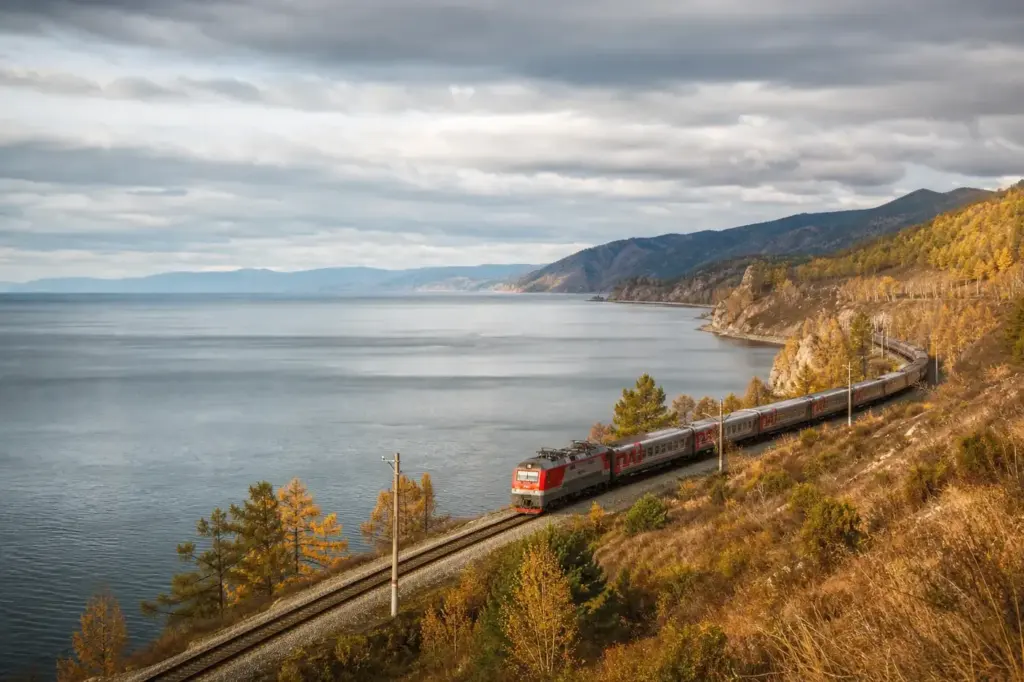
The Trans-Siberian Railway journey from Moscow to Lake Baikal is one of the world’s most legendary train journeys. Whether you’re a seasoned traveller or making your first Trans-Siberian trip, how to travel from Moscow to Lake Baikal by train on the Trans-Siberian Railway involves booking the right ticket, preparing for 3–4 days aboard, and knowing which compartment class suits your comfort level. The most popular option is a 2nd-class (kupé) compartment with four berths—a comfortable middle ground between budget and luxury.
Most travellers end their Trans-Siberian journey at Irkutsk, the closest major city to Lake Baikal, rather than continuing all the way to Vladivostok on the Pacific. From Irkutsk, you can easily reach the lake’s shores in Listvyanka, Olkhon Island or other settlements within hours.
Quick answer: Book your tickets at least 60–90 days in advance through an international agency (with English support) or the official Russian Railways website. The train departs from Moscow's Yaroslavsky Station and takes approximately 3 days and 4 hours to reach Irkutsk. Travel in 2nd-class (kupé) compartments—four berths in a lockable cabin—or upgrade to 1st-class (spalny vagon, 2-berth, more private). Total cost ranges from budget to moderate depending on class and season.
At a Glance
| Total time | 3 days 4 hours (Moscow to Irkutsk); add 1–2 hours each for stops and arrivals |
|---|---|
| Typical cost | ₽₽ |
What You Need Before You Start
- Valid passport with a Russian visa (or e-visa if applicable)
- Ticket reservations made 60–90 days before departure
- Payment method: foreign credit card, alternative booking agency, or Russian bank card
- Small overnight bag with essentials (toiletries, change of clothes, medications)
- Cash in Russian rubles for station purchases and tips (bedding attendants)
- Luggage packed and checked in—most compartments have limited storage space
Compare Your Options
| Option | Duration | Price | Notes |
|---|---|---|---|
| 2nd-class (kupé) compartment on Train 1/2 Rossiya | 3 days 4 hours | ₽₽ | Runs daily from Moscow Yaroslavsky to Vladivostok. Four-berth lockable compartment with window. Most popular choice for international travellers. Includes bedding. Comfort and privacy balance. Book 60–90 days ahead. Higher price during summer (June–August). |
| 1st-class (spalny vagon) compartment on Train 1/2 Rossiya | 3 days 4 hours | ₽₽₽ | Runs daily. Two-berth private compartment, more spacious and exclusive. No shared compartment mates. Includes bedding and some meals. Best for those prioritising privacy and comfort. Most expensive regular option. Rarely available; book well in advance. |
| 2nd-class (kupé) compartment on Train 100 | 3 days 4 hours | ₽ | Runs every two days (less frequently than Rossiya). Budget-friendly option with same compartment layout as Rossiya. Four-berth lockable cabin. Less crowded than Rossiya. Slightly longer wait between departures if you miss your preferred date. |
| 3rd-class (platskartny) open compartment | 3 days 4 hours | ₽ | Available on some services. Open dorm-style carriage with six berths per section, no doors or privacy. Very budget-friendly. Social atmosphere with other travellers. Noisier and less secure. Best for young independent travellers seeking cultural immersion or those on tight budgets. |
| Private tour operator train with hotel stops | 6–10 days (includes city stops and hotel nights) | ₽₽₽₽ | Operated by companies like RZD Tour or private operators. Train journeys mixed with overnight stays in Kazan, Yekaterinburg, Krasnoyarsk and Irkutsk. 1st-class cabins, guided tours, meals included. Most expensive but all-inclusive experience with minimal planning required. Limited departures (typically seasonal). |
₽ budget · ₽₽ moderate · ₽₽₽ upscale · ₽₽₽₽ splurge. Price levels are estimates compared with typical prices for visitors.
Step-by-Step Instructions
Step 1: Decide your travel dates and compartment class
Choose your preferred month—spring to early autumn offers the best weather and Baikal views. Decide between 1st-class (spalny vagon: 2-berth private cabins, more expensive but quieter), 2nd-class (kupé: 4-berth lockable compartments, the most popular choice), or 3rd-class (platskartny: open 6-berth dorms, budget but no privacy). Remember that if the train passes Lake Baikal at night, you may miss the views; check the schedule for daytime travel. Book 60–90 days in advance—tickets go on sale at that window.
Tip: Lower berths in 2nd-class compartments are more expensive than upper berths but easier to access and better for luggage storage. Consider upper berths if travelling on a tighter budget.
Step 2: Choose your ticket-booking method
You have three main options. First, the official Russian Railways website (rzd.ru) has the lowest prices but requires a Russian payment method (MIR card or Russian bank account); Western credit cards are blocked and you may need a VPN from outside Russia. Second, international booking agencies like RussianTrain, RussianRail, or railrussia.com offer English-language support and accept foreign credit cards—they charge a markup (typically 5–50%) but handle all complications. Third, buy tickets in person at a railway station ticket office (cheapest, but risky if you need a specific date). Most visitors choose an international agency for convenience.
Tip: Compare prices across agencies; some offer lower markups than others. Booking through an agency is worth the extra cost for peace of mind and English-language confirmation.
Step 3: Search for and book your specific train
On your booking platform (rzd.ru or agency website), enter 'Moscow (Moskva)' or 'Moscow Yaroslavsky Station' as the starting point and 'Irkutsk' as the destination. Select your departure date and search. You will see several trains; the main regular options are Train 1/2 'Rossiya' (daily, more comfortable, higher price) and Train 100 (every two days, cheaper). Select your preferred train and compartment class. Enter your full name exactly as it appears on your passport—the ticket is attached to your identity. Confirm you are booking a seat, not just a reservation.
Tip: If booking through an agency, after payment you'll receive an electronic ticket (e-ticket) or a reservation number. You will collect your physical paper ticket at the station before departure.
Step 4: Arrange payment and receive your e-ticket or reservation number
If booking on rzd.ru directly, you'll need a Russian payment method. If booking through an international agency, provide your foreign credit card details and your email. The agency will send you a confirmation email with your reservation number, ticket details, and often a PDF e-ticket. Print your confirmation or e-ticket—some agencies will also print and mail a paper ticket, or you can collect it at the station. Verify all details: train number, date, departure time (Moscow Time), compartment number and berth number, and your full name.
Tip: Keep screenshots or photos of your e-ticket or confirmation on your phone as a backup in case you lose the printed copy.
Step 5: Arrive at Moscow Yaroslavsky Station 1.5–2 hours early
Head to Moscow Yaroslavsky Railway Station (Yaroslavl Station), not one of the other Moscow stations. Allow time for security screening (bag checks at the entrance). Find your train number on the departure board (showing Moscow Time). Platform numbers are assigned 20–30 minutes before departure. Go to the correct platform and find your carriage number (marked on the side of each train car). Your ticket will show your carriage and berth number. Show your ticket and passport to any conductor checking passengers. If you have an electronic ticket, show it on your phone or a printout.
Tip: Arrive even earlier if travelling during peak season (June–August). The station can be crowded, and security lines move slowly.
Step 6: Board and locate your compartment
As you board your carriage (vagón), conductors are stationed at carriage entrances. Show your ticket, and they will direct you to your compartment. Compartments are numbered sequentially along the corridor. Enter your compartment and verify your assigned berth matches your ticket. In 2nd-class (kupé) compartments, typically there are two lower and two upper berths. Place your main luggage under the lower berths (secure it or keep your compartment locked). You may find bedding already on your berth; if not, the carriage attendant (provodnik or provodnitsa) will bring it shortly after departure.
Tip: In shared compartments, introduce yourself to your travelling companions. It's common to share food or tea during the journey. Compartment doors lock from inside for security.
Step 7: Explore the train and locate dining and toilet facilities
Take a short walk along the corridor to locate the dining car (restoran), toilet facilities (tualet), and hot water dispensers (kipyatok). Most trains have a restaurant car with basic meals, snacks, tea and beverages available for purchase. Toilets are located at the end of each carriage. Hot water dispensers are usually near the end of carriages and are free to use for tea or instant noodles (bring your own tea bags or buy them on the train). Some trains include meals in 1st-class tickets; 2nd and 3rd-class passengers pay separately for food.
Tip: Bring instant noodles, tea bags, biscuits or light snacks to save money. Toilet paper is usually provided but bring extra in case.
Step 8: Pass through the main towns and regions
Your train travels through central Russia (forests and hills), crosses the Ural Mountains at Yekaterinburg (marking the Europe-Asia border, approximately 26–27 hours from Moscow), and enters Siberia. Major stops include Nizhny Novgorod (6 hours), Perm (20 hours), Yekaterinburg (26 hours), Omsk (38 hours), Novosibirsk (46 hours), Krasnoyarsk (59 hours), and finally Irkutsk (76 hours, approximately 3 days 4 hours). The train may stop for 30 minutes to 2 hours at some of these stations—you can briefly exit to stretch your legs, but never leave your belongings unattended on the train. Station stops are listed on a chart posted in your carriage corridor.
Tip: At larger stops you can buy fresh food, drinks, or snacks on the platform from vendors. Don't stray far from the station—the train may depart early.
Step 9: Watch for Lake Baikal from the train (between Slyudyanka and Babushkin)
The most scenic part of your journey occurs when the train runs along the southern shore of Lake Baikal for approximately 100 km between Slyudyanka and Babushkin (formerly Mysovsk) station. This section takes about 1.5–2 hours and is visible from the right (south) side of the train if you're travelling eastbound (Moscow to Vladivostok direction). The views are spectacular during daylight hours. The Slyudyanka station building itself is notable—it is built entirely of green and white marble. If your train passes this section at night, you will miss the views; check the precise arrival time at Slyudyanka before booking.
Tip: Have your camera or phone ready during daylight hours in this section. If you travel in summer, the section often passes in daylight; in winter, timing is less predictable.
Step 10: Arrive at Irkutsk and disembark
The train arrives at Irkutsk Central Railway Station (Tsentralnaya stantsiya). Gather your belongings, ensure you have your passport, ticket and small bag. Disembark when the train comes to a complete stop and doors open. Station staff may check your ticket. If you booked an e-ticket through an agency and haven't yet collected a paper ticket, you may be able to do this at the station ticket office, though this is usually handled before departure. Exit the station and arrange your onward travel to Lake Baikal: Listvyanka, Olkhon Island, Khuzhir or other towns. Irkutsk is 65 km from Listvyanka (about 1.5 hours by road).
Tip: Have local currency (rubles) and a phone with a working connection to book your next transport (taxi, minibus or tour shuttle) in Irkutsk. Many tour operators offer direct pickups from the railway station.
Step 11: Complete your onward journey to Lake Baikal shores
From Irkutsk Railway Station, take a taxi, ride-share app (Yandex Taxi, Uber), or pre-booked minibus to reach the lake. The most common destination is Listvyanka (the closest town to Irkutsk, 65 km away, approximately 1.5–2 hours). You can also arrange tours or shuttles through your hotel or a local travel agency. Some visitors spend a few days in Irkutsk to rest and explore the city before heading to the lake. Note: the Trans-Siberian route itself does not bring you directly to the lake shore—Irkutsk is the nearest major city and is your jump-off point.
Tip: Book your onward transport in advance if travelling during peak season. Many tour companies offer package deals that include train tickets and transfers to the lake.
Common Mistakes to Avoid
- Booking too close to departure date. Tickets sell out or disappear from schedules 4–6 weeks before departure during peak season. Book 60–90 days in advance to guarantee availability and better prices.
- Confusing Moscow train stations. There are several major railway stations in Moscow (Yaroslavsky, Belorussky, Kazansky, Leningradsky, etc.). The Trans-Siberian departs from Moscow Yaroslavsky Station only. Arriving at the wrong station means missing your train.
- Expecting the train itself to reach Lake Baikal shores. The Trans-Siberian Railway runs along Lake Baikal's southern shore but does not stop at tourist destinations on the lake. You must disembark at Irkutsk (65 km from Listvyanka) and arrange separate onward transport to reach the actual lake.
- Missing the Lake Baikal views by travelling at night. If your train passes Slyudyanka station (where you'll see the lake) between sunset and sunrise, you'll miss the views. Check the scheduled arrival time at Slyudyanka before booking; trains travelling eastbound in summer typically pass this section in daylight.
- Not booking hotel or transport from Irkutsk in advance. Arriving in Irkutsk without onward plans can lead to long waits for taxis, higher prices, or scrambling to find accommodation. Arrange your Irkutsk hotel and transfer to the lake before you depart Moscow.
- Packing too much luggage. Compartments have limited floor space and storage only under lower berths. Bring one large suitcase and one small bag maximum; keep the small bag with you for easy access during the journey.
Tickets, Payment and Booking
Tickets for the Trans-Siberian are sold by Russian Railways (RZD). Booking methods for foreign visitors:
- Official RZD website (rzd.ru): Cheapest prices but requires a Russian payment method (MIR card or Russian bank account). Western Visa/Mastercard are blocked. Access from outside Russia may require a VPN. English interface available, though navigation can be complex.
- International booking agencies: Recommended for most foreign travellers. Agencies like RussianTrain, RussianRail (russianrail.com), and railrussia.com accept international credit cards and offer English-language customer support. They charge a markup (typically 5–50% above official prices) but handle payment complications. You receive an e-ticket via email and can collect a physical ticket at the station.
- Train station ticket offices: Buy in person at Moscow Yaroslavsky Station. Cheapest option but staff may not speak English, and you risk missing your preferred date if trains are full.
Payment: Foreign credit cards accepted through international agencies only. Cash is not accepted for ticket purchases in advance; pay when you book online.
Warnings: Avoid ticket resellers and unofficial websites; they often charge inflated prices and may sell invalid tickets. Book only through official RZD channels or verified international agencies.
Russia Vibes Tips
- Buy food at station stops to save money. Fresh bread, cheese, fruits, and drinks are sold by vendors on platforms at major stations like Yekaterinburg, Novosibirsk, and Krasnoyarsk. Train dining cars are convenient but more expensive than station purchases.
- Pack tea bags and instant noodles. These are essential comfort items during a long train journey. Hot water dispensers (kipyatok) are free and located near toilet facilities. You'll save significantly on dining car meals this way.
- Bring cash in Russian rubles for tips, bedding rental, and station food. Station ATMs exist but may not accept all foreign cards. Arrive with at least some rubles converted before boarding. Tip the carriage attendant (provodnik/provodnitsa) 100–200 rubles if they assist with luggage or bedding.
- Set your watch to Moscow Time for the entire journey. The train operates on Moscow Time regardless of local time zones. Schedules shown on charts in your carriage corridor are in Moscow Time. Irkutsk local time is 5 hours ahead of Moscow Time, which can be confusing when checking arrival times.
- Request a compartment on the south side of the train when booking if possible (or note this when contacting your agency). The right side of the train has the best views of Lake Baikal during the 1.5–2 hour scenic section. Not all booking systems allow side selection, but it's worth asking.
- Keep your passport, ticket and cash on you at all times. Compartment locks are reliable, but carrying valuables separately reduces risk. Use the small bag under your lower berth only for non-essential items.
Explore Nearby How to Travel from Moscow to Lake Baikal by Train, Trans-Siberian Railway
Sights near How to Travel from Moscow to Lake Baikal by Train, Trans-Siberian Railway
 Listvyanka, Lake Baikal · typical visit: 2–3 days
Main image: AI-generated illustration. It may not show the place exactly as it looks.
 Olkhon Island, Lake Baikal · typical visit: 2–3 days
Main image: AI-generated illustration. It may not show the place exactly as it looks.
Related guides
 How to Book Trans-Siberian Railway Tickets, Trans-Siberian Railway: Booking Guide
Main image: AI-generated illustration. It may not show the place exactly as it looks.
 Lake Baikal: Where to Go, What to See and How to Visit
Main image: AI-generated illustration. It may not show the place exactly as it looks.
 Irkutsk: 130 Kvartal, Decembrists and Gateway to Lake Baikal
Main image: AI-generated illustration. It may not show the place exactly as it looks.
Browse more: All How-To · All How-To in Trans-Siberian Railway · All Metro and Trains · All Trans-Siberian Railway
FAQ
How long does the Moscow to Lake Baikal train journey take?
Approximately 3 days and 4 hours from Moscow Yaroslavsky Station to Irkutsk, the gateway city to Lake Baikal. The journey covers 5,153 km. Journey times vary slightly depending on the specific train and seasonal scheduling variations.
Can I see Lake Baikal from the train?
Yes, but only briefly. The Trans-Siberian skirts the southern shore of Lake Baikal for approximately 100 km between Slyudyanka and Babushkin stations, taking about 1.5–2 hours. Views are visible from the right (south) side of the train travelling Moscow to Vladivostok. The views are most spectacular during daylight hours. If the train passes this section at night, you will miss them.
When should I book my tickets?
Book 60–90 days before your intended departure date. Tickets go on sale 90 days in advance on the official Russian Railways website. International booking agencies may have slightly different schedules. During peak season (June–August), lower berths and 1st-class compartments sell out quickly, so book as early as possible.
What is included in the ticket price?
Your ticket includes a berth (bed) with bedding provided. Meals are not included in 2nd or 3rd-class tickets; you must purchase food from the dining car or bring your own. 1st-class tickets on some trains may include limited meals. Hot water for tea is free. You must tip the carriage attendant separately for any additional services.
Can I leave the train at stops to explore?
Yes, you can briefly exit the train at major stops (Yekaterinburg, Novosibirsk, Krasnoyarsk, etc.) to stretch your legs and buy food from station vendors. Stops range from 30 minutes to 2 hours. Never leave your belongings unattended on the train, and always stay near the station so you don't miss the train's departure. Return with enough time to re-board before the train leaves.
Do I need to collect a paper ticket before boarding?
This depends on your booking method. If you booked through an international agency, you'll receive an e-ticket (PDF) via email. You can board with a printout or your e-ticket on your phone. Some agencies offer printed tickets by mail. You may also collect a paper ticket at the railway station ticket office on the day of departure (bring your booking confirmation and passport). It's safe to board with a valid e-ticket.
Will my Western credit card work to buy tickets online?
Not on the official RZD website, because cards issued outside Russia do not work. Use an international booking agency (RussianTrain, RussianRail, etc.) that accepts international credit cards. Alternatively, if you have a Russian bank account or MIR card, you can book directly on rzd.ru. Plan to pay in cash at a station ticket office.
Is the train safe for solo travellers and families?
Yes. The Trans-Siberian is used by local passengers and international tourists daily. 1st and 2nd-class compartments have lockable doors, providing security and privacy. Conductors are present in each carriage and monitor passengers. Solo travellers and families commonly use the route. Keep valuables close and use common sense, as on any crowded public transport.
Russia Vibes is a one-person project. A coffee keeps it going
Not legal advice. This is general information for visitors. Rules on visas, entry, registration, customs and similar matters change often and can depend on your nationality. Check the official source and, if in doubt, ask your embassy or a qualified adviser.

Take this guide with you
Get a free PDF of this guide to print or read offline: key facts, tips and a map link on a few clean pages.
Report an issue on this page
Paying for your trip: please read
Payments and bookings between Russia and many other countries are currently restricted. In practice, cards issued in the EU, the UK, the US and several other countries often cannot be used in Russia, Russian cards usually cannot be used abroad, and some booking platforms, airlines and payment providers limit or pause their services for Russia. The situation changes frequently.
We do not give legal or financial advice, and this site does not encourage anyone to break any rule that applies to them. Whatever you plan, you are responsible for following the laws and regulations that apply to you, including those of your country of residence and citizenship.
Many travelers still organise their stay without problems. It is worth asking your bank or payment provider what is currently possible, contacting hotels, tour operators and carriers directly about the payment methods they accept, and checking which services are open to customers from your country. Clarify payment, cancellation and refund terms before you commit to a booking, and keep your plans flexible.
Partner links on this site may not be available in every country, and prices, availability and rules in our guides can differ from what you see when you book.
How we research and update our guides
About this guide: AI assistance and accuracy
This guide is created with the help of AI and is based on official sources where available. Mistakes can still happen. Opening hours, prices, rules and other details are given to the best of our knowledge as of the date shown and can change without notice. It offers general recommendations only, not professional, legal or travel advice. Please confirm important details with the official source before you travel; you are responsible for your own plans and decisions.
* Affiliate link: as an Amazon Associate we earn from qualifying purchases at no extra cost to you.