
This list covers Best WWII & Stalingrad History Sites, Volgograd, a selection of 10 museums, memorials and original battle sites that document one of history’s most significant military conflicts. The Battle of Stalingrad lasted nearly 200 days, from August 1942 to February 1943, and resulted in approximately 2 million casualties.
These sites range from preserved buildings that stood during the battle to large-scale memorial complexes constructed after the war. Each location reveals something distinct about the civilians caught in urban warfare, the soldiers on both sides, and the Soviet victory that shifted the war’s momentum on the Eastern Front.
At a Glance
| # | Place | Best for | Good to know |
|---|---|---|---|
| 1 | Mamayev Kurgan | Central memorial and viewpoint | Prospekt Imeni V.I. Lenina; open 24 hours, free admission; tram stop Mamayev Kurgan at the base; passport or guide recommended for understanding the complex layout. |
| 2 | Panorama Museum Battle of Stalingrad | Largest exhibition and circular panorama | City centre, near the Gerhardt mill ruins; paid admission ₽₽; open typically 10 AM–8 PM; spiral staircase to the panorama room (no lift); English signage limited, consider a guide. |
| 3 | Memory Museum | German capitulation site | City centre, basement of Central Department Store; paid admission ₽; typically requires a guide for fuller understanding. |
| 4 | Ruined Mill Monument | Preserved wartime building | City centre, adjacent to Panorama Museum; freely visible from outside; no entry into the ruin itself. |
| 5 | Piskaryovskoye Memorial Cemetery | Mass burial site and memorial | Primary Stalingrad memorials are at Mamayev Kurgan; other burial and memorial sites throughout the city mark mass graves. |
| 6 | House of Pavlov | Fortified residential building | Tsentralny District, residential area; freely visible from street; no interior access; commemorative plaque marks the site. |
| 7 | Stalingrad Tractor Factory Site | Industrial battlefield | Industrial district north of city centre; parts of the factory complex still operate or have been repurposed; memorials and plaques mark key locations; limited public interior access. |
| 8 | Central Volgograd Museum (State Historical Museum) | Civil war and early Soviet history | Gogol Street, city centre; paid admission ₽; opening hours vary; documents early history but limited WWII focus now. |
| 9 | Volga River Embankment | Strategic location and views | City centre waterfront; freely accessible; panoramic views of the Volga; walking trail connects to other sites. |
| 10 | Soldiers and Sailors Monument | Waterfront memorial | City centre waterfront; free access; integrated into the embankment walking area. |
| 11 | Red October Factory and Memorial | Industrial strongpoint | Industrial district; partly operational or repurposed industrial area; memorials and plaques visible from street; limited interior public access. |
How We Chose
Entries are verified as currently operating and publicly accessible. They include:
- Major memorial complexes and museums dedicated to the battle
- Sites with original wartime architecture or authentic locations
- Places offering both indoor exhibits and outdoor memorial spaces
- Locations documented on official Russian heritage lists or the websites of cultural institutions
- Sites accessible to independent visitors, with or without a guide
1. Mamayev Kurgan – Central memorial and viewpoint
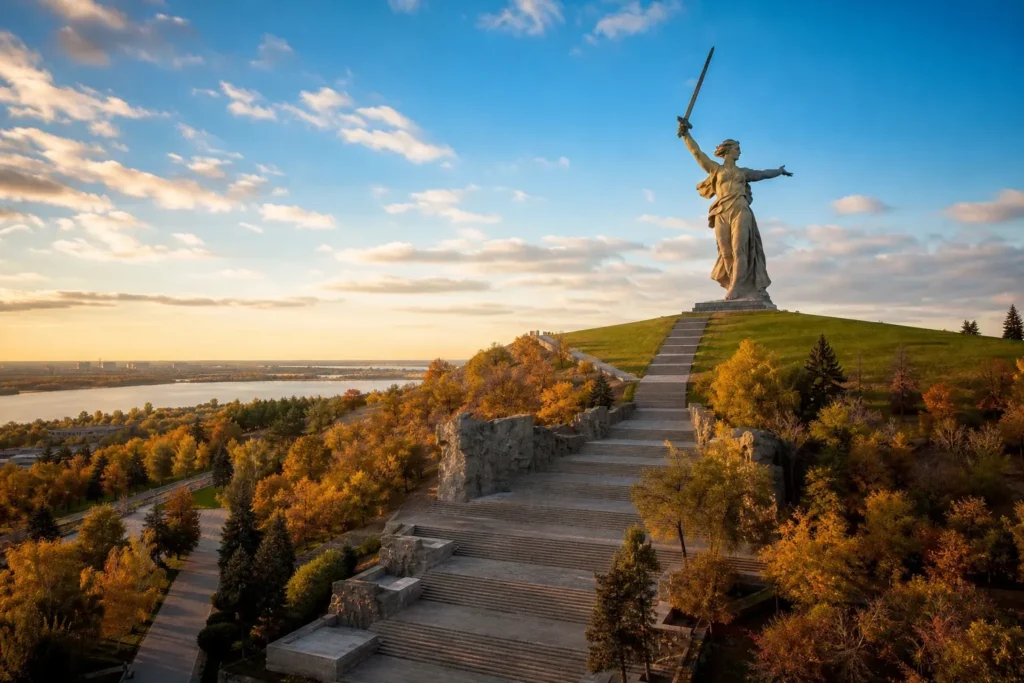
A 102-metre hill that was the highest and most fiercely contested point in the battle. The memorial complex, completed between 1959 and 1967, is dominated by "The Motherland Calls", a colossal concrete statue designed by sculptor Yevgeny Vuchetich. The site includes ceremonial steps, trenches, walls inscribed with names, and a Hall of Military Glory. Stone terraces and monuments rise from the base toward the hilltop statue, creating a processional journey through the site. The hill offers views over the Volga River and surrounding city.
Good to know: Prospekt Imeni V.I. Lenina; open 24 hours, free admission; tram stop Mamayev Kurgan at the base; passport or guide recommended for understanding the complex layout.
Tip: Visit early morning or late afternoon for better light and fewer visitors; bring comfortable shoes for climbing the terraced pathways and stone steps. The site contains fragments of metal and bone still visible in the earth—tangible reminders of the intensity of the fighting.
2. Panorama Museum Battle of Stalingrad – Largest exhibition and circular panorama
The centerpiece is a massive 16-by-120-metre circular painted panorama depicting the defeat of German forces on 26 January 1943, created by seven artists over two years based on battlefield sketches and witness accounts. The museum occupies eight halls on the ground floor arranged chronologically from June 1941 through the German surrender. Exhibits include uniforms, weapons, personal effects, military trophies, documents, letters and postcards from soldiers, dioramas measuring 5 by 25 metres, a portrait gallery of Soviet commanders, and interactive digital maps and animations. The old mill ruin stands outside the museum building.
Good to know: City centre, near the Gerhardt mill ruins; paid admission ₽₽; open typically 10 AM–8 PM; spiral staircase to the panorama room (no lift); English signage limited, consider a guide.
Tip: The spiral staircase to the panorama room requires climbing; pace yourself. The ground-floor exhibition before you enter the panorama can be thoroughly explored in 1–2 hours alone. A guide with English is highly recommended since museum labels are in Russian.
3. Memory Museum – German capitulation site
Located in the basement of the Central Department Store (Univermag), this small but focused museum occupies the authentic location where German Field Marshal Friedrich Paulus and his 6th Army headquarters were based during the final phase of the battle. The basement shows original war damage, period details, and artifacts. The museum takes a distinctive perspective by examining the war through German eyes and features original items alongside accounts of German soldiers' experiences. This provides context often absent in Soviet-centred narratives.
Good to know: City centre, basement of Central Department Store; paid admission ₽; typically requires a guide for fuller understanding.
Tip: This museum is smaller and less visited than Panorama; combining a visit here with Panorama gives a more complete picture. The German perspective on Stalingrad's catastrophe is crucial to understanding the battle's impact on both sides.
4. Ruined Mill Monument – Preserved wartime building
The Gerhardt mill, a brick building severely damaged during the final Soviet counteroffensive in November 1942, stands next to the Panorama Museum as a silent witness to the urban destruction. The roofless, gutted structure remains as found after the fighting ended. Its ruin contrasts with the commemorative landscape around it, showing the scale of destruction inflicted on civilian infrastructure. A lawn in front of the mill features a copy of the famous Barmaley fountain (children dancing around a crocodile), an attempt to reclaim the city's pre-war cultural life.
Good to know: City centre, adjacent to Panorama Museum; freely visible from outside; no entry into the ruin itself.
Tip: Stand at different angles to photograph the mill's profile; its blackened brickwork and collapsed interior are stark against the modern cityscape. The contrast between preservation and reconstruction symbolises the war's aftermath.
5. Piskaryovskoye Memorial Cemetery – Mass burial site and memorial
While technically in Leningrad (now Saint Petersburg), this cemetery is closely linked to Soviet WWII memory and contains thousands of victims of the siege and broader war. However, the primary Stalingrad burial sites and memorials are centred at Mamayev Kurgan, where Soviet General Vasily Chuikov is buried. Many soldiers who died in the Battle of Stalingrad are commemorated at Mamayev Kurgan's wall inscriptions and halls rather than individual graves.
Good to know: Primary Stalingrad memorials are at Mamayev Kurgan; other burial and memorial sites throughout the city mark mass graves.
Tip: Focus your time at Mamayev Kurgan's memorial spaces rather than seeking individual cemeteries; the scale of casualties (millions across the Soviet Union) means most Stalingrad dead lack individual marked graves.
6. House of Pavlov – Fortified residential building
A four-storey residential apartment building in the Tsentralny District that became a heavily fortified Soviet strongpoint during street fighting in September–November 1942. German forces attacked it repeatedly; a small Soviet garrison of about 25 soldiers held it for nearly 60 days. The walls still show bullet and shrapnel scars. Soviet propaganda called it an "unbreakable fortress"; it remains a symbol of determined civilian and military resistance in urban combat. Today it is a protected heritage site with a plaque and small memorial.
Good to know: Tsentralny District, residential area; freely visible from street; no interior access; commemorative plaque marks the site.
Tip: This is a working residential building, not a museum; visitors should respect residents' privacy. The external scars and weathered appearance are deliberate preservation choices to document the battle's intensity.
7. Stalingrad Tractor Factory Site – Industrial battlefield
The factory, one of the Soviet Union's major tank and tractor production facilities, became a fortified strongpoint during the battle and was the scene of prolonged street-to-street fighting in late 1942. The factory complex suffered enormous damage and casualties. Today much of the original industrial area has been redeveloped, but portions of the site and adjacent memorials commemorate the factory workers and soldiers who died defending it. The factory played a symbolic role in Soviet war narratives as both a centre of socialist industrial might and a focal point of brave resistance.
Good to know: Industrial district north of city centre; parts of the factory complex still operate or have been repurposed; memorials and plaques mark key locations; limited public interior access.
Tip: The factory site is less visually dramatic than Mamayev Kurgan but historically crucial. Visiting with a knowledgeable guide who can explain the 1942 layout and key positions is valuable; the modern urban landscape obscures much of the original topography.
8. Central Volgograd Museum (State Historical Museum) – Civil war and early Soviet history
Located on Gogol Street, this older museum building originally opened in 1937 and focused on the Defence of Tsaritsyn during the Russian Civil War (1918–1921). After World War II, it was expanded with battle artifacts and reopened in 1948. Today the main WWII collections have moved to the Panorama Museum, but this institution retains exhibits on the city's history from its founding through Soviet times, providing context for the region before 1942.
Good to know: Gogol Street, city centre; paid admission ₽; opening hours vary; documents early history but limited WWII focus now.
Tip: This museum is useful for visitors interested in the city's broader history and the Russian Civil War period, but is secondary to Panorama Museum and Mamayev Kurgan for WWII content.
9. Volga River Embankment – Strategic location and views
The river itself was a crucial military feature during the battle. Soviet forces crossed here under German fire, reinforcements arrived by boat, and the opposite bank provided defensive depth. Walking the embankment offers perspective on the geography that shaped the fighting. Several memorials and plaques mark key events. The river's width and current made crossings under bombardment extraordinarily difficult and costly.
Good to know: City centre waterfront; freely accessible; panoramic views of the Volga; walking trail connects to other sites.
Tip: Visit early morning when light is soft and the river is calm; this helps visualise how exposed soldiers would have been crossing by boat in 1942. The width of the river becomes viscerally clear from the embankment.
10. Soldiers and Sailors Monument – Waterfront memorial
Located on the embankment, this monument commemorates the troops who defended Stalingrad. The monument includes sculpture, inscriptions, and a memorial garden. It is one of several smaller but significant memorials scattered through the city, each marking a specific unit's contribution or a particularly costly engagement.
Good to know: City centre waterfront; free access; integrated into the embankment walking area.
Tip: Combine embankment walks with the monument visits to get a sense of the full geography of the defence and the strategic importance of controlling the river crossing.
11. Red October Factory and Memorial – Industrial strongpoint
Another major factory complex that became a fortified zone in the final stages of the battle. Like the Tractor Factory, the Red October works were defended fiercely and suffered substantial damage. Portions of the original industrial landscape remain, along with commemorative plaques and memorials to the workers and soldiers who died there. The site illustrates how Soviet factories were conscripted into military defence.
Good to know: Industrial district; partly operational or repurposed industrial area; memorials and plaques visible from street; limited interior public access.
Tip: The factory sites are most meaningful with contextual knowledge; a guide or detailed research beforehand is recommended. The industrial landscape itself is the memorial rather than a museum space.
Russia Vibes Tips
- Plan at least two full days for the major sites: one day for Mamayev Kurgan and the Panorama Museum, and a second for Memory Museum, the mill ruin, House of Pavlov, and embankment walks. Rushing limits the emotional and educational impact.
- Book an English-speaking guide in advance, especially for Panorama Museum and factory sites. Most original signage is in Russian, and understanding the chronology and spatial relationships greatly enhances the experience.
- Visit Mamayev Kurgan in the late afternoon or early morning to avoid crowds and gain better light for photographs. The site is open 24 hours, but the commemorative guard is present 9 AM–8 PM.
- Wear sturdy, comfortable walking shoes. Mamayev Kurgan involves climbing steep terraces and uneven stone steps; Panorama Museum requires a spiral staircase with no lift; embankment walks are long.
- Visit in spring (May) for Victory Day commemorations, or in autumn when the summer heat subsides. Winter can be cold and damp; summer crowds at major sites are heaviest in July–August.
- Read or listen to brief background on the battle's timeline before arriving—August 1942 German attack, September street fighting, November Soviet counteroffensive, February 1943 German surrender. This context transforms what you see from ruins into specific, comprehensible moments in history.
Explore Nearby Best WWII & Stalingrad History Sites, Volgograd
Browse more: All Culture Lists · All Guides · All Guides in Volgograd · All Volgograd
FAQ
Is Mamayev Kurgan free to visit?
Yes, Mamayev Kurgan is open 24 hours a day with no admission charge. The Hall of Military Glory and terrace walkways are freely accessible. Parking and facilities nearby may have costs.
How long does it take to visit Panorama Museum?
Plan 2–3 hours minimum. The eight exhibition halls take 1–1.5 hours, the panorama room and its viewing gallery another 30–45 minutes. Many visitors spend longer reading exhibits and using interactive displays. A guided tour may extend this to 3–4 hours.
Do I need a guide for these sites?
Guides are highly recommended for Panorama Museum (no English signage), Memory Museum (smaller, requires context), and factory sites (landscape is heavily altered). Mamayev Kurgan can be experienced independently with preparation. Guides provide crucial chronological and geographical context that transforms the sites from physical remnants into understandable history.
What is the difference between Memory Museum and Panorama Museum?
Panorama Museum is the larger, comprehensive facility with extensive collections, the famous 16-by-120-metre panoramic painting, and eight exhibition halls covering the entire battle chronologically. Memory Museum is smaller, located in the basement of the Central Department Store (the actual German headquarters location), and focuses on the German perspective and the final surrender. Both complement each other.
Can I visit House of Pavlov?
Yes, House of Pavlov is a working residential building with a commemorative plaque visible from the street. There is no interior museum access; respect residents' privacy. The external scars and bullet marks on the walls are deliberately preserved to document the fighting.
How were so many people killed in Stalingrad?
The battle lasted nearly 200 days in an urban setting where German and Soviet forces fought block by block. Artillery bombardment destroyed buildings and trapped civilians. Disease, starvation, and exposure added to combat deaths. Soviet casualties were particularly high due to frontal assaults and Soviet doctrine at the time. Total casualties (military and civilian, killed, wounded, missing) reached approximately 2 million across all sides.
What is the best time of year to visit?
Spring and early autumn (May and September–October) offer moderate temperatures and clear skies. May includes Victory Day (9 May) commemorations with ceremonies and larger crowds. Summer is hot; winter is cold and damp. Late autumn and winter light can be atmospheric but conditions underfoot may be muddy or icy.
Are the sites accessible for people with mobility issues?
Mamayev Kurgan involves significant climbing on terraced steps with no ramps or lifts. Panorama Museum has a spiral staircase to the panorama room (no lift). Memory Museum is basement-level. House of Pavlov and factory sites are outdoor, uneven terrain. The embankment is relatively flat. Visitors with mobility limitations should plan carefully and may need to prioritise certain sites; guides familiar with accessibility options are valuable.
Russia Vibes is a one-person project. A coffee keeps it going
Last updated: October 18, 2026.
How we research and update our guides
About this guide: AI assistance and accuracy
This guide is created with the help of AI and is based on official sources where available. Mistakes can still happen. Opening hours, prices, rules and other details are given to the best of our knowledge as of the date shown and can change without notice. It offers general recommendations only, not professional, legal or travel advice. Please confirm important details with the official source before you travel; you are responsible for your own plans and decisions.
International sanctions affect payments between Russia and many other countries. In practice, cards issued in the EU, the UK, the US and several other countries often do not work in Russia, Russian cards usually do not work abroad, and some booking platforms, airlines and payment providers limit or suspend their services for Russia. The situation changes frequently. We do not give legal or financial advice, and this site does not encourage anyone to break or circumvent sanctions. Whatever you plan, you are responsible for following the laws and regulations that apply to you, including those of your country of residence and citizenship. Many travelers still organise their stay lawfully. It is worth asking your bank or payment provider what is currently permitted, contacting hotels, tour operators and carriers directly about the payment methods they accept, and checking which services are open to customers from your country. Clarify payment, cancellation and refund terms before you commit to a booking, and keep your plans flexible. Partner links on this site may not be available in every country, and prices, availability and rules in our guides can differ from what you see when you book.Paying for your trip: please read
Report an issue on this page

Take this guide with you
Get a free PDF of this guide to print or read offline: key facts, tips and a map link on a few clean pages.