
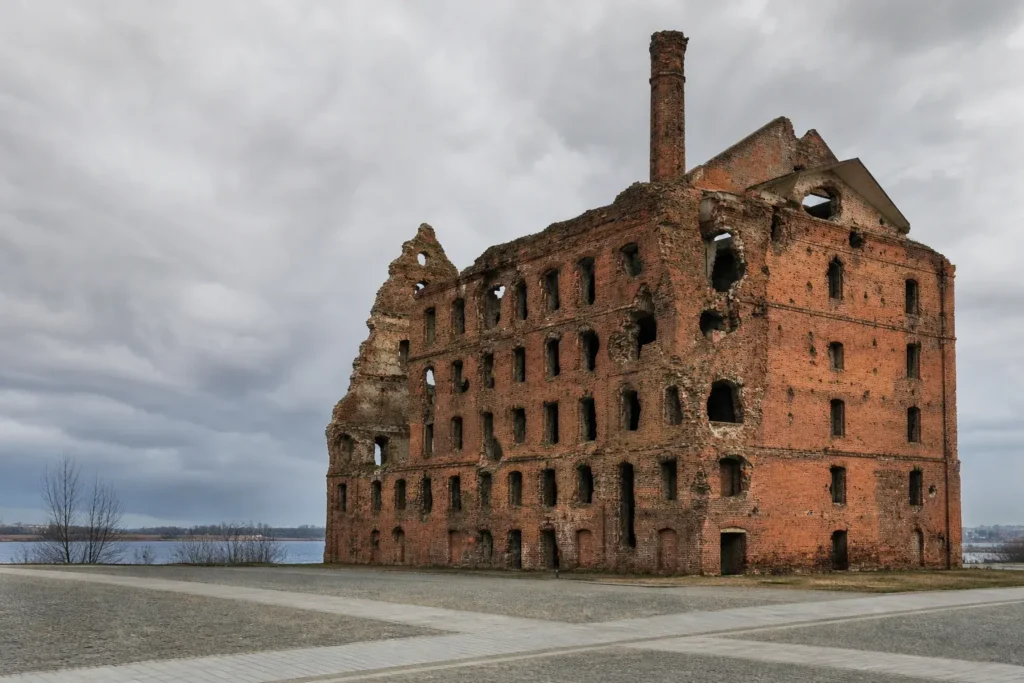
In 1899, the Gerhardt family of entrepreneurs received permission to build a flour-grinding complex overlooking the Volga, and the mill began operations with flour sales in August 1900. Located on the banks of the Volga, this five-story red-brick structure was once a cutting-edge industrial facility, but today it stands as a historical monument.
During the Battle of Stalingrad, Gerhardt’s Mill became the final frontier, with the Soviet Red Army deterring the army of German Field Marshal Friedrich Paulus on the approaches to the Volga. It is one of only three buildings that were not restored or repaired from the battle era. Visitors encounter the mill’s battle-scarred facade, with the owner’s name still visible on its walls—a piece of pre-war Volgograd frozen in time.
Quick Facts
| Russian name | мельница Гергардта |
|---|---|
| Built / opened | 1900 |
| Address | ул. имени Маршала В.И. Чуйкова, 47, Волгоград OpenStreetMap · Google Maps |
| District | Tsentralny District |
| Opening hours | Daily 24 hours |
| Admission | free |
| Best time to visit | Intense sunshine can be a factor during visits. Early morning (before 10:00) or late afternoon (after 16:00) offer better photography light and smaller crowds. Spring and autumn have the most pleasant weather. Summer is hot and sometimes crowded in the plaza. Winter offers solitude and a stark atmosphere, though cold wind off the Volga can be sharp. There is no season when the ruins are closed or inaccessible. |
| Recommended duration | 30–45 minutes |
What Is (and Isn't) Part of a Visit to Gerhardt's Mill, Volgograd?
| Part | Status | Notes |
|---|---|---|
| The mill ruins themselves (five-story building with damaged facade) | Included in the standard ticket | Free to view and walk around externally; open 24 hours. |
| Interior access | Not open to visitors | The interior is not accessible to visitors; you can only view through window openings. |
| Battle of Stalingrad Museum-Panorama (separate building nearby) | Separate ticket or institution | Located across the plaza; requires a separate ticket and is a different institution. |
| Pavlov's House (across the plaza) | Outside / not part of it | A reconstructed building, different from Gerhardt's Mill; visitors often confuse them because both are Battle of Stalingrad landmarks. |
| The surrounding plaza and memorial elements | Included in the standard ticket | The ground-level plaza and any memorial plaques or markers are part of the public site. |
Why Visit Gerhardt's Mill, Volgograd?
Gerhardt’s Mill stands as one of Volgograd’s most immediate connections to the Battle of Stalingrad. The sides of the building testify to the different intensities of mortar and artillery fire—minimal on the Volga side, on the three other sides traces of firing from all types of artillery can be seen, as well as loopholes in the window openings made by the defenders. The owner’s name “Gergardt” is inscribed on the end walls at roof level; all three inscriptions have survived. Unlike most war-damaged buildings in the city that were rebuilt, the mill’s preservation in its ruined state offers a stark, unmediated view of the conflict’s scale and ferocity.
Highlights of Gerhardt's Mill, Volgograd
The Five-Story Red-Brick Facade
Originally built in 1899 and rebuilt after a fire in 1907, the current structure was completed by May 1908. The five-story red-brick structure was once a cutting-edge industrial facility. The shell-riddled walls show the intensity of warfare; visitors should look for the loopholes cut into window openings by defending soldiers and bullet and shrapnel marks that pock nearly every surface.
Tip: Walk around all four sides to see how damage varies—the Volga-facing side is less damaged because it faced away from German positions.
The Owner's Inscriptions
On both end walls at roof level is a brick inscription "Gergardt"—the name of Volga German entrepreneur Alexander Gergardt. The same inscription is lined with bricks of different shade on the Volga side of the building on the 5th floor; all three inscriptions have survived. These namemarks personalize the industrial monument with the biography of a Volga German businessman.
Tip: The clearest inscription on the Volga-facing side is best visible in afternoon light.
The Surviving Brick Chimney
The building had its own generator and boiler house, from which the brick smokestack has survived, and internal mechanical conveyors, from which there are still broken remnants. The tall chimney, still standing amid the ruins, is the most recognizable element of the mill's industrial purpose and draws the eye from across the plaza.
Tip: The chimney is a good landmark if navigating the square; it rises well above the main building.
The Industrial Complex That Supplied a Region
Despite being called a "mill", it served as a food processing complex, where in addition to the mill, there was a smokery for fish, butter production facilities, a bakery, and warehouses for finished products. In 1911 the company "Gerhardt and heirs" employed 78 workers, with 165 working days per year, with a working day of 10.5 hours. The scale of the building reflects its role as a major regional supplier.
Tip: The firewall running through the center divided production (north) from warehousing (south)—you can still see this division in the ruin.
The Defensive Stronghold During the Battle
Since the building was on the way to the Volga, it served as a strategic object, which the Soviet soldiers defended as a fortress, and was subjected to constant shelling for 58 days. The increased strength and vibration resistance of the reinforced concrete frame, necessary for the operation of industrial equipment of the mill, helped prevent the building from being razed to the ground. The mill's industrial durability, paradoxically, made it an unintentional fortress.
Tip: The north and east walls facing the German lines show the heaviest damage; look for defensive loopholes positioned for maximum coverage.
One of Three Preserved Battle-Era Buildings
It is one among only three buildings that were not restored or repaired from the battle era, along with the command post of the 138th Division on Lyudnikov Island and the building of the factory laboratory of the Krasny Oktyabr plant. After the war, it was decided not to restore the mill and leave it as a memorial. This choice makes it uniquely valuable as an unaltered record of the battle's physical toll.
Tip: Compare its state to the reconstructed Pavlov's House (visible across the plaza)—Gerhardt's Mill shows what pre-restoration Stalingrad actually looked like.
Atmosphere
The five-story red-brick structure stands as an open-air monument, intentionally left in an unrestored state. Among the city’s many buildings, only three were preserved in this condition to serve as visual evidence of major historical events. Sturdy concrete and brick walls, scarred by time, create an incredibly powerful visual image. The plaza around the mill is typically quiet, with few crowds. Visitors often walk slowly around the perimeter, tracing the bullet holes and shell impacts with their eyes. The building’s scale is imposing up close; its isolation on the plaza gives it a solitary, almost solemn presence. The Volga lies beyond, unchanged since 1942.
History of Gerhardt's Mill, Volgograd
In 1899 the Gerhardt family of entrepreneurs received permission to build a flour-grinding complex in what is now central Volgograd, overlooking the River Volga. The mill was put into operation, and flour sales began in August 1900. The technical equipment used the most advanced technologies of its time: it had its own generator, which gave independence from the city power grid, its own boiler house, and internal mechanical conveyors. The interior of the mill was made of reinforced concrete—walls, floors, and stairs. The reinforced brick walls featured metal bands fifty millimeters thick built inside, required to protect the structure from vibrations arising from the work of flour milling machines.
The mill operated until a devastating fire in August 1907 destroyed the complex. A new building was built on the same site by May 1908. In 1911 the company “Gerhardt and heirs” employed 78 workers, with 165 working days per year, with a working day of 10.5 hours. The mill prospered through the prewar years, supplied by rail to a grain-rich region.
After the 1917 revolution, the mill was collectivized and nationalized, designated Number 4 among the Stalingrad mills. In the 1930s the mill was named after Grudinin, in honour of the lathe operator K. Grudinin who was killed because of his communistic activity. It continued to serve the city’s food needs through Stalin’s era and into the Second World War.
The mill was destroyed by two high-explosive bombs in September 1942. Since the building was on the way to the Volga, it served as a strategic object, which the Soviet soldiers defended as a fortress, and was subjected to constant shelling for 58 days. The increased strength and vibration resistance of the reinforced concrete frame, necessary for the operation of industrial equipment of the mill, helped prevent the building from being razed to the ground. When the German armies finally withdrew in January 1943, the mill—unlike nearly every other structure in the city—still stood, albeit as a shell.
After the war, it was decided not to restore the mill and leave it as a memorial. Now the mill is part of the Museum of the Battle of Stalingrad. It remains one of only three buildings in Volgograd that were not restored or repaired from the battle era. Seventy years later, the mill’s scarred facade continues to bear witness to the battle that redefined Volgograd’s identity.
Legends and Myths about Gerhardt's Mill, Volgograd
Why the mill survived when almost everything else didn't
Disputed by historians. The reinforced concrete frame and metal-banded brick walls, designed to withstand the vibrations of industrial equipment, unexpectedly saved the building from destruction. This measure, much later, predetermined the incredible stability of the building in those terrible trials that fell on its share. The mill's industrial engineering became accidental architecture of war resistance.
Tickets and Booking for Gerhardt's Mill, Volgograd
Gerhardt’s Mill is free and open to the public 24 hours a day. No tickets are required or sold. It is an open-air ruin accessible from the surrounding plaza. There is no formal entrance, entrance fee, or booking system.
The site is part of the Battle of Stalingrad Museum-Reserve, but admission to the mill itself is free; the separate museum building (located nearby) requires its own ticket and has different hours.
Suggested itineraries Gerhardt's Mill, Volgograd
20–30 minutes
Walk slowly around all four sides of the mill building. Start at the Volga-facing side (least damaged) to understand the tactical layout, then move to the north and east walls where shell and bullet damage is most intense. Photograph from different angles. Note the owner's inscriptions and surviving chimney.
45 minutes to 1 hour
Combine the mill with the nearby Battle of Stalingrad Museum-Panorama. Begin at the museum if you want historical context before viewing the ruin, or start at the ruin first and then enter the museum. The museum is across the plaza and provides indoor relief and deeper information.
2 hours
Visit the mill in early morning or late afternoon for better photography light. Spend 30–45 minutes at the mill, then walk to nearby Pavlov's House (a reconstructed building also associated with the battle) to compare architectural responses to war. Include a short walk along the Volga embankment if time permits.
How to Get to Gerhardt's Mill, Volgograd
By foot from Ploshchad Lenina Metro Station (Red Line): Exit the metro and move toward the Volga. The mill is clearly visible from the station, roughly a 5–8 minute walk downslope through the city center. Follow signs or ask locals for “Gerhardt’s Mill” or “Mel’nitsa Gergardta.”
By taxi or ride-hailing: Show the driver the address: ул. имени Маршала В.И. Чуйкова, 47, Волгоград. The mill is on the street level overlooking the Volga, next to the Battle of Stalingrad Museum-Panorama.
Walking from Volga embankment: If you are on the central Volga embankment (where boats and river transport operate), look upslope for the tall red-brick building with the visible chimney and damaged facade. The mill is one of the most recognizable ruins in the city.
Accessibility
The mill is viewed entirely from outside at ground level; there are no stairs or interior spaces to access. The surrounding plaza is paved and relatively flat, making it wheelchair-accessible for viewing the exterior. There are benches in the plaza where visitors can rest. No formal accessibility facilities are provided, but the open-air nature of the site makes mobility generally straightforward.
Food Nearby
The area immediately around the mill is primarily a war memorial plaza with limited food options within the ruins zone itself. The Battle of Stalingrad Museum-Panorama (across the plaza) may have a café. Nearby Nevsky Prospekt area, a short walk uphill from the mill, has cafés, restaurants, and shops. For quick meals, look for small Soviet-style stolovaya (canteen) restaurants in the surrounding streets. Street vendors and kiosks occasionally set up in the plaza, especially during tourist season.
What to Bring
Comfortable walking shoes (the plaza is paved, but an uneven surface). Sun protection (hat, sunscreen, sunglasses) for daytime visits; the plaza offers little shade. A light jacket or sweater for wind off the Volga, especially in shoulder seasons. A camera or smartphone with good battery for photography. Water bottle. In winter, warm clothing, as wind can be severe.
Best Views and Photo Spots of Gerhardt's Mill, Volgograd
Volga-facing side (south facade)
The Volga side shows minimal mortar and artillery fire damage. The least damaged facade contrasts with the more heavily damaged sides, making it useful for showing how the building's position shaped its fate. The Volga and embankment form a backdrop.
Best time: Late afternoon when low sun illuminates the facade and shadows enhance the texture of the brick.
North facade (heaviest damage)
On the three other sides traces of firing from all types of artillery can be seen, as well as loopholes in the window openings made by the defenders. The most shell-pocked and visually dramatic side, showing the intensity of combat.
Best time: Early morning for best detail visibility; frontal sun highlights every crater and bullet hole.
Chimney and boiler house remains
The tall surviving brick chimney, standing amid rubble, is the most iconic element and immediately recognizable as industrial infrastructure. It rises above the main building.
Best time: Clear days with blue sky behind the chimney; afternoon light creates good contrast.
Owner's inscriptions on end walls
"Gergardt" is inscribed on both end walls at roof level in brick; the same inscription is lined with bricks of different shade on the Volga side at the 5th floor. Close-up detail shots of the surviving namemarks.
Best time: Afternoon light, positioned to avoid shadow; visit the Volga-facing side when sun angle is low for best legibility.
Plaza view with mill and museum in frame
Wide view from the plaza showing the full five-story facade, chimney, surrounding open space, and the museum-panorama building for scale and context.
Best time: Mid-morning for even light; late afternoon for dramatic shadows that emphasize the ruin's isolation.
Photography Rules
The mill is excellent for photography from all angles. Tripods are permitted. Drones are not permitted without special authorization (check with local authorities or the museum-reserve office first). Flash is not necessary outdoors but can be used. No indoor photography rules apply because the interior is not accessible.
Family Suitability
The mill is suitable for school-age children and adults interested in history, particularly World War II history. There is no entrance fee or ticketing barrier. The exterior walkway is flat and safe for strollers, though the emphasis is on viewing from outside. The site may be emotionally heavy for young children unfamiliar with war; parents should be prepared to explain the historical significance. Teenagers and history-focused families will find it meaningful. The open plaza and unrestricted access make it family-friendly from a logistics perspective, though the somber nature of a war ruin may not appeal to very young children seeking recreation.
Russia Vibes Tips
- Visit early morning or late afternoon for better light and fewer crowds. The mill's damaged brick texture photographs far better when sun is at a low angle. Midday sun creates harsh shadows that obscure detail.
- Walk all four sides of the building, not just one. The variation in damage—minimal on the Volga side, intense on the north and east sides—tells the story of the defensive position and German bombardment direction. Skip this and you miss half the visual narrative.
- Don't confuse Gerhardt's Mill with Pavlov's House, visible across the plaza. Pavlov's House is a reconstructed building (rebuilt after the war); Gerhardt's Mill is the actual unreconstructed ruin. Many visitors mix them up. The mill is the more historically authentic battle site.
- Look for the defensive loopholes cut into window openings on the north and east faces. These small holes were positions for Soviet defenders; they are subtle but tell the story of the desperate 58-day defense more clearly than any plaque.
- If you're visiting in winter, arrive on a clear day. Wind off the Volga can be severe, and overcast skies flatten the texture of the damaged facade, reducing the visual impact. A clear winter day, though cold, provides dramatic and memorable photographs.
- The site is free and open 24 hours, but security presence is minimal. It is safe during the day but can be isolated at night. Visit during daylight for the best experience and to see other visitors in the plaza.
Explore Nearby Gerhardt's Mill, Volgograd
Sights near Gerhardt's Mill, Volgograd
 Volgograd Panorama Museum, Volgogradabout 50 m away (~1 min walk) · typical visit: 2–3 hours
Main image: AI-generated illustration. It may not show the place exactly as it looks.
 Pavlov's House, Volgograd – about 50 m away (~1 min walk) · typical visit: 30–45 minutesOpen 24 hours
Main image: AI-generated illustration. It may not show the place exactly as it looks.
 Volgograd Planetarium, Volgograd – about 650 m away (~10 min walk) · typical visit: 1–2 hoursOpen daily 10:00–18:00
Main image: AI-generated illustration. It may not show the place exactly as it looks.
 Central Embankment, Volgograd – about 1.0 km away (~17 min walk) · typical visit: 1–2 hoursOpen 24 hours
Main image: AI-generated illustration. It may not show the place exactly as it looks.
 Volgograd Railway Station, Volgograd – about 1.5 km away (~24 min walk) · typical visit: 30 minutesOpen daily 00:00–23:59
Main image: AI-generated illustration. It may not show the place exactly as it looks.
 Mamayev Kurgan, Volgograd – about 3.0 km away · typical visit: 3–4 hoursOpen daily 09:00–18:00
Main image: AI-generated illustration. It may not show the place exactly as it looks.
Restaurants and cafes near Gerhardt's Mill, Volgograd
 Denver Burgers, Volgogradabout 1.4 km away (~23 min walk)
Main image: AI-generated illustration. It may not show the place exactly as it looks.
Nightlife near Gerhardt's Mill, Volgograd
 Gastropub Biblioteka, Volgograd – about 1.5 km away (~24 min walk)Open daily 12:00–00:00
Main image: AI-generated illustration. It may not show the place exactly as it looks.
Hotels near Gerhardt's Mill, Volgograd
 Stariy Stalingrad, Volgogradabout 900 m away (~15 min walk)
Main image: AI-generated illustration. It may not show the place exactly as it looks.
 Hilton Garden Inn Volgograd, Volgogradabout 1.4 km away (~22 min walk)
Main image: AI-generated illustration. It may not show the place exactly as it looks.
 Intourist Hotel, Volgogradabout 1.5 km away (~24 min walk)
Main image: AI-generated illustration. It may not show the place exactly as it looks.
Train stations and river piers near Gerhardt's Mill, Volgograd
 Volgograd Bus Station, Volgogradabout 1.2 km away (~20 min walk)
Main image: AI-generated illustration. It may not show the place exactly as it looks.
 Volgograd Metrotram, Volgogradabout 1.5 km away (~24 min walk)
Main image: AI-generated illustration. It may not show the place exactly as it looks.
Related guides
 Amalienau: Königsberg’s Best-Preserved Garden Villa District
Main image: AI-generated illustration. It may not show the place exactly as it looks.
 Hotel Volgograd: Historic City Centre Hotel with Stalinist Architecture
Main image: AI-generated illustration. It may not show the place exactly as it looks.
 Palkin, Saint Petersburg: Historic Russian Fine Dining7 min on foot from Mayakovskaya metro, Open daily 12:00–23:00
Main image: AI-generated illustration. It may not show the place exactly as it looks.
 Gogol, Saint Petersburg: Russian Cuisine and Dining Guide1 min on foot from Admiralteyskaya metro, Open daily 12:00–23:00
Main image: AI-generated illustration. It may not show the place exactly as it looks.
Browse more: More in Tsentralny District · All Landmarks · All Sightseeing · All Sightseeing in Volgograd · All Volgograd
FAQ: Gerhardt's Mill, Volgograd
Is there an entrance fee?
No, the mill is free to visit. It is an open-air ruin with no ticketing or admission control.
Can I go inside the mill?
No, the interior is not accessible to visitors. You can view the building only from outside and look through window openings.
Is Gerhardt's Mill the same as Pavlov's House?
No. Pavlov's House was reconstructed after the war, while Gerhardt's Mill is the unreconstructed ruin. Both are Battle of Stalingrad landmarks; both are visible from the same plaza but are separate buildings.
How long does a visit take?
20–30 minutes if you walk around the exterior once; 45 minutes to 1 hour if you photograph and study the damage closely. Combining it with the nearby museum-panorama can take 2–3 hours.
Is it part of the Battle of Stalingrad Museum?
The mill is now part of the Museum of the Battle of Stalingrad, but the mill itself is free to view externally. The separate museum building (across the plaza) requires its own ticket.
Why wasn't the mill repaired or rebuilt after the war?
After the war, it was decided not to restore the mill and leave it as a memorial. It is one of only three buildings in Volgograd that were not restored or repaired from the battle era. It was preserved to show the actual state of the city after the battle.
What is the "Gergardt" inscription on the building?
On both end walls at the level of the roof is a brick inscription "Gergardt"—the name of the owner, Volga German Alexander Gergardt. The name has survived decades of weathering and war damage.
How far is the mill from Volgograd city center?
The mill is located in central Volgograd, on the banks of the Volga. It is a 5–8 minute walk from Ploshchad Lenina metro station, making it easily accessible from downtown.
Russia Vibes is a one-person project. A coffee keeps it going
How we research and update our guides
About this guide: AI assistance and accuracy
This guide is created with the help of AI and is based on official sources where available. Mistakes can still happen. Opening hours, prices, rules and other details are given to the best of our knowledge as of the date shown and can change without notice. It offers general recommendations only, not professional, legal or travel advice. Please confirm important details with the official source before you travel; you are responsible for your own plans and decisions.

Take this guide with you
Get a free PDF of this guide to print or read offline: key facts, tips and a map link on a few clean pages.
Report an issue on this page
Paying for your trip: please read
International sanctions affect payments between Russia and many other countries. In practice, cards issued in the EU, the UK, the US and several other countries often do not work in Russia, Russian cards usually do not work abroad, and some booking platforms, airlines and payment providers limit or suspend their services for Russia. The situation changes frequently.
We do not give legal or financial advice, and this site does not encourage anyone to break or circumvent sanctions. Whatever you plan, you are responsible for following the laws and regulations that apply to you, including those of your country of residence and citizenship.
Many travelers still organise their stay lawfully. It is worth asking your bank or payment provider what is currently permitted, contacting hotels, tour operators and carriers directly about the payment methods they accept, and checking which services are open to customers from your country. Clarify payment, cancellation and refund terms before you commit to a booking, and keep your plans flexible.
Partner links on this site may not be available in every country, and prices, availability and rules in our guides can differ from what you see when you book.