
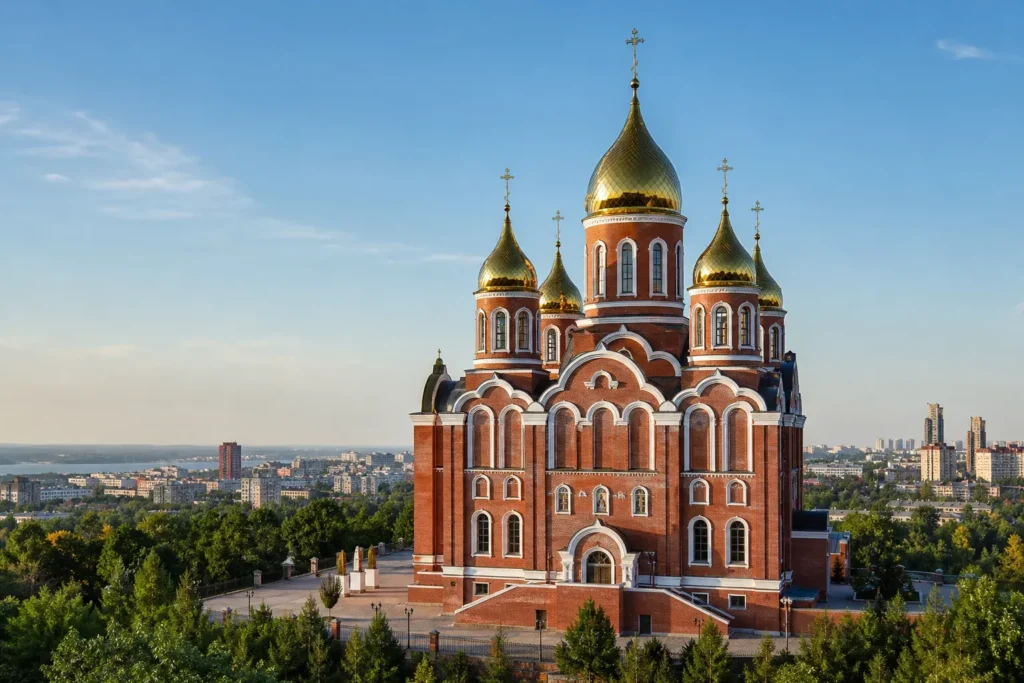
The Kazan Cathedral in Volgograd is a striking Orthodox church that dominates the city’s spiritual and architectural landscape. Built in the elegant Pseudo-Russian style with bright red-brick facades and white moldings, it is topped by five expressive tent-roofed domes, which were restored at the beginning of the 21st century.
In 1892, the authorities of Tsaritsyn decided to build a new church because the only temple in the Zatsaritsynsky part of the city could no longer accommodate all the parishioners. The foundation was laid in 1894, and by August 1899, the cathedral was consecrated. The cathedral stands on an elevated site, making its domes visible across the city.
Quick Facts
| Russian name | Казанский кафедральный собор |
|---|---|
| Built / opened | 1899 |
| Architect(s) | Mikhail Nikolaevich Grudistov |
| Address | Липецкая улица, 10, Волгоград, 400120 OpenStreetMap · Google Maps |
| District | Voroshilovskiy District |
| Opening hours | Mon-Fri 07:00-19:00; Sat 07:00-20:00; Sun 07:00-19:00 |
| Admission | free |
| Best time to visit | Spring (April–May) and early autumn (September–early October) offer pleasant weather and clear light for photography. Summer (June–August) can be very hot; early morning or late afternoon visits are more comfortable. Winter (December–February) is cold but the cathedral is striking against snow. Weekday mornings are quieter than weekends. Avoid visiting during active liturgical services unless you intend to participate respectfully. |
| Recommended duration | 1–2 hours |
| Website | volgograd-sobor.ru |
| Last updated | October 18, 2026 |
What Is (and Isn't) Part of a Visit to Kazan Cathedral, Volgograd?
| Part | Status | Notes |
|---|---|---|
| Main Cathedral | Included in the standard ticket | The entire interior, including the nave, iconostasis, and frescoes, is accessible during opening hours. |
| Bell Tower | Not open to visitors | The interior of the bell tower is not open to visitors. |
| Cathedral Grounds | Included in the standard ticket | The exterior and surrounding grounds are accessible; a peaceful garden is located inside the cathedral fence. |
| Sunday Liturgy and Religious Services | Included in the standard ticket | Visitors may attend Orthodox liturgical services, but dress codes apply and photography may be restricted during active worship. |
Why Visit Kazan Cathedral, Volgograd?
Inside, visitors will find unique frescoes from the mid-20th century and a solemn iconostasis. The building has a classic cross shape and can accommodate up to a thousand people at once, reaching a height of 36 meters. The cathedral is notable for surviving World War II and remaining a working place of worship. Its red-brick exterior with white decorative details and golden domes creates a striking contrast in the urban landscape, making it one of Volgograd’s most photographed monuments.
Highlights of Kazan Cathedral, Volgograd
Red-Brick Façade with White Moldings
The cathedral's bright red-brick facades are decorated with delicate white moldings and intricate brickwork. The exterior displays careful attention to decorative detail, with relief patterns created by master stonemasons visible throughout. The building exemplifies Russian Revival architecture at its finest, combining traditional Orthodox forms with 19th-century aesthetic principles.
Tip: Walk around the entire perimeter of the cathedral to appreciate the quality of the brickwork and geometric patterns, especially on the north and south sides.
Five Tent-Roofed Domes
The building is topped by five expressive tent-roofed domes, which were restored at the beginning of the 21st century. The modern appearance, featuring elegant tented domes, was achieved during a large-scale restoration between 2005 and 2010. These domes are the cathedral's most recognizable feature and guide visitors' eyes upward toward the sky.
Tip: Visit in late afternoon when the setting sun catches the golden surfaces of the domes, creating a warm, luminous effect.
Bell Tower
The slender bell tower was added to the main building only in 1904. The tower was reconstructed during the 2005–2010 restoration, returning the cathedral to its original architectural vision. The tower is one of the defining vertical elements of Volgograd's skyline.
Tip: The bell tower is best viewed from Lipetskaya Street looking east, where it creates a striking silhouette.
Interior Frescoes and Iconostasis
Inside, visitors will find unique frescoes from the mid-20th century and a solemn iconostasis. The frescoes were painted after the cathedral's restoration in the 1940s, reflecting Orthodox religious themes. The iconostasis is a large, ornate screen decorated with religious icons typical of Eastern Orthodox tradition.
Tip: Allow your eyes to adjust to the interior light to see the frescoes clearly. The soft light from windows helps illuminate the vault paintings.
Cathedral Status and Active Worship
The temple received the status of a cathedral in 1954 by decree of Patriarch Alexy I. The cathedral remains the primary Orthodox church in Volgograd, with regular liturgical services and active parish life. Unlike some museums or closed churches, this is a living place of worship.
Tip: Respect the dress code when entering: women should cover their heads and wear modest clothing; men should remove hats.
Wartime Survival and Restoration History
One of the few churches in Volgograd that survived the war and was almost never closed during Soviet times. It was badly damaged during the Battle of Stalingrad but in 1946 the surviving shell of the building was restored in the Russian revival style and in 1948 the church was reopened, but now as a cathedral. The building's resilience is remarkable given the destruction surrounding it.
Tip: The recent 2005–2010 restoration returned many original details. The domes and bell tower visible today reflect how the cathedral would have looked in 1904.
Atmosphere
The cathedral creates a sense of spiritual calm and architectural grandeur. Located on an elevation, the cathedral is not only an important religious site but also a striking architectural landmark that attracts the attention of everyone interested in the culture and history of the region. The interior is reverent and solemn, with worshippers and visitors moving quietly through the space. The vaulted ceilings, fresco paintings, and soft light from tall windows create an atmosphere of contemplation. Outside, the red brick and white moldings stand out sharply against the sky, especially dramatic during sunrise and sunset.
History of Kazan Cathedral, Volgograd
In 1892, the authorities of Tsaritsyn decided to build a new church because the only temple in the Zatsaritsynsky part of the city could no longer accommodate all the parishioners. The project was developed by the Saratov architect Mikhail Grudistov, who used the Alexander Nevsky Cathedral in Paris as a model. Funds for the construction—about 30,000 rubles—were raised in record time thanks to generous donations from citizens. The foundation was laid in 1894, and by August 1899, the cathedral was consecrated.
The original appearance of the cathedral was completed gradually; for instance, the slender bell tower was added to the main building only in 1904. The completed building became a landmark of Tsaritsyn (as Volgograd was known until 1925), visible across the steppe landscape.
After the October Revolution the church was eventually closed and used as a bakery. During the Soviet period, many Orthodox churches were demolished or repurposed, but this cathedral’s strong construction and community importance helped ensure its survival, albeit in diminished circumstances.
This church was heavily damaged in the Battle of Stalingrad. The German occupation force allowed the reopening of the church, in which reportedly a mass was held in favor of a quick German victory in December 1942. The building sustained significant structural damage, losing original decorative elements and suffering fire damage to its interior.
By 1946, permission was granted to restore the sanctuary. Under the guidance of architect Vasily Simbirtsev, the cathedral was restored and re-consecrated in 1948, becoming a spiritual pillar of the reviving city. The post-war restoration was an act of religious rehabilitation in a devastated city.
The temple received the status of a cathedral in 1954 by decree of Patriarch Alexy I. This elevation reflected both the building’s importance and the post-Stalin thaw in Soviet religious policy. The cathedral served as a symbol of Volgograd’s reconstruction and spiritual renewal.
Its modern appearance, featuring elegant tented domes, was achieved during a large-scale restoration between 2005 and 2010. This comprehensive restoration returned the cathedral to something approaching its original appearance, with careful attention to Grudistov’s 1890s design intent.
Tickets and Booking for Kazan Cathedral, Volgograd
Entry to the Kazan Cathedral is free. The cathedral is open daily to parishioners and visitors. Opening hours: Monday–Friday and Sunday 07:00–19:00; Saturday 07:00–20:00. These hours are subject to change for major Orthodox holidays and special services, so check the official website at volgograd-sobor.ru for the current schedule.
No advance booking is required for general visits. Dress code: Visitors are expected to dress modestly. Women should cover their heads (a scarf is appropriate) and wear long skirts or trousers. Men should remove hats. Photography may be restricted during active services; ask before photographing the interior during worship.
The cathedral remains an active place of worship, so quiet, respectful behavior is essential. Liturgical services follow the Orthodox calendar and occur at set times; casual visiting is best done outside service hours.
Plan and Book
Suggested itineraries Kazan Cathedral, Volgograd
30–45 minutes
View the exterior in detail, walking around all sides to appreciate the red-brick facades, white moldings, and five domes. Photograph from different angles, especially from the elevated position. If the cathedral is open and services are not underway, step inside briefly to see the iconostasis and main interior space.
1–2 hours
Begin with an exterior tour, noting the bell tower and dome details. Enter the cathedral and spend time looking at the fresco paintings and iconostasis. Sit quietly in the nave to absorb the atmosphere. If interested in church history, learn about its survival through World War II and its restoration. Conclude with views from the elevated grounds looking out across the city.
How to Get to Kazan Cathedral, Volgograd
The Kazan Cathedral is located at Lipetskaya Street, 10, in the Voroshilovskiy District of Volgograd. The cathedral stands on elevated terrain known as Dar-gora, making it prominent in the cityscape.
By public transport: Volgograd has a tram network but no metro. Tram routes serve the central city. Check local transport information or maps for tram stops nearest to Lipetskaya Street. Tram 2 passes near the cathedral according to visitor reports.
By taxi or ride-hailing: From central Volgograd, a taxi ride to the cathedral takes 10–20 minutes depending on traffic. Use Yandex Maps or a local ride-hailing app to navigate.
Walking: If you are staying in central Volgograd, the cathedral may be within walking distance (15–30 minutes depending on your starting point). Use offline maps or ask locals for directions to Lipetskaya Street.
Accessibility
The cathedral stands on elevated terrain, and there is a slight slope leading to the main entrance. Entry and circulation within the main prayer space are generally accessible, though traditional Orthodox church layouts may have some steps. The interior floor is flat in most areas. Accessible toilet facilities are not documented; check the official website or phone ahead to confirm current accessibility. Companions or assistive devices are permitted. There are benches inside for seating.
Food Nearby
The cathedral is located in a residential area of Volgograd. Cafés and small restaurants can be found along Lipetskaya Street and in nearby commercial areas. Street vendors and kiosks selling snacks and drinks operate in the district. For more substantial meals, head toward the central areas of Volgograd, a short tram or taxi ride away. Check Google Maps or Yandex Maps for restaurants near the address, as specific venue names change.
What to Bring
Comfortable, modest clothing and sturdy footwear suitable for standing and walking. A head covering (scarf or hat) for women is important for cathedral etiquette. Sunscreen and a hat for sunny days, as the cathedral's elevated position offers little shade. An offline map or smartphone with GPS and maps app loaded, as internet connectivity may be inconsistent. A camera for exterior photography, though respect restrictions on interior photos during services. In winter, warm layers, hat, gloves and warm footwear are essential.
Best Views and Photo Spots of Kazan Cathedral, Volgograd
Lipetskaya Street approach from the south
The full frontal view of the cathedral showing the five domes, red-brick façade, white moldings, and the bell tower at right. This is the most iconic angle and works well in golden-hour light.
Best time: Late afternoon (3–5 PM) when the setting sun illuminates the red brick and creates shadows in the relief patterns.
Elevated platform to the east of the cathedral
A side view showing the cathedral's main dome and the bell tower against the sky, with the city visible in the background.
Best time: Morning light (8–10 AM) from the east provides clear, directional illumination of the domes.
Northwest corner of the cathedral grounds
A three-quarter view capturing the bell tower, multiple domes, and the intricate brickwork of the north and west facades together.
Best time: Midmorning (10 AM–12 PM) or afternoon (3–5 PM) for balanced lighting that emphasizes architectural detail.
Street level looking upward from Lipetskaya Street
A dramatic low-angle perspective emphasizing the height of the domes and the dominance of the cathedral in the urban landscape.
Best time: Midday or early afternoon when the sky is clear and the contrast between the domes and background is strong.
Photography Rules
Exterior photography and video are permitted freely. Interior photography is allowed during regular visiting hours when services are not underway, but flash and tripods are prohibited inside the cathedral. Do not photograph during active liturgical services without explicit permission. Drones are not permitted in the cathedral grounds. Be respectful of worshippers and ask staff if you are unsure about specific situations.
Family Suitability
The cathedral is suitable for families and children of all ages. The open interior space is easy to navigate with strollers, though the slight slope to the entry and some interior steps should be considered. Children benefit from learning about Orthodox architecture and history. The peaceful atmosphere and beautiful interior hold children's attention. Dress code requirements (modest clothing, head covering for girls and women) should be explained beforehand. During services, children are welcome but should be kept quiet and calm. The cathedral grounds offer gentle walking and views suitable for a short family outing.
Russia Vibes Tips
- Visit early morning (7–8 AM) or late afternoon (5–7 PM) on weekdays to experience the cathedral with fewer tourists and worshippers, allowing for peaceful photography and quiet contemplation.
- The cathedral sits on elevated terrain. Approach from Lipetskaya Street to appreciate its dominance in the cityscape. Wear comfortable shoes, as the grounds have some slopes and you will want to walk around the entire perimeter.
- If you visit during active services, do not interrupt worship. Respect the liturgy and sit quietly at the back. Services typically occur in the early morning and evening; ask staff or check the website for exact times.
- The cathedral's Russian Revival style is best understood by comparing it to photographs of Mikhail Grudistov's other works and to the Alexander Nevsky Cathedral in Paris, which inspired this design. Having background knowledge enhances appreciation.
- The recent 2005–2010 restoration reconstructed the bell tower and refined the domes. Many of the frescoes visible inside were painted post-1946 during the Soviet-era restoration, not original 1890s artwork. This historical layering is worth understanding.
- The cathedral's survival of the Battle of Stalingrad and Soviet-era closure makes it one of the few major Orthodox churches in Volgograd still in active use. This historical resilience is part of its significance beyond architecture alone.
Explore Nearby Kazan Cathedral, Volgograd
Sights near Kazan Cathedral, Volgograd
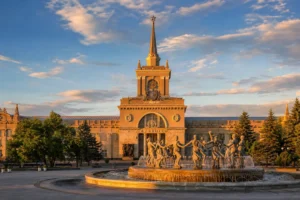 Volgograd Railway Station, Volgograd – about 2.6 km away · typical visit: 30 minutesOpen daily 00:00–23:59
Main image: AI-generated illustration. It may not show the place exactly as it looks.
Restaurants and cafes near Kazan Cathedral, Volgograd
 Voronka, Volgogradabout 1.4 km away (~23 min walk)
Main image: AI-generated illustration. It may not show the place exactly as it looks.
Hotels near Kazan Cathedral, Volgograd
 Hampton by Hilton Volgograd Profsoyuznaya, Volgogradabout 850 m away (~14 min walk)
Main image: AI-generated illustration. It may not show the place exactly as it looks.
 Hostel Centre, Volgogradabout 2.1 km away
Main image: AI-generated illustration. It may not show the place exactly as it looks.
 Cosmos Volgograd Hotel, Volgogradabout 2.5 km away
Main image: AI-generated illustration. It may not show the place exactly as it looks.
Browse more: More in Voroshilovskiy District · All Churches · All Sightseeing · All Sightseeing in Volgograd · All Volgograd
FAQ: Kazan Cathedral, Volgograd
Is there a separate ticket to enter the cathedral?
No. Entry to the Kazan Cathedral is free. No ticket is required. Simply arrive during opening hours and enter respectfully. Make a donation if you wish to support the cathedral's upkeep.
Can I visit during religious services?
Yes, but with respect for ongoing worship. Services occur at set times, typically early morning and evening. Check the official website or phone +7 844 294-78-43 to confirm service times. Dress modestly and sit quietly at the back if you attend.
What is the best time of day to visit?
Weekday mornings (8–10 AM) or late afternoons (4–6 PM) are quietest and offer good natural light for photography. Avoid peak tourist hours (midday on weekends) and active service times if you prefer a peaceful visit.
Is photography allowed inside the cathedral?
Yes, interior photography is allowed during regular visiting hours when services are not underway. Flash, tripods, and video recording are prohibited. Always ask staff if you are unsure, and do not photograph during active worship without permission.
Do I need special clothing to enter?
Yes. Dress modestly: women should cover their heads with a scarf or hat and wear long skirts or trousers; men should remove hats. This is expected etiquette in Orthodox churches and shows respect for the sacred space.
How long should I plan to spend there?
1–2 hours allows time to walk around the exterior, appreciate the domes and brickwork, enter the interior, and view the frescoes and iconostasis. A quick 30-minute visit is also possible if time is limited.
Is the cathedral accessible for people with disabilities?
The cathedral is located on elevated terrain and has a sloped entrance. The interior is generally navigable, though it retains some traditional Orthodox church features including steps in places. Call +7 844 294-78-43 ahead to confirm current accessibility details.
What survived from the Battle of Stalingrad?
The cathedral's brick shell survived the fighting but was heavily damaged. It was restored in 1946–1948. Most of the interior frescoes and details visible today date from the post-war restoration, not the original 1899 decoration. The building's survival itself is remarkable.
Russia Vibes is a one-person project. A coffee keeps it going
Last updated: October 18, 2026.
How we research and update our guides
About this guide: AI assistance and accuracy
This guide is created with the help of AI and is based on official sources where available. Mistakes can still happen. Opening hours, prices, rules and other details are given to the best of our knowledge as of the date shown and can change without notice. It offers general recommendations only, not professional, legal or travel advice. Please confirm important details with the official source before you travel; you are responsible for your own plans and decisions.
International sanctions affect payments between Russia and many other countries. In practice, cards issued in the EU, the UK, the US and several other countries often do not work in Russia, Russian cards usually do not work abroad, and some booking platforms, airlines and payment providers limit or suspend their services for Russia. The situation changes frequently. We do not give legal or financial advice, and this site does not encourage anyone to break or circumvent sanctions. Whatever you plan, you are responsible for following the laws and regulations that apply to you, including those of your country of residence and citizenship. Many travelers still organise their stay lawfully. It is worth asking your bank or payment provider what is currently permitted, contacting hotels, tour operators and carriers directly about the payment methods they accept, and checking which services are open to customers from your country. Clarify payment, cancellation and refund terms before you commit to a booking, and keep your plans flexible. Partner links on this site may not be available in every country, and prices, availability and rules in our guides can differ from what you see when you book.Paying for your trip: please read
Report an issue on this page

Take this guide with you
Get a free PDF of this guide to print or read offline: key facts, tips and a map link on a few clean pages.