
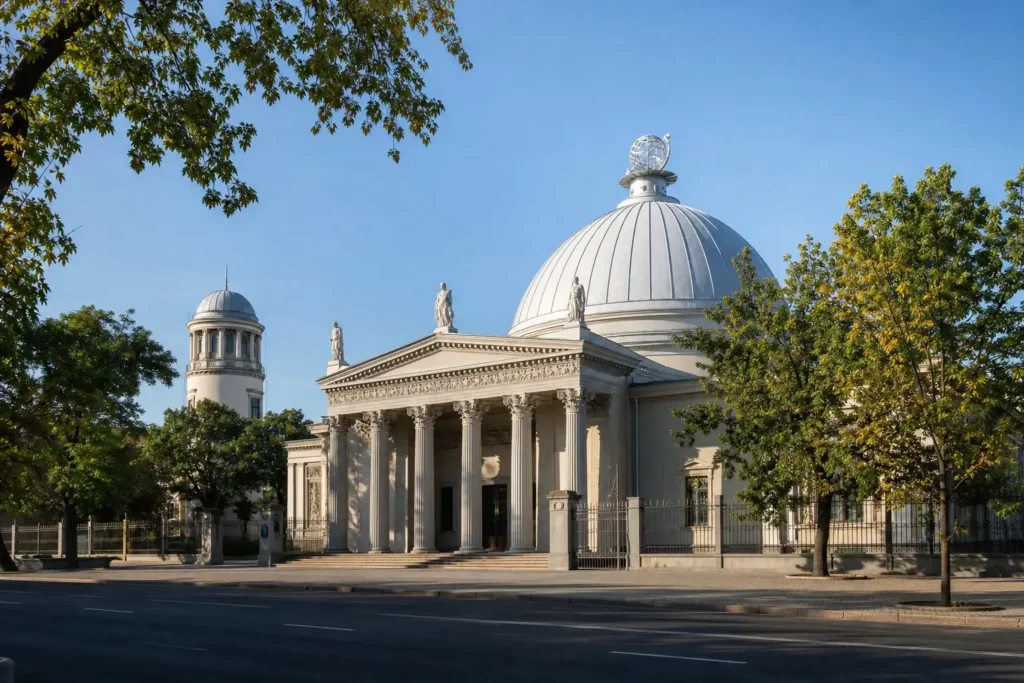
The Volgograd Planetarium was inaugurated on 19 September 1954 and was built and donated to the city by the people and government of the German Democratic Republic. This monumental structure has become one of Volgograd’s most recognizable landmarks, standing in the city’s historic center on Gagarina Street—the first street to be fully restored after World War II.
The Star Hall seats 450 spectators and is equipped with a large planetarium apparatus housing 99 projectors, which can simultaneously display 6,000 stars and planets. Since 2019, the planetarium has also become digital, with a full-dome system projecting films across the entire dome in 360-degree view.
Quick Facts
| Russian name | Волгоградский планетарий |
|---|---|
| Built / opened | 1954 |
| Architect(s) | V. N. Simbirtsev |
| Address | улица Гагарина, 14 OpenStreetMap · Google Maps |
| District | Tsentralny |
| Opening hours | Daily 10:00-18:00 |
| Admission | ₽ |
| Best time to visit | Visit on weekday mornings for shorter queues and better chances of booking a preferred observation time at the observatory. Clear daytime hours allow solar observation; clear evenings permit lunar and planetary observation. Avoid school vacation periods (late May to early September, late December to early January, March spring break) when the planetarium is crowded with groups. Spring and autumn have pleasant weather and fewer international tourists competing for spots. Winter afternoons offer clear skies but very short daylight for observatory visits. |
| Recommended duration | 1–2 hours |
| Website | volgogradplanetarium.ru |
| Last updated | October 18, 2026 |
What Is (and Isn't) Part of a Visit to Volgograd Planetarium, Volgograd?
| Part | Status | Notes |
|---|---|---|
| Star Hall planetarium shows | Included in the standard ticket | Entry ticket includes access to the main dome shows; specific showtimes vary daily and are published on the official website. |
| Exhibition halls and foyer displays | Included in the standard ticket | Ground floor foyer and second floor exhibition space are included with admission. |
| Astronomical observatory telescope | Included in the standard ticket | Visits to the observatory with telescope observation are included in standard admission; staff guide the telescope to celestial objects. |
| Outdoor astronomical square | Included in the standard ticket | Access to the landscaped grounds with ancient astronomical instruments is included. |
| Digital full-dome films (when scheduled) | Separate ticket or institution | Modern digital shows may require a separate ticket or higher admission level; confirm current pricing with the ticket office. |
Why Visit Volgograd Planetarium, Volgograd?
The site includes its own astronomical observatory, where visitors can conduct both daytime and evening observations with a 12-inch refractor telescope made by Carl Zeiss. The planetarium hosts hour-long educational science programs daily, each including an engaging tour, demonstrations of all exhibits, and a Foucault pendulum experiment, with lectures covering a variety of topics aimed at both adults and children. The building itself is an architectural treasure, featuring neoclassical design with a colonnade and topped by a dome.
How Volgograd Planetarium, Volgograd Is Laid Out
The planetarium complex consists of three main areas. The main building houses the Star Hall on the ground floor with its grand foyer and projection dome. A separate astronomical observatory—a round building 26 meters tall with a rotating domed roof—sits in the courtyard of the planetarium, with the dome featuring a large opening for the Carl Zeiss telescope. An astronomical square surrounds the planetarium where visitors can observe ancient astronomical instruments: an armillary sphere, sundial, and an Earth globe. Enter through the main colonnade facing Gagarina Street.
Highlights of Volgograd Planetarium, Volgograd
Star Hall and Classical Zeiss Projector
The Star Hall accommodates 450 spectators and features a domed screen with a large 'Planetarium' apparatus that houses 99 projectors, allowing simultaneous viewing of 6,000 stars and planets. This is the original projector from 1954, still in operation and showing traditional astronomical shows alongside modern digital presentations.
Tip: Arrive early to secure seating directly under the dome for the best immersive experience; check the schedule on the official website for show times and content.
The 'World' Sculpture and Dome
The building's dome is crowned with the sculpture 'The World' by sculptor Vera Ignatievna Mukhina, known for the sculpture 'Worker and Collective Farmer' at VDNH. This is her final major work. The dome itself reaches 23 meters in diameter. The neoclassical facade with massive columns and the gleaming white dome create an unmistakable silhouette.
Tip: View the sculpture and dome from Gagarina Street for the best exterior photographs; the sculpture can be seen clearly from the middle of the street.
Carl Zeiss Observatory
The observatory features a 12-inch refractor telescope made by Carl Zeiss with a focal length of 5 meters and 800x magnification. This round building stands 26 meters tall with a rotating dome that can turn in any direction, with a large split for the telescope. You can observe the moon, planets, and star clusters through the actual telescope, making real astronomical observation possible.
Tip: Visit in clear daytime hours for solar observation (check ahead for availability), or book evening sessions when the moon and planets are visible; staff will guide the telescope to specific celestial objects.
Ground Floor Foyer and Soviet Exhibition
The foyer features twelve columns of pink marble and displays the layout of the Vostok spacecraft, the layout of the first satellite in full size, and other exhibits. The space evokes Soviet-era scientific optimism and includes models of early space hardware. Visitors can see original meteorite samples and learn about the space program.
Tip: Don't skip the foyer—it sets the historical and aesthetic tone for the entire visit and is included with your regular admission.
Second Floor Exhibition Space
The main exhibit of the second floor is a Foucault pendulum, along with several types of globes: moon, star, internal structure of the Earth, and two meteorites named 'Tsar' and 'Sikhote-Alin'. The Foucault pendulum demonstrates the Earth's rotation in real time, a classic physics demonstration that fascinates both children and adults.
Tip: Arrive when an official demonstration is scheduled to have the Foucault pendulum explained; timing varies by day.
Astronomical Square and Outdoor Exhibits
An astronomical square around the planetarium features historical astronomical instruments: a horizontal sun-clock, an Earth globe, and an armillary sphere. These ancient instruments show how astronomers measured and understood the sky before modern technology. The landscaped garden provides a pleasant outdoor space.
Tip: Visit during clear weather to use the working sun-clock; compare its time with your watch to see the effects of longitude and season on solar time.
Digital Full-Dome Shows
Since 2019, the planetarium has a full-dome system that projects films across the entire dome with a 360-degree view. These modern programs complement the classic starfield shows, featuring immersive documentaries on space exploration, distant galaxies, and planetary systems. The digital system coexists with the mechanical projector.
Tip: Ask at the ticket desk which shows are available on your visit day; digital shows are often scheduled at specific times and may require separate or higher admission.
Atmosphere
Walking inside, the atmosphere shifts immediately from the Soviet-era grandeur of the foyer—with its pink marble and space-age models—to the hushed darkness of the Star Hall. The dome above creates a sense of intimacy and wonder as the projector brings the night sky to life with thousands of points of light. The architecture feels both monumental and purposeful, untouched by modern glossiness; voices echo slightly off the marble and stone, adding to the sense of being in a place built with serious scientific intent.
Visitors range from school groups to families with young children to astronomy enthusiasts. The pace is contemplative during shows, though the foyer and exhibition floors have a busier energy. The 1954 design creates a time capsule feel—part museum, part working scientific institution. Best visited on weekday mornings when crowds are lighter and more observation slots are available at the observatory.
History of Volgograd Planetarium, Volgograd
The grand opening took place on 19 September 1954. At that time, it was only the third planetarium in the USSR after Moscow and Kyiv, but in terms of technical equipment, it surpassed many similar facilities worldwide. The building was built and donated to the city by the people and government of the German Democratic Republic. Gagarina Street itself was the first street in Volgograd to be completely restored after World War II.
The planeterium was designed as a gift from the Soviet ally, reflecting Cold War-era scientific cooperation. The architect was honored folk architect V. N. Simbirtsev, in collaboration with N. I. Khomotovy. The dome is crowned with the sculpture ‘The World’ by sculptor Vera Ignatievna Mukhina, known for the sculpture ‘Worker and Collective Farmer’ at VDNH.
The classical design—a neoclassical temple-like structure with a colonnade and dome—reflects Soviet scientific ambitions of the 1950s. The building’s neoclassical style was intentional, presenting astronomy as a noble, timeless pursuit. The original mechanical Zeiss projector remained the centerpiece for decades, installed with 1950s German precision engineering.
Over decades of operation, more than 32 million people have visited, including Soviet cosmonauts who used the local starry sky to study navigation charts before their flights. In the 1990s and 2000s, as the Soviet Union fell and post-Soviet Russia struggled, the planetarium continued operating, though aging. In 2019, a major upgrade added a full-dome digital projection system, allowing modern astronomical films to be shown alongside the classical mechanical shows. Today, it remains both a working scientific institution and a symbol of Volgograd’s cultural recovery after the devastation of the Battle of Stalingrad.
Legends and Myths about Volgograd Planetarium, Volgograd
The Gift from East Germany
Disputed by historians. According to local tradition, the planetarium was given to Volgograd by East Germany as a gesture of Soviet friendship and in honor of Stalin's 70th birthday in 1954. Some accounts emphasize that the building was constructed and donated entirely by German workers and engineers, making it a unique Cold War gift. This narrative celebrates international scientific cooperation during an otherwise tense geopolitical period.
Soviet Cosmonauts' Navigation Training
Legend – historically unreliable. The story holds that Soviet cosmonauts studied the planetarium's starfield before launching into space, using the projected constellations to learn celestial navigation for their missions. This lore reflects the building's prestige during the Space Age and its association with Soviet space achievement. The planetarium's technical capabilities made it a suitable training facility for cosmonauts.
Tickets and Booking for Volgograd Planetarium, Volgograd
| Ticket | Price | Includes |
|---|---|---|
| Standard admission (adults and most visitors) | ₽ | Access to all exhibition halls, the Star Hall with traditional planetarium show, and the observatory telescope. |
| Group visits | ₽ | Available for organized groups; requires advance booking through the official website. |
₽ budget · ₽₽ moderate · ₽₽₽ upscale · ₽₽₽₽ splurge. Price levels are estimates compared with typical prices for visitors.
The planetarium is open daily from 10:00 to 18:00. Sessions in the Star Hall are held according to a specific schedule, which may change depending on the day of the week and scheduled events. Purchase tickets at the entrance or by contacting the planetarium directly through their official website.
Walk-in visitors are generally welcome, though during busy times (school holidays, weekends) sessions may fill. For organized groups or to confirm session schedules in advance, visit volgogradplanetarium.ru. The official website lists all show times and provides information on current exhibitions. Pricing for Russian citizens, students, and other concessions differs from visitor rates; see the official ticket page for all categories and current rates.
Plan and Book
Suggested itineraries Volgograd Planetarium, Volgograd
1 hour
Fast overview: foyer and space exhibits (15 minutes), Star Hall show (40 minutes). Best for those with limited time or young children. Skip the second floor and observatory.
1.5–2 hours
Full visit: foyer exhibits (10 minutes), Star Hall show (40 minutes), second floor exhibition with Foucault pendulum and globe models (20 minutes), brief observatory visit with telescope observation (10 minutes), outdoor square walk (5 minutes).
3+ hours
Deep dive: Start with foyer and space exhibits, attend a Star Hall show, explore the second floor thoroughly with staff explanations, spend time at the observatory observing specific celestial objects (especially rewarding in clear weather), stroll the astronomical square, and revisit any section that particularly interests you.
How to Get to Volgograd Planetarium, Volgograd
The Volgograd Planetarium is located at 14 Gagarina Street in the city center. The location is very convenient, within walking distance of many central streets. The building sits on Gagarina Street, which runs through central Volgograd.
By foot: From central landmarks like Lenin Square or the nearby Gorky Library, the planetarium is within a 5–10 minute walk. The large white domed building with colonnade is visible from Gagarina Street and easy to spot.
By public transport: Volgograd operates tram and bus services. Tram lines run on or near Gagarina Street; take a tram heading toward the city center and exit at the planetarium stop. Bus routes also serve the central area; check local transit maps (Yandex Maps or Google Maps display current routes and schedules).
By taxi: Ride-hailing apps (Yandex Taxi, other local services) will take you directly to the address. The journey from the central railway station takes about 15–20 minutes depending on traffic.
Accessibility
The main floor is accessible via the colonnade entrance. The foyer and Star Hall are wheelchair accessible. The second floor is reached by stairs; elevator availability should be confirmed in advance by contacting the planetarium. The observatory courtyard is accessible, though the observatory building itself may have steps; call ahead to arrange accommodations. Companion tickets may be available for visitors with mobility restrictions; inquire at the ticket desk.
Food Nearby
The city center around Gagarina Street has cafes and restaurants within walking distance. Options include casual Soviet-style stolovaya (cafeteria) restaurants serving traditional Russian food, modern cafes, and street food vendors. The planetarium itself does not appear to have an on-site cafe; plan to eat before or after your visit. Water is available inside.
What to Bring
Wear comfortable walking shoes for the outdoor square and multiple floors. In winter, bring warm clothing; the building is heated but the outdoor areas are cold. In summer, bring sunscreen and sunglasses for the sunny outdoor square. A light jacket is useful year-round. The planetarium does not restrict bags, but avoid large items that obstruct others' views in the Star Hall.
Best Views and Photo Spots of Volgograd Planetarium, Volgograd
Gagarina Street facade and dome
From the middle of Gagarina Street, looking at the main building. The white neoclassical colonnade, the dome, and the 'World' sculpture are all visible in one shot. The street's tree-lined setting provides framing.
Best time: Late morning (10:00–11:00) or late afternoon (16:00–17:00) for soft directional light that highlights the dome; avoid harsh midday sun. Overcast days produce even, shadowless light.
Dome interior from within the Star Hall (between shows, if permitted by staff)
The massive dome overhead with its ribbed interior structure is visually striking. The scale conveys the ambition of the 1954 construction. Best captured from various seats within the hall.
Best time: During daylight hours when doors are open; ask staff if photography is permitted between sessions.
Observatory building from the courtyard
The round tower with rotating dome in the landscaped courtyard. The distinct architecture and the telescope aperture are visible from the courtyard path. Trees provide framing.
Best time: Afternoon light (14:00–16:00) illuminates the round building well; avoid backlighting.
Foyer with pink marble columns
The grand entrance foyer with its twelve pink marble columns and space-age exhibits (Vostok model, satellite layout) conveys the Soviet-era aesthetic. The soaring space and exhibits create visual depth.
Best time: Daytime when natural light enters; photography is generally permitted. Avoid flash to prevent disturbing the atmospheric lighting.
Astronomical square with ancient instruments and dome beyond
The outdoor square with armillary sphere, sun-clock, and globes in the foreground, with the main dome visible behind. The combination of historical and modern elements in one composition.
Best time: Late morning (10:00–12:00) or early afternoon (14:00–16:00) for angled light that highlights the instruments' details.
Photography Rules
Photography is generally permitted in exhibition halls and the outdoor square. Flash photography should be avoided in exhibition halls to prevent disturbing the ambient lighting. The Star Hall during shows typically does not permit photography due to darkness and to protect the show experience. Tripods may not be permitted in crowded areas; ask staff. The outdoor dome and sculptures photograph well from Gagarina Street.
Family Suitability
Excellent for families with children ages 5 and up. The Star Hall shows are designed for all ages and are captivating for children; the darkness, projected stars, and narration hold attention. The foyer exhibits—spacecraft models and meteorites—appeal strongly to children interested in space. The second-floor Foucault pendulum demonstration fascinates all ages. The outdoor square provides play space. Young toddlers may struggle with the quietness required during shows, but the museum overall is stroller-friendly (main floors are flat and accessible). The bright, engaging content makes it suitable for school-age children. Preschoolers may find the 40-minute Star Hall show too long; plan shorter visits.
Russia Vibes Tips
- Check the official website before arriving to confirm the day's Star Hall show schedule and times; scheduling varies by day of the week and there are no fixed 'on the hour' shows like some planetariums.
- Visit the observatory early in your visit if you're interested in telescope observation; clear-sky viewing slots may fill or be cancelled if clouds arrive later.
- Allow 10 minutes to walk from Gagarina Street through the foyer to reach the Star Hall entrance; the building is larger than it appears from outside.
- The outdoor astronomical square is often overlooked; spend 5–10 minutes there to appreciate the sun-clock and ancient instruments, and it's a good photo spot.
- Go on a weekday if possible; weekends and school holiday periods (especially summer) draw large groups, making shows and observation slots harder to book.
- The website and signage are in Russian; if you don't speak Russian, ask the ticket staff for an English-language summary of show content before purchasing, as shows are narrated in Russian.
Explore Nearby Volgograd Planetarium, Volgograd
Sights near Volgograd Planetarium, Volgograd
 Volgograd Panorama Museum, Volgogradabout 600 m away (~10 min walk) · typical visit: 2–3 hours
Main image: AI-generated illustration. It may not show the place exactly as it looks.
 Pavlov's House, Volgograd – about 600 m away (~10 min walk) · typical visit: 30–45 minutesOpen 24 hours
Main image: AI-generated illustration. It may not show the place exactly as it looks.
 Gerhardt's Mill, Volgograd – about 650 m away (~10 min walk) · typical visit: 30–45 minutesOpen 24 hours
Main image: AI-generated illustration. It may not show the place exactly as it looks.
 Volgograd Railway Station, Volgograd – about 850 m away (~13 min walk) · typical visit: 30 minutesOpen daily 00:00–23:59
Main image: AI-generated illustration. It may not show the place exactly as it looks.
 Central Embankment, Volgograd – about 850 m away (~14 min walk) · typical visit: 1–2 hoursOpen 24 hours
Main image: AI-generated illustration. It may not show the place exactly as it looks.
Restaurants and cafes near Volgograd Planetarium, Volgograd
 Denver Burgers, Volgogradabout 1.0 km away (~16 min walk)
Main image: AI-generated illustration. It may not show the place exactly as it looks.
 Restaurant Marusya, Volgogradabout 1.2 km away (~19 min walk)
Main image: AI-generated illustration. It may not show the place exactly as it looks.
 Bamberg, Volgograd – about 1.3 km away (~22 min walk)Open daily 11:00–23:00
Main image: AI-generated illustration. It may not show the place exactly as it looks.
Hotels near Volgograd Planetarium, Volgograd
 Cosmos Volgograd Hotel, Volgogradabout 950 m away (~16 min walk)
Main image: AI-generated illustration. It may not show the place exactly as it looks.
 Stariy Stalingrad, Volgogradabout 1.2 km away (~19 min walk)
Main image: AI-generated illustration. It may not show the place exactly as it looks.
 Hilton Garden Inn Volgograd, Volgogradabout 1.8 km away (~29 min walk)
Main image: AI-generated illustration. It may not show the place exactly as it looks.
Related guides
 Voronka: Volgograd’s Best Coffee, Wine, and All-Day Breakfast Café
Main image: AI-generated illustration. It may not show the place exactly as it looks.
 Mamayev Kurgan: The Motherland Calls and Battle of Stalingrad MemorialOpen daily 09:00–18:00
Main image: AI-generated illustration. It may not show the place exactly as it looks.
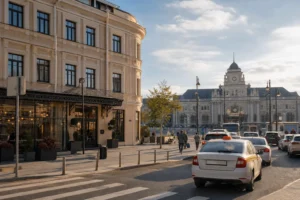 Crystal Hotel, Kazan: Convenient Central Location Opposite the Railway Station
Main image: AI-generated illustration. It may not show the place exactly as it looks.
Browse more: More in Tsentralny · All Museums · All Sightseeing · All Sightseeing in Volgograd · All Volgograd
FAQ: Volgograd Planetarium, Volgograd
What is the difference between the traditional show and the digital full-dome show?
The traditional show uses the original 1954 Zeiss projector, displaying a classical starfield and constellations with narration—an iconic mid-20th-century experience. The digital full-dome show (added in 2019) projects modern films in 360-degree immersion across the dome, showing documentaries on space exploration and distant galaxies. Both are educational. Digital shows may cost more; confirm pricing and availability on the day of your visit.
Is the observatory included in the ticket price?
Yes. Access to the observatory telescope is included with standard admission. You can observe through the telescope during visiting hours, with staff assistance. Clear weather is required for optimal viewing; cloudy days may mean limited observation opportunities.
Can I visit without watching a Star Hall show?
Yes. You can purchase admission to view the foyer exhibits, second-floor exhibition (Foucault pendulum, globes, meteorites), outdoor astronomical square, and use the observatory telescope without attending a show. However, the Star Hall is the main attraction and is included in the ticket price, so it's worth catching a showing if time permits.
How long does a Star Hall show last?
Shows typically last around 40 minutes to 1 hour, including an introduction by a presenter. This is a fixed experience with a beginning and end; you cannot arrive mid-show.
What languages are shows presented in?
Shows are narrated in Russian. If you don't speak Russian, it's worth asking staff for a brief English summary of the show's content before purchasing; visual elements are universally understood, so you will follow along with projected celestial objects and music.
Is there a cafe inside the planetarium?
No on-site cafe has been confirmed. Bring water and plan to eat at nearby cafes or restaurants on Gagarina Street before or after your visit.
Do I need to buy tickets in advance online?
For individual visitors, walk-in tickets are typically available, especially on weekday mornings. For large groups or to guarantee entry at a specific time, book in advance through the official website. Check the website for current booking procedures.
Is the planetarium wheelchair accessible?
The main floors (foyer, Star Hall, and second floor via elevator or stairs) are accessible. The observatory courtyard is accessible, though reaching the telescope may require assistance. Contact the planetarium in advance to arrange accommodations for specific accessibility needs.
Russia Vibes is a one-person project. A coffee keeps it going
Last updated: October 18, 2026.
How we research and update our guides
About this guide: AI assistance and accuracy
This guide is created with the help of AI and is based on official sources where available. Mistakes can still happen. Opening hours, prices, rules and other details are given to the best of our knowledge as of the date shown and can change without notice. It offers general recommendations only, not professional, legal or travel advice. Please confirm important details with the official source before you travel; you are responsible for your own plans and decisions.
International sanctions affect payments between Russia and many other countries. In practice, cards issued in the EU, the UK, the US and several other countries often do not work in Russia, Russian cards usually do not work abroad, and some booking platforms, airlines and payment providers limit or suspend their services for Russia. The situation changes frequently. We do not give legal or financial advice, and this site does not encourage anyone to break or circumvent sanctions. Whatever you plan, you are responsible for following the laws and regulations that apply to you, including those of your country of residence and citizenship. Many travelers still organise their stay lawfully. It is worth asking your bank or payment provider what is currently permitted, contacting hotels, tour operators and carriers directly about the payment methods they accept, and checking which services are open to customers from your country. Clarify payment, cancellation and refund terms before you commit to a booking, and keep your plans flexible. Partner links on this site may not be available in every country, and prices, availability and rules in our guides can differ from what you see when you book.Paying for your trip: please read
Report an issue on this page

Take this guide with you
Get a free PDF of this guide to print or read offline: key facts, tips and a map link on a few clean pages.