
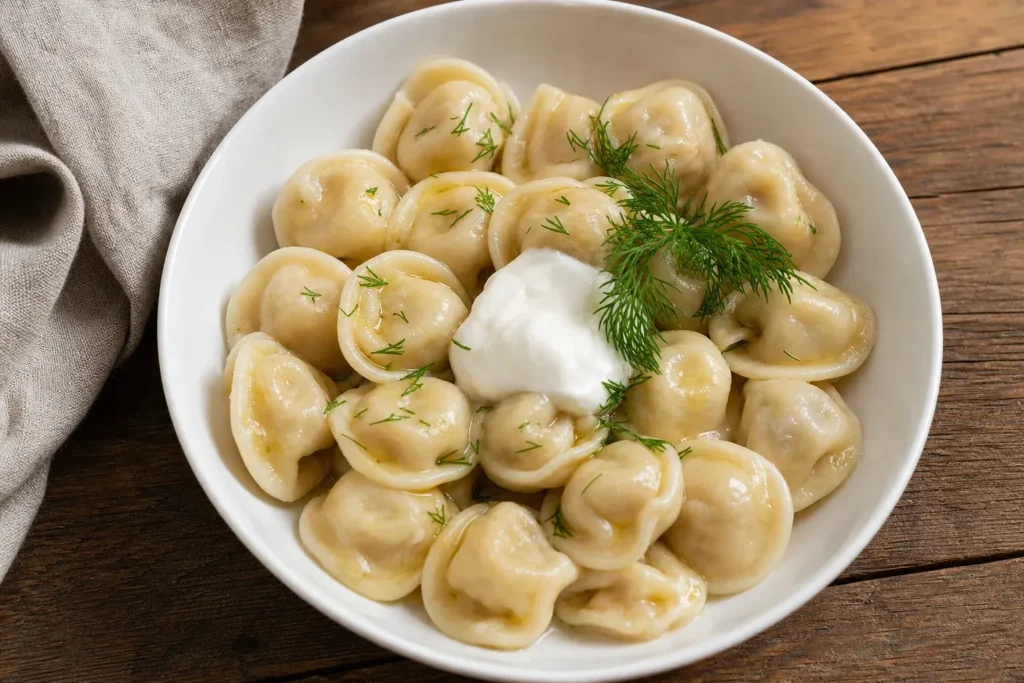
Pelmeni are among Russia’s most iconic comfort foods, and learning to make them at home opens a window into Russian home cooking. If you want to prepare pelmeni from scratch, this guide covers the straightforward technique: mixing simple dough, preparing meat filling, shaping the dumplings, and boiling them until they float. The whole process works best when done in stages, and the good news is that uncooked pelmeni freeze beautifully, so many cooks make large batches.
This recipe serves 2–4 people and takes roughly 90 minutes from start to table. How to make Russian meat dumplings begins with a basic dough and moves through filling, shaping, and cooking in just a few steps.
Quick answer: Mix flour, eggs, water and salt into a stiff dough, let it rest 30 minutes, then roll thin and cut circles. Fill each with raw seasoned ground meat and onion, fold into half-moons, pinch the edges together into an ear shape, and boil in salted water until they float. Takes 90 minutes; serves 2–4.
At a Glance
| Type | Dishes |
|---|---|
| Local name | пельмени |
| Origin | Siberia and Ural Mountains region of Russia. The name derives from pel'nyan' in the Komi language, meaning 'ear bread,' referring to their ear-like shape when folded. |
| Servings | 2–4 people (makes approximately 40–50 dumplings) |
| Total time | 90 minutes |
| Difficulty | Medium |
History and Story of Pelmeni, Volgograd
Pelmeni became a staple of Russian cuisine during the period of Russian expansion into the Ural Mountains and Siberia. This particular shape actually originated in the Ural Mountains region. Many believe they originated in China and were brought to the country by Mongolians who absorbed the delicious treats into their own cuisine and brought the dish into Siberia and the Urals. The term “pelmeni” derives from the word “pel’n’an'” from the native Finno-Ugric Komi and Udmurt languages, meaning “ear bread” and referring to the particular shape of the dumplings. Dumplings are ideal for the conditions of the Siberian climate: due to long frosts, dumplings could be stored all winter through and taken on camping and hiking. For a long time pelmeni were a traditional dish of the dwellers of Siberia and the Urals.
Ingredients
- 350 g all-purpose flour
- 1 egg
- 150 ml cold water
- 1 teaspoon salt
- 300 g ground beef or pork (or mixed)
- 1 medium onion, finely chopped or minced
- ½ teaspoon ground black pepper
- 1 tablespoon sour cream or water (for filling)
How Pelmeni, Volgograd Is Made
Step 1: Make the dough
In a large bowl, combine flour and salt. Beat the egg and mix with cold water, then slowly add the liquid to the flour while stirring with your hands until a soft, slightly stiff dough forms. Knead for 5–7 minutes until smooth and no longer sticky. The dough should pull cleanly away from the sides of the bowl. Cover with a damp cloth and let rest for 30 minutes.
Tip: Cold water helps the dough stay firm; warm water makes it too soft for shaping.
Step 2: Prepare the filling
Finely mince or grate the onion and place in a bowl with ground meat. Add salt and pepper. Mix thoroughly with your hands until the filling is uniform. Some cooks add a tablespoon of sour cream or water to keep the filling moist. Set aside.
Tip: Use raw meat, not precooked—it cooks inside the sealed dough and stays juicy.
Step 3: Roll and cut the dough
On a lightly floured surface, divide the rested dough into 4 equal portions. Roll each portion thin, about 2–3 mm thick, into a rectangular sheet. Using a drinking glass or small bowl (roughly 5–6 cm diameter), cut out circles of dough. Arrange the circles on a floured board.
Tip: Work quickly so the dough doesn't dry out. Re-roll scraps to make more circles.
Step 4: Fill and fold the dumplings
Place roughly ½ teaspoon of filling in the center of each dough circle. Wet the edges of the circle with a finger dipped in cold water. Fold the circle in half to form a half-moon shape, pressing firmly at the edges to seal. Then bring the two pointed ends of the half-moon together and pinch to close, forming an ear or small curved dumpling.
Tip: Seal tightly—loose edges will burst during boiling and the filling will escape.
Step 5: Freeze the shaped dumplings (optional but recommended)
Arrange the shaped pelmeni on a floured tray or plate in a single layer without touching. Place in the freezer for at least 30 minutes, or until solid. Frozen pelmeni keep for weeks and can be cooked directly without thawing.
Tip: Frozen pelmeni are easier to handle and cook more evenly; they also keep longer than fresh ones.
Step 6: Boil and serve
Bring a large pot of salted water to a rolling boil. Carefully add pelmeni, a few at a time, stirring gently to prevent sticking. They will sink initially, then float to the surface within 1–2 minutes. Once floating, simmer for another 2–3 minutes until fully cooked. Scoop out with a slotted spoon and transfer to a warm bowl. Toss with melted butter or top with sour cream and fresh dill.
Tip: Do not crowd the pot—cook in batches. Keep cooked pelmeni warm while the rest cook.
Variants
- Can be filled with mushrooms, potatoes, or a combination of meat and mushrooms.
- Traditional Siberian Pelmeni are made with half-and-half mix of beef and pork, though any kind of ground meat can be used – beef, pork, lamb, chicken, turkey or a mix.
- Meat like mutton and venison are also used in North Eastern regions.
- Fish and shrimp fillings with dill and garlic
- Some cooks add fresh herbs such as parsley to the meat filling
Common Mistakes to Avoid
- Overfilling the dumplings. Too much filling makes them hard to seal and bursts during cooking; use just ½ teaspoon per dumpling.
- Sealing too loosely. If edges are not pinched firmly, they open in boiling water and the filling spills out; press hard and check the seal.
- Rolling the dough too thick. Thick dough makes dense, doughy pelmeni instead of tender ones; aim for 2–3 mm thickness.
- Using precooked meat. Traditional pelmeni use raw meat that cooks inside the dough and stays juicy; precooked meat dries out.
- Skipping the rest period for dough. Resting the dough relaxes gluten and makes it easier to roll; skipping this step creates tough, elastic dough.
- Cooking at too low a temperature. A gentle simmer is fine, but do not let the water drop below boiling or pelmeni become soggy; a rolling boil is safest.
How to Order and Eat It
Pelmeni are usually served with butter and sour cream or in their cooking liquid which becomes a flavorful broth. They are typically served with sour cream, vinegar, butter, or broth—simple accompaniments that highlight the flavor of the meat. They can be served alone, in soup, or topped with sour cream, melted butter, mustard, horseradish or vinegar. Fresh dill is a traditional garnish. They can be boiled in water or fried in oil.
To order: Пельмени со сметаной [Pelmeni so smetanoy] (Pelmeni with sour cream)
Where to Try Pelmeni, Volgograd
Irkutsk
 Taiga, Irkutsk Siberian cuisine with game, smoked dishes and local products
Main image: AI-generated illustration. It may not show the place exactly as it looks.
Russia Vibes Tips
- Make pelmeni in a big batch and freeze them uncooked. Once frozen solid, transfer to freezer bags and store for weeks. Cook straight from the freezer—no thawing needed—by dropping them into boiling salted water; they take only 3–4 minutes longer than fresh ones.
- If you want to speed up shaping, look for a pelmenitsa (pelmeni mold), a small handheld tool that cuts and shapes dumplings in one press. Many Russian kitchen shops sell them, and they cut the hand-shaping time significantly.
- The meat filling should stay cold while you work. If it warms up, it becomes sticky and hard to portion; keep it in the refrigerator and work in batches, taking out only what you need.
- When boiling pelmeni, add a bay leaf or peppercorn to the water for subtle flavor, but keep it simple—the dumpling itself should shine, not be masked by broth.
- Don't skip the final ear-pinch step. The distinctive folded ear shape is not just traditional; it also helps seal the dumpling and looks attractive on the plate.
Explore Nearby Pelmeni, Volgograd
Browse more: All Food & Drink · All Food & Drink in Volgograd · All Other · All Volgograd
FAQ
What is the difference between pelmeni and pierogi or vareniki?
Pelmeni are small with thin dough and a filling made exclusively of raw minced meat that cooks inside the dough during boiling. Vareniki, by contrast, are larger with thicker dough and can contain potatoes, cheese, mushrooms, or sweet fillings. Pelmeni are always savory and made with raw meat.
Can I make pelmeni with chicken instead of beef and pork?
Pelmeni are typically stuffed with a filling of ground pork, chicken, turkey, or beef seasoning with onions and salt and pepper. Chicken works well, though traditional recipes use beef and pork for richer flavor.
How long can I store uncooked pelmeni?
Uncooked pelmeni freeze beautifully for 3–4 weeks when stored in a freezer bag. Layer them on a tray first to freeze individually, then transfer to a bag to save space. Cook them straight from the freezer.
Do pelmeni contain pork?
Traditional pelmeni are typically made with a mixture of beef and pork, though beef alone, lamb, chicken, fish, or mushrooms can also be used. Check the filling ingredients if you avoid pork.
Why do my pelmeni burst open during cooking?
Bursting usually means the edges were not sealed tightly enough. Pinch the seal firmly and double-check it before cooking. Also avoid overfilling—use only about ½ teaspoon per dumpling—and do not use hot dough, which is harder to seal cleanly.
Can I boil pelmeni straight from the freezer?
Yes. Big batches can be frozen and quickly boiled or fried on demand. Add them to boiling salted water directly from the freezer; they will take 3–4 minutes longer to cook than thawed ones.
What should I serve with pelmeni?
Each family has their preferred toppings for pelmeni. Some top them with sour cream, caramelized onion, fresh dill or vinegar. Melted butter is also popular.
How much filling goes in each dumpling?
Use roughly ½ teaspoon of filling per dumpling. Too little and the dumpling is bland; too much makes it hard to seal and prone to bursting.
Russia Vibes is a one-person project. A coffee keeps it going
How we research and update our guides
About this guide: AI assistance and accuracy
This guide is created with the help of AI and is based on official sources where available. Mistakes can still happen. Opening hours, prices, rules and other details are given to the best of our knowledge as of the date shown and can change without notice. It offers general recommendations only, not professional, legal or travel advice. Please confirm important details with the official source before you travel; you are responsible for your own plans and decisions.

Take this guide with you
Get a free PDF of this guide to print or read offline: key facts, tips and a map link on a few clean pages.
Report an issue on this page
Paying for your trip: please read
International sanctions affect payments between Russia and many other countries. In practice, cards issued in the EU, the UK, the US and several other countries often do not work in Russia, Russian cards usually do not work abroad, and some booking platforms, airlines and payment providers limit or suspend their services for Russia. The situation changes frequently.
We do not give legal or financial advice, and this site does not encourage anyone to break or circumvent sanctions. Whatever you plan, you are responsible for following the laws and regulations that apply to you, including those of your country of residence and citizenship.
Many travelers still organise their stay lawfully. It is worth asking your bank or payment provider what is currently permitted, contacting hotels, tour operators and carriers directly about the payment methods they accept, and checking which services are open to customers from your country. Clarify payment, cancellation and refund terms before you commit to a booking, and keep your plans flexible.
Partner links on this site may not be available in every country, and prices, availability and rules in our guides can differ from what you see when you book.