
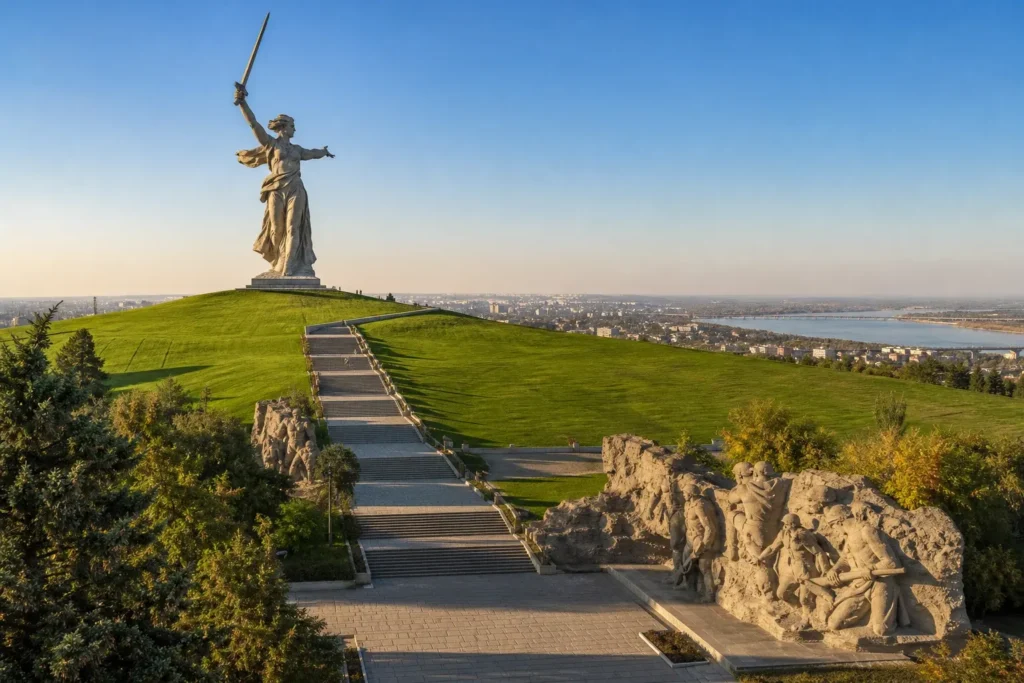
Mamayev Kurgan overlooks Volgograd from the north, a 102-metre hill transformed into a solemn memorial to the Battle of Stalingrad (1942–43). The complex blends landscape, sculpture and symbolic geography: visitors walk paths and staircases past monumental figures, pools, and inscriptions, culminating at The Motherland Calls—a female figure striding forward with a raised sword. The name means ‘tumulus of Mamai’, referring to a legendary Tatar chieftain buried here in ancient times.
Every element was designed to honour the estimated two million Soviet and German casualties who died during the eight-month battle. The hill itself remains an unmarked grave for over 34,500 Russian soldiers killed at Stalingrad. Built between 1959 and 1967 under sculptor Yevgeny Vuchetich’s direction, the memorial is one of Russia’s most powerful testament to warfare and sacrifice.
Quick Facts
| Russian name | Мамаев курган |
|---|---|
| Built / opened | 1967 |
| Architect(s) | Yevgeny Vuchetich, Yakov Belopolsky, Nikolai Nikitin |
| Address | Volgograd, Tsentralny District, Volgograd Oblast, Russia OpenStreetMap · Google Maps |
| District | Tsentralny |
| Opening hours | Open 24 hours; Hall of Military Glory 9:00-18:00 (may vary seasonally) |
| Admission | free |
| Best time to visit | Spring (April–June) offers mild temperatures, blooming greenery and long daylight hours ideal for walking and photography. Summer (July–August) brings hot weather (+35°C or higher) but extended daylight until 20:00 or later, and the site hosts occasional evening concerts.
Autumn (September–October) provides golden light, cooler temperatures and fewer tourists. Winter (November–March) is crisp with occasional snow; winds from the Volga can be strong, but crowds thin dramatically and the illuminated statue against evening skies is particularly striking. Avoid midday in summer heat. Early morning (before 9:00) or late afternoon (after 17:00) are optimal for photography and contemplation. Commemorative dates—especially Victory Day (9 May) and the anniversary of the battle's end in February—draw large crowds and may see increased security or restricted access. |
| Recommended duration | 3–4 hours |
| Last updated | October 18, 2026 |
What Is (and Isn't) Part of a Visit to Mamayev Kurgan, Volgograd?
| Part | Status | Notes |
|---|---|---|
| Main hilltop complex and monuments (open-air sculpture, staircase, pathways) | Included in the standard ticket | Free access 24 hours daily. The exterior spaces, sculptures, and walking paths are all part of the main memorial and require no ticket. |
| Hall of Military Glory (indoor memorial hall) | Included in the standard ticket | Part of the main memorial but access restricted to daytime hours (typically 9:00–18:00; closes Mondays). No separate ticket required as of October 2026, but hours may vary seasonally. |
| Museum-Panorama 'Battle of Stalingrad' | Separate ticket or institution | A separate museum located near the complex (separate entrance and ticket). Displays artifacts, panoramic dioramas and historical exhibits about the battle. |
| Volgograd Arena (sports venue) | Outside / not part of it | Located opposite the base of Mamayev Kurgan. Not part of the memorial; a separate modern sports facility. |
| Volgograd railway station ruins | Outside / not part of it | A heavily damaged railway station building is visible from parts of the memorial but is a separate historical site, not officially part of Mamayev Kurgan. |
Why Visit Mamayev Kurgan, Volgograd?
The site is a pilgrimage for history and memorial tourism. The Motherland Calls commands international recognition—at 85 metres, it dominated the world’s skyline as the tallest free-standing sculpture when unveiled. Visitors walk the same paths where soldiers fought for control of this strategic height, connecting physical geography to lived history. The complex offers both grandeur (enormous concrete and steel figures) and intimacy (small plaques, pools, quiet reflective spaces). The panoramic city views from the summit provide perspective on how controlling this hilltop meant controlling Stalingrad itself.
How Mamayev Kurgan, Volgograd Is Laid Out
The complex unfolds as a procession up the hill. At the base stands a monument of a Soviet soldier in combat gear, followed by relief sculptures of soldiers in battle. A grand staircase with 200 steps—symbolizing the 200 days of the Battle of Stalingrad—leads upward.
Midway stands the Square of Sorrow (also called the Square of Grief), centred on the Lake of Tears, a reflection pool surrounding a stone monument of a grieving mother. This marks a turning point: the mood shifts from active combat to mourning.
Continuing upward, the Hall of Military Glory (open daytime hours) displays names of the fallen. Beyond this, a zigzagging pathway leads to the summit where The Motherland Calls stands. From the top, panoramic views stretch across Volgograd and the Volga River to the east—the direction from which Soviet reinforcements arrived during the battle.
Highlights of Mamayev Kurgan, Volgograd
The Motherland Calls statue
The colossal female figure, 85 metres tall from tip of sword to base (52 metres for the body, 33 metres for the sword alone), dominates the hilltop and skyline. Unveiled 15 October 1967, it was the world's tallest freestanding sculpture at that time. The sculptor Yevgeny Vuchetich took inspiration from classical allegorical figures. The concrete figure, weighing 7,900 tonnes and reinforced with steel, strides forward with sword raised, her face turned toward the city. She is visible from many points across Volgograd.
Tip: Arrive early morning or late afternoon for soft light and fewer crowds; the figure is particularly striking against a sunset or clear evening sky.
200 Steps of commemoration
The grand staircase climbing the hill contains 200 steps, each symbolizing one day of the Battle of Stalingrad. The steps form the spine of the memorial's spatial progression. Along the sides are relief sculptures of Soviet soldiers emerging from abstract ruined walls, caught mid-combat. These carvings are carved directly into the hillside, making the ascent itself a sculptural experience. The visual metaphor is clear: visitors climb through layers of remembrance.
Tip: The climb takes 10–15 minutes at a steady pace. Benches are spaced along the route if you need to rest. Many visitors skip the steps and find alternative pathways on the side of the hill.
Square of Sorrow and Lake of Tears
Midway up the hill, an open plaza surrounds a shallow circular pool reflecting the sky. In the centre stands a stone monument carved with the figure of a grieving mother hunched over her dead son—Mother's Sorrow. This is the emotional core of the memorial, marking the transition from battle imagery to mourning. Inscriptions in Russian surround the pool. The water, still and reflective, creates a moment of quiet amid the monumental scale.
Tip: In winter, the pool may freeze; in late spring and summer, it becomes a visual anchor among the concrete and stone.
Hall of Military Glory
An indoor circular chamber below the summit displays the names of fallen soldiers. Open daytime hours (typically 9:00–18:00, closed Mondays; hours vary seasonally). The room is decorated with mosaics and Soviet-era artwork celebrating victory. At the chamber's centre burns an eternal flame. The hall serves as a solemn registry and was a major architectural innovation for its time. Visitors often light candles here.
Tip: Check opening hours before ascending, as the hall sometimes closes for maintenance or state ceremonies on commemorative dates.
Panoramic views from the summit
From the hilltop, visitors see the entire arc of the city stretching eastward toward the Volga River. The river's far bank was the staging ground for Soviet reinforcements during the battle. The view emphasises the hill's strategic importance: it dominates the terrain. On clear days, the expanse of Volgograd unfolds in all directions. The vista connects the memorial's meaning to the actual battlefield geography.
Tip: Visit in spring (April–June) or early autumn (September) for best visibility and comfortable temperatures. Midday glare can wash out photos; early morning light is superior.
Monument of a Soviet soldier at the base
At the foot of the hill stands a monumental bare-chested figure clutching a machine gun in one hand and a grenade in the other, torso rippling with musculature. The figure rises approximately as tall as a three-storey building and appears to emerge from the rock itself. This is the first major sculpture visitors encounter, immediately setting the tone for combat and sacrifice. The style is socialist realist—heroic, muscular, ideologically charged.
Tip: Photo this figure from below looking up to emphasise its scale against the sky. Early morning light creates dramatic shadows on the sculpted musculature.
Atmosphere
The atmosphere is solemn and meditative, especially on clear days when the hill is quiet. Early morning or late afternoon brings fewer visitors and creates a contemplative mood. The scale of the monuments—vast concrete and steel forms—can feel overwhelming, but the spacing and green grass slopes between structures prevent claustrophobia. The sound of wind across the open hillsides and the occasional call of birds contrast with the silence many visitors maintain as a mark of respect.
Families and school groups visit during daylight; evenings are quieter. The illumination at night makes the statue visible for kilometres. Flowers and wreaths are often left at the bases of sculptures, particularly on commemorative dates like Victory Day (9 May) and the anniversary of the battle’s end. The grass itself is treated as sacred by many visitors—people walk on designated paths and avoid treading on the planted areas.
History of Mamayev Kurgan, Volgograd
The hill itself has a much longer history. Mamayev Kurgan is an ancient burial mound (kurgan in Russian), traditionally named after Mamai, a legendary Tatar khan of the 14th century, though this attribution is disputed by historians. For centuries it was simply a geographical feature overlooking the Volga and the settlement of Tsaritsyn (later Stalingrad).
During World War II, the hill became one of the deadliest battlefields on Earth. In September 1942, German forces attacked the city and designated the height ‘Height 102.0’ in military maps. The Soviets had built defensive lines of trenches, barbed wire and minefields on the slopes. Fighting for control of Mamayev Kurgan became brutal and protracted. The 13th Guards Rifle Division, commanded by Alexander Rodimtsev, recaptured the hill on 16 September 1942, but the Germans attacked repeatedly. Control of the height changed hands many times. By the time the battle ended in February 1943 with Soviet victory, the ground was scorched and churned; fragments of metal and bone remained embedded in the soil.
In the early 1950s, sculptor Yevgeny Vuchetich began petitioning Soviet officials to design a monument to the battle. He had previously collaborated on the Soviet War Memorial in Berlin’s Treptower Park. Vuchetich worked with architect Yakov Belopolsky to develop a design. The project was approved and construction began in 1959. The massive concrete statue, requiring the engineering expertise of Nikolai Nikitin to manage the structural challenges of 7,900 tonnes of concrete, took eight years to complete. On 15 October 1967, The Motherland Calls was unveiled. At that moment, it was the world’s tallest free-standing sculpture. The entire memorial complex was designed to transform the battlefield into a place of remembrance, layering sculpture, landscape and symbolic pathways to guide visitors from combat imagery toward mourning and memory.
Legends and Myths about Mamayev Kurgan, Volgograd
The sword that sang in the wind
Legend – historically unreliable. In the early years after the statue's unveiling, the 33-metre sword blade vibrated in strong winds and produced an audible squeaking or singing sound. Visitors reported hearing an eerie wail emanating from the monument. After five years, engineers replaced the original titanium-sheathed blade with a different material, and the phenomenon ceased. Whether the original sound was structural resonance or something more mysterious became a minor part of local folklore.
The spirit of the hill
Legend – historically unreliable. Local legend holds that the spirits of the 34,500 Soviet soldiers buried unmarked in the hill's soil protect the site. Some visitors and residents report sensing a profound presence on the hill, particularly on quiet evenings or during commemorations. Pilgrims leave flowers and wreaths, and many speak of feeling moved to tears or silence in the presence of The Motherland Calls. Whether this is emotional response to the monument's power or something attributed to spiritual presences is a matter of personal interpretation.
Tickets and Booking for Mamayev Kurgan, Volgograd
Mamayev Kurgan is free to enter at all times. No tickets are required for the open-air memorial, staircases, sculptures, or pathways. Visitors may walk the site 24 hours daily without advance booking or registration.
The Hall of Military Glory (the enclosed hall with the eternal flame) is also included at no charge but operates on daytime hours only (typically 9:00–18:00; closed Mondays). Exact hours vary by season and may change for state commemorations, so check locally if the hall is your priority.
The separate Museum-Panorama ‘Battle of Stalingrad’ has its own ticket and entrance; inquire at the site or through local tourism for current admission fees and hours.
As of October 2026, admission rates for Russian citizens and concessions (students, military, pensioners) are different; for international visitors, the site is free. Check the official website or local tourism information for any updates to access rules or hours, as these can change without notice.
Suggested itineraries Mamayev Kurgan, Volgograd
2 hours
Enter at the base monument of the soldier with the grenade and machine gun. Ascend the 200 steps, pausing to observe the relief sculptures of soldiers on either side. Reach the Square of Sorrow and Lake of Tears, spend 10 minutes in quiet reflection. Continue to the Hall of Military Glory if open (10 minutes inside). Ascend the final pathway to The Motherland Calls and spend time viewing the statue from different angles. Take in the panoramic city view from the summit.
3 hours
Follow the 2-hour itinerary but add 15 minutes at the base to study the combat-themed sculpture in detail. Spend more time on the staircase reading inscriptions and examining the relief work. At the summit, walk the full perimeter around the statue's base and explore all sides. Visit the Hall of Military Glory for its full duration (not rushed). Rest and photograph from multiple vantage points.
Half day (4 hours)
Begin early morning for soft light and fewer crowds. Explore the entire complex as in the 3-hour itinerary. After descending, visit the nearby Museum-Panorama 'Battle of Stalingrad' (separate ticket; allow 1–1.5 hours). Rest at a café near the base. Return to a different section of the memorial for an evening visit to see the illuminated statue as light fades.
1.5 hours (brief visit)
Take a side pathway (not the main 200 steps) to ascend quickly to the summit. Spend 20 minutes at The Motherland Calls for photos and views. Descend via the same route. Suitable only if time is limited; misses the reflective spaces and relief sculptures of the main ascent.
How to Get to Mamayev Kurgan, Volgograd
By public transport: Volgograd has a metro system. The nearest metro station is Mamayev Kurgan, which serves the site directly. From central Volgograd, take metro trains toward the station and follow signage to the memorial.
By bus: Buses heading northwest along V. I. Lenin Avenue pass near the base of the hill. Look for stops on the main avenue and ask locals for ‘Mamayev Kurgan’ (Мамаев курган) to confirm the correct stop.
By taxi: Taxis are readily available in Volgograd. Ask for ‘Mamayev Kurgan’ or provide the coordinates (48.74228°N, 44.53708°E). The site is approximately 3 km northwest of Volgograd’s city centre.
Walking from the base: Once at the memorial’s base, the main entrance is marked. The 200-step staircase is the traditional route but steep. A side pathway with a gentler gradient offers an alternative ascent for those with limited mobility or preferring a less strenuous climb.
Accessibility
The site has significant accessibility challenges. The 200-step staircase is steep and unsuitable for wheelchair users. An alternative side pathway exists with a gentler gradient but still involves sustained inclines. The Hall of Military Glory has indoor steps and may have limited lift access. Benches are spaced along the main staircase for rest stops. The summit and The Motherland Calls statue itself are accessible to those who reach the top, but the path remains paved rather than smoothed.
Visitors with mobility issues are advised to take the alternative side pathway or consider viewing the memorial primarily from ground level at the base monuments. Companions are not charged extra. Contact local tourism for specific accessibility details about the Hall of Military Glory's interior layout and any recent improvements.
Food Nearby
Limited food options exist immediately at the memorial itself. Cafés and small restaurants are scattered along the main roads approaching the site and in the Volgograd Arena complex opposite. A few kiosks near the base of the hill may sell drinks and snacks during peak hours.
For a proper meal, descend to areas near VI Lenin Avenue or explore the Volgograd city centre 3 km south. Street vendors occasionally appear near the memorial entrance during busy periods. Bring water and snacks if planning a 3–4 hour visit; the open hilltop offers no shade.
What to Bring
Comfortable walking shoes with good grip are essential for the staircase and sloped pathways. In spring and autumn, bring a light jacket; in winter, warm clothing including a hat and gloves because winds off the Volga are sharp. Summer requires sun protection: hat, sunglasses, high-SPF sunscreen, and a water bottle (refill points are limited).
Bring a camera; the monument and city views reward photography. A small bag for personal items is fine; no security restrictions apply to visitors of the open-air memorial. The grass areas are considered sacred—stay on designated paths.
Best Views and Photo Spots of Mamayev Kurgan, Volgograd
Base of the hill looking upward
Shoot the combat-themed soldier sculpture against the sky, or frame The Motherland Calls in the distance at the summit. Low-angle shots from ground level emphasise the monument's scale. The perspective shows the pathway ascending toward the figure, creating depth.
Best time: Early morning (6:00–8:00) for warm sidelighting and clear air before crowds arrive.
The 200 steps staircase from midway
Look backward down the steps to frame the relief sculptures of soldiers on either side, creating visual depth and emphasising the ritualistic nature of the ascent. The steps themselves form leading lines.
Best time: Mid-morning or afternoon when shadows define the relief carvings; avoid harsh midday sun.
The Motherland Calls from directly below
Position yourself at the base of the statue's plinth and shoot upward. The figure appears to stride directly overhead, dominating the frame. The sword blade cuts a dramatic silhouette against the sky.
Best time: Late afternoon with the sun behind the statue and the sky still bright; this creates a halo effect around the figure's edges.
The Lake of Tears (Square of Sorrow)
Shoot the reflection of the grieving mother monument and sky in the still water. The circular pool frames the sculpture. Early morning or late afternoon provides the most striking reflections.
Best time: Golden hour (first hour after sunrise or last hour before sunset) for warm reflections and soft directional light.
Summit panorama across Volgograd and the Volga
From the top, sweep views extend eastward across the city to the river. Wide-angle shots capture the urban landscape; telephoto shots isolate architectural landmarks or the river's curve.
Best time: Clear days in spring or autumn; visibility is best in early morning or late afternoon before haze builds up.
The statue at night
As darkness falls, the memorial is illuminated. The Motherland Calls glows against the darkening sky. The surrounding structures are lit from below, creating drama and shadow.
Best time: 30–45 minutes after sunset, when the sky retains enough ambient light to define the silhouettes while artificial lights create contrast.
Photography Rules
General photography is permitted throughout the open-air memorial and is encouraged. No commercial filming or drone use without official permission. Tripods may be used on the pathways but should not obstruct other visitors or damage grass areas. Flash is not necessary outdoors; avoid it inside the Hall of Military Glory to respect the solemn atmosphere. Some state ceremonies or events may temporarily restrict photography in certain zones; ask on-site staff.
Family Suitability
The memorial is appropriate for older children (8+) and families with a historical interest. The steep 200-step staircase is challenging for very young children or those with limited stamina; parents may need to carry younger children or use the alternative pathway.
The theme—war, death and sacrifice—requires age-appropriate context. Strollers are not practical on the staircase, though flat areas at the base and summit are accessible. The open spaces and grass areas appeal to children, though they must stay on paths. The visit can be emotionally powerful for teens learning about World War II. A family visit typically takes 2–3 hours including rest stops.
Russia Vibes Tips
- Arrive very early (before 8:00 AM) on weekends and in May or September to avoid crowds and enjoy the site in quiet reflection. Late afternoon (after 17:00) is equally peaceful.
- The alternative side pathway is less steep than the main 200-step staircase but longer; ask at the base for directions. Use it if you prefer a gentler ascent or need easier access.
- The grass on the hill is considered sacred and visitors are expected not to step on it. Stick to the marked paths and walkways; this is a serious matter of respect at the site.
- The Hall of Military Glory closes Mondays and has limited afternoon hours. If you specifically want to see the eternal flame and inscribed names, confirm opening hours before visiting.
- Bring water and sun protection in summer; the open hill offers no shade and the climb can be hot. In winter, strong winds from the Volga make it feel colder than the air temperature.
- Do not expect food options at the memorial itself. Cafés are several hundred metres away along VI Lenin Avenue. Pack snacks if visiting for 3+ hours.
Explore Nearby Mamayev Kurgan, Volgograd
Sights near Mamayev Kurgan, Volgograd
 Gerhardt's Mill, Volgograd – about 3.0 km away · typical visit: 30–45 minutesOpen 24 hours
Main image: AI-generated illustration. It may not show the place exactly as it looks.
 Pavlov's House, Volgograd – about 3.0 km away · typical visit: 30–45 minutesOpen 24 hours
Main image: AI-generated illustration. It may not show the place exactly as it looks.
Hotels near Mamayev Kurgan, Volgograd
 Hilton Garden Inn Volgograd, Volgogradabout 1.7 km away (~28 min walk)
Main image: AI-generated illustration. It may not show the place exactly as it looks.
Related guides
 Denver Burgers, Volgograd: Open-Flame Burgers in Central City
Main image: AI-generated illustration. It may not show the place exactly as it looks.
 Bamberg: German Brewery and Food in Central VolgogradOpen daily 11:00–23:00
Main image: AI-generated illustration. It may not show the place exactly as it looks.
 Voronka: Volgograd’s Best Coffee, Wine, and All-Day Breakfast Café
Main image: AI-generated illustration. It may not show the place exactly as it looks.
 Volgograd Planetarium: Tickets, Shows and Soviet Space HistoryOpen daily 10:00–18:00
Main image: AI-generated illustration. It may not show the place exactly as it looks.
 Central Embankment, Volgograd: A Historic Waterfront WalkOpen 24 hours
Main image: AI-generated illustration. It may not show the place exactly as it looks.
Browse more: More in Tsentralny · All Landmarks · All Sightseeing · All Sightseeing in Volgograd · All Volgograd
FAQ: Mamayev Kurgan, Volgograd
Is Mamayev Kurgan the same as The Motherland Calls statue?
No. Mamayev Kurgan is the entire memorial complex—the hill, pathways, sculptures, plaques and spaces. The Motherland Calls is the large female figure at the summit. The complex contains many elements: the base soldier sculpture, relief carvings, the Square of Sorrow, the Lake of Tears, and the Hall of Military Glory. The Motherland Calls is the most famous part but not the whole site.
Do I need a ticket to visit?
No. The memorial complex is free and open 24 hours daily. No advance booking or ticket purchase is required. The Hall of Military Glory (the indoor chamber with the eternal flame) is also free but operates only during daytime hours (typically 9:00–18:00, closed Mondays). The separate Museum-Panorama does have an admission fee; that is a different venue.
How long does it take to visit?
Plan 2–3 hours for a full visit including the ascent, the main sculptures, and time at the summit. This includes breaks and rest stops. A rushed visit can be done in 90 minutes. If visiting the Hall of Military Glory and the Museum-Panorama as well, add 2–3 hours more. Early morning or late afternoon visitors often spend 4+ hours.
Can I reach the top without climbing the 200 steps?
Yes. An alternative side pathway with a gentler gradient exists, though it is longer and still involves sustained inclines. Ask at the base of the memorial for directions to this route. Wheelchair users and visitors with serious mobility limitations should inquire about alternative access or view the memorial from the base.
Is The Motherland Calls statue climbable or accessible inside?
No. The statue is a solid concrete sculpture. Visitors cannot enter it, climb it, or access any interior spaces. The complex is designed for external viewing and walking; all access is to the memorial grounds and pathways.
When is the best time to visit—morning or evening?
Early morning (6:00–9:00) offers the fewest crowds, softest light for photography, and cool temperatures. Late afternoon (16:00–19:00) is also peaceful and provides golden light as the sun sets. The illuminated statue after dark is striking but the memorial feels less intimate. Midday in summer is hot with larger crowds. Avoid midday on sunny days unless you have strong sun protection.
What should I know about respectful behaviour on site?
The hill is treated as a sacred space by many visitors and locals. Stay on marked paths and do not step on the grass. Speak quietly and avoid loud conversations or playful behaviour. Many visitors leave flowers or wreaths at the bases of sculptures as a gesture of remembrance. Photography is welcome but take it seriously—frame shots with respect for the memorial's purpose.
Is there food or water at the memorial?
Very limited options exist on site; a few kiosks may appear during peak hours but are not reliable. Cafés and small restaurants are several hundred metres away along VI Lenin Avenue. Bring water, especially in summer, and snacks if planning a long visit. The open hilltop offers no shade.
Russia Vibes is a one-person project. A coffee keeps it going
Last updated: October 18, 2026.
How we research and update our guides
About this guide: AI assistance and accuracy
This guide is created with the help of AI and is based on official sources where available. Mistakes can still happen. Opening hours, prices, rules and other details are given to the best of our knowledge as of the date shown and can change without notice. It offers general recommendations only, not professional, legal or travel advice. Please confirm important details with the official source before you travel; you are responsible for your own plans and decisions.
International sanctions affect payments between Russia and many other countries. In practice, cards issued in the EU, the UK, the US and several other countries often do not work in Russia, Russian cards usually do not work abroad, and some booking platforms, airlines and payment providers limit or suspend their services for Russia. The situation changes frequently. We do not give legal or financial advice, and this site does not encourage anyone to break or circumvent sanctions. Whatever you plan, you are responsible for following the laws and regulations that apply to you, including those of your country of residence and citizenship. Many travelers still organise their stay lawfully. It is worth asking your bank or payment provider what is currently permitted, contacting hotels, tour operators and carriers directly about the payment methods they accept, and checking which services are open to customers from your country. Clarify payment, cancellation and refund terms before you commit to a booking, and keep your plans flexible. Partner links on this site may not be available in every country, and prices, availability and rules in our guides can differ from what you see when you book.Paying for your trip: please read
Report an issue on this page

Take this guide with you
Get a free PDF of this guide to print or read offline: key facts, tips and a map link on a few clean pages.