
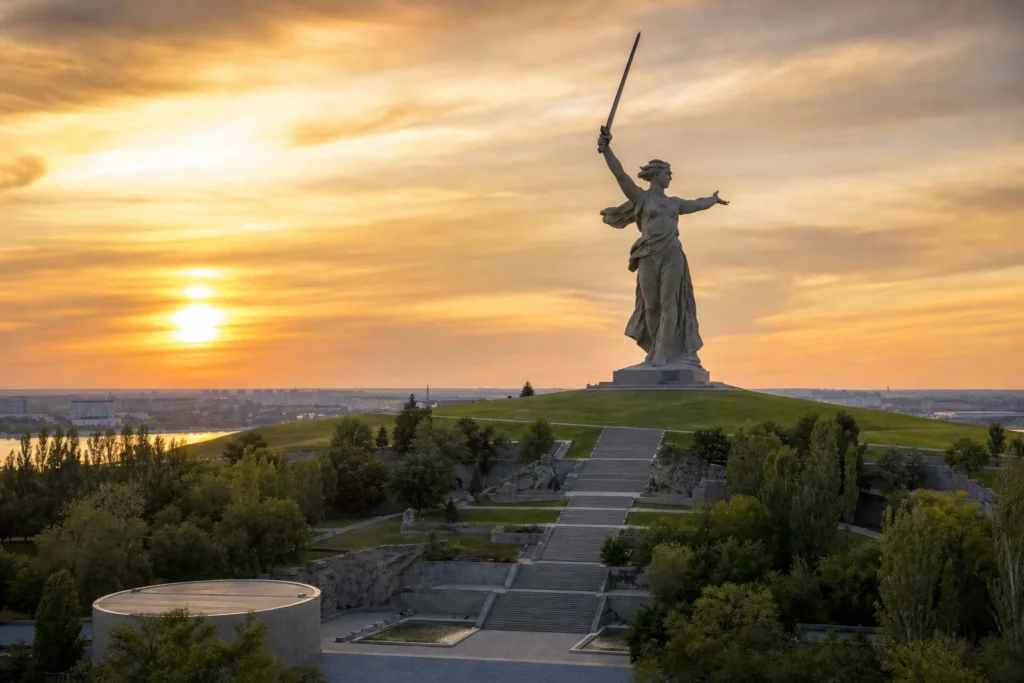
This Volgograd travel guide is for first-time visitors who want to understand a city shaped by one of the largest battles of the Second World War. Volgograd lies along the western bank of the Volga river and was called Stalingrad for much of the Soviet era. Today it is a long, narrow city, rebuilt after the war.
Most visitors focus on the memorial sites, above all Mamayev Kurgan with The Motherland Calls statue, the Panorama Museum and the ruins and houses that survived the fighting. The city also has a river embankment and a light-rail line known as the Metrotram. Hours, tickets and transport details change, so check the official source for each place before you go.
Quick Facts
| Russian name | Волгоград |
|---|---|
| Address | OpenStreetMap · Google Maps |
| Best time to visit | Late spring and early autumn are comfortable for walking the memorials and the embankment, and summer is warm and sunny, sometimes hot. Winter is cold and windy, which suits visitors who plan the Panorama Museum and indoor sights. Check the forecast and the schedules of the memorials, since ceremonies and opening hours can change. |
| Recommended duration | 2 days |
| Last updated | October 13, 2026 |
Why Visit Volgograd?
Volgograd gives a concentrated view of the Battle of Stalingrad, which took place in 1942 and 1943 and is remembered in Russia as a turning point of the war. The memorial complex on Mamayev Kurgan, a hill that was a key position during the fighting, is dominated by the statue The Motherland Calls, about 85 meters tall, according to a travel source.
The sites are close together and easy to understand. The Panorama Museum shows a large circular painting of the battle, Pavlov’s House and the ruins of Gerhardt’s Mill stand nearby, and the embankment on the Volga offers a calmer walk. It is a serious place, and many visitors find that a day or two is enough for the main sights.
Highlights of Volgograd
Mamayev Kurgan and The Motherland Calls
The memorial complex To the Heroes of the Battle of Stalingrad covers the slopes of Mamayev Kurgan, a hill that overlooked the city and the river during the battle. Visitors climb a long route of monuments and squares, including the Square of Sorrow and the Hall of Military Glory, to reach the statue The Motherland Calls at the top, about 85 meters tall, according to a travel source. It is a place of remembrance, so behave quietly.
Tip: Go in the late afternoon, when the light is soft and the crowds are smaller, and allow a couple of hours.
The Hall of Military Glory
A circular hall on the memorial route with an eternal flame and a ceremonial guard, according to travel sources, where the guard changes at regular intervals. It is one of the most solemn parts of the complex. Check the official site for the current schedule, since ceremonies and access can change.
Tip: Stand quietly and follow the signs for photography.
The Battle of Stalingrad Panorama Museum
A museum that houses a large circular panoramic painting of the battle, with lighting and sound effects, according to travel sources, and several halls with uniforms, weapons and documents that explain the course of the war. It is part of the same state memorial museum as the complex on Mamayev Kurgan but stands in a different place, by the Volga. Check the official site for opening days and tickets.
Tip: Plan about two hours and check whether an audio guide is available.
Pavlov's House
A residential building that Soviet soldiers held for almost two months during the battle, according to travel sources, and which became one of the best-known episodes of the defense. A memorial wall with bricks from the original house stands beside it. It is close to the Panorama Museum and can be visited in a short stop.
Tip: Combine it with the mill and the museum in one walk.
The ruins of Gerhardt's Mill
A ruined red brick mill, left untouched as a memorial to the fighting, according to a travel source, with its walls still marked by shells and bullets. It stands next to the Panorama Museum and Pavlov's House. It is a stark reminder of the scale of destruction in the city.
Tip: Look at the walls closely, and keep to the marked paths.
The Central Embankment
The embankment of the 62nd Army runs along the Volga, with a wide stairway and a colonnade, according to a travel source, and offers views of the river and the bridges. It is the calmer part of the city, a place to walk in the evening. In the evening Mamayev Kurgan is lit in the distance.
Tip: Walk it in the evening, after the memorial sites.
The Volgograd Metrotram
A high-speed tram line that runs partly underground, which is unusual in Russia, according to a travel source, and is a useful way to cross the long city. It links parts of the center with other districts, and many visitors use it to reach the memorial sites. Check the official site for routes and payment.
Tip: Check the route and the stop names before you board.
Atmosphere
Volgograd feels wide and solemn. The city runs for many kilometers along the Volga, with broad avenues, Stalinist buildings in the center and large squares, and the hill of Mamayev Kurgan with its tall statue is visible from many places. The river and its bridges give a sense of space.
The mood at the memorials is quiet and respectful, with school groups, local families and visitors from across Russia laying flowers. Away from the memorials, the embankment and the squares feel calm, and the pace is slow. In summer the river is busy, and in winter the cold wind comes off the Volga.
History of Volgograd
Volgograd began as the fortress of Tsaritsyn, founded on the Volga in 1589, according to general sources, to guard the southern borders of the Russian state and the river trade route. It grew into a trading and industrial town in the following centuries.
In 1925 the city was renamed Stalingrad, and it developed in the Soviet period as a major industrial center, with factories along the river. The Volga–Don Canal, opened in 1952, later linked the Volga to the Don near the city.
During the Second World War, the Battle of Stalingrad was fought from the summer of 1942 to early 1943, according to general sources. It is remembered in Russia and around the world as one of the largest and bloodiest battles of the war and as a turning point of the conflict on the eastern front. The city was almost completely destroyed, and Mamayev Kurgan was one of the key positions in the fighting.
After the war, the city was rebuilt, and much of its center was designed in the Stalinist style. Some ruins, such as Gerhardt’s Mill, were kept as memorials, and the memorial complex on Mamayev Kurgan was built in the following decades. The statue The Motherland Calls was unveiled in the 1960s, according to general sources, and was one of the tallest statues in the world at the time.
In 1961 the city was renamed Volgograd, after the river. It was given the title of Hero City in the Soviet period, an honor awarded to cities for their role in the war.
The Panorama Museum, which houses the large painting of the battle, was rebuilt and expanded in later years, and it is part of the state memorial museum of the Battle of Stalingrad, together with the memorial complex.
Today Volgograd is a large industrial city and the administrative center of Volgograd Oblast. Its memorial sites remain the main reason for visitors, and ceremonies and wreath-laying take place there throughout the year.
The dates and details above come from general sources and should be checked against official museum and city sources. Visitors should treat the sites as places of remembrance.
Tickets and Booking for Volgograd
Arriving by air. Volgograd International Airport serves the city, with flights from Moscow and other Russian cities. A suburban train, buses and taxis are the usual ways into town, and a direct train runs from the airport to the Mamayev Kurgan station in about 30 minutes, according to a travel source, but routes and times change, so check them with the official operators.
Arriving by train. The main station is Volgograd-1, close to the center. Overnight trains from Moscow take about 18 to 20 hours, according to a travel source. Check which station your ticket names.
Confirm before you go. Schedules, ticket types and entry conditions for transport and sights depend on the operator and can change. Always confirm times and tickets with the official operator or the official website of each place, and keep your booking confirmations offline.
How to Get to Volgograd
Most visitors arrive by air or by train.
- By air: Volgograd International Airport serves the city, with flights from Moscow of about two hours, which should be checked with the airlines. A suburban train to the Mamayev Kurgan station takes about 30 minutes, according to a travel source, and buses and taxis also run.
- By train: overnight trains from Moscow take about 18 to 20 hours, according to a travel source, and arrive at Volgograd-1 Station near the center.
- In the city: the Metrotram, buses and taxis link the center with the memorial sites, which lie several kilometers apart.
Check routes, schedules and booking steps with the official operators, and save your hotel address offline in Latin letters and in Russian.
Accessibility
Accessibility differs between sights. The memorial route on Mamayev Kurgan is long and climbs a hillside with many steps, and the Panorama Museum and other buildings have their own entrances. Check the official website of each place for lifts, ramps and support for visitors with reduced mobility, and plan taxis for the longer distances.
Food Nearby
The center and the embankment have many cafes and restaurants, with Russian dishes and international cuisine, and the area around the Panorama Museum has places for a simple meal. Menus differ from place to place, so ask staff for local dishes and mention any allergies. Specific venues were not verified here, so check opening hours before you go.
What to Bring
Bring comfortable walking shoes, since the memorial route is long and has many steps, plus sun protection and water in summer and warm layers in winter. Dress modestly and respectfully at the memorials. A portable charger and offline maps are useful, and large bags may need to go in a cloakroom at museums.
Photography Rules
Photography is usually allowed on the memorial grounds, but rules differ in museums and at the Hall of Military Glory, where it is a place of ceremony, and flash and tripods may be restricted. Check the signs and ask staff if you are unsure. Drone rules also apply in cities and near memorials, so check the current regulations with the official source before you use one.
Family Suitability
Volgograd can suit families with older children who want to learn about the history, but the content is serious, and the memorial route is long and steep. Younger children may find the museums heavy, so plan shorter visits and breaks on the embankment, and check access with strollers at each sight.
Russia Vibes Tips
- Plan the memorial complex on Mamayev Kurgan as a half-day visit, and wear shoes for many steps.
- Group the Panorama Museum, Pavlov's House and Gerhardt's Mill in one walk, since they stand close together.
- Treat the memorials as places of remembrance, and keep your voice low and your dress modest.
- Use the Metrotram or a taxi between the sights, since distances in the long city are larger than they look.
- Finish the day on the embankment, where the mood is calmer and Mamayev Kurgan is lit in the distance.
- Check the Panorama Museum's opening days in advance, since it has its own schedule and days off.
Explore Nearby Volgograd
Browse more: All Cities · All Soviet Russia
FAQ: Volgograd
How many days do I need in Volgograd?
Two days cover Mamayev Kurgan, the Panorama Museum, Pavlov's House and the embankment, according to a travel source. A single day is enough for the two main sights if you start early.
Is Volgograd the same as Stalingrad?
Yes, the city was called Stalingrad from 1925 to 1961, and was renamed Volgograd afterward. Before 1925 it was Tsaritsyn.
What is The Motherland Calls?
It is a monumental statue on Mamayev Kurgan, about 85 meters tall, according to a travel source, and the main symbol of the memorial complex to the Battle of Stalingrad.
Is the Panorama Museum part of Mamayev Kurgan?
It belongs to the same state memorial museum but stands in a different place, by the Volga. Check the official site for its opening days and tickets.
How do I get to Mamayev Kurgan?
Many visitors use the suburban train, the Metrotram, buses or a taxi. A direct train runs from the airport to the Mamayev Kurgan station, according to a travel source; check the current routes.
How do I get from Moscow to Volgograd?
Many visitors fly, with a flight of about two hours, or take an overnight train of about 18 to 20 hours, according to a travel source. Check schedules with the official operators.
What is the Metrotram?
It is a high-speed tram line that runs partly underground and is a useful way to cross the long city, according to a travel source. Check the routes and payment with the operator.
Is Volgograd suitable for a short stop?
Yes, many visitors stop for one or two days, mainly for the memorial sites. Check the opening hours and plan the transport in advance.
Last updated: October 13, 2026. Found an error or something out of date? Report it and we will check and fix it.
About this guide: AI assistance and accuracy
This guide is created with the help of AI and is based on official sources where available. Mistakes can still happen. Opening hours, prices, rules and other details are given to the best of our knowledge as of the date shown and can change without notice. It offers general recommendations only, not professional, legal or travel advice. Please confirm important details with the official source before you travel; you are responsible for your own plans and decisions.
International sanctions affect payments between Russia and many other countries. In practice, cards issued in the EU, the UK, the US and several other countries often do not work in Russia, Russian cards usually do not work abroad, and some booking platforms, airlines and payment providers limit or suspend their services for Russia. The situation changes frequently. We do not give legal or financial advice, and this site does not encourage anyone to break or circumvent sanctions. Whatever you plan, you are responsible for following the laws and regulations that apply to you, including those of your country of residence and citizenship. Many travelers still organise their stay lawfully. It is worth asking your bank or payment provider what is currently permitted, contacting hotels, tour operators and carriers directly about the payment methods they accept, and checking which services are open to customers from your country. Clarify payment, cancellation and refund terms before you commit to a booking, and keep your plans flexible. Partner links on this site may not be available in every country, and prices, availability and rules in our guides can differ from what you see when you book.Paying for your trip: please read
 Ask Masha