
Last updated
Best Museums in Volgograd guides you through the city’s most significant cultural institutions. Volgograd’s museum scene centers on the Battle of Stalingrad and its legacy, but extends far beyond war history into fine arts, regional traditions, and science. This list includes 10 museums verified to be currently operating, ordered by historical importance and visitor accessibility.
Most museums operate year-round with consistent hours. All locations mentioned are reachable by public transport or short taxi rides from the city center. Allow 2–3 hours minimum for the major panorama complex, and 1–2 hours for specialized museums.
Route: 2 stops, about 3–5 hours including walking (estimate)
At a Glance
| # | Place | Best for | Good to know |
|---|---|---|---|
| 1 | State Historical and Memorial Preserve The Battle of Stalingrad | Largest WWII museum complex | Centralniy district, Ulitsa Marshala Chuikova 47. Tuesday–Sunday 10:00–18:00 (Thursday until 21:00 in summer); closed Monday. Paid entry; ticket office closes 30–40 minutes before closing time. |
| 2 | Museum Pamyat | German HQ basement immersion | Centralniy district, basement of the Central Department Store. Tuesday–Sunday 10:00–18:00; closed Monday. Paid entry; arrive by 17:00 to see all halls. |
| 3 | Volgograd Museum of Fine Arts named after I. Mashkov | Russian and Soviet art collection | Centralniy district. 10:00–18:00 daily. Paid entry; check official website for current hours. |
| 4 | Musical Instruments Museum of Y. Pushkin | Rare stringed instruments | Volgograd city center. Operating hours to be confirmed on official sources; paid entry. |
| 5 | Volgograd Planetarium | Universe exploration for all ages | Volgograd city center. Check official website for show times and admission rates. |
| 6 | Old Sarepta (Museum-Reserve) | Open-air ethnographic heritage | Kirovsky district, on the outskirts south of the city center. 10:00–18:00 daily. Paid entry; accessible by marshrutka or taxi. |
| 7 | Memorial and Historical Museum | Civil War and early Soviet period | Near Volgograd Railway Station. 10:00–18:00 daily. Paid entry. |
| 8 | Volgograd Planetarium | Interactive science experiences | Central location in Volgograd. Operating hours and admission available on official website. |
| 9 | Volgograd Museum of Measurements and Scales | Weights and measures history | Volgograd city center. Operating hours and admission to be confirmed; paid entry. |
| 10 | Volgograd Regional Local Lore Museum | Regional history and nature | Volgograd city center. Opening hours and admission to be confirmed; check official website. |
| 11 | Ot Stalingrada Do Berlina (From Stalingrad to Berlin) | Soviet war path exhibition | Volgograd; exact location and hours to be confirmed on official sources. Paid entry. |
How We Chose
Museums were selected based on:
- Current operation and verified opening hours (as of October 2026)
- Accessibility to visitors with standard transport
- Significance to understanding Volgograd’s history and culture
- Range of topics from WWII to art and regional heritage
- Official information from museum websites and city sources
Hours and closures are subject to change; check official websites before visiting. Most museums do not offer English-language materials, so a guide book or translation app is useful.
1. State Historical and Memorial Preserve The Battle of Stalingrad – Largest WWII museum complex
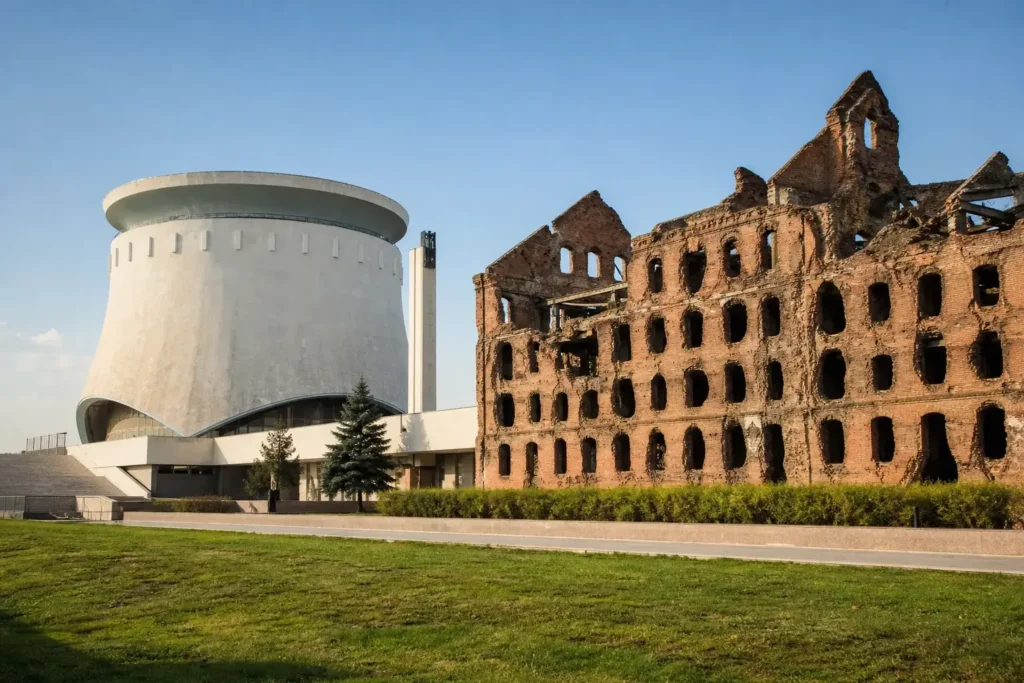
The principal museum dedicated to the Battle of Stalingrad, which marked the turning point of WWII on the Eastern Front. The complex includes the Panorama Museum with a massive circular painting of the battle, multiple exhibition halls covering the battle chronologically, dioramas, military trophies, and personal items of soldiers from both sides. The building houses 8 halls with more than 3,500 artifacts. Outside stand preserved tanks, artillery, and other military equipment. Next to the museum stands the shell of the Gerhardt Mill, destroyed in 1943 and preserved as a war memorial—one of the largest war ruins in Russia.
Good to know: Centralniy district, Ulitsa Marshala Chuikova 47. Tuesday–Sunday 10:00–18:00 (Thursday until 21:00 in summer); closed Monday. Paid entry; ticket office closes 30–40 minutes before closing time.
Tip: Plan 2–3 hours minimum. The digital panorama in the main hall and the open-air exhibits are best seen together, not separately. Arrive by mid-afternoon to see everything without rushing.
2. Museum Pamyat – German HQ basement immersion
A branch of the State Historical and Memorial Preserve located in the basement of the Central Department Store building, where Field Marshal Paulus, commander of the German 6th Army, was captured in January 1943. Restorers have recreated the original headquarters atmosphere with authentic household items, military gear, and period details. The museum opened in 2003 and became part of the official Stalingrad battle complex in 2012. The space itself—a cold, damp basement—conveys the claustrophobic reality of those final days.
Good to know: Centralniy district, basement of the Central Department Store. Tuesday–Sunday 10:00–18:00; closed Monday. Paid entry; arrive by 17:00 to see all halls.
Tip: This museum is smaller and less crowded than the main panorama museum. Combine it with a visit to the Panorama Museum for a complete picture of the German surrender.
3. Volgograd Museum of Fine Arts named after I. Mashkov – Russian and Soviet art collection
Volgograd's only dedicated art museum, opened to visitors in 1963. The collection spans 19th- and 20th-century Russian art, including works donated from the State Hermitage, the State Historical Museum, and the Tretyakov Gallery in Moscow. A separate section features works by Volgograd painters. The museum covers Russian painting traditions and Soviet-era art, offering a cultural counterweight to the city's war-focused attractions.
Good to know: Centralniy district. 10:00–18:00 daily. Paid entry; check official website for current hours.
Tip: This museum is quieter than war-related sites and gives a sense of pre-war Volgograd culture. Labels are in Russian; a guide book helps.
4. Musical Instruments Museum of Y. Pushkin – Rare stringed instruments
A specialized museum dedicated to musical instruments, particularly Russian and Eastern European stringed instruments collected by Yuri Pushkin. The collection focuses on traditional folk instruments and historical pieces. Small but distinct, this museum offers a refreshing break from history-heavy attractions and showcases Russian cultural traditions outside the WWII context.
Good to know: Volgograd city center. Operating hours to be confirmed on official sources; paid entry.
Tip: Check opening hours and location in advance, as smaller museums sometimes have irregular schedules. A guided visit is recommended to understand the instruments' cultural significance.
5. Volgograd Planetarium – Universe exploration for all ages
Located in the heart of Volgograd, the planetarium features a state-of-the-art digital projection system. Visitors can explore the night sky, distant galaxies, and the mysteries of outer space through immersive shows. The planetarium offers both educational and entertainment programs suitable for families and adults. Shows change seasonally and by theme.
Good to know: Volgograd city center. Check official website for show times and admission rates.
Tip: Planetarium shows are typically offered at set times throughout the day. Book ahead if possible, especially on weekends and during school holidays.
6. Old Sarepta (Museum-Reserve) – Open-air ethnographic heritage
An open-air museum covering 5 hectares, preserving the architectural heritage of the 18th–19th centuries. Six national cultural centers operate here—Russian, Tatar, German, Kalmyk, Ukrainian, and Belarusian—each showcasing the region's diverse populations and traditions. The museum collection includes ethnographic, archaeological, and artistic exhibits. Visitors can walk through restored period buildings and experience the multicultural history of the Volga region.
Good to know: Kirovsky district, on the outskirts south of the city center. 10:00–18:00 daily. Paid entry; accessible by marshrutka or taxi.
Tip: Old Sarepta is a full outdoor museum, so dress for weather. Spring and autumn are ideal for walking the grounds. Some buildings contain craftspeople demonstrating traditional crafts.
7. Memorial and Historical Museum – Civil War and early Soviet period
Located in a small red brick building near the railway station, this museum covers the history of the city during the Russian Civil War period, when Volgograd was known as Tsaritsyn. Exhibits cover local events from the early Soviet era, providing context for the city's history before its role in WWII. The building itself is a historical landmark in Russian architectural style.
Good to know: Near Volgograd Railway Station. 10:00–18:00 daily. Paid entry.
Tip: This museum is often overlooked by visitors focused on WWII sites, but it provides essential context for understanding the city's twentieth-century transformation.
8. Volgograd Planetarium – Interactive science experiences
Beyond the projection dome shows, the planetarium building houses interactive science exhibits and displays about astronomy and physics. Exhibits explain celestial mechanics, the solar system, and space exploration. Combined with the main show, it provides a full science experience suitable for curious visitors of all ages.
Good to know: Central location in Volgograd. Operating hours and admission available on official website.
Tip: Visit the interactive exhibits before or after a show session to maximize your time. Shows are typically in Russian but visually engaging.
9. Volgograd Museum of Measurements and Scales – Weights and measures history
A specialized museum documenting the history of measurement systems and scales used in commerce and daily life. The collection traces how the region measured goods from medieval times through the Soviet era. While niche in focus, it offers an unusual glimpse into practical history and the evolution of trade standards. A small but informative museum for those interested in material culture.
Good to know: Volgograd city center. Operating hours and admission to be confirmed; paid entry.
Tip: This museum is quite small; plan 30–45 minutes. It appeals most to those interested in social and economic history.
10. Volgograd Regional Local Lore Museum – Regional history and nature
A general museum of local history covering the Volgograd region's geography, natural resources, wildlife, and cultural development. Exhibits span prehistory through the Soviet period, including materials on the Don and Volga rivers, regional flora and fauna, and traditional ways of life. The museum provides a broader regional perspective beyond military history.
Good to know: Volgograd city center. Opening hours and admission to be confirmed; check official website.
Tip: Good for rainy days and for understanding the region beyond the Battle of Stalingrad. Less visited than major war museums, so fewer crowds.
11. Ot Stalingrada Do Berlina (From Stalingrad to Berlin) – Soviet war path exhibition
A specialized military museum focused on the Soviet Army's journey from victory at Stalingrad through the final assault on Berlin. Exhibits document the campaigns, battles, and military operations of 1943–1945. The museum combines photographs, documents, uniforms, and weapons to tell the story of the Soviet advance across Eastern Europe.
Good to know: Volgograd; exact location and hours to be confirmed on official sources. Paid entry.
Tip: This museum complements the main Panorama Museum by showing what happened after Stalingrad. Smaller and more specialized, it suits military history enthusiasts.
Russia Vibes Tips
- The Battle of Stalingrad complex (Panorama Museum, Memory Museum, Mamayev Kurgan memorial) is the heart of Volgograd tourism. Many visitors try to see everything in one day, but 2–3 hours minimum is needed for the Panorama Museum alone; a full day is realistic. Split across two days if your schedule allows.
- Most museums close on Monday and stop admitting visitors 30–40 minutes before closing time. Plan accordingly if visiting late in the day; arrive by mid-afternoon for the major sites. Thursday hours extend to 9 p.m. in some museums during summer months.
- The open-air museum Old Sarepta requires good weather and comfortable shoes. It is located outside the city center and less convenient by public transport; allow half a day including travel time. Best visited in spring or autumn.
- Few museums offer English-language materials or guides. Download a translation app, carry a printed guide book, or consider booking a private guide for the Panorama Museum, where the narrative context is essential to understanding the exhibits.
- The city is WWII-history-saturated; non-military museums (Fine Arts, Planetarium, Measurements Museum) provide cultural variety and are less crowded. Mix them into your itinerary to avoid history fatigue.
- Mamayev Kurgan, the memorial complex with The Motherland Calls sculpture, is free to enter and open 24 hours. The Hall of Military Glory museum inside the complex requires paid entry; the panoramic views from the height do not. Climb the steps at dawn or sunset for the best photography.
Explore Nearby Best Museums, Volgograd
Browse more: All Culture Lists · All Guides · All Guides in Volgograd · All Volgograd
FAQ
Is the Panorama Museum the same as the Memorial and Historical Museum?
No. The State Historical and Memorial Preserve The Battle of Stalingrad is a large complex with multiple branches: the Panorama Museum (main building with exhibitions and the famous circular panorama canvas), the Memory Museum (in the Central Department Store basement, focused on German headquarters), and the Memorial and Historical Museum (covering the Russian Civil War era, located near the railway station). Tickets may be bundled or separate; check the official website.
How much time do I need for the Panorama Museum?
Plan 2–3 hours minimum to see the main halls, the circular panorama, and outdoor exhibits. Visitors who skip the outdoor section may finish in 1.5 hours, but the open-air military equipment and mill ruins are essential to the experience. A guided tour adds another hour.
Are museums closed on specific days?
Most museums close on Monday. Some extend Thursday hours to 9 p.m. during summer months. Always check the official website before visiting, as schedules can change seasonally.
Can I visit Mamayev Kurgan and The Motherland Calls sculpture without paying?
Yes. The outdoor memorial complex is free to enter and open 24 hours. The Hall of Military Glory museum inside the complex requires paid entry. You can climb to the observation deck and see the sculpture without buying a ticket.
Which museum is best for first-time visitors?
Start with the Panorama Museum of the Battle of Stalingrad. It is the largest, most visited, and provides the essential historical context for understanding Volgograd. Then add the Memory Museum or Memorial and Historical Museum for deeper detail. Non-military museums work best as a second-day activity.
Is Old Sarepta worth the trip outside the city center?
Yes, if you have time and want to escape the war-history focus. It is the only major open-air ethnographic museum in the region and offers a sense of pre-Soviet regional life. Allow half a day including transport. It works best in good weather and is less essential than the central museums.
Do museums offer English-language tours or guides?
Few museums have English-language permanent materials. The Panorama Museum may arrange English-speaking guides with advance booking. Others rely on Russian labels. Translation apps and printed guides are practical solutions. Check the official website before visiting.
What is the best season to visit Volgograd's museums?
Indoor museums are comfortable year-round. Spring (April–May) and autumn (September–October) are ideal for combining indoor museums with outdoor sites like Mamayev Kurgan and Old Sarepta. Summer can be very hot; winter is cold but atmospheric for war memorial sites.
Russia Vibes is a one-person project. A coffee keeps it going
How we research and update our guides
About this guide: AI assistance and accuracy
This guide is created with the help of AI and is based on official sources where available. Mistakes can still happen. Opening hours, prices, rules and other details are given to the best of our knowledge as of the date shown and can change without notice. It offers general recommendations only, not professional, legal or travel advice. Please confirm important details with the official source before you travel; you are responsible for your own plans and decisions.
International sanctions affect payments between Russia and many other countries. In practice, cards issued in the EU, the UK, the US and several other countries often do not work in Russia, Russian cards usually do not work abroad, and some booking platforms, airlines and payment providers limit or suspend their services for Russia. The situation changes frequently. We do not give legal or financial advice, and this site does not encourage anyone to break or circumvent sanctions. Whatever you plan, you are responsible for following the laws and regulations that apply to you, including those of your country of residence and citizenship. Many travelers still organise their stay lawfully. It is worth asking your bank or payment provider what is currently permitted, contacting hotels, tour operators and carriers directly about the payment methods they accept, and checking which services are open to customers from your country. Clarify payment, cancellation and refund terms before you commit to a booking, and keep your plans flexible. Partner links on this site may not be available in every country, and prices, availability and rules in our guides can differ from what you see when you book.Paying for your trip: please read
Report an issue on this page

Take this guide with you
Get a free PDF of this guide to print or read offline: key facts, tips and a map link on a few clean pages.