
This architecture walk is for visitors interested in Soviet design and urban planning, and for anyone wanting to understand how a remote Arctic city was built in the twentieth century. The route takes about three hours at a leisurely pace, moving through the compact downtown along Lenin Prospekt and its side streets.
By the end, you will have seen the major surviving structures from the 1930s to 1970s: residential blocks designed by Leningrad architects, the regional drama theatre, the towering Azimut Hotel, and the railway station with its red star. You’ll understand what Arctic urban architecture looked like when it was built, and how it looks today.
At a glance: Day 1 begins at the railway station, moves south along Lenin Prospekt through the city center, visits Five Corners Square and the Azimut Hotel, then continues to the waterfront. The walk ends at the Alyosha Monument for views over the city, with an optional detour to the Lenin icebreaker museum.
Day 1: Soviet Murmansk from Station to Square
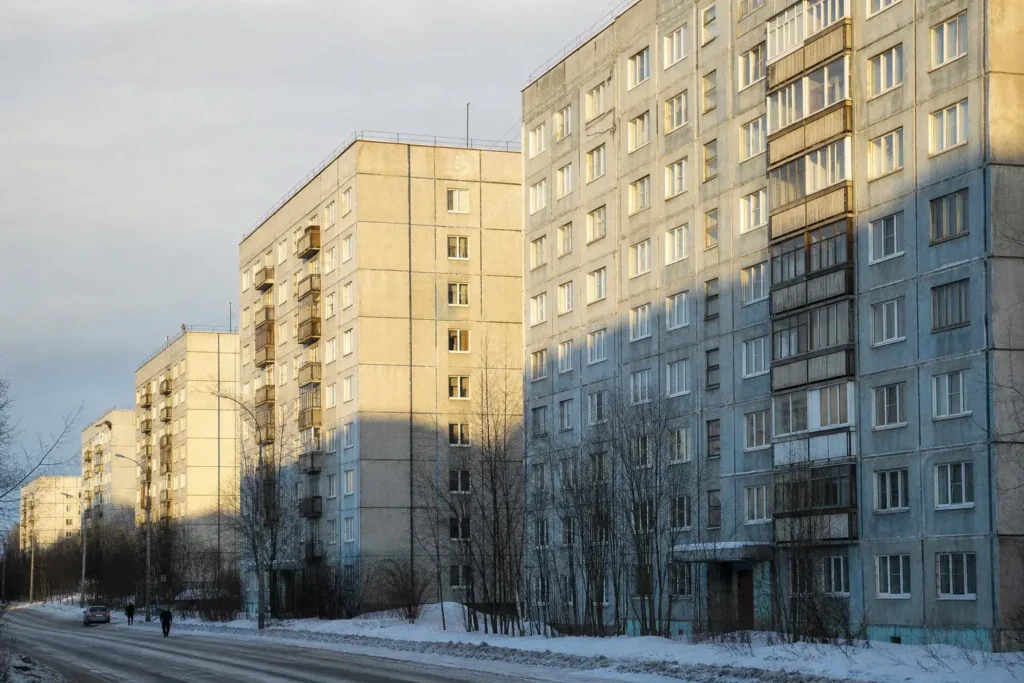
Start at the railway station, where a red star crowns the building. Walk south along Lenin Prospekt, the main north-south axis that Leningrad architects shaped in the 1930s. Watch for the symmetrical seven-story residential blocks on either side—concrete and brick apartment buildings with minimal ornament, designed to withstand Arctic wind. The architecture here is functional and severe, a contrast to civilian comfort.
- Murmansk Railway Station – Red star on roof, railway architecture (10 minutes)
- Lenin Prospekt, between station and Five Corners – Soviet-era residential and public buildings (30 minutes walking)
- Five Corners Square (Ploshchad Pyat Uglov) – Main public square with central garden, surrounding administrative buildings (20 minutes)
- Azimut Hotel (formerly Hotel Arktika) – 1984 tower, 72 meters, tallest building north of the Arctic Circle (10 minutes outside)
- Murmansk Regional Drama Theatre – 1950s-era theatre building on Lenin Prospekt (exterior only | 10 minutes)
- Marine Savior-on-Waters Orthodox Cathedral (Spaso-Preobrazhensky) – Religious architecture from post-Soviet revival (15 minutes)
Tip: Start early in the morning when light is best for photographing the buildings' facades. Five Corners Square is most lively around midday when locals gather there. Metro tram 3 passes nearby if you need to rest or skip sections.
Day 2: Waterfront and Monument
Walk from the city center down to the port area to see the Lenin icebreaker museum and the waterfront structures. Then head north and uphill to the Alyosha Monument on a plateau overlooking the bay. This section shows how Murmansk's architecture responds to its Arctic location: industrial structures for the port, then a dramatic war memorial set high for panoramic views.
- Murmansk Sea Station – Constructivist maritime terminal building (exterior view | 10 minutes)
- Lenin Nuclear Icebreaker Museum – 1957 decommissioned ship-turned-museum, world's first nuclear icebreaker (guided tour 90 minutes | optional)
- Alyosha Monument (Defenders of the Soviet Arctic) – 1974 concrete statue, 42 meters tall, on plateau overlooking Kola Inlet (1 hour there and back)
- City views from Alyosha plateau – Panoramic vantage point over downtown, bay, and surrounding landscape (15 minutes)
Tip: The walk up to Alyosha is steep; allow extra time and wear good shoes. The monument is free to visit. Take a northbound trolleybus (lines 2, 3, or 4 toward Gagarina stop) if the climb is too difficult. In winter, the plateau can be icy.
Day 3: Soviet Details and Side Streets
Explore the residential blocks off Lenin Prospekt, looking for Soviet mosaics and murals on the sides of apartment buildings. Walk through smaller streets to find minor monuments, memorials, and the texture of everyday Soviet urban life. This walk is less structured—focus on wandering and observing architectural details rather than visiting specific sites.
- Apartment building mosaics and murals – Soviet-era decoration on residential blocks throughout downtown (60 minutes exploring)
- Minor monuments and memorials – Scattered throughout central district on small squares (30 minutes)
- Murmansk Regional Library – Large-scale renovation of public library building (15 minutes)
- Side streets off Lenin Prospekt – Residential neighborhoods with Soviet-era housing (45 minutes)
- Any café or small public space – Rest and observe architectural surroundings (20 minutes)
Tip: This day is for detailed observation rather than a fixed route. Bring a camera for close-ups of mosaics and details. Many small monuments and plaques are in Russian; you may not understand their significance, but the Soviet imagery and style are visually clear. Murmansk's untended vegetation and aging facades are part of the architectural story—do not expect perfect restoration.
Russia Vibes Tips
- The Leningrad architects who shaped Murmansk in the 1930s–1950s brought a distinct style from the west. Look for the proportions and details—they are more refined than typical Stalinist industrial architecture, reflecting Leningrad's pre-revolutionary building traditions. The buildings age visibly now, but that decay is part of what makes the Arctic city's architecture authentic and compelling.
- Winter light in Murmansk is low and brief (October to February), but it creates dramatic shadows on concrete facades. If you visit in winter, plan your photography for midday (around 10:00–14:00) when the sun is highest. Summer brings midnight sun (June) but also overcast Arctic weather that flattens detail. Spring and autumn offer clearer light and moderate walking conditions.
- Five Corners Square is not quiet or picturesque by Western standards. It is a working city center with shops, traffic, and heavy foot traffic. The aesthetic is utilitarian and worn. This is intentional—Soviet urban planning prioritized function over visual polish. Expect crowds during weekday lunch hours and avoid the square on very cold days when few people linger outdoors.
- Many Soviet buildings in Murmansk have no plaques or explanations. The railway station, Azimut Hotel, and drama theatre are the most recognizable. Smaller residential blocks and public buildings are unmarked. If you want specific historical information, download an offline map app (2GiS is popular in Russia) or ask locally, as most signs are in Russian. Hotel staff can often provide building names and approximate construction dates.
- Do not rely on Google Maps street view for Murmansk—it is outdated and incomplete. Use Yandex Maps instead, which has more current coverage. Take screenshots or download the map offline before walking, as cell service can be spotty in some areas.
- The walk from the railway station to Alyosha Monument (mentioned in some guides as 'under two hours') is flattened time—it depends heavily on stopping, photography, and how many side streets you explore. Add another hour if you want to see details, visit the drama theatre entrance, or stop for a meal. In winter, add time for careful footing on ice.
Explore Nearby Architecture walk, Murmansk
Sights near Architecture walk, Murmansk
 Murmansk Regional Drama Theater, Murmansk · typical visit: 2–3 hours
Main image: AI-generated illustration. It may not show the place exactly as it looks.
Browse more: All Itineraries · All Itineraries in Murmansk · All Murmansk · All Themed Routes
FAQ
What era of architecture does Murmansk showcase?
Murmansk's downtown features primarily Soviet architecture from the 1930s to 1970s. The main styles are Stalinist (1930s–1950s) residential blocks and administrative buildings designed by Leningrad architects, followed by modernist apartment blocks and the 1984 Azimut Hotel. The city was founded in 1915 but rebuilt under Soviet planning, so pre-Soviet buildings are rare in the center.
Can I visit the interiors of the apartment buildings?
No, the residential blocks are private homes and not open to visitors. You can photograph exteriors, observe architectural details from the street, and look for Soviet mosaics on building sides. Interiors are off-limits unless you know a resident.
Is the railway station accessible?
Yes, the railway station is a working transport hub and open to the public. The red star on the roof is visible from outside and from the street. If you are taking a train or have time, the main hall has period Soviet details. No special ticket needed to view the building from the street or public areas.
How much does it cost to visit Alyosha Monument?
Entry to the plateau around Alyosha is free. The monument itself has no admission fee. A free bus line (trolleybus 2, 3, or 4) stops nearby if you do not want to walk uphill. Some guides arrange paid photo tours that include professional photography from Alyosha, but the monument itself is accessible without payment.
What is the difference between the Azimut Hotel and the old Hotel Arktika?
The first Hotel Arktika (1933) was a four-story brick building. It was demolished in 1972 and replaced by the current Azimut Hotel tower in 1984. The Azimut is the visible building today—a modern high-rise, 72 meters tall, at Five Corners Square. It is no longer exclusively a hotel but a mixed-use building, though the name persists.
Where should I go to learn more about the buildings' history?
The Murmansk Regional Library at Five Corners Square has been renovated and now includes exhibitions. The Murmansk Regional Museum of Local Lore has exhibits on the city's history and architecture. Some buildings have small plaques in Russian. For English-language context, download offline maps or ask your hotel staff.
Is it safe to walk alone in the downtown area?
Yes, the downtown walking route is safe for solo travelers. It is a working city center with shops, restaurants, and foot traffic during the day. Avoid very late evening hours and deserted side streets after dark. Take standard urban precautions (keep valuables secure, stay aware of surroundings). Winter conditions (ice, darkness, cold) pose practical challenges, not security risks.
How long does the full architecture walk take?
If you walk the entire route without stops: station to Five Corners is about 1 hour, Five Corners to Alyosha is another 1–1.5 hours. With photography, café breaks, and exploring side streets, allow 4–5 hours total for Days 1–2. Day 3 (exploring residential details) is flexible and can be 1–3 hours depending on your interest and pace.
Russia Vibes is a one-person project. A coffee keeps it going
How we research and update our guides
About this guide: AI assistance and accuracy
This guide is created with the help of AI and is based on official sources where available. Mistakes can still happen. Opening hours, prices, rules and other details are given to the best of our knowledge as of the date shown and can change without notice. It offers general recommendations only, not professional, legal or travel advice. Please confirm important details with the official source before you travel; you are responsible for your own plans and decisions.

Take this guide with you
Get a free PDF of this guide to print or read offline: key facts, tips and a map link on a few clean pages.
Report an issue on this page
Paying for your trip: please read
International sanctions affect payments between Russia and many other countries. In practice, cards issued in the EU, the UK, the US and several other countries often do not work in Russia, Russian cards usually do not work abroad, and some booking platforms, airlines and payment providers limit or suspend their services for Russia. The situation changes frequently.
We do not give legal or financial advice, and this site does not encourage anyone to break or circumvent sanctions. Whatever you plan, you are responsible for following the laws and regulations that apply to you, including those of your country of residence and citizenship.
Many travelers still organise their stay lawfully. It is worth asking your bank or payment provider what is currently permitted, contacting hotels, tour operators and carriers directly about the payment methods they accept, and checking which services are open to customers from your country. Clarify payment, cancellation and refund terms before you commit to a booking, and keep your plans flexible.
Partner links on this site may not be available in every country, and prices, availability and rules in our guides can differ from what you see when you book.