
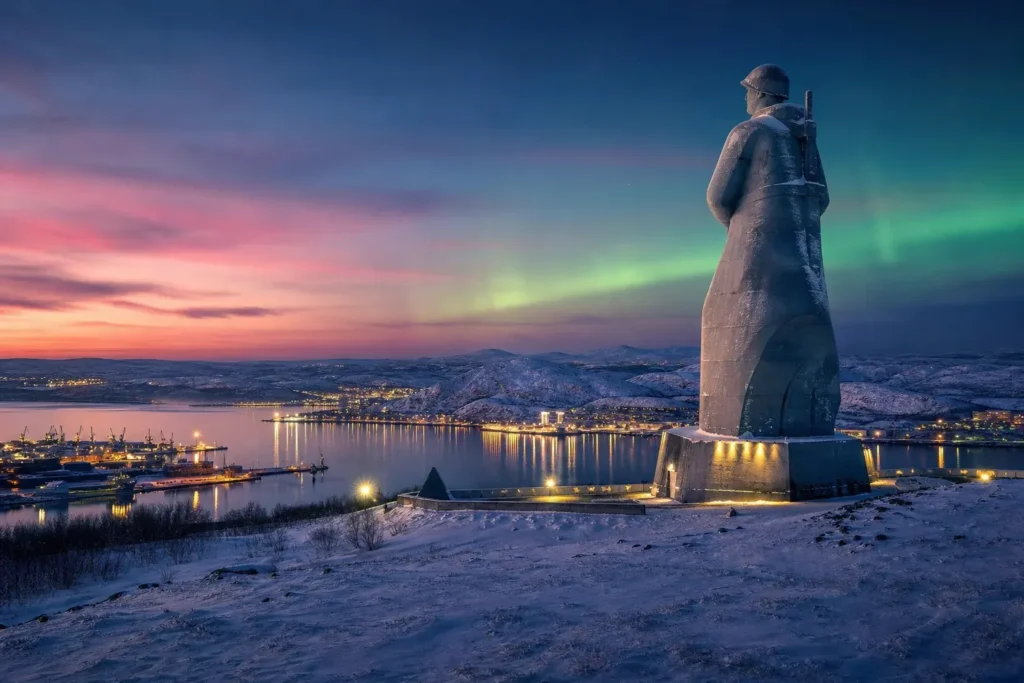
This Murmansk travel guide is for first-time visitors who want to plan a trip to the far north of Russia. Murmansk is a port on Kola Bay, an inlet of the Barents Sea, and it is described by the regional tourism portal as the largest city in the world beyond the Arctic Circle.
Most visitors come for a short stay, with the Lenin nuclear icebreaker, the Alyosha monument and the museums in the center, and many travel in winter to look for the northern lights. The light changes dramatically through the year, with a polar night in winter and a polar day in summer. Hours, tickets and transport details change, so check the official source for each place before you go.
Quick Facts
| Russian name | Мурманск |
|---|---|
| Address | OpenStreetMap · Google Maps |
| Best time to visit | Winter, from November to March, is the main season for the northern lights and the polar night, and it is very cold with short days. Summer has the polar day, when the sun stays above the horizon for weeks, and milder weather for walking and trips outside the city. Check the forecast and the schedules of the sights, since seasonal services and aurora conditions change. |
| Recommended duration | 2 days in the city, plus 1 to 2 days for trips outside |
| Website | murmansk.travel |
| Last updated | October 13, 2026 |
Why Visit Murmansk?
Murmansk offers things that are hard to see elsewhere. The Lenin, the world’s first nuclear-powered surface ship, is docked in the harbor and open as a museum, and the Alyosha monument, a giant figure of a Soviet soldier on a hill, looks out over the city and Kola Bay.
It is also a place for the Arctic landscape. In winter many visitors come to look for the northern lights, while in summer the sun stays above the horizon for weeks. The surrounding tundra, the open Barents Sea coast and villages such as Teriberka can be reached from the city, so it makes a base for a short Arctic trip.
Highlights of Murmansk
The nuclear icebreaker Lenin
The Lenin, the world's first nuclear-powered surface ship, is permanently docked in the harbor and open as a museum, according to travel sources. Visitors walk through the ship, including the bridge, the engine areas and the crew quarters, to see how an Arctic icebreaker worked. To reach it, you cross the railway by an elevated footbridge next to the central station. Check the official site for tours and times.
Tip: Book the tour in advance in busy periods, and wear warm clothes since parts of the ship are cold.
The Alyosha monument
A monument to the Defenders of the Soviet Arctic of the Second World War, a statue about 35 meters tall that stands on a hill above the city, according to travel sources. It is the best-known landmark in Murmansk and is visible from many places. The hill gives wide views over the city, Kola Bay and the surrounding hills, and there are footpaths on the grassy slopes.
Tip: Go in the late afternoon for the light over the bay, and check the weather first.
Kola Bay and the harbor
Murmansk lies on Kola Bay, an inlet of the Barents Sea, and the port is one of the largest in Russia, according to a travel source. The shoreline and the docks give views of ships and the hills on the far side. The bay stays ice-free in winter, which is why the port works all year, according to general knowledge that should be checked.
Tip: Walk the embankment near the central station for views of the harbor.
Murmansk Regional Museum of Local Lore
The regional museum covers the development of the area from the earliest times to the present, including Sami culture, maritime history and polar research, according to a travel source. It also has dioramas of Arctic wildlife and displays on the polar convoys of the Second World War and the icebreaker fleet. It is a good rainy or cold-day option.
Tip: Check the official site for opening days and any special exhibitions.
Murmansk Oceanarium
An oceanarium in the city with marine animals of the northern seas, which is popular with families, according to travel sources. It is a good indoor stop in the cold months and fits easily into a day with the museums. Check the official site for the address, hours and any shows.
Tip: Plan it as an indoor break on a cold or windy day.
The Northern Fleet Naval Museum and city monuments
The city has a naval museum devoted to the Northern Fleet and several memorials related to the sea, including the monument to the icebreaker Yermak and a memorial complex to those who died in peacetime, according to travel sources. They reflect the role of Murmansk as a port and naval base. Check which are open and how to reach them.
Tip: Check opening days, since small museums have limited hours.
Northern lights and the polar seasons
Murmansk has a polar night in winter, from about 29 November to 15 January, and a polar day in summer, from about 21 May to 22 July, according to the regional tourism portal. Winter is the main season for looking for the northern lights, though they depend on clear skies and cannot be guaranteed. Many visitors go out of town for darker skies.
Tip: Allow several nights, since the weather decides whether you see the lights.
Atmosphere
Murmansk feels like a northern port that has made peace with its climate. The city stretches along the hills above Kola Bay, with Soviet-era blocks, Stalinist buildings in the center and cranes and ships along the shore. The landscape around is open tundra and low hills.
The light defines the mood. In winter the polar night brings weeks of twilight, with lamps and cafes warming the streets, and in summer the daylight is almost constant. The Alyosha monument stands over it all, and the wind off the bay is a constant. Visitors are a mix of Arctic travellers, aurora seekers and people on business.
History of Murmansk
Murmansk is a young city by Russian standards. It was founded in 1916, during the First World War, as a port on the ice-free Kola Bay, and it was first called Romanov-on-Murman, according to general sources. The port was built to bring in supplies, and a railway line to the south was completed at the same time.
In 1917 the city was renamed Murmansk, and it remained a port and a regional center in the following decades. In the Soviet period it grew as a base for the fleet, for fishing and for polar shipping, and its population increased quickly.
During the Second World War, Murmansk was one of the ports that received supplies by sea from the Allies, along the Arctic convoys, according to general sources. The city was heavily bombed, and much of it was destroyed. The Alyosha monument, completed in the 1970s, commemorates the defenders of the Soviet Arctic of that period.
After the war the city was rebuilt, and Stalinist and later Soviet buildings shaped its center. It became the base of the Soviet nuclear icebreaker fleet, and the Lenin, the first nuclear surface ship, was launched in the 1950s and served in the Arctic for many years, according to general sources.
After the end of the Soviet Union, the city went through years of decline and population loss, but it remained an important port and naval base. The Lenin was converted into a museum and docked in the harbor, where it is open to visitors today.
In recent years Murmansk has developed as a destination for visitors who come to see the Arctic, the northern lights and the polar seasons, and the region promotes trips to the coast and to villages such as Teriberka. Today it is the administrative center of Murmansk Oblast and one of the largest ports in Russia.
The dates and details above come from general sources and should be checked against official museum and city sources.
Tickets and Booking for Murmansk
Arriving by air. The main airport is Murmansk International Airport (MMK). A flight from Moscow takes about two to two and a half hours, according to the regional tourism portal, and flights from Saint Petersburg take about two hours. A bus or a taxi is the usual way into town, but routes and fares change, so check them with the official operators.
Arriving by train. The central station is in the middle of the city. A journey from Moscow takes about 35 to 40 hours and from Saint Petersburg about 27 to 30 hours, according to a travel source. Check which train and which station your ticket names.
Confirm before you go. Schedules, ticket types and entry conditions for transport and sights depend on the operator and can change. Always confirm times and tickets with the official operator or the official website of each place, and keep your booking confirmations offline.
How to Get to Murmansk
Most visitors arrive by air or by train.
- By air: Murmansk International Airport (MMK) serves the city. A flight from Moscow takes about two to two and a half hours, and from Saint Petersburg about two hours, according to the regional tourism portal. Check the current transfer options with the operators.
- By train: the central station is near the harbor. A journey from Moscow takes about 35 to 40 hours, and from Saint Petersburg about 27 to 30 hours, according to a travel source, and a faster branded train also runs.
- In the city: most sights lie in a fairly compact area in the center, and the Lenin is reached by a footbridge over the railway next to the station.
Check routes, schedules and booking steps with the official operators, and save your hotel address offline in Latin letters and in Russian.
Accessibility
Accessibility differs between sights. The Lenin is a ship with steep stairs and narrow passages, and the Alyosha monument is on a hill with footpaths. In winter, snow and ice make pavements harder to use. Check the official website of each place for lifts, ramps and support for visitors with reduced mobility, and confirm access with the operator.
Food Nearby
The center has cafes and restaurants, and the region is known for seafood such as cod and salmon, according to travel sources. Menus differ from place to place, so ask staff for local dishes and mention any allergies. Specific venues were not verified here, so check opening hours before you go.
What to Bring
Bring very warm layers, a windproof outer jacket, a hat, gloves and boots with a good grip for winter, since temperatures are low and the wind is strong. In summer pack a light jacket and a sleep mask for the polar day. A portable charger, a tripod for aurora photographs and offline maps are useful, and large bags may need to go in a cloakroom at museums.
Photography Rules
Photography is usually allowed in the streets and at the monument, but rules differ in museums and on the Lenin, and flash and tripods may be restricted. Photography of port and naval facilities may be restricted, so check the signs and ask staff if you are unsure. Drone rules also apply in cities, near the port and at military sites, so check the current regulations with the official source before you use one.
Family Suitability
Murmansk suits families who like museums, ships and winter scenery, and the oceanarium and the icebreaker are good with children. The cold, ice and steep stairs on the ship can be hard with young children and strollers, so plan warm breaks and check access at each sight.
Russia Vibes Tips
- Start with the Lenin and the harbor, then go up to the Alyosha monument in the late afternoon.
- If you come for the northern lights, plan several nights and check the weather forecast, since cloud decides the outcome.
- In the polar night, plan outdoor sights for the middle of the day, when it is lightest.
- Dress for wind as much as for temperature, since it is windy on the hill and by the bay.
- For Teriberka and the Barents Sea coast, plan a separate day and check the road and weather conditions first.
- Use museums and the oceanarium as warm breaks between outdoor stops.
Explore Nearby Murmansk
Browse more: All Cities · All Landmarks
FAQ: Murmansk
How many days do I need in Murmansk?
One to two days cover the city, including the Lenin, the Alyosha monument and the museums. Add a day or more for the northern lights or a trip to the Barents Sea coast.
When can I see the northern lights in Murmansk?
Winter is the main season, from November to March, according to a travel source, but the lights depend on clear skies and cannot be guaranteed. Allow several nights and check the forecast.
What is the polar night?
It is the period in winter when the sun does not rise above the horizon, from about 29 November to 15 January, according to the regional tourism portal. There is twilight around midday.
How do I get from Moscow to Murmansk?
Many visitors fly, with a flight of about two to two and a half hours, or take the train of about 35 to 40 hours. Check schedules and booking steps with the official operators.
Can I go inside the Lenin icebreaker?
Yes, it is a museum ship open to visitors, according to travel sources. Check the official site for tour times and tickets, and wear warm clothes.
What is the Alyosha monument?
It is a monument to the defenders of the Soviet Arctic in the Second World War, a statue about 35 meters tall on a hill above the city, according to a travel source.
Is Murmansk good in summer?
Yes, many visitors like the polar day, from about 21 May to 22 July, according to the regional tourism portal, when the sun stays up for weeks. The sea and the tundra are easier to reach.
Can I visit Teriberka from Murmansk?
Yes, the village on the Barents Sea coast can be reached by road, according to the regional tourism portal, and many visitors go on a day trip or a tour. Check the conditions in advance.
Last updated: October 13, 2026. Found an error or something out of date? Report it and we will check and fix it.
About this guide: AI assistance and accuracy
This guide is created with the help of AI and is based on official sources where available. Mistakes can still happen. Opening hours, prices, rules and other details are given to the best of our knowledge as of the date shown and can change without notice. It offers general recommendations only, not professional, legal or travel advice. Please confirm important details with the official source before you travel; you are responsible for your own plans and decisions.
International sanctions affect payments between Russia and many other countries. In practice, cards issued in the EU, the UK, the US and several other countries often do not work in Russia, Russian cards usually do not work abroad, and some booking platforms, airlines and payment providers limit or suspend their services for Russia. The situation changes frequently. We do not give legal or financial advice, and this site does not encourage anyone to break or circumvent sanctions. Whatever you plan, you are responsible for following the laws and regulations that apply to you, including those of your country of residence and citizenship. Many travelers still organise their stay lawfully. It is worth asking your bank or payment provider what is currently permitted, contacting hotels, tour operators and carriers directly about the payment methods they accept, and checking which services are open to customers from your country. Clarify payment, cancellation and refund terms before you commit to a booking, and keep your plans flexible. Partner links on this site may not be available in every country, and prices, availability and rules in our guides can differ from what you see when you book.Paying for your trip: please read
 Ask Masha