
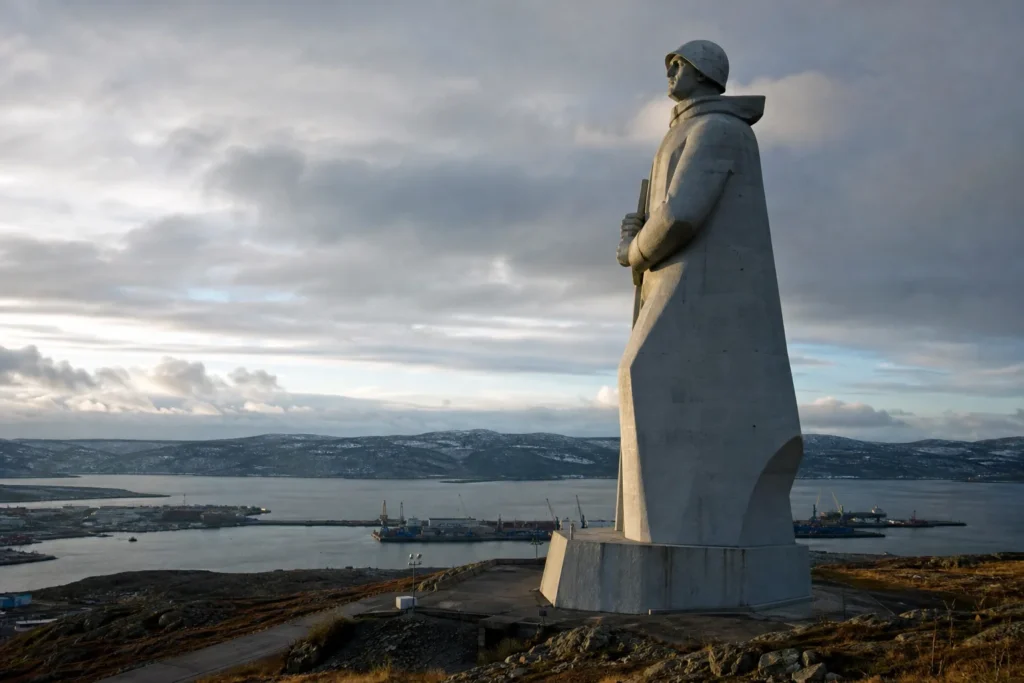
The Monument to the Defenders of the Soviet Arctic during the Great Patriotic War, commonly called Alyosha (an affectionate diminutive form of the name Aleksey), is a monument in Murmansk to Soviet soldiers, sailors, and airmen of World War II. It stands on a hill overlooking the city and Kola Bay at Cape Green in the Leninsky District.
The statue depicts a soldier in a greatcoat with a submachine gun slung over his shoulder. The monument is visible from almost anywhere in the city; it meets and sees off ships sailing along the Kola Bay and peers menacingly to the west. From the viewing platform, there are magnificent views of the city, port, bay and hills.
Quick Facts
| Russian name | Памятник защитникам Советского Заполярья в годы Великой Отечественной войны |
|---|---|
| Built / opened | 1974 |
| Architect(s) | Igor Pokrovsky (architect); Isaac Brodsky (sculptor) |
| Address | Green Cape Hill (Zeleny Mys), Murmansk OpenStreetMap · Google Maps |
| District | Leninsky |
| Admission | free |
| Best time to visit | The monument is accessible year-round. Summer months (June to August) offer the best weather and longest daylight hours for viewing the statue and panoramic views. During winter, the site remains open but can be icy; sturdy footwear is essential. Spring (May) is ideal if you wish to visit on or near Victory Day (May 9), when ceremonies and commemorations take place. Avoid visiting during heavy snow or fog, which can obscure views of Kola Bay. |
| Recommended duration | 1–2 hours |
What Is (and Isn't) Part of a Visit to Alyosha Monument, Murmansk?
| Part | Status | Notes |
|---|---|---|
| The main statue and pedestal | Included in the standard ticket | The 35.5-metre soldier statue is the primary monument; included in a free visit. |
| Observation deck and viewing platform | Included in the standard ticket | Panoramic views of Kola Bay and Murmansk city; free and accessible from the main site. |
| Eternal flame and Unknown Soldier burial site | Included in the standard ticket | Located at the base of the monument; free to view. |
| Anti-aircraft guns from World War II | Included in the standard ticket | Placed to the side of the monument; original military hardware on display, free to inspect. |
| Alley of memorial plates of Hero Cities | Included in the standard ticket | Added in 2004; commemorative plaques honouring Soviet Hero Cities, free to view. |
Why Visit Alyosha Monument, Murmansk?
Entry is free, and the ascent to the monument is smooth and will be accessible to everyone. The soldier faces west, toward the Valley of Glory, where the fiercest fighting of the Arctic Campaign occurred. An eternal flame burns in memory of the fallen soldiers, and the surrounding area is adorned with commemorative plaques. In October 2004, on the 60th anniversary of the Soviet victory in the Arctic, the memorial was completed with an Alley of memorial plates of Hero Cities.
Highlights of Alyosha Monument, Murmansk
The 35.5-Metre Statue
The statue stands 35.5 metres tall on a 7-metre pedestal. The weight of the hollow statue is over 5,000 tons. It depicts a soldier in a greatcoat with a submachine gun slung over his shoulder. The soldier faces west, toward the Valley of Glory, where the fiercest fighting of the Arctic Campaign occurred. This commanding presence dominates the skyline and can be seen from across the city.
Tip: Stand at the observation deck on the west side of the monument base for the best full-frame view and clearest shots of the soldier's profile against the sky.
The Eternal Flame and Unknown Soldier
On May 9, 1975, a solemn reburial ceremony was held and the eternal flame was lit at the monument's base. The eternal flame burns in memory of the fallen soldiers. The flame is a focal point for commemorative ceremonies, especially on Victory Day each May 9, when residents gather to honor the Arctic defenders.
Tip: Visit on May 9 (Victory Day) to witness local ceremonies and see how the monument remains a central gathering place for remembrance in Murmansk.
Panoramic Views of Kola Bay and the City
An observation deck offers magnificent views of the city, port, bay and hills. Views from the Alyosha Monument area extend to Kola Bay. On clear days, visitors can see across the Kola Bay and identify major landmarks of Murmansk's port district. The elevated position on Green Cape Hill makes this one of the highest vantage points in central Murmansk.
Tip: Bring binoculars to spot ships in Kola Bay and identify structures across the port. Visit in late afternoon when the low Arctic sun illuminates the bay and distant hills.
Memorial Plaques and Inscriptions
The pedestal is made of polished granite with the names of the military formations that defended the Arctic. In October 2004, an Alley of memorial plates of Hero Cities was added to the memorial complex. The plaques honour Soviet Hero Cities and commemorate the broader Arctic defense effort. Each plaque tells part of the story of the 30-year struggle against Nazi forces.
Tip: Walk slowly along the Alley of Hero Cities to read individual plaques; they reveal the extent of the Soviet Arctic defense network and the cities most affected.
Anti-Aircraft Guns from World War II
To the side of the monument there are two anti-aircraft guns from the war. These are original military hardware from the Arctic Campaign and serve as physical reminders of the combat systems that defended Murmansk. The presence of these weapons grounds the memorial in concrete military history.
Tip: Examine the inscriptions on the gun carriages, which often state their unit designation and date. These details connect the guns to specific units that fought in the Arctic.
The Choice of Green Cape Hill
The original plan was to build the monument at Five Corners, the main square of Murmansk, but it was later decided to build it on a hill overlooking the city and Kola Bay at Cape Green in the Leninsky District. This elevated, isolated location reinforces the monument's role as a guardian watching over the city and the strategic port. The decision reflects Soviet monumentalist principles of placing memorials on commanding natural features.
Tip: Visit in the morning or early afternoon when the sun illuminates the soldier's face and the pedestal clearly. The elevated position makes the climb part of the commemorative experience.
Atmosphere
The 40-metre Alyosha itself is stern, gray and gloomy – like a real northerner, like Murmansk itself and its nature. The monument stands alone on its hilltop, exposed to Arctic winds and the elements. The atmosphere is one of solemn remembrance rather than celebration; visitors often stand in quiet reflection at the viewing platform. The wind that sweeps across Green Cape gives the statue an almost living presence, as if the soldier is still keeping watch. The eternal flame at the base provides a human focal point, and ceremonial wreaths appear on major dates. Throughout the year, small groups of locals and tourists climb the smooth pathway, each drawn by different aspects—some for history, some for views, some out of civic duty or family remembrance.
History of Alyosha Monument, Murmansk
Collection of funds for the project was initiated by a floating workshop collective named “Chisel”. Ground was broken on October 17, 1969, and construction began in May 1974. The monument was designed by I. A. Pokrovsky and erected under the supervision of I.D. Brodsky.
The monument was dedicated on the 30th anniversary of the defeat of German forces in the Arctic – October 19, 1974. At the opening ceremony, a column proceeded to the site, with two armored personnel carriers at the head and at the rear a gun carriage with the remains of an Unknown Soldier and two capsules, one of water and one of earth. Standing on the roads in Kola Bay, the cruiser Murmansk saluted with 30 volleys in honour of the holiday and the opening of the memorial.
On May 9, 1975, the Unknown Soldier was reburied in a solemn ceremony at the eternal flame at the foot of the monument. In October 2004, on the 60th anniversary of the victory of Soviet troops in the Arctic, the memorial was accomplished with the Alley of memorial plates of Hero Cities.
Tickets and Booking for Alyosha Monument, Murmansk
Entry to the Alyosha Monument is free. There are no tickets or advance reservations required. The site is open year-round and accessible at all times. Parking is available, though small, and there is a free toilet.
Plan and Book
Suggested itineraries Alyosha Monument, Murmansk
30 minutes
Enter from the main pathway and ascend to the statue. Stand at the observation deck to take photographs and view Kola Bay. Read a few plaques on the pedestal, then depart.
1 hour
Climb to the statue and spend time at the observation deck. Walk around the base to view the eternal flame and anti-aircraft guns. Read the granite inscriptions naming the military formations. Visit the Alley of Hero Cities plaques.
1–2 hours
Take the full circuit: ascend slowly, study the plaques and inscriptions, visit the observation deck, examine the anti-aircraft guns in detail, read the Hero Cities plaques, and spend quiet time at the eternal flame. Consider timing your visit to catch late afternoon light across Kola Bay.
How to Get to Alyosha Monument, Murmansk
The Alyosha Monument is located on Green Cape Hill (Zeleny Mys) in the Leninsky District. Murmansk has no metro system; the city is served by local buses and taxis. From central Murmansk, take a taxi directly to the monument (approximately 5–10 minutes from downtown). Alternatively, local buses serve the area; ask at your hotel or a local information point for the current bus routes to Green Cape. The site is accessible by car; a small parking area is available at the base of the pathway. If walking from the city centre, the distance is approximately 2–3 kilometres and involves hills; a taxi is recommended.
Accessibility
The ascent to the monument is smooth and will be accessible to everyone. The pathway is paved and gradual. There is wheelchair access to the lower observation areas. The site has limited facilities; parking is small and there is a free toilet. No dedicated accessible parking is mentioned in available sources.
Food Nearby
No shops or cafés are located at the monument site itself. The nearest food options are in central Murmansk, a short taxi ride or local bus journey away. Stock up on water and snacks before visiting if you plan to spend extended time at the site.
What to Bring
Wear sturdy, comfortable walking shoes for the climb. In winter and spring, bring warm clothing and waterproof boots; the site is exposed to wind and can be icy. Sunglasses and sunscreen are recommended in summer. Bring a camera or phone with good battery for photographs. Water is advisable, as there are no refreshment stands on site. Winter visitors should allow extra time and take care on icy sections of the pathway.
Best Views and Photo Spots of Alyosha Monument, Murmansk
Main observation deck at the monument's base
Direct frontal view of the 35.5-metre soldier statue against the Arctic sky. The eternal flame and granite pedestal are in sharp focus. Kola Bay and the port district stretch behind and below. This is the most iconic angle for the monument's profile.
Best time: Late afternoon (16:00–18:00 in summer) when the low sun illuminates the statue's face and casts long shadows across the bay, creating dramatic contrast.
Northwest corner of the observation deck
Side profile of the soldier with the rifle slung across the shoulder. Kola Bay and ships in the port are visible to the left. This angle shows the soldier's vigilant pose more clearly.
Best time: Morning light (09:00–11:00) from the east, which highlights the statue's contours and the bay beyond.
The pathway leading uphill to the monument
The statue rises progressively larger as you ascend, with Murmansk's residential areas and the bay visible in the background. Captures the sense of scale and the climb itself as part of the experience.
Best time: Any time of day; the ascending perspective is dramatic regardless. Early morning or dusk offer softer light and fewer crowds.
Anti-aircraft guns display area
Close-up of the original WWII hardware with plaques. The guns frame views toward the bay and create historical context in the foreground.
Best time: Midday or early afternoon when the guns' metal surfaces catch direct light, enhancing detail and texture.
Alley of Hero Cities plaques
Individual plaques arranged in a line, each honouring a Soviet Hero City. The plaques are readable and form a compositional line leading toward the monument.
Best time: Any time; good for detail photography and reading the inscriptions. Overcast days reduce glare on the polished granite and plaques.
Photography Rules
Photography is permitted throughout the monument. No restrictions on still photography or standard cameras are published. The site is popular for wedding photography. Drone flights may be restricted; check local regulations before flying drones near military memorials.
Family Suitability
The monument is suitable for families with older children and teenagers interested in World War II history. The ascent is smooth and accessible, though young children may find the climb tiring. The site is outdoors and exposed to wind; small children will need warm clothing in cold weather. Stroller access is limited due to the pathway's slope, though older prams may manage the ascent. The monument itself offers few interactive elements for very young children; teenagers and adults interested in military history will find it more engaging. Plan for 1–2 hours to avoid children becoming bored. The viewing platform provides a safe rail, and the site is not crowded, making supervision straightforward.
Russia Vibes Tips
- Visit on a clear day to maximize views of Kola Bay and the port. Fog and cloud can reduce visibility to just the immediate monument and surrounding slopes.
- Wear sturdy shoes even in summer; the pathway is paved but can be slippery from rain or morning dew, and there are no handrails on most of the ascent.
- Time your visit to avoid midday sun directly overhead in summer; early morning or late afternoon light creates better photographs and is more comfortable for standing still.
- Bring water and snacks; there are no vendors or cafés at the monument, and the site is quite isolated from the nearest shops.
- If you speak Russian, ask locals for "Alyosha" rather than using the full formal name; the diminutive is how residents refer to the monument in everyday conversation.
Explore Nearby Alyosha Monument, Murmansk
Related guides
 Understand Russian Customs and Etiquette in Murmansk: Greetings, Home Visits, and Public Behavior
Main image: AI-generated illustration. It may not show the place exactly as it looks.
 Museum + cultural half-day, Murmansk: Sami heritage and Arctic WWII history
Main image: AI-generated illustration. It may not show the place exactly as it looks.
 Zuma, Vladivostok: Upscale Pan-Asian Dining on Partizanskiy Prospekt
Main image: AI-generated illustration. It may not show the place exactly as it looks.
Browse more: More in Leninsky · All Landmarks · All Murmansk · All Sightseeing · All Sightseeing in Murmansk
FAQ: Alyosha Monument, Murmansk
Is entry free?
Yes, entry is free. There are no tickets or advance bookings required to visit the monument and observation areas.
How tall is the statue?
The statue is 35.5 metres tall, and the pedestal is 7 metres. It is the second-tallest statue in Russia, after The Motherland Calls in Volgograd.
What does the monument commemorate?
The monument was dedicated on the 30th anniversary of the defeat of German forces in the Arctic – October 19, 1974. It honours Soviet soldiers, sailors, and airmen who fought in World War II, particularly in the Arctic Campaign.
Is the monument accessible for people with disabilities?
The ascent to the monument is smooth and will be accessible to everyone. However, the site offers no dedicated accessible parking or other special facilities, so those with limited mobility should plan accordingly.
What are the visiting hours?
The monument is open year-round and accessible at any time. There are no restricted visiting hours or seasonal closures.
Can I take photographs?
Yes, photography is permitted throughout the monument. The site is popular for both tourist and wedding photography. Standard photo restrictions apply; check local regulations regarding drones.
How do I get to the Alyosha Monument from central Murmansk?
A taxi is the most direct option; the journey takes approximately 5–10 minutes from downtown Murmansk. Alternatively, local buses serve the area—ask at your hotel for current route information. Walking from the city centre is possible but approximately 2–3 kilometres and involves hills.
What is there to see besides the main statue?
The site features an eternal flame in memory of the fallen soldiers and is adorned with commemorative plaques and engravings. There are two anti-aircraft guns from the war to the side of the monument. An observation deck offers views of Kola Bay and the city.
Russia Vibes is a one-person project. A coffee keeps it going
How we research and update our guides
About this guide: AI assistance and accuracy
This guide is created with the help of AI and is based on official sources where available. Mistakes can still happen. Opening hours, prices, rules and other details are given to the best of our knowledge as of the date shown and can change without notice. It offers general recommendations only, not professional, legal or travel advice. Please confirm important details with the official source before you travel; you are responsible for your own plans and decisions.

Take this guide with you
Get a free PDF of this guide to print or read offline: key facts, tips and a map link on a few clean pages.
Report an issue on this page
Paying for your trip: please read
International sanctions affect payments between Russia and many other countries. In practice, cards issued in the EU, the UK, the US and several other countries often do not work in Russia, Russian cards usually do not work abroad, and some booking platforms, airlines and payment providers limit or suspend their services for Russia. The situation changes frequently.
We do not give legal or financial advice, and this site does not encourage anyone to break or circumvent sanctions. Whatever you plan, you are responsible for following the laws and regulations that apply to you, including those of your country of residence and citizenship.
Many travelers still organise their stay lawfully. It is worth asking your bank or payment provider what is currently permitted, contacting hotels, tour operators and carriers directly about the payment methods they accept, and checking which services are open to customers from your country. Clarify payment, cancellation and refund terms before you commit to a booking, and keep your plans flexible.
Partner links on this site may not be available in every country, and prices, availability and rules in our guides can differ from what you see when you book.