
Nizhny Novgorod‘s public transport system spans metro, trams, trolleybuses, buses and city rail—all working on a unified fare. For visitors, understanding the basics of this network saves time and money, especially if you’re moving between the Upper City (historic centre) and Lower City (industrial areas).
This guide covers the main transport types, where to get tickets, and how to pay with cash, cards or your phone. For most journeys within the city, you’ll use one ticket method across all modes.
Quick answer: The metro consists of 2 lines and 15 stations, covering 21.6 km. The metro operates from 05:15 to 00:15. A single ride costs 26 rubles with a contactless card or 35 rubles in cash. For a one-time journey, buy a token or tap a card at the turnstile. For multiple rides, contactless payment is most convenient.
At a Glance
| Total time | 30–60 minutes total, depending on destination and transport mode |
|---|---|
| Typical cost | ₽ |
What You Need Before You Start
- Cash or contactless card (Visa, Mastercard, Mir) if buying single tickets
- Smartphone with Apple Pay or Google Pay (optional, for payment)
- Small change or notes no larger than 1000 rubles if paying cash on surface transport
- Arrival at least 5 minutes before departure for confidence
Compare Your Options
| Option | Duration | Price | Notes |
|---|---|---|---|
| Metro (recommended for speed) | 5–20 minutes depending on distance | ₽ | The metro has 2 lines and 15 stations. Open from 05:15 to 00:15. Trains run every 6–8 minutes during peak hours and 11–12 minutes during off-peak times. Moskovskaya is the only station with four routes and 2 lines, connecting the Lower City to the industrial Avtozavod area and, since 2012, the Upper City via Gorkovskaya. |
| Tram (comprehensive network) | 10–40 minutes depending on stops | ₽ | The city has 14 tram lines. Nizhny Novgorod has one of Russia's oldest tram networks (running since 1896). Slower than metro but covers neighbourhoods the metro does not reach. Pay driver or conductor on boarding. |
| Bus or trolleybus (most extensive coverage) | 15–60 minutes depending on stops and traffic | ₽ | There is a network of buses, trolleybuses and marshrutkas. Public transport is available from 05:00 to 00:00. Some routes (mainly buses and trolleybuses) stop running after 21 hours. Best for reaching areas outside the metro network. |
| City rail (Sormovskaya and Priokskaya lines) | 5–15 minutes depending on stops | ₽ | The City Rail connects areas where there are no metro lines and connects with the subway at the Moscow railway station. It has 2 lines: Sormovskaya and Priokskaya. Fast for longer suburban journeys. |
| Marshrutka (fixed-route minibus) | Varies widely | ₽ | Small shared taxis follow fixed routes and are faster than regular buses for longer distances. Payment is usually made in cash; cards are accepted only for the duration of the route. Stop anywhere along the route by waving. |
₽ budget · ₽₽ moderate · ₽₽₽ upscale · ₽₽₽₽ splurge. Price levels are estimates compared with typical prices for visitors.
Step-by-Step Instructions
Step 1: Find the transport entrance
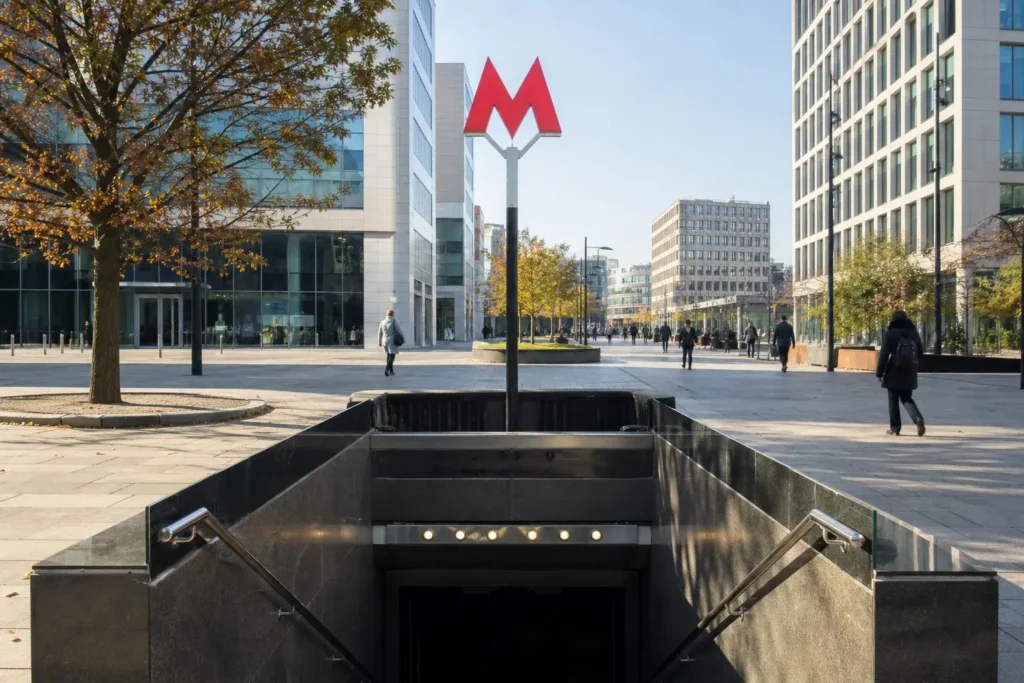
For the metro, look for an underground passage with a red letter M on top and go down under the ground. For surface transport (trams, buses, trolleybuses), look for the stop sign showing the route number. The number appears on the side of the vehicle and in the front window.
Tip: Metro entrances are always marked clearly. If you're unsure, ask a local—they're usually helpful.
Step 2: For metro: buy a token or use a card
At the entrance to the metro you need to go through the security system. If paying cash, approach the ticket booth (kassa) and buy a token. A single ride costs 26 rubles with a contactless card or 35 rubles in cash. If using a card, you can tap it directly at the turnstile without a booth.
Tip: Contactless payment (tapping your card) is faster than waiting for a token at busy times.
Step 3: For metro: insert token or tap card at the turnstile
Tokens are dropped into a slot on the turnstile, after which the passage is unlocked. For a card or phone, tap on the validator panel on the side of the turnstile. Wait for the gates to open before passing through.
Tip: One person per token or tap. Children travel free if accompanied by an adult.
Step 4: For trams, trolleybuses, buses: board and pay the driver or conductor
On surface public transport (trams, trolleybuses, buses and marshrutkas) you are expected to pay within one stop after you enter, the fare is fixed for one ride. A conductor will come to you, take money and issue a ticket; if there is no conductor, you should pay directly to the driver.
Tip: Have the exact fare or small notes ready. Notes of 1000 rubles and larger are sometimes denied.
Step 5: Payment options on surface transport
As of 2019, you can pay by Apple Pay/Google Pay/Visa PayWave/Mastercard Contactless on board on any public transport including marshrutkas. Alternatively, you can use a city transport card or Moscow Troika card.
Tip: Contactless payment works on buses and trams as well as the metro. No need to carry cash if your phone or card supports it.
Step 6: Find your stop and exit
On the side sign, there is a list of stops, normally with all the big stops listed. Watch the stop names on electronic displays or listen for announcements. Press the bell or button to signal your stop. For the metro, follow signs to your station name on the platforms.
Tip: Keep a note of your destination in Russian if possible—showing it to the conductor or driver helps.
Step 7: Consider a transport card for multiple journeys
You can get a non-personal Citicard card at any post office or one of the many replenishment points for 50 rubles (activation cost). A contactless urban transport card (Ediny) costs 26 rubles per ride and works on tram, bus, trolleybus and metro. You can also buy a ticket directly in the 2GIS application and pass through the turnstile using a QR code on your smartphone screen.
Tip: To recoup the cost of a Citicard card, you will have to make 25 trips, and only then will the trips go with savings. For short stays, contactless card taps are more practical.
Common Mistakes to Avoid
- Confusing metro tokens with other coins. Tokens (valid only at turnstiles) look like coins but cannot be spent elsewhere. Buy them only at the ticket booth or vending machines.
- Assuming you can tap a Moscow Troika card everywhere. The Moscow Troika card is accepted in Nizhny Novgorod metro, but not all city transport readers support it; a local Citicard is more reliable.
- Not paying within one stop on surface transport. You are expected to pay within one stop after you enter the vehicle. Delaying payment may result in being asked to leave.
- Trying to board a metro train during rush hours without a firm grip. Platforms can be crowded; hold the rail and stand back from the doors until they fully open.
- Using large bills on buses or minibuses. Notes of 1000 rubles and larger are sometimes denied. Break larger notes in advance or use contactless payment.
- Missing your stop because announcements are only in Russian. Check the electronic displays on vehicles or ask the conductor to signal when your stop approaches.
Tickets, Payment and Booking
Where to buy tickets:
- Metro: ticket booths at every station entrance (cashiers selling tokens), or vending machines for cash and contactless cards.
- Surface transport (trams, buses, trolleybuses): on board directly from the driver or conductor. No advance booking.
- City rail: ticket booths at stations or on board.
Payment methods:
- Contactless bank cards (Visa, Mastercard, Mir) work at all metro turnstiles and surface transport readers. You can also buy a ticket directly in the 2GIS application and pass through the turnstile using a QR code on your smartphone screen.
- Cash: accepted everywhere, but drivers may refuse notes larger than 1000 rubles.
- Urban transport card (Ediny): a rechargeable card available at metro booths and post offices, works across metro, tram, bus and trolleybus.
- Tokens: Soviet-style tokens for metro, bought at ticket booths.
Important: Foreign bank cards and contactless payments work throughout the system. No registration or local ID is needed to pay with a foreign card or phone. Resellers and unofficial touts do not operate on this system; buy only from official booths or machines.
Helpful Links
Compare hotel pricesSearch flights
Advertisement: these are partner links. If you book or buy through them, we may earn a commission at no extra cost to you.
Russia Vibes Tips
- Time the metro to avoid peak rush hours (08:00–09:30 and 17:00–19:00 on weekdays). Trains are less crowded mid-morning and mid-afternoon.
- Moskovskaya station is the main interchange between metro lines and the hub for surface transport. If unsure where to go, ask staff or look for transfer signs.
- Check the official Nizhny Novgorod transport website or BusTime app for tram and bus schedules. You can check out the transport schedule on the website and in the BusTime app.
- If you're staying multiple days, a Citicard reduces the per-ride cost but requires a 50-ruble initial purchase. Calculate whether it's worth it based on your travel plans before buying.
- The historic Upper City centre is served by Gorkovskaya metro station, which is relatively new (opened 2012). Most other metro stations serve the Lower City and industrial zones.
Explore Nearby Use Public Transport in Nizhny Novgorod
Browse more: All How-To · All How-To in Nizhny Novgorod · All Metro and Trains · All Nizhny Novgorod
FAQ
Do I need a ticket before boarding the metro, or do I buy it at the station?
You buy it at the station. There's no advance booking. At the metro entrance, use a ticket booth to buy a token (if paying cash), or tap your contactless card at a turnstile validator.
Can I use my credit card instead of buying a token?
In Nizhny Novgorod, all metro turnstiles have been equipped to accept bank card payments since 2017. You can pay with a bank card, a smartphone, a bracelet or city pass. Tap at the validator on the turnstile side panel.
What's the difference between a token and a smart card?
Tokens are one-time plastic coins you insert into the metro turnstile; you buy them for cash and discard after use. Smart cards are reusable and store credit for multiple journeys across all transport modes (metro, tram, bus, trolleybus) at a reduced per-ride rate.
Is there a daily unlimited pass?
Electronic transport cards are available for 90 rubles for 24 hours of travel on all types of public transport. These are available at post offices and transport card resellers, though they require registering the card.
Can children travel for free?
Children under 7 years travel free of charge. Older children and students require a discount card or full fare.
What time does public transport stop running?
The metro operates from 05:15 to 00:15. Some bus and trolleybus routes stop running after 21 hours. Trams and city rail have varying schedules; check the BusTime app or official website for your specific route.
Do I need to show my passport or ID to buy a transport ticket?
No. Tokens and single fares require no ID. Only if you're buying a personal smart card (as opposed to a temporary one) will you need to provide local resident identification.
Which station should I use to reach the historic city centre?
Gorkovskaya is the only metro station in the historic city centre; it opened in 2012. Burevestnik is the northwestern terminus and the best way to get close to Sormovo, a historically shipbuilding district. Most other attractions require a short walk from Gorkovskaya or access via tram and bus.
Russia Vibes is a one-person project. A coffee keeps it going
How we research and update our guides
About this guide: AI assistance and accuracy
This guide is created with the help of AI and is based on official sources where available. Mistakes can still happen. Opening hours, prices, rules and other details are given to the best of our knowledge as of the date shown and can change without notice. It offers general recommendations only, not professional, legal or travel advice. Please confirm important details with the official source before you travel; you are responsible for your own plans and decisions.

Take this guide with you
Get a free PDF of this guide to print or read offline: key facts, tips and a map link on a few clean pages.
Report an issue on this page
Paying for your trip: please read
International sanctions affect payments between Russia and many other countries. In practice, cards issued in the EU, the UK, the US and several other countries often do not work in Russia, Russian cards usually do not work abroad, and some booking platforms, airlines and payment providers limit or suspend their services for Russia. The situation changes frequently.
We do not give legal or financial advice, and this site does not encourage anyone to break or circumvent sanctions. Whatever you plan, you are responsible for following the laws and regulations that apply to you, including those of your country of residence and citizenship.
Many travelers still organise their stay lawfully. It is worth asking your bank or payment provider what is currently permitted, contacting hotels, tour operators and carriers directly about the payment methods they accept, and checking which services are open to customers from your country. Clarify payment, cancellation and refund terms before you commit to a booking, and keep your plans flexible.
Partner links on this site may not be available in every country, and prices, availability and rules in our guides can differ from what you see when you book.