
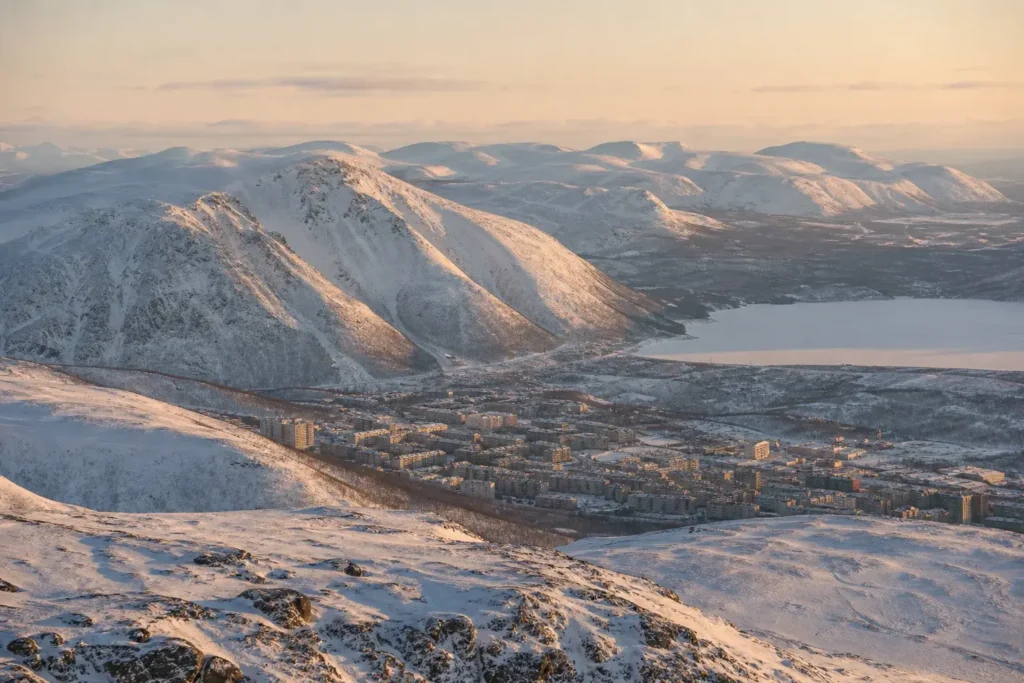
The Khibiny Mountains & Kirovsk make a compelling full-day excursion from Murmansk. Located 175 kilometers south of the city, this remote mountain landscape sits on the Kola Peninsula well beyond the Arctic Circle. Kirovsk, founded in 1929 as a mining town on the shore of Lake Bolshoy Vudyavr, grew into the gateway to Russia’s northern mountain playground.
These ancient peaks—more than 350 million years old—are among Europe’s highest northern mountains. The range spreads across 1,300 square kilometers of taiga and tundra, with Yudychvumchorr peak reaching 1,201 meters. Today, visitors come to hike alpine valleys in summer, ski steep slopes in winter, ride cable cars to panoramic viewpoints, explore ice caves filled with sculptures, and visit museums devoted to the extraordinary mineral deposits that still draw mining operations to the region.
Quick Facts
| Russian name | Хибины |
|---|---|
| Distance from the nearest major city | approximately 2,100 km |
| Travel time from the nearest major city | approximately 3–4 hours by flight plus transfer |
| Built / opened | 1929 |
| Address | Kirovsk, Murmansk Oblast OpenStreetMap · Google Maps |
| Admission | free |
| Best time to visit | Winter (December–April) offers snow-filled landscapes, the Snow Village ice cave, the dramatic contrast of artificial lights against Arctic darkness, and the possibility of viewing Northern Lights from mountain elevations. Spring (March–May) brings longer daylight and stable snow conditions—ideal for skiers and photographers. Summer (June–September) opens alpine tundra hiking with near-24-hour daylight, low temperatures (5–15 °C), and tundra vegetation in bloom. Autumn (September–November) transitions to shorter days and increasing snow; the region begins to feel remote and austere. Crowds peak in winter (January–February); shoulder seasons (March, September) are quieter. Winter also brings extreme cold (−20 to −30 °C) and short daylight hours, which challenges logistics but rewards hardy travelers with dramatic scenery and fewer tourists. For photographers, winter sunset and Arctic dawn light are exceptional. |
| Recommended duration | 10–12 hours |
| Website | kirovsk.ru |
What Is (and Isn't) Part of a Visit to Khibiny Mountains & Kirovsk, Murmansk?
| Part | Status | Notes |
|---|---|---|
| Kirovsk town center and Soviet architecture | Included in the standard ticket | Walking around the town's central squares and viewing period buildings is free; no admission required. |
| Lake Bolshoy Vudyavr shoreline and observation points | Included in the standard ticket | Public access to the lake shore and designated viewpoints is free and unrestricted. |
| Cable car (Sky resort funicular) to Aykuayvenchorr summit | Separate ticket or institution | Requires a separate ticket; typically included in organized tours but purchased separately if visiting independently. Operates seasonally; closed during maintenance periods. |
| Snow Village (ice cave with sculptures) | Separate ticket or institution | Open December through April only; requires a separate ticket. Included in most winter tours; not accessible in summer. |
| Mineralogy Museum of Kirovsk | Separate ticket or institution | Requires a separate admission ticket; typically 1–1.5 hours inside. Often included in organized tours. |
| Ski resorts (Big Wood, Kukisvumchorr, Kolasportland) | Separate ticket or institution | Each resort charges daily ski passes or activity fees. Separate from the day-trip itinerary unless skiing is the primary purpose. Equipment rental available on-site. |
| Hiking trails on alpine tundra | Included in the standard ticket | General access to marked and unmarked hiking areas is free. However, hiring a professional guide is strongly recommended for safety and proper route navigation. |
| Apatite Museum and Exhibition Centre (in Apatity town) | Outside / not part of it | Located 20 kilometers from Kirovsk in the separate town of Apatity; requires additional time and travel. Some tours visit this instead of or in addition to Kirovsk attractions. |
How to Get from the nearest major city to Khibiny Mountains & Kirovsk, Murmansk
| Option | Duration | Price | Notes |
|---|---|---|---|
| Organized Day Tour from Murmansk | 11–12 hours total; 2.5–3 hours travel each way | ₽₽₽ | Multiple tour operators in Murmansk offer full-day guided packages including transport, guide, lunch, and admission to Snow Village and cable car. Tours typically depart 8–9 am from central hotels and return by evening. This is the most popular option for international visitors without Russian language skills or a rental car. |
| Train from Murmansk | 3.5–4 hours train; plus time in Kirovsk | ₽ | A slow train runs between Murmansk and Kirovsk (stopping at Imandra station), offering an immersive journey through Arctic landscape. Trains operate year-round; schedules vary seasonally. This option requires independence—no guide or transportation within Kirovsk—but costs significantly less. Return train departs in late afternoon or evening. |
| Taxi or Private Driver from Murmansk | approximately 3 hours each way | ₽₽ | Hire a driver in advance through a Murmansk hotel or app-based service. This allows flexible timing but requires navigation skills, arrangement of meals, and coordination of specific activities in Kirovsk. Parking is available near main attractions. Best suited for travelers with Russian language ability or a good guide. |
| Rental Car from Murmansk | approximately 3 hours drive; unlimited time in Kirovsk | ₽₽–₽₽₽ | International drivers with a valid license and International Driving Permit can rent a car. The highway to Kirovsk is well-maintained. This option maximizes flexibility but requires comfort with Arctic driving conditions and potential winter road hazards. Return the same day requires an early start. |
₽ budget · ₽₽ moderate · ₽₽₽ upscale · ₽₽₽₽ splurge. Price levels are estimates compared with typical prices for visitors.
Why Visit Khibiny Mountains & Kirovsk, Murmansk?
The Khibiny offer a rare glimpse of Arctic mountain culture and geology. Kirovsk preserves Neoclassical Soviet-era architecture overlooking dramatic terrain—a contrast between human settlement and raw wilderness. Winter visitors discover snow-filled valleys, the Sky resort cable car reaching 850 meters, and the Snow Village, an ice cave carved annually with illuminated sculptures.
Summer brings serious trekkers seeking high plateaus and mountain streams through virtually untouched terrain. The Mineralogy Museum displays rare stones found nowhere else on Earth—some specimens 90 million years old. For photographers, aurora-framed mountains in winter and midnight-sun highlands in summer are unmissable. Most day trips run about 11–12 hours from Murmansk, making them feasible even on tight schedules.
Highlights of Khibiny Mountains & Kirovsk, Murmansk
Cable Car Ascent of Aykuayvenchorr
The Sky resort funicular climbs to approximately 850 meters above Kirovsk, delivering panoramic views of the mountain ring and the town below. From the summit, visitors spend 20–30 minutes photographing the tundra plateau and on clear days can see Lake Imandra to the west. Look for the local legend of 'King Arthur's Sword' supposedly embedded at the peak. The cable car ride takes roughly 15 minutes each way.
Tip: Book early if traveling in winter; the ride operates seasonally and weather can cause closures. Bring heavy layers as wind at the summit is sharp.
Snow Village (Seasonal Winter Attraction)
Built annually between December and April, the Snow Village is an ice cave carved from compacted snow and decorated with illuminated ice sculptures inspired by local folklore and fairy tales. Visitors walk through the tunnel-like interior, spotting familiar cartoon characters and mythical beings rendered in ice. The interior temperature hovers around freezing, and the experience lasts 30–40 minutes. This attraction typically operates only in the winter season.
Tip: Bring waterproof gloves and a warm coat—the cold is intense inside. Photography is excellent but bring a tripod as lighting is moody and artificial.
Mineralogy Museum of Kirovsk
A stone-walled museum displays an extraordinary collection of minerals extracted from Khibiny and sourced globally. Specimens include agates, amethysts, and rare Khibiny minerals not found elsewhere, some aged 90 million years. The museum includes interactive exhibits and illuminated miniatures of mining equipment. Visits typically last 1–1.5 hours. The building itself reflects Soviet-era scientific architecture.
Tip: Ask the guide or staff for English-language explanations of the rarest specimens. Many visitors skip the technical details—the visual display alone is worth 30 minutes.
Lake Bolshoy Vudyavr and Observation Points
Kirovsk sits on the shore of this large glacial lake, which freezes solid in winter. Observation points overlook the frozen or open water with the mountains beyond. The nearby mountain river Vudyavryok flows from a valley above, creating small cataracts and pools. Viewpoints provide stark, quiet moments and excellent photography light in early morning or late afternoon.
Tip: Winter photography is exceptional here—the contrast of dark rock, white snow, and dark water creates dramatic compositions. Bring a camera lens that can handle extreme cold.
Apatite Mining Quarry (Observation)
Open-pit mining operations remain visible from designated viewpoints in the Khibiny landscape. These quarries extract rare minerals, and their scale reveals why mining defines the region's economy and culture. Visitors typically observe from a safe distance rather than entering active sites. The quarry landscape is a striking reminder of industrial presence within pristine wilderness.
Tip: Ask your guide which quarries are safely visible from the road. Do not attempt to enter mining areas without explicit permission and a licensed guide.
Hiking in the Alpine Tundra (Summer)
From June through September, the tundra plateau comes alive with low vegetation, small streams, and tundra plants adapted to permafrost. Day hikes from Kirovsk range from 2 hours to full-day treks into valleys and across high passes. The terrain is open and exposed—wind is constant, but views extend for kilometers. Trails are unmarked; professional guides are recommended for all but the shortest walks.
Tip: Hire a guide through Khibiny Mountain Club or a local tour operator. Bring waterproof boots; the tundra is boggy in summer, and weather changes rapidly.
Atmosphere
Kirovsk feels suspended between Soviet heritage and Arctic isolation. The town center preserves 1930s–1950s architecture in pale stone, giving it a monumental, somewhat haunted quality. On the water’s edge, the landscape shifts suddenly from human settlement to bare rock and tundra. Winters are fierce—deep snow blankets everything, daylight shrinks to a few hours, and temperatures drop below −20 °C. Summer brings the opposite: near-24-hour twilight, a gentler landscape with blooming tundra plants, and the sense of vast space.
Inside the Snow Village, artificial lights cast blue and magenta hues across ice sculptures, creating an otherworldly atmosphere. The cable car ride is quiet, offering gradual perspective shifts as Kirovsk shrinks below and the mountain ring expands overhead. The Mineralogy Museum is austere and scholarly—Soviet-style displays lit by fluorescent lights, with the occasional visitor lingering over 90-million-year-old specimens. Throughout the region, human presence feels small against the geological and climatic extremes.
History of Khibiny Mountains & Kirovsk, Murmansk
The Khibiny Mountains themselves are ancient—formed over 350 million years ago as a plutonic intrusion into older rocks. This geological drama created the rich mineral deposits that would later attract industrial attention. For millennia, Sami reindeer herders inhabited the Kola Peninsula around these peaks, navigating the tundra seasonally. The mountains remained largely untouched by outside settlement until the early 20th century.
In 1929, Soviet prospectors discovered vast phosphate deposits in the Khibiny. The Soviet state rapidly developed mining infrastructure, founding the town of Khibinogorsk (renamed Kirovsk in 1934 after a Leningrad party official). By the mid-1930s, Kirovsk had grown into a planned Soviet city with neoclassical architecture, housing for workers, and facilities supporting industrial extraction. Apatite, a key phosphate mineral, became the focus of large-scale open-pit mining.
During World War II and the Cold War, the region was strategically important but remained largely closed to outsiders. Mining continued steadily through the Soviet period, making Kirovsk a typically isolated Soviet town. After 1991, the region gradually opened to tourism. In the 1990s and 2000s, winter sports infrastructure developed—ski lifts and resorts capitalized on the reliable Arctic snow. In 2018, Khibiny National Park was established to balance mining, recreation, and environmental protection. Today, while mining continues, tourism has become increasingly important to the local economy.
Tickets and Booking for Khibiny Mountains & Kirovsk, Murmansk
| Ticket | Price | Includes |
|---|---|---|
| Cable Car to Aykuayvenchorr Summit (round trip) | ₽₽ | One-way or round-trip funicular ascent to approximately 850 meters; 15–20 minutes each way; panoramic viewing area and photo opportunity at summit. |
| Snow Village Admission (winter only) | ₽₽ | Access to the ice cave with illuminated sculptures; guided walk through the interior; approximately 30–40 minutes; available December–April only. |
| Mineralogy Museum of Kirovsk | ₽ | Admission to the mineral collection and exhibits; self-guided or guide-accompanied tour; approximately 1–1.5 hours; open year-round. |
| Full-Day Organized Tour (from Murmansk) | ₽₽₽ | Round-trip transport from Murmansk (2.5–3 hours each way); English-speaking guide; lunch (typically buffet style); admissions to Snow Village and cable car; approximately 11–12 hours total; operates December–April for winter focus, but some tours run year-round with summer hiking emphasis. |
₽ budget · ₽₽ moderate · ₽₽₽ upscale · ₽₽₽₽ splurge. Price levels are estimates compared with typical prices for visitors.
Organized tours: Book 1–3 days in advance through major Murmansk hotels, travel agencies, or online platforms such as Viator or local operators (North For You, Kola Travel). English-speaking guides are included in international tour packages. Winter tours (December–April) are the most popular and sometimes require advance booking. If a specific date is unavailable, try nearby dates or ask about private tour arrangements.
Cable car and Snow Village: Pay admission on site or ask your tour operator to pre-book tickets. No advance booking is typically required unless you are arriving in a large group. Winter hours may shorten during severe weather.
Train tickets: Purchase at Murmansk Railway Station or online via the Russian Railways website (rzd.ru). Prices for Russian citizens and non-residents differ; ticket counters and the website will show your category. Concession fares apply to children, students, and seniors—clarify your eligibility when purchasing.
Independent visitors: Arrive in Kirovsk by taxi, train, or rental car; purchase attraction tickets directly at each location. Minerology Museum and cable car staff speak limited English; having a translated list of attractions or a phrasebook is helpful. Check official Kirovsk tourism information (kirovsk.ru) or contact local guides for current opening hours and closures due to weather or maintenance.
Suggested itineraries Khibiny Mountains & Kirovsk, Murmansk
4 hours on site (6–7 hours total including travel)
Drive or be driven to Kirovsk; arrive by midday. Spend 30 minutes walking the town center and lake shore. Ride the cable car up and down (30 minutes including summit time). Lunch (1 hour). Brief visit to the Mineralogy Museum or Snow Village if time permits (30 minutes). Return to Murmansk by late evening.
8 hours on site (10–11 hours total including travel)
Depart Murmansk 8 am; arrive Kirovsk 11 am. Lake and town exploration (30 minutes). Cable car ascent and summit viewing (40 minutes). Lunch (1 hour). Snow Village (40 minutes). Mineralogy Museum (1 hour). Free time for shopping or photos (30 minutes). Depart Kirovsk 5–6 pm; arrive Murmansk 8–9 pm. Standard organized-tour itinerary in winter.
Full day hiking (10–12 hours on site)
Depart Murmansk dawn or early morning; arrive Kirovsk by 9 am. Guided alpine tundra hike (4–6 hours depending on route and fitness level) into valleys or across high passes with a professional guide. Lunch in the mountains or at a café. Return to town; visit Mineralogy Museum or relax (1 hour). Depart Kirovsk early evening; arrive Murmansk by nightfall. Summer focus (June–September); requires advance guide booking.
Half day (3–4 hours total)
Take a morning train from Murmansk (3.5 hours); arrive Kirovsk early afternoon. Walk the town and lake shore (45 minutes). Ride the cable car (30 minutes). Light lunch (1 hour). Quick stop at Mineralogy Museum (30 minutes). Catch the return train late afternoon or early evening.
How to Get to Khibiny Mountains & Kirovsk, Murmansk
From Murmansk to Kirovsk:
- By organized tour (recommended for most visitors): Hotels in central Murmansk arrange pickups; tours depart 8–9 am from hotel lobbies. The journey covers approximately 210 kilometers south on the main road toward Apatity, taking 2.5–3 hours each way. Return transportation is included; typical return to Murmansk is 7–9 pm.
- By train: Murmansk Railway Station (Жилой район, улица Речная) operates a slow train service to Imandra station or Apatity. Trains run year-round; schedules vary. Tickets cost significantly less than tours. From Imandra or Apatity, local transport or a short taxi ride reaches Kirovsk (approximately 20 kilometers).
- By taxi or ride-share: Arrange in advance through your hotel or via app-based services (Yandex Taxi, Gett). The ride takes 2.5–3 hours and costs more than train tickets but less than organized tours. Drivers expect to be paid in cash or via Russian payment apps.
- By rental car: Pick up at Murmansk International Airport or city center. Drive south on the main highway (A134/R66) toward Apatity; Kirovsk is well-signposted. Distance is approximately 210 kilometers; driving time approximately 3 hours on a maintained but winding route. Winter driving requires experience with snow and ice.
In Kirovsk: The town center, lake shore, and cable car station are within walking distance or a short local taxi ride from each other. Attractions are clustered and easily navigable on foot if you have 4+ hours.
Accessibility
The cable car has a small enclosed cabin with minimal interior access; wheelchair users may find boarding and exit challenging without assistance. The Mineralogy Museum building is at ground level with doorway access, though interior layout and narrow aisles may limit wheelchair navigation. The town center and lake-shore viewpoints are partially accessible on paved or compacted paths but include some unpaved areas and steps. The Snow Village interior is an ice cave with uneven flooring and no handrails; not wheelchair accessible and requires mobility to navigate safely. The climbing terrain in the tundra is unsuitable for wheelchairs. Most organized tour buses do not have wheelchair lifts; notify the tour operator in advance of access requirements. The train from Murmansk has limited accessibility features; staff will assist with boarding if notified.
Food Nearby
Kirovsk has several cafés and restaurants clustered near the town center. Organized tours typically include a buffet lunch at a local hotel café (Hotel Tirvas or similar), offering simple Russian fare. Independent travelers can find basic lunch options within a 5–10 minute walk of the cable car station. Bring snacks (chocolate, nuts, dried fruit) as food options in the mountains and on trails are nonexistent. Thermos flasks and hot tea or coffee are essential for full-day hikes. Some cafés in Kirovsk are open only during winter tourist season or may have irregular hours in summer; ask your guide or hotel for current recommendations before departing Murmansk.
What to Bring
Winter (December–May): Extreme cold requires layered clothing—insulated parka rated to −30 °C, thermal base layers, insulated winter boots, thick socks, mittens or gloves (carry spares; wet gloves freeze fast), warm hat covering ears, balaclava or neck gaiter, and sunglasses (snow glare is intense). Hand and foot warmers are practical. Summer (June–September): Waterproof hiking boots, rain jacket, insect repellent (mosquitoes are voracious), sunscreen, hat, sunglasses, and light layers (temperature swings are large; wind is constant). A headlamp is useful for late-evening outings in twilight. Year-round: Bring a camera with a battery backup (cold drains batteries); a thermos for hot drinks; a light day pack; and any medications. Security in Kirovsk is generally safe; carry valuables in a front pocket or internal bag. Large luggage or bags are not needed; most attractions are within walking distance or short vehicle rides.
Best Views and Photo Spots of Khibiny Mountains & Kirovsk, Murmansk
Aykuayvenchorr Summit (cable car top)
Panoramic 360-degree vista of the mountain ring, Kirovsk below, and Lake Bolshoy Vudyavr beyond. The tundra plateau stretches in every direction; in winter, snow-covered slopes and rocky outcrops create stark black-and-white contrasts. In summer, low vegetation adds texture. This is the single best vantage point for landscape photography.
Best time: Early morning (6–8 am in summer; limited daylight in winter) offers golden light and minimal crowds. Winter sunset light is brief but dramatic. Midday light is harsh; avoid noon–2 pm unless targeting the 'King Arthur's Sword' formation.
Lake Bolshoy Vudyavr shoreline (town viewpoint)
The frozen or open lake with mountains rising behind and Kirovsk's neoclassical buildings framing one side. In winter, the contrast between dark water (or white ice), snow-covered peaks, and human settlement creates compositional depth. The river outflow (Vudyavryok) adds a foreground element.
Best time: Late afternoon light rakes across the landscape, emphasizing texture and shadow. Winter is ideal; in summer, the openness is less dramatic without snow. Sunrise light is often hazy; wait for mid-morning clarity.
Cable car cabin during ascent (from inside cabin)
Looking downward as Kirovsk shrinks and the tundra expands; the perspective shift is visual storytelling. The ride takes 15–20 minutes; photographing different elevations captures the transition from human scale to wilderness scale.
Best time: Clear-sky days yield sharp distant views. Winter affords the most dramatic contrast. Photograph on the ascent for downward perspective; the descent offers reverse views.
Snow Village ice sculptures (interior cave)
Illuminated ice figures in blue, magenta, and white light create a surreal, otherworldly scene. The ice reflects light; sculptures range from fantasy creatures to local folklore characters. The contrast between cold ice surfaces and colored lighting is striking.
Best time: Evening visits (after 4 pm in winter) offer better contrast between artificial lights and exterior darkness. Midday visits compete with daylight and offer flatter illumination. Hand-held camera technique is needed; tripods are difficult to position in the ice cave.
Mineralogy Museum specimen display
Close-up macro photography of rare minerals—agates, amethysts, and Khibiny-unique stones under fluorescent museum lighting. Colorful specimens with translucent or crystalline properties capture visual interest. Reflection and shadow play off polished surfaces.
Best time: Dedicated photography requires off-peak museum hours (ask staff for quiet times). Avoid midday tourist crowds. Tripod and macro lens enable detail work; flash reflects off glass cases; use available light when possible.
Tundra plateau vista during alpine hike
From high passes or plateaus, the horizon stretches unbroken. Low-angle light grazes tundra vegetation; distant ridges layer into misty blue. In summer, the sky's pale midnight sun illuminates the landscape softly. In shoulder seasons, dramatic cloud formations move rapidly.
Best time: Hikes on clear days (book with a guide who can predict weather). Early morning and evening light is magical; midday light is flat. Summer's extended daylight allows photography at any hour. Wind is constant; stabilize the camera and protect the lens.
Photography Rules
Photography is permitted throughout Kirovsk and the surrounding landscape without restrictions. Drones are not mentioned in official guidance; assume restrictions apply—check with local authorities or your tour operator before flying. Tripods are useful for low-light conditions in winter and for capturing cable car views. Flash photography inside the Snow Village is permitted and enhances the ice sculptures' illumination; bring extra camera batteries as low temperatures drain them rapidly. Inside the Mineralogy Museum, flash is not typically restricted, but the lighting is artificial; tripods help with sharper interior shots. Extreme cold can cause condensation on lenses when moving between indoors and outdoors; bring lens cloths and allow equipment to warm gradually.
Family Suitability
Kirovsk and the Khibiny are suitable for families with children age 8 and older on organized day tours. Cable car rides appeal to children and offer safe, contained experiences. The Snow Village (winter) delights younger visitors but requires mobility on uneven ice. The Mineralogy Museum's visual specimens hold children's attention, though the content is technical. Lake-shore walks are gentle and accessible for families with strollers on paved sections. Full-day alpine hikes are not suitable for young children; guided shorter hikes (2–3 hours) are age-appropriate for active kids 10+. Winter weather (extreme cold, rapid darkness) requires careful planning and supervision. Train travel is slower but appeals to children interested in travel itself. The long journey times (2.5–3 hours from Murmansk) tire young children; bring books, snacks, and activities. Organized tours handle logistics and pace, making them ideal for family groups. Independent visits require more coordination but offer flexibility.
Russia Vibes Tips
- Book organized tours 2–3 days in advance, especially in winter. Slots fill quickly, and weather can cause cancellations; a backup date is wise. Many operators require commitment by 5 pm the day before departure to confirm transport and guide.
- Hire a guide if hiking independently. Trails in the tundra are unmarked, weather changes rapidly, and terrain is exposed. Local guides know safe routes and can predict weather shifts. Khibiny Mountain Club and local tour operators maintain directories of vetted guides.
- Dress in layers for winter even if traveling by organized tour and sitting in a heated bus most of the day. The cable car ride and summit viewpoint expose you to extreme cold and wind for 20–30 minutes. A thin insulating layer under your main parka is more effective than a single heavy coat.
- Arrive at the cable car station early in the morning (before 1 pm in winter) to ensure operation in good weather. Afternoon clouds and wind often close the lift. Snow Village also closes on bad-weather days; confirm opening with your guide before the trip.
- Bring a Russian phrasebook or translation app if traveling independently. English is rarely spoken outside organized tours. Staff at attractions appreciate hand-written notes with your language and a simple question. Hotel staff can provide written directions in Russian to carry with you.
- Expect limited English at restaurants and shops in Kirovsk. Point at menu items or use a translation app to order. Organized tours handle meal logistics; independent travelers should carry snacks. Thermos flasks are invaluable; most hotels fill them with hot water for free or a small fee.
Explore Nearby Khibiny Mountains & Kirovsk, Murmansk
Browse more: All Day Trips · All Day Trips in Murmansk · All Murmansk · All Parks
FAQ: Khibiny Mountains & Kirovsk, Murmansk
Is general access to the Khibiny Mountains free?
Yes, access to the mountain landscape, hiking trails, and public areas is free. However, specific attractions charge separate admissions: the cable car (Aykuayvenchorr), the Snow Village (winter only), and the Mineralogy Museum each require tickets. General access means you can walk around Kirovsk and the lake shore at no cost; organized activities and enclosed attractions are paid.
When is the best time to visit for a day trip?
Winter (December–April) offers the Snow Village attraction, dramatic snowy landscapes, and potential Northern Lights views from mountain elevations—but extreme cold and short daylight challenge logistics. Summer (June–September) brings accessible alpine hiking, near-24-hour daylight, and tundra flowers, but the Snow Village is closed. Spring (March–May) and early autumn (September) are quieter and weather is milder. Winter is most popular with international tourists; summer appeals to hikers.
Can I visit Kirovsk as a day trip from Murmansk, or should I overnight there?
A day trip is feasible and typical: most tours depart Murmansk 8–9 am and return 7–9 pm, providing 8–10 hours on site. This covers main attractions if time is managed carefully. Overnighting in Kirovsk (1–2 nights) allows slower pacing, full-day hiking, or experiences like Northern Lights viewing that require evening time. Both approaches work; choose based on your schedule and interests.
What is included in an organized tour from Murmansk?
Typical full-day organized tours include round-trip transport (2.5–3 hours each way), an English-speaking guide, lunch (buffet style at a local café), admissions to the cable car and Snow Village (in winter), and guided walks in town or the tundra. Prices vary; budget ₽₽₽ for the full package. Some tours add the Mineralogy Museum or Apatite Museum. Confirm what is included before booking, as operators vary.
Is the train to Kirovsk a viable alternative to organized tours?
Yes, trains run year-round from Murmansk to Imandra or Apatity, taking 3.5–4 hours and costing significantly less than tours (₽). However, you must arrange your own transportation within Kirovsk, navigate attractions independently, and handle meals. Train travel suits travelers comfortable with minimal English, those on tight budgets, or anyone interested in the slow-travel experience. Bring a phrasebook and printed attraction information.
Do I need a guide to hike in the Khibiny?
For short walks on established paths near Kirovsk (30 minutes to 1 hour), you may manage without a guide. For longer hikes into the alpine tundra or high valleys, hiring a professional guide is strongly recommended. Trails are unmarked, weather changes rapidly, terrain is exposed, and mobile signals are unreliable. Guides also enhance the experience with knowledge of geology, wildlife, and local history.
What should I pack for the cable car and summit?
Pack extreme cold-weather gear even if it seems overkill: insulated parka rated to −30 °C, thermal layers, insulated winter boots, thick socks, mittens with spares, warm hat, balaclava, and sunglasses (snow glare). Wind at the summit makes the cold feel sharper. Hand and foot warmers are practical. The ride lasts 15–20 minutes up and down, and the summit viewpoint can feel harsh for sensitive skin or extremities.
Can I see the Northern Lights from Kirovsk?
Yes, Kirovsk sits well north of the Arctic Circle and experiences aurora activity from September through March, particularly in winter months. However, Northern Lights sightings depend on geomagnetic activity and clear skies—no sighting is guaranteed. Viewing from mountain elevations increases visibility. Many visitors combine a day trip with an evening glamping experience outside Kirovsk specifically for aurora viewing. Check aurora forecasts and geomagnetic activity before traveling.
Russia Vibes is a one-person project. A coffee keeps it going
How we research and update our guides
About this guide: AI assistance and accuracy
This guide is created with the help of AI and is based on official sources where available. Mistakes can still happen. Opening hours, prices, rules and other details are given to the best of our knowledge as of the date shown and can change without notice. It offers general recommendations only, not professional, legal or travel advice. Please confirm important details with the official source before you travel; you are responsible for your own plans and decisions.

Take this guide with you
Get a free PDF of this guide to print or read offline: key facts, tips and a map link on a few clean pages.
Report an issue on this page
Paying for your trip: please read
International sanctions affect payments between Russia and many other countries. In practice, cards issued in the EU, the UK, the US and several other countries often do not work in Russia, Russian cards usually do not work abroad, and some booking platforms, airlines and payment providers limit or suspend their services for Russia. The situation changes frequently.
We do not give legal or financial advice, and this site does not encourage anyone to break or circumvent sanctions. Whatever you plan, you are responsible for following the laws and regulations that apply to you, including those of your country of residence and citizenship.
Many travelers still organise their stay lawfully. It is worth asking your bank or payment provider what is currently permitted, contacting hotels, tour operators and carriers directly about the payment methods they accept, and checking which services are open to customers from your country. Clarify payment, cancellation and refund terms before you commit to a booking, and keep your plans flexible.
Partner links on this site may not be available in every country, and prices, availability and rules in our guides can differ from what you see when you book.